AI Adoption Statistics 2026: Global Trends & Enterprise Data

Author
Ravi Prajapati

The definitive guide to AI adoption statistics: global trends, industry data, enterprise adoption rates, ROI, challenges, and verified sources.
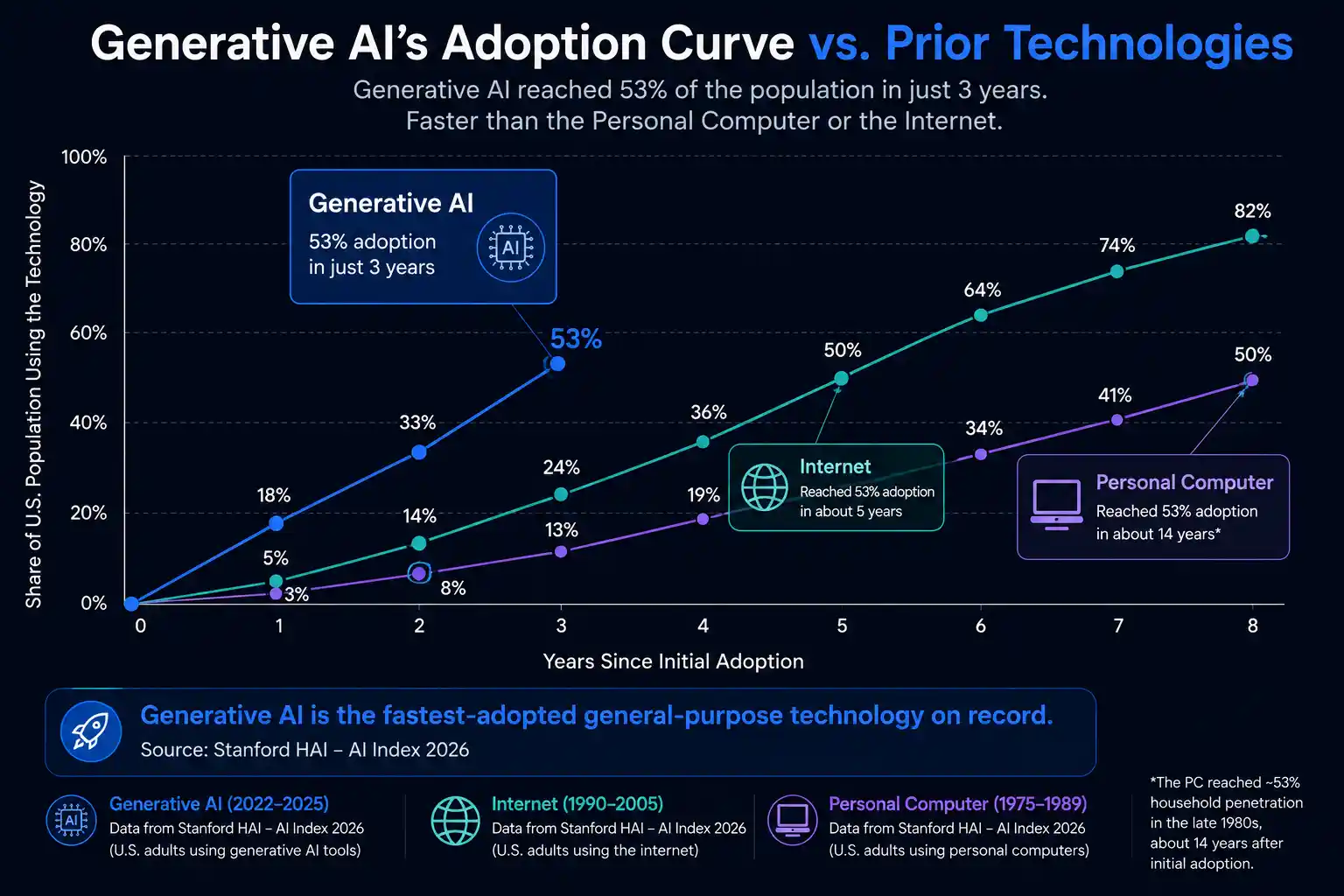
As of early 2026, 88% of organizations worldwide report using AI in at least one business function, up from 78% a year earlier, according to McKinsey's State of AI 2025 survey and Stanford HAI's 2026 AI Index. At the national level, an official OECD measurement puts firm-level AI adoption at 20.2% across member countries in 2025, more than double the 8.7% recorded in 2023. The gap between these figures reflects different definitions: McKinsey and Stanford ask whether a company uses AI anywhere in the business, while OECD and Eurostat measure formally integrated AI technology use reported through national statistical offices. Generative AI specifically reached 53% population-level adoption within three years of ChatGPT's launch, a faster curve than either the personal computer or the internet, per Stanford HAI.
Key Takeaways
88% of organizations report using AI in at least one business function as of late 2025/early 2026, up from 78% the prior year (McKinsey, 2025; Stanford HAI, 2026).
20.2% of firms across OECD countries formally used AI in 2025, more than double the 8.7% recorded in 2023 (OECD, 2026).
19.95%–20.0% of EU enterprises used at least one AI technology in 2025, up from 13.5% in 2024, with Denmark leading at 42.0% (Eurostat, December 2025).
Only 6% of organizations qualify as AI "high performers" attributing 5%+ EBIT impact to AI, even though 88% report using it somewhere in the business (McKinsey, 2025).
Generative AI adoption reached 70% of organizations using it in at least one business function, and consumer-level adoption hit 53% of the population within three years (Stanford HAI, 2026).
62% of organizations are experimenting with AI agents, but only 23% report scaling agentic AI anywhere in the enterprise (McKinsey, 2025).
Global AI infrastructure spending is forecast to hit $497 billion in 2026, en route to more than $1 trillion by 2029 (IDC, 2026).
The World Economic Forum projects a net gain of 78 million jobs by 2030, even as 41% of employers plan workforce reductions where AI can automate tasks (WEF Future of Jobs Report 2025).
ChatGPT reached 900 million weekly active users by February 2026, up from 800 million in October 2025 (OpenAI, via TechCrunch).
74% of AI's measurable economic value is being captured by just 20% of organizations, according to PwC's 2026 AI Performance Study.
Three years after ChatGPT's public launch pushed generative AI into mainstream conversation, the question executives ask has changed. It used to be "should we adopt AI?" Now it's "why hasn't adoption translated into the returns we expected?"
That gap between adoption and impact is the defining story of AI adoption statistics heading into 2026. Nearly nine in ten organizations say they use AI somewhere in the business. Far fewer can point to a bottom-line number that proves it was worth doing. This article pulls together the most recent, credibly sourced data on where AI adoption actually stands, country by country, industry by industry, and department by department, and explains why the headline number depends entirely on which survey you're reading.
We draw on primary research from McKinsey, Stanford HAI's AI Index, the OECD, Eurostat, the US Census Bureau, the World Economic Forum, PwC, Deloitte, Gartner, and IDC, among others. Every statistic below is dated and sourced so you can trace it back to the original publication.
Read our guide on AI Agents for a deeper look at how autonomous systems are being deployed inside enterprises.
Executive Summary
AI adoption in 2026 is best described as broad but shallow. Depending on how you measure it, somewhere between one-fifth and nine-tenths of organizations are "using AI":
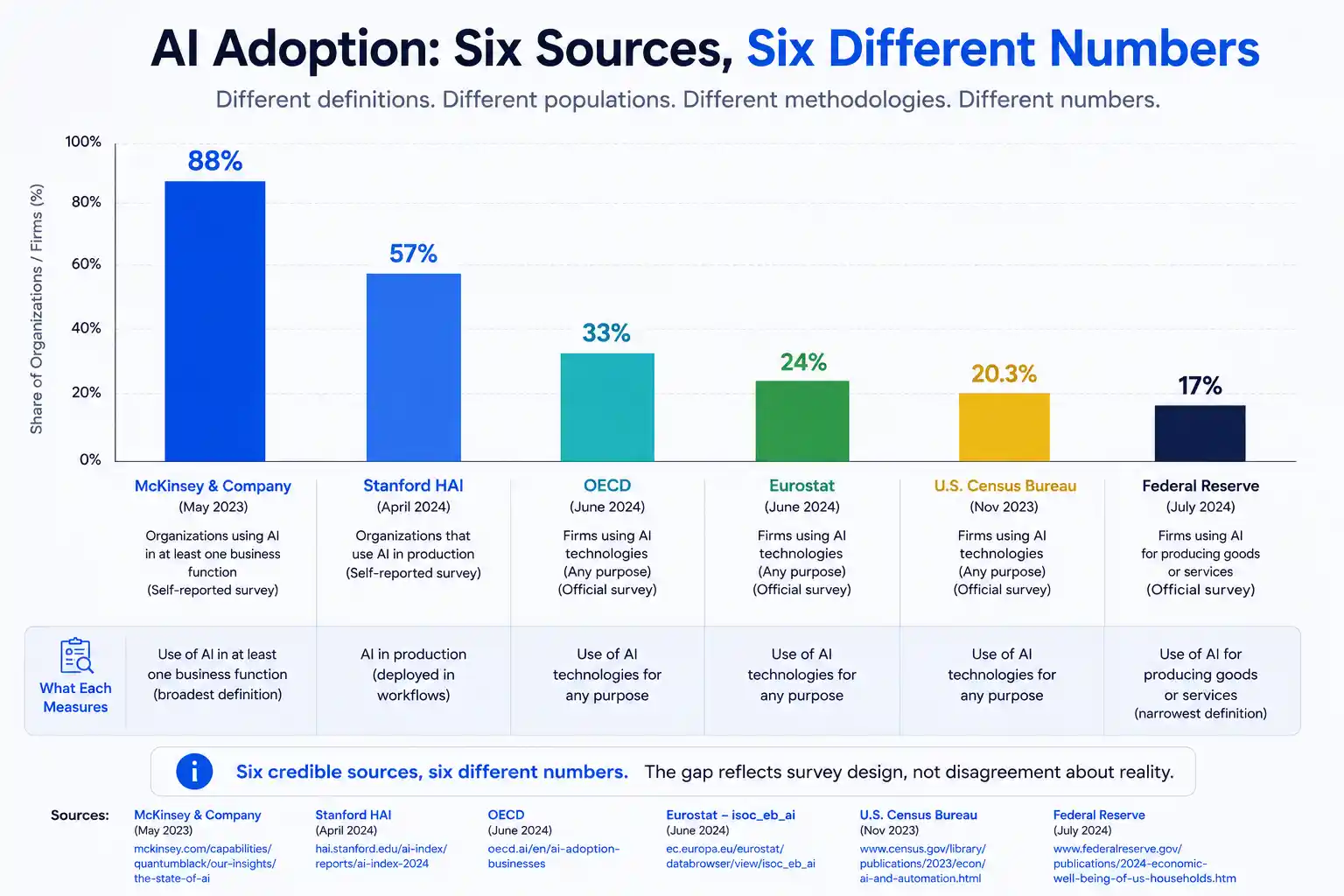
Self-reported enterprise adoption is nearly universal. McKinsey's global survey of 1,993 executives across 105 countries found 88% of organizations use AI in at least one business function, up from 78% a year earlier. Stanford HAI's 2026 AI Index independently arrives at the same 88% figure.
Official statistical-agency adoption is far lower. The OECD's harmonized measurement across member countries puts firm-level AI adoption at 20.2% in 2025. Eurostat's parallel measurement for the EU27 puts it at 19.95%–20.0%. The US Census Bureau's Business Trends and Outlook Survey found AI use hovering between 17% and 20% of US businesses from December 2025 to May 2026.
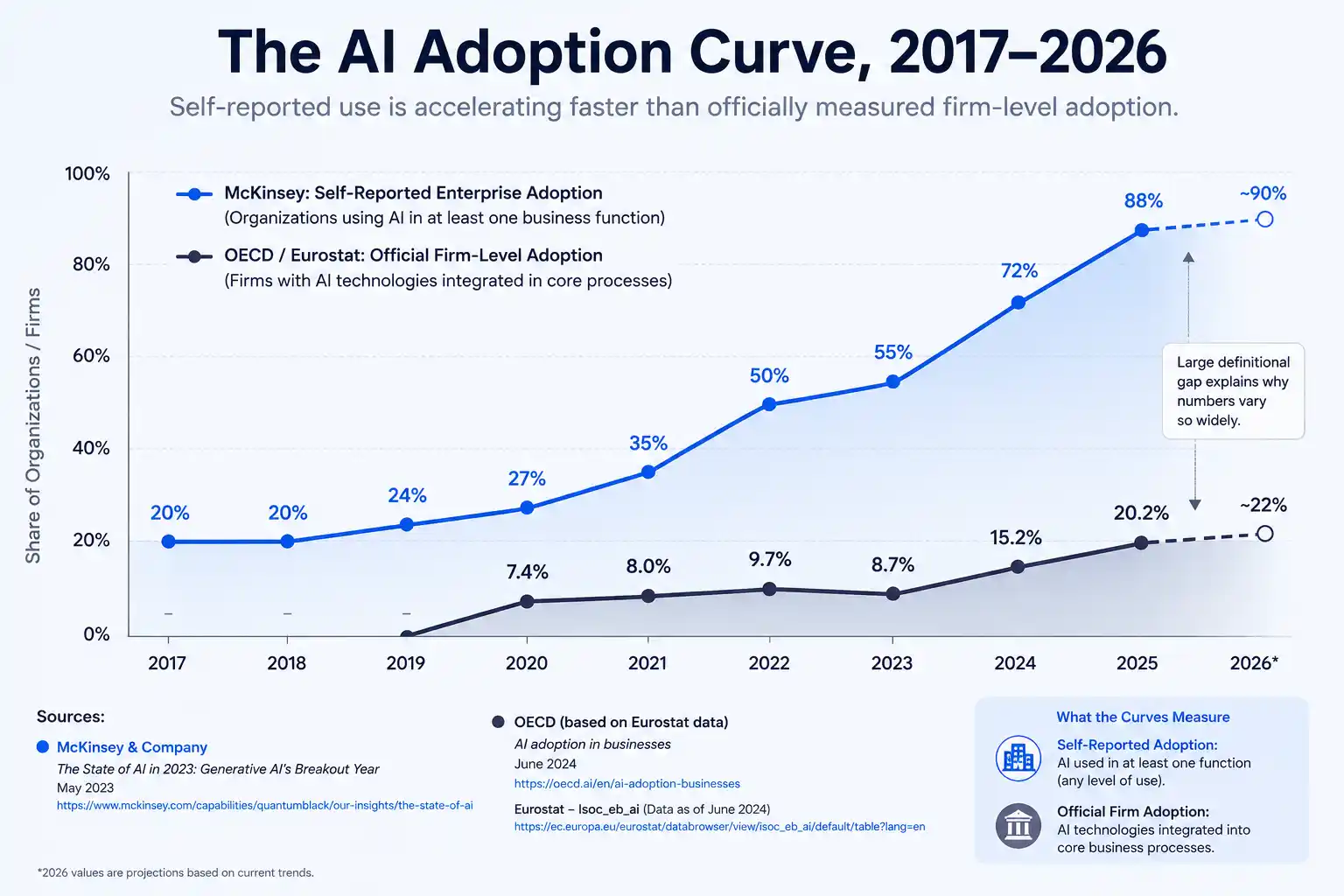
The difference is definitional, not contradictory. Executive surveys ask, informally, "does your organization use AI anywhere?" National statistical offices ask whether a firm has integrated a specific, defined AI technology into its operations during a fixed reference period. Both numbers are real; they measure different things.
Value capture lags adoption everywhere. Only 6% of organizations in McKinsey's survey qualify as AI "high performers" attributing 5% or more of EBIT to AI. PwC's 2026 AI Performance Study found 74% of AI's measurable economic value accrues to just 20% of companies.
Agentic AI is the current frontier, and it's early. 62% of organizations are experimenting with AI agents, but only 23% report scaling them anywhere, and no single business function shows more than 10% of respondents scaling agents, per McKinsey.
Consumer adoption of generative AI has outpaced any prior general-purpose technology. Stanford HAI measured 53% population-level generative AI adoption within three years of ChatGPT's release, faster than the PC or the internet.
What Is AI Adoption
AI adoption refers to the extent to which individuals, businesses, and governments integrate artificial intelligence technologies, including machine learning, natural language processing, computer vision, and generative AI, into everyday tasks, products, or operations.
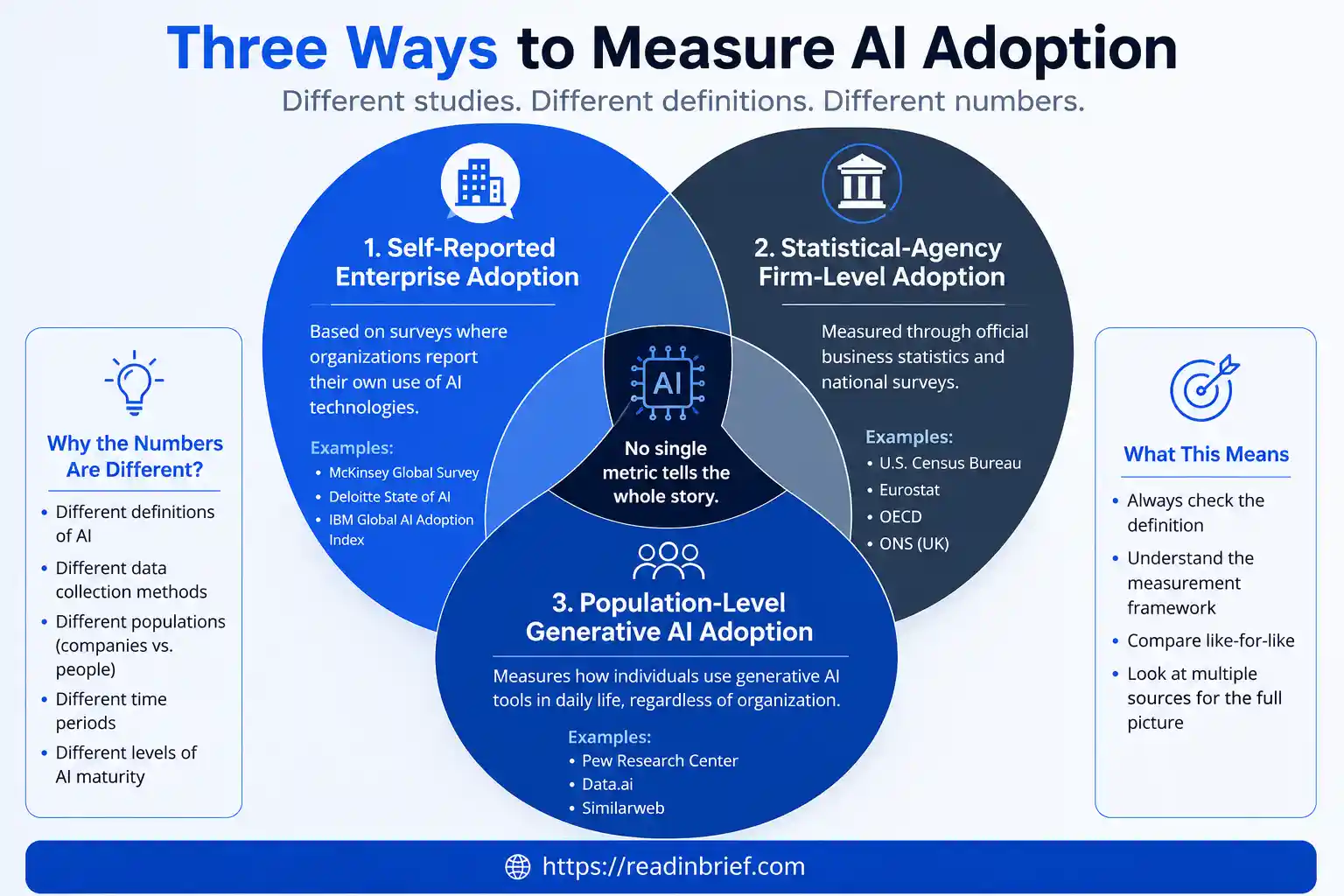
Researchers typically measure AI adoption along three distinct axes:
Firm-level adoption: the share of businesses that report using at least one defined AI technology, as tracked by national statistical agencies such as Eurostat and the US Census Bureau.
Functional or self-reported adoption: the share of organizations that say AI is used anywhere in the business, as measured by executive surveys such as McKinsey's State of AI series.
Individual or population-level adoption: the share of people who have personally used a generative AI tool, as measured by Stanford HAI, the OECD, and consumer-facing companies themselves.
These three axes rarely agree with each other, and conflating them is the single most common error in AI adoption reporting. A statement like "88% of businesses use AI" and "20% of firms use AI" can both be true and both be correctly sourced; they simply describe different surveys with different definitions and different reference periods.
Evolution of AI Adoption
Year | Milestone | Adoption Data Point | Source |
|---|---|---|---|
2017 | Early enterprise AI/ML pilots | ~20% of large firms reported some AI use | McKinsey Global Survey series |
2022 | ChatGPT launches (Nov 30, 2022) | Consumer generative AI enters mainstream awareness | OpenAI |
2023 | Early enterprise gen AI experimentation | 55% of organizations reported using AI in 2023 (Stanford measurement basis) | Stanford HAI AI Index 2025 |
2023 | EU enterprise AI use | 8.0%–8.1% of EU enterprises used AI technologies | Eurostat |
2024 | Enterprise adoption accelerates sharply | 78% of organizations reported using AI in at least one business function, up 23 points in a year | Stanford HAI AI Index 2025 |
2024 | EU enterprise AI use | 13.5% of EU enterprises used AI technologies | Eurostat |
2024 | OECD firm-level adoption | 14.2% of firms across OECD countries used AI | OECD |
2025 | Enterprise adoption approaches saturation | 88% of organizations report regular AI use in at least one function | McKinsey State of AI 2025 |
2025 | OECD firm-level adoption | 20.2% of firms across OECD countries used AI, more than double 2023 | OECD |
2025 | EU enterprise AI use | 19.95%–20.0% of EU enterprises used AI technologies | Eurostat |
2026 | Agentic AI moves from pilot to early scaling | 23% of organizations scaling AI agents somewhere in the enterprise; 62% experimenting | McKinsey State of AI 2025 (fielded mid-2025) |
2026 | Generative AI reaches population-level milestone | 53% population adoption of generative AI within three years of launch | Stanford HAI AI Index 2026 |
Global AI Adoption Statistics
The clearest global snapshot combines several independently run surveys, each with its own scope:
88% of organizations report using AI in at least one business function as of the 2025 survey wave (McKinsey State of AI 2025, fielded June 25–July 29, 2025 among 1,993 participants across 105 countries).
88% organizational adoption confirmed independently by Stanford HAI's 2026 AI Index, released April 13, 2026.
70% of organizations use generative AI specifically in at least one business function, per Stanford HAI's 2026 AI Index, with China and Europe posting the largest year-over-year increases.
20.2% of firms across OECD member countries formally used AI in 2025, up from 14.2% in 2024 and 8.7% in 2023, more than doubling in two years (OECD, January 2026).
19.95%–20.0% of EU27 enterprises with 10 or more employees used at least one AI technology in 2025, up from 13.5% in 2024 (Eurostat, December 11, 2025).
17%–20% of US businesses reported using AI in the prior two weeks, according to the Census Bureau's biweekly Business Trends and Outlook Survey (BTOS), covering December 14, 2025 to May 3, 2026.
78% of the US labor force works at a firm that has adopted AI in some form, and 54% works at a firm that specifically uses large language models, per the Federal Reserve's Survey of Business Uncertainty, cited in an April 2026 Federal Reserve research note.
~41% work-related generative AI adoption among individuals, as measured by the Real-Time Population Survey as of November 2025 (Federal Reserve research note, April 2026).
Total corporate AI investment reached $252.3 billion globally in 2024, with private investment up 44.5% year over year (Stanford HAI AI Index 2025).
AI infrastructure spending is projected to reach $497 billion in 2026, roughly 56% growth year over year, en route to surpassing $1 trillion by 2029 (IDC, Q1 2026 tracker).
Comparison Table: How Different Organizations Measure Global AI Adoption
Source | Measurement basis | 2025/2026 figure | What it captures |
|---|---|---|---|
McKinsey Global Survey on AI | Self-reported executive survey, any business function | 88% | Broadest possible definition of "using AI" |
Stanford HAI AI Index 2026 | Organizational survey plus aggregated data | 88% (any AI); 70% (generative AI specifically) | Cross-validates McKinsey's figure independently |
OECD | National statistical agency data, firms 10+ employees | 20.2% | Formally integrated, defined AI technologies |
Eurostat (EU27) | ICT Usage in Enterprises Survey, firms 10+ employees | 19.95%–20.0% | EU-specific version of the OECD methodology |
US Census Bureau (BTOS) | Biweekly survey, all employer firms | 17%–20% | Narrow two-week reference window, all firm sizes |
Federal Reserve SBU | Senior business leaders, employment-weighted | 78% of labor force at AI-adopting firms | Employment-weighted, so large employers dominate |
AI Adoption by Country
Country-level comparisons are similarly sensitive to methodology. The clearest apples-to-apples comparison uses Eurostat's harmonized EU enterprise survey.
EU27 Enterprise AI Adoption by Country, 2025 (Eurostat)
Rank | Country | Share of enterprises using AI (2025) | Change vs. 2024 |
|---|---|---|---|
1 | Denmark | 42.0% | +14.5 pp |
2 | Finland | 37.8% | +13.5 pp |
3 | Sweden | 35.0% | — |
4 | Belgium | 34.5% | — |
5 | Luxembourg | 33.6% | — |
6 | Netherlands | 33.2% | — |
— | EU27 average | 20.0% | +6.5 pp |
25 | Bulgaria | 8.55% | — |
26 | Poland | 8.36% | — |
27 | Romania | 5.21% | — |
Source: Eurostat, "20% of EU enterprises use AI technologies," published December 11, 2025, based on the ICT Usage in Enterprises Survey (dataset isoc_eb_ai). Figures cover enterprises with 10 or more employees.
Beyond the EU, several additional data points round out the global picture:
Across OECD member countries overall, large firms (250+ employees) report 52% AI adoption, compared with 17.4% for small firms, illustrating a persistent size divide (OECD, January 2026).
Individual, population-level use of generative AI across OECD countries rose to more than one-third (37%) of the population in 2025, up from 28% in 2024 and 19% in 2023 (OECD, January 2026).
Stanford HAI's 2026 AI Index separately tracks population-level generative AI adoption and finds it correlates strongly with GDP per capita, though some countries outperform what income alone would predict: Singapore (61%) and the United Arab Emirates (64%) rank among the highest, while the United States ranks 24th at 28.3%, reflecting a wide gap between US enterprise adoption and US individual-level generative AI use.
In the US specifically, adoption is markedly uneven by firm size and sector. The Census Bureau's BTOS data show 37% of firms with 250+ employees reported using AI, versus 32% for firms with 100–249 employees, during the survey window ending May 3, 2026.
Comparison Table: Country-Level AI Adoption Signals (Multiple Metrics)
Country/Region | Metric | Figure | Source |
|---|---|---|---|
Denmark | Enterprise AI adoption | 42.0% | Eurostat, Dec. 2025 |
EU27 average | Enterprise AI adoption | 20.0% | Eurostat, Dec. 2025 |
OECD average | Firm-level AI adoption | 20.2% | OECD, Jan. 2026 |
OECD average | Individual generative AI use | 37% | OECD, Jan. 2026 |
Singapore | Population-level generative AI use | 61% | Stanford HAI AI Index 2026 |
United Arab Emirates | Population-level generative AI use | 64% | Stanford HAI AI Index 2026 |
United States | Population-level generative AI use | 28.3% (ranks 24th globally) | Stanford HAI AI Index 2026 |
United States | Firms using AI (two-week window) | 17%–20% | US Census Bureau BTOS |
United States | Share of labor force at AI-adopting firms | 78% | Federal Reserve SBU, cited April 2026 |
Explore AI Regulations by region for how policy is shaping these adoption curves differently across jurisdictions.
AI Adoption by Industry
Industry-level adoption data is the area where methodology varies most, so figures below are attributed individually and should not be summed or averaged across sources.
Official OECD Sector Data (2025)
Information and communication technology (ICT) firms: 57.3% AI adoption, the highest of any sector tracked (OECD, 2026).
Professional and scientific services: 36.8% adoption (OECD, 2026).
Manufacturing: 19.1% adoption (OECD, 2026).
Fastest year-over-year growth in adoption, rather than absolute level, came from sectors that started from a lower base: accommodation and food services grew 62.5% year over year, and construction grew 59.1%, even though their absolute adoption levels remain modest (OECD, 2026).
McKinsey Survey Findings by Industry (2025)
Reported AI use increased in nearly every industry compared with the prior year's survey. The technology sector had already exceeded 90% AI use and saw the smallest further increase, since it started from the highest base.
Media and telecommunications and insurance respondents reported AI use levels now on par with technology.
AI agent use is most widely reported in the technology, media and telecommunications, and healthcare sectors.
Within functions, IT and knowledge management show the most reported agent use, driven by service-desk management and "deep research" style use cases.
Manufacturing-Specific Data
77% of manufacturers report having implemented AI to some extent, up from 70% in 2023, according to a 2025 State of AI in Manufacturing industry survey.
Manufacturing use cases concentrate in production (31%), customer service (28%), and inventory management (28%).
The leading manufacturing investment areas are supply chain management (49%) and big data analytics (43%).
Financial Services
The OECD notes financial services is excluded from its main enterprise adoption figure due to differing survey treatment, but sector-specific research consistently shows financial services among the faster adopters, with fraud detection, document processing, and customer service automation cited as leading production use cases across multiple industry surveys.
Comparison Table: AI Adoption by Industry (Multiple Sources, Attributed Individually)
Industry | Adoption figure | Source |
|---|---|---|
ICT/Technology | 57.3% (OECD firm-level) | OECD, 2026 |
Professional & scientific services | 36.8% (OECD firm-level) | OECD, 2026 |
Manufacturing | 19.1% (OECD firm-level); 77% self-reported "implemented AI to some extent" | OECD, 2026; 2025 State of AI in Manufacturing survey |
Accommodation & food services | 62.5% YoY growth (off a low base) | OECD, 2026 |
Construction | 59.1% YoY growth (off a low base) | OECD, 2026 |
Technology/Media/Telecom/Healthcare | Highest reported use of AI agents specifically | McKinsey State of AI 2025 |
AI Adoption by Business Size
Firm size is the single most consistent predictor of AI adoption across every data source reviewed for this report.
OECD: large firms (250+ employees) report 52% adoption versus 17.4% for small firms in 2025.
OECD SME discussion paper (2024 reference data): 40% of firms with 250+ employees used AI, compared with 20.4% of firms with 50–249 employees, and 11.9% of firms with fewer than 50 employees.
McKinsey: nearly half (46%) of respondents from companies with more than $5 billion in annual revenue say their organization has reached the AI-scaling phase, compared with 29% of those with less than $100 million in revenue.
US Census Bureau BTOS: firms with 250+ employees reported 37% AI use, versus 32% for firms with 100–249 employees, in the survey window ending May 3, 2026; usage among firms with fewer than 20 employees did not change significantly over the same period.
Eurostat: the gap between large and small enterprises within individual EU countries reaches as high as 53.5 percentage points (Slovenia), with Belgium (47.6 pp) and Finland (45.9 pp) also showing wide large-small divides.
Comparison Table: AI Adoption by Business Size
Business size | Adoption rate | Source |
|---|---|---|
Large firms (250+ employees), OECD average | 52% | OECD, 2026 |
Small firms, OECD average | 17.4% | OECD, 2026 |
Firms with $5B+ revenue reaching "scaling" phase | 46% | McKinsey State of AI 2025 |
Firms with <$100M revenue reaching "scaling" phase | 29% | McKinsey State of AI 2025 |
US firms, 250+ employees | 37% | US Census Bureau BTOS, 2026 |
US firms, 100–249 employees | 32% | US Census Bureau BTOS, 2026 |
AI Adoption by Department
McKinsey's eight years of running the State of AI survey consistently identify the same leading functions:
IT and marketing and sales have, across eight years of research, most consistently been the functions with the highest reported AI use.
Knowledge management has newly emerged as one of the top functions for reported AI use in the most recent survey wave.
The most common individual use cases reported are: capturing, processing, and delivering information (often via a conversational interface); content support for marketing strategy (drafting, idea generation, and strategic presentation materials); and contact-center or customer-service automation.
Cost benefits from AI are most commonly reported in software engineering, manufacturing, and IT.
Revenue benefits from AI are most commonly reported in marketing and sales, strategy and corporate finance, and product and service development.
Two-thirds of organizations now use AI in more than one function, and half report use in three or more functions.
Comparison Table: Function-Level AI Impact (McKinsey State of AI 2025)
Business function | Primary reported benefit |
|---|---|
IT | Cost savings; highest reported AI agent use |
Marketing and sales | Revenue growth; content generation |
Software engineering | Cost savings; productivity |
Manufacturing | Cost savings |
Knowledge management | Newly emerged high-adoption function |
Strategy and corporate finance | Revenue growth |
Product and service development | Revenue growth |
Read our guide on AI Productivity Tools for department-specific implementation recommendations.
Generative AI Adoption
Generative AI, distinct from AI broadly, refers specifically to models capable of producing new text, images, audio, video, or code in response to a prompt.
70% of organizations use generative AI in at least one business function, per Stanford HAI's 2026 AI Index, with China and Europe posting the largest year-over-year gains.
53% population-level adoption of generative AI was reached within three years of the technology's mainstream introduction, a faster curve than the personal computer or the internet, according to Stanford HAI's 2026 AI Index.
The estimated value of generative AI tools to US consumers reached $172 billion annually by early 2026, up from $112 billion a year earlier, with the median value per user roughly tripling over the same period (Stanford HAI, 2026).
78% of organizations reported using AI in at least one business function in 2024, up from 55% in 2023, according to Stanford HAI's 2025 AI Index — a 23-percentage-point jump attributed largely to generative AI's mainstream arrival.
Inference costs for GPT-3.5-equivalent performance fell roughly 280-fold in 18 months, dramatically changing the unit economics of deploying generative AI at scale (Stanford HAI AI Index 2025).
Enterprise AI Adoption
Enterprise adoption statistics are the most heavily researched segment of this report, anchored primarily by McKinsey's annual global survey and Stanford HAI's independent cross-check.
88% of organizations report regular AI use in at least one business function, up from 78% a year earlier (McKinsey, fielded June–July 2025; Stanford HAI 2026 AI Index, independently confirming 88%).
Approximately one-third of organizations report having begun scaling AI programs across the enterprise; the remaining two-thirds remain in experimentation or pilot phases.
39% of respondents attribute any level of EBIT impact to AI use, and most of those attribute less than 5% of EBIT to it.
6% of respondents qualify as AI "high performers," defined as attributing 5%+ EBIT impact to AI and reporting "significant" enterprise value from its use.
High performers are more than three times as likely as other organizations to say they intend to use AI for transformative, enterprise-wide change, rather than incremental efficiency gains.
High performers are nearly three times as likely to have fundamentally redesigned individual workflows around AI, one of the strongest predictors of high-performer status identified in McKinsey's relative-weights analysis of 31 organizational variables.
More than one-third of high performers commit more than 20% of their digital budgets to AI technologies, versus a much smaller share of other organizations.
About three-quarters of high performers report scaling or having scaled AI, compared with roughly one-third of all other organizations.
51% of organizations using AI report at least one negative consequence from its use, with inaccuracy the most commonly cited issue (nearly one-third of all respondents).
Deloitte's State of AI in the Enterprise 2026 report (survey of 3,235 senior leaders across 24 countries, fielded August–September 2025) found 34% of organizations are starting to use AI to deeply transform the business (new products, reinvented processes or models), 30% are redesigning key processes around AI, and the remaining 37% are using AI at a surface level with little process change.
Worker access to AI rose by 50% during 2025, according to Deloitte, and the number of companies reporting 40% or more of AI projects in production is expected to double within six months of the survey.
Comparison Table: Enterprise AI Maturity Segments
Maturity segment | Share of organizations | Characteristic | Source |
|---|---|---|---|
Piloting/experimenting only | ~two-thirds | AI used in isolated pockets, not embedded in workflows | McKinsey, 2025 |
Scaling across the enterprise | ~one-third | Multiple functions, deeper integration | McKinsey, 2025 |
AI "high performers" | 6% | 5%+ EBIT impact, significant reported value | McKinsey, 2025 |
Deeply transforming (Deloitte definition) | 34% | New products/services or reinvented core processes | Deloitte, 2026 |
Redesigning key processes (Deloitte definition) | 30% | Meaningful workflow change | Deloitte, 2026 |
Surface-level use (Deloitte definition) | 37% | Little or no process change | Deloitte, 2026 |
Consumer AI Adoption
Consumer-facing generative AI products have achieved unprecedented user bases in a short period.
ChatGPT reached 900 million weekly active users by late February 2026, along with 50 million paying subscribers, up from 800 million weekly active users reported by OpenAI CEO Sam Altman at the company's October 2025 developer conference (OpenAI, reported by TechCrunch, February 27, 2026).
ChatGPT's weekly active user count grew from roughly 400 million in February 2025 to 900 million in February 2026, a more than doubling within a single year.
Generative AI reached 53% adoption among the global population within three years, according to Stanford HAI's 2026 AI Index, a faster trajectory than the personal computer or the internet.
Individual use of generative AI across OECD member countries rose to more than one-third (37%) of the population in 2025, up from 28% in 2024 and 19% in 2023 (OECD, January 2026).
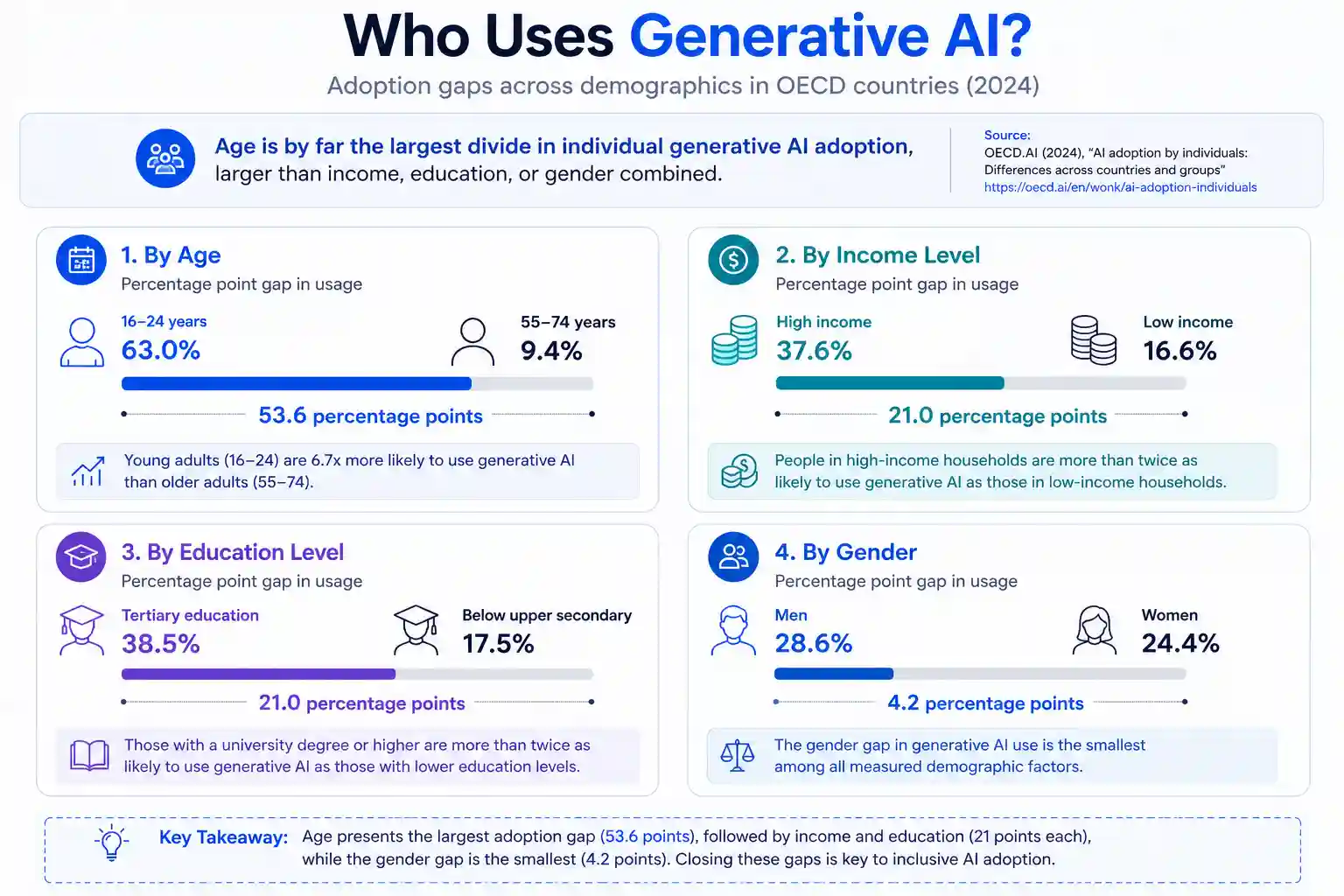
Within the OECD population, generative AI use is notably concentrated by age (a 53.6 percentage point gap between the youngest and oldest cohorts), income, and education level (each showing roughly a 21 percentage point gap), while the gender gap is comparatively small at 4.2 percentage points (OECD, January 2026).
Three-quarters of students aged 16 and over across OECD countries report using generative AI tools (OECD, January 2026).
Adoption is also elevated among the employed (41.1%) and unemployed (36.7%) populations, compared with retired or otherwise economically inactive individuals (12.5%), per the same OECD release.
AI Agent Adoption
Agentic AI, systems that can plan, use tools, and execute multi-step tasks with limited human oversight, is the newest and least mature layer of enterprise AI adoption.
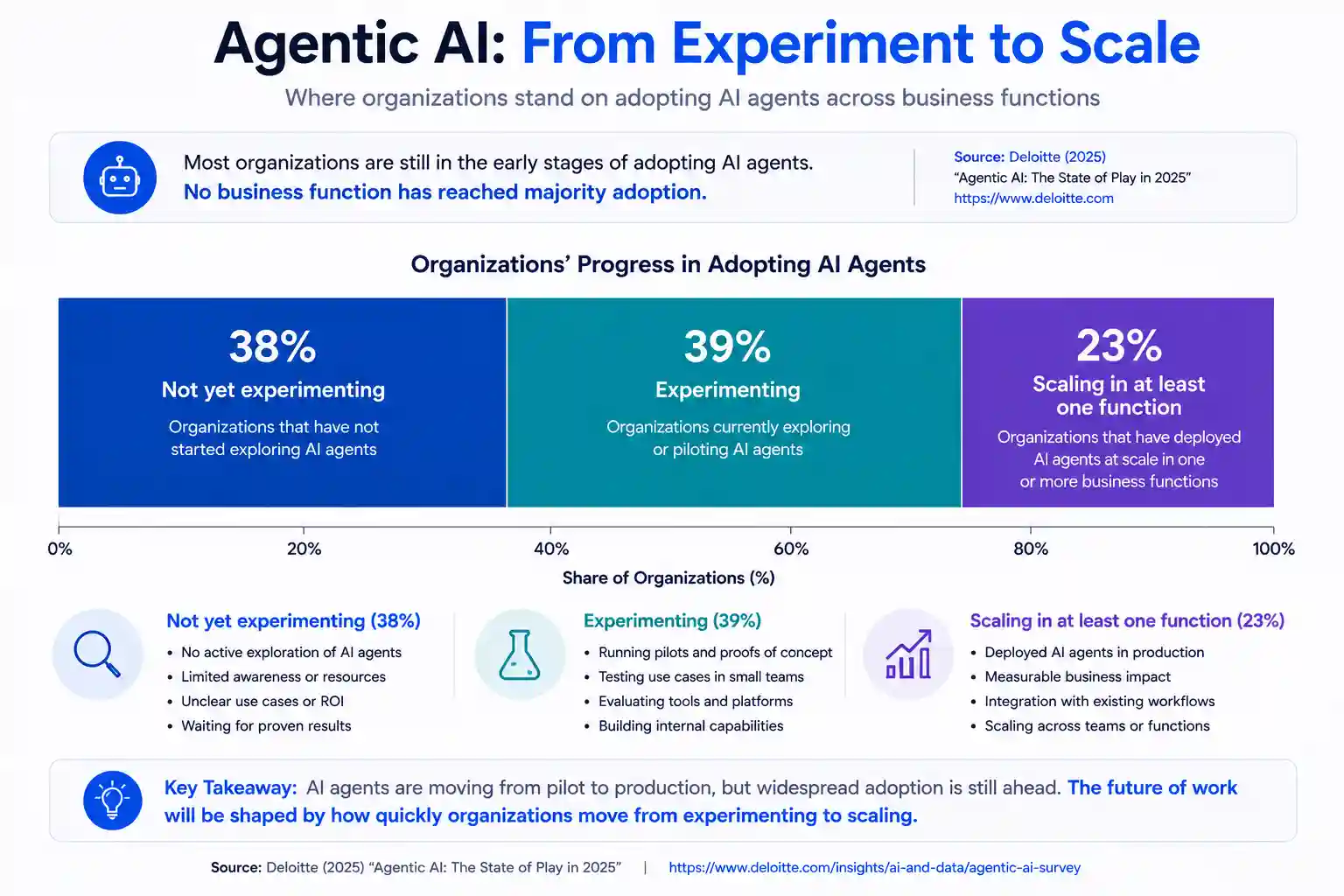
62% of organizations report at least experimenting with AI agents, according to McKinsey's 2025 survey.
23% report scaling an agentic AI system somewhere in the enterprise (defined as expanding deployment and adoption within at least one business function).
An additional 39% say they have begun experimenting with agents but have not yet scaled them.
In any individual business function, no more than 10% of respondents report scaling AI agents, indicating that even "scaling" organizations are typically doing so in only one or two functions.
AI agent use is most commonly reported in IT and knowledge management, where service-desk automation and "deep research" use cases have matured fastest.
By industry, agent use is most widely reported in technology, media and telecommunications, and healthcare.
AI high performers are, in most business functions, at least three times more likely than other organizations to report scaling agents.
Gartner forecasts that 40% of enterprise applications will feature task-specific AI agents by the end of 2026, up from less than 5% in 2025 (Gartner, August 26, 2025 press release).
Gartner's best-case scenario projects agentic AI could drive approximately 30% of enterprise application software revenue by 2035, surpassing $450 billion, up from roughly 2% in 2025.
Comparison Table: Agentic AI Adoption Stages
Stage | Share of organizations | Source |
|---|---|---|
Not yet experimenting with agents | ~38% | McKinsey, 2025 |
Experimenting with agents | 39% | McKinsey, 2025 |
Scaling agents in at least one function | 23% | McKinsey, 2025 |
Enterprise apps with task-specific agents (2025 baseline) | <5% | Gartner, 2025 |
Enterprise apps with task-specific agents (2026 forecast) | 40% | Gartner, 2025 |
Coding AI Adoption
Software development is the function where AI tool adoption is most mature and best measured, thanks to GitHub's platform-level telemetry.
80% of new developers on GitHub adopted GitHub Copilot within their first week on the platform, according to GitHub's Octoverse 2025 report (published October 28, 2025).
GitHub added 36 million new developers in 2025, bringing the platform total to more than 180 million developers, the fastest absolute growth rate in the platform's history.
More than 1.1 million public repositories now import a large language model SDK, up 178% year over year as of August 2025.
TypeScript overtook both Python and JavaScript in August 2025 to become the most-used language on GitHub by monthly contributors, a shift GitHub attributes partly to AI coding agents favoring statically typed languages that catch errors earlier.
The GitHub Copilot coding agent authored more than 1 million pull requests between May and September 2025 alone.
Developers merged a record 518.7 million pull requests in 2025, up 29% year over year, and pushed nearly 1 billion commits, up 25.1% year over year.
81.5% of contributions in 2025 occurred in private repositories, reflecting substantial enterprise usage alongside public open-source activity.
Explore our Best AI Coding Assistants comparison for a tool-by-tool breakdown.
Marketing AI Adoption
Marketing and sales, alongside IT, has been one of the two functions most consistently reporting the highest AI use across all eight years McKinsey has run its State of AI survey.
Content support for marketing strategy, including drafting, idea generation, and knowledge synthesis, is among the most commonly cited individual AI use cases in McKinsey's 2025 survey.
Revenue increases attributable to AI are most commonly reported within marketing and sales, consistent with prior years of McKinsey's research.
Read our comparison of ChatGPT vs. Claude for enterprise content workflows.
Healthcare AI Adoption
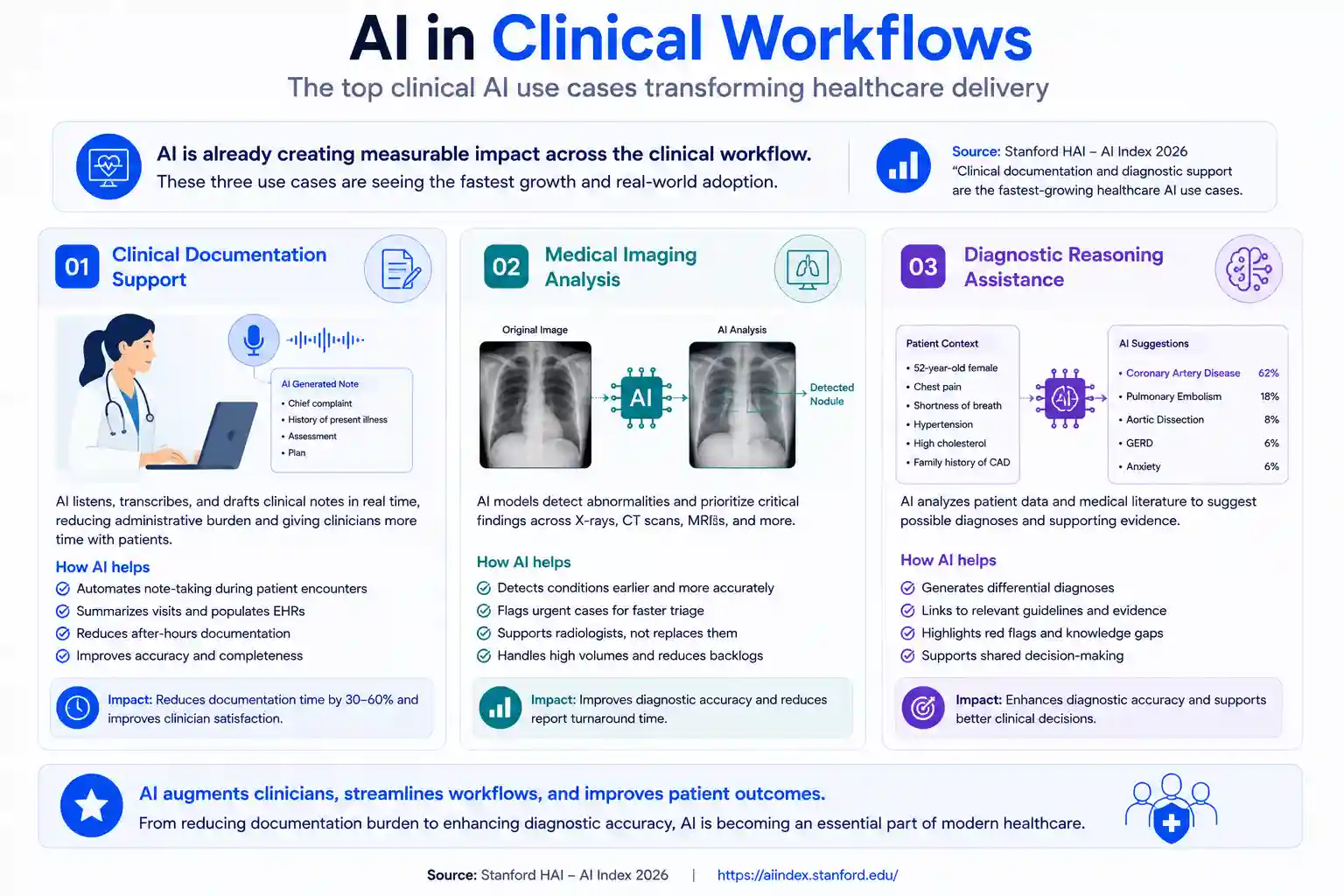
Stanford HAI's 2026 AI Index specifically documents a sharp increase in AI adoption in medicine, with significant growth in clinical documentation, medical imaging, and diagnostic reasoning applications.
McKinsey's 2025 survey found healthcare among the top three industries, alongside technology and media/telecommunications, for reported AI agent use.
Publicly available data on precise healthcare-sector adoption percentages varies significantly by survey methodology and country; readers should treat any single-sourced healthcare adoption percentage with caution and consult primary sources such as Stanford HAI's medicine chapter for the most rigorously documented figures.
Finance AI Adoption
McKinsey's survey data shows strategy and corporate finance among the functions most commonly reporting AI-driven revenue benefits.
Financial services is frequently cited across multiple industry surveys as an early adopter of AI for fraud detection, document processing automation, and customer service, though publicly available, rigorously sourced adoption percentages specific to financial services at a global level are more limited than for the OECD's cross-industry figures. Where precise, independently verifiable statistics were not available for this sector at the time of publication, we note that limitation rather than estimate a figure.
Education AI Adoption
Across OECD countries, three-quarters of students aged 16 and over report using generative AI tools, one of the highest usage rates of any demographic segment measured (OECD, January 2026).
Stanford HAI's 2026 AI Index reports that more than 80% of US high school and college students now use AI for school-related tasks, while only about half of middle and high schools have formal AI policies in place, and just 6% of teachers say those policies are clear.
This gap between student usage and institutional policy clarity is one of the more consistently documented findings across both Stanford HAI and OECD research for 2025–2026.
Government AI Adoption
The OECD's AI Policy Observatory and related G7 work (including the 2025 OECD/BCG/INSEAD study, "The Adoption of Artificial Intelligence in Firms") continues to serve as the primary multilateral reference point for tracking government and public-sector AI adoption policy across member states.
Canada's 2025 G7 Presidency made accelerating small and medium-sized enterprise AI adoption a formal priority, resulting in an OECD discussion paper proposing a "Blueprint for SME AI Adoption," published December 2025.
Publicly available, standardized data comparing government AI adoption rates across countries remains more limited than private-sector data; readers seeking authoritative government-specific figures should consult the OECD AI Policy Observatory directly.
Manufacturing AI Adoption
77% of manufacturers report having implemented AI to some extent, up from 70% in 2023, according to the 2025 State of AI in Manufacturing Survey.
The leading manufacturing AI use cases are production applications (31%), customer service (28%), and inventory management (28%).
The leading manufacturing AI investment priorities are supply chain management (49%) and big data analytics (43%).
53% of manufacturing specialists surveyed say they would prefer collaborative "copilot"-style AI agents that support human workflows over fully autonomous systems.
56% of manufacturers remain unsure whether their existing ERP systems are ready for full AI integration.
At the OECD level specifically, formally measured manufacturing-sector AI adoption stands at 19.1%, notably lower than the sector's self-reported "implemented AI to some extent" figures, illustrating the same definitional gap seen at the global level.
Retail AI Adoption
McKinsey's data shows retail is not among the top three industries for reported AI agent use (technology, media/telecom, and healthcare lead on that specific measure), though retail applications such as demand forecasting, personalization, and inventory optimization are widely cited across industry research as leading generative AI use cases in the sector.
Deloitte's 2025 US Retail Industry Outlook specifically highlights generative AI's growing role in commerce applications, though granular, independently verifiable adoption percentages specific to global retail were not available from primary sources at the time of publication.
Read our guide on AI Tools Directory for retail-specific AI platforms.
AI Adoption Timeline
Date | Event | Source |
|---|---|---|
November 30, 2022 | ChatGPT launches publicly | OpenAI |
2023 | 55% of organizations report AI use in at least one function (2023 reference year) | Stanford HAI AI Index 2025 |
2023 | 8.0%–8.1% of EU enterprises use AI | Eurostat |
2024 | 78% of organizations report AI use, up 23 points | Stanford HAI AI Index 2025 |
2024 | Total corporate AI investment hits $252.3 billion globally | Stanford HAI AI Index 2025 |
2024 | 13.5% of EU enterprises use AI | Eurostat |
January 8, 2025 | WEF publishes Future of Jobs Report 2025 | World Economic Forum |
April 7, 2025 | Stanford HAI publishes 2025 AI Index (8th edition) | Stanford HAI |
June 25–July 29, 2025 | McKinsey fields its 2025 State of AI survey | McKinsey |
August 26, 2025 | Gartner forecasts 40% of enterprise apps will embed task-specific agents by 2026 | Gartner |
August–September 2025 | Deloitte fields its State of AI in the Enterprise 2026 survey (3,235 leaders, 24 countries) | Deloitte |
October 6, 2025 | OpenAI announces ChatGPT has reached 800 million weekly active users | OpenAI, via press reports |
October 28, 2025 | GitHub publishes Octoverse 2025 | GitHub |
November 5, 2025 | McKinsey publishes "The State of AI in 2025: Agents, innovation, and transformation" | McKinsey |
December 11, 2025 | Eurostat reports 20.0% of EU enterprises use AI in 2025 | Eurostat |
January 2026 | OECD reports 20.2% firm-level AI adoption and 37% individual generative AI use across member countries | OECD |
February 27, 2026 | OpenAI announces ChatGPT has reached 900 million weekly active users and 50 million paying subscribers | OpenAI, via TechCrunch |
April 3, 2026 | Federal Reserve publishes note on US AI adoption combining Census, RPS, and SBU survey data | Federal Reserve |
April 13, 2026 | Stanford HAI publishes 2026 AI Index | Stanford HAI |
May 2026 | US Census Bureau reports AI use among businesses stabilizing between 17%–20% | US Census Bureau |
Benefits of AI Adoption
According to McKinsey's 2025 survey, respondents most often cite the following enterprise-level qualitative benefits from AI use:
Improved innovation: cited by a majority of respondents as an outcome of AI use.
Improved customer satisfaction and competitive differentiation: cited by nearly half of respondents.
Use-case-level cost benefits, concentrated most heavily in software engineering, manufacturing, and IT.
Use-case-level revenue benefits, concentrated most heavily in marketing and sales, strategy and corporate finance, and product and service development.
64% of respondents say AI is enabling innovation within their organization.
Deloitte's 2026 research adds that worker access to AI tools rose 50% during 2025, expanding the population of employees who can potentially realize productivity benefits, though Deloitte also notes that education, not workflow or role redesign, remains organizations' primary response to the resulting AI skills gap.
Challenges and Barriers
Skills gaps: The World Economic Forum's Future of Jobs Report 2025 identifies the skills gap as the most significant barrier to business transformation, cited by 63% of employers, with 39% of core job skills expected to change by 2030 (down slightly from 44% expected in the 2023 edition).
Data quality and governance: McKinsey and Deloitte both identify data readiness and governance maturity as persistent barriers to moving from pilots to scaled deployment.
Negative consequences already experienced: 51% of organizations using AI report having experienced at least one negative consequence, most commonly related to inaccuracy (nearly one-third of all respondents), according to McKinsey's 2025 survey.
Risk mitigation still incomplete: organizations reported actively mitigating an average of four AI-related risk categories in 2025, up from an average of two in 2022, per McKinsey, though explainability, the second most commonly experienced risk, is not among the most commonly mitigated.
Governance and integration friction in agentic AI specifically: Gartner projects that more than 40% of agentic AI projects will be canceled by the end of 2027 due to escalating costs, unclear business value, or inadequate risk controls.
Workforce uncertainty: McKinsey's 2025 survey found respondents divided on AI's likely effect on total workforce size over the coming year: 32% expect a decrease of 3% or more, 43% expect little to no change, and 13% expect an increase of that magnitude. The World Economic Forum separately found 41% of employers globally (48% in the United States specifically) plan to reduce their workforce where AI can automate tasks, while 77% plan to upskill existing employees.
Comparison Table: Reported Benefits vs. Reported Challenges
Benefits (McKinsey, Deloitte) | Challenges (McKinsey, WEF, Gartner) |
|---|---|
Majority report improved innovation | 63% cite skills gap as top barrier (WEF) |
~50% report improved customer satisfaction | 51% experienced at least one negative consequence (McKinsey) |
Clear cost benefits in software engineering, manufacturing, IT | Inaccuracy is the most commonly experienced and mitigated risk |
Clear revenue benefits in marketing/sales, finance, product development | Only 6% of organizations qualify as "high performers" |
Worker access to AI rose 50% in 2025 (Deloitte) | 40%+ of agentic AI projects forecast to be canceled by 2027 (Gartner) |
AI ROI
Only 39% of McKinsey's 2025 respondents attribute any enterprise-level EBIT impact to AI use at all, and most of those attribute less than 5%.
Just 6% qualify as AI "high performers" attributing 5%+ EBIT impact and reporting significant overall value.
PwC's 2026 AI Performance Study, surveying 1,217 senior executives across 25 sectors, found that 74% of AI's measurable economic value is captured by just 20% of organizations, and that the highest-performing companies use AI to drive growth and pursue new revenue streams rather than focusing solely on cost reduction.
PwC's separate 2025 Responsible AI survey found 60% of executives say responsible AI practices boost ROI and efficiency, and 55% report improved customer experience and innovation as a result, though nearly half also said operationalizing those principles remains a challenge.
High-performing organizations, per McKinsey, are distinguished less by which AI tools they use and more by execution discipline: fundamentally redesigning workflows (nearly 3x more likely), committing more than 20% of digital budgets to AI (over one-third of high performers do so), and having senior leadership actively and visibly engaged (3x more likely to strongly agree leadership demonstrates ownership).
Case Studies
Robust, independently verifiable, named case studies with disclosed financial results are relatively scarce in the publicly available research reviewed for this report. Rather than present unverifiable or approximate company examples, we point readers to the primary sources that document sector-wide patterns with the most rigor:
McKinsey's Rewired research program, referenced within its 2025 State of AI survey, is based on more than 200 at-scale AI transformations and identifies the management practices, spanning strategy, talent, operating model, technology, data, and adoption, that most consistently separate high performers from the rest.
Stanford HAI's 2026 AI Index documents sector-specific patterns in medicine (clinical documentation, imaging, diagnostic reasoning) and education (student usage far outpacing institutional policy) with named methodology and cited underlying studies, available in the report's medicine and education chapters.
Readers seeking specific named-company case studies with disclosed ROI figures should consult these primary sources directly, since publicly available, independently verifiable case data changes quickly and is best sourced at the time of reading rather than reproduced here.
Future Trends and Predictions
Gartner forecasts that by the end of 2026, 40% of enterprise applications will feature task-specific AI agents, up from less than 5% in 2025, and that in a best-case scenario, agentic AI could drive roughly 30% of enterprise application software revenue by 2035 (over $450 billion), up from about 2% in 2025.
Gartner also projects that more than 40% of agentic AI projects will be canceled by the end of 2027 due to cost overruns, unclear value, or inadequate governance, implying a significant "trough of disillusionment" phase even as headline adoption numbers rise.
IDC projects global AI infrastructure spending will reach $497 billion in 2026 (roughly 56% year-over-year growth), surpassing $1 trillion by 2029 ($1.08 trillion) and reaching $1.21 trillion by 2030, a roughly 30% five-year compound annual growth rate from 2025.
IDC separately forecasts that broader worldwide AI IT spending, including agentic AI-enabled applications, will grow at roughly 31.9% annually between 2025 and 2029, reaching $1.3 trillion in 2029, with agentic AI exceeding 26% of total worldwide IT spending.
PwC's 2026 predictions anticipate that more companies will shift from bottom-up, crowdsourced AI experimentation toward top-down, enterprise-wide AI strategies centered on a small number of high-ROI workflows, with agentic AI's real value becoming more demonstrable through clearer benchmarks and governance.
The World Economic Forum projects that by 2030, 170 million jobs will be created and 92 million displaced by a combination of technological, economic, demographic, and green-transition trends, for a net gain of 78 million jobs, equivalent to 22% churn across the 1.2 billion formal jobs studied.
Stanford HAI's 2026 AI Index documents a widening gap between AI's rapidly advancing technical capability and the frameworks available to govern, evaluate, and understand it, noting that its Foundation Model Transparency Index average fell from 58 to 40 as leading labs disclosed less about training data, code, and parameter counts, even as documented AI incidents rose to 362.
Expert Opinions
Russell Wald, Executive Director at Stanford HAI, described AI as "a civilization-changing technology, not confined to any one sector, but transforming every industry it touches," in the release accompanying Stanford's 2025 AI Index.
McKinsey's authoring team (Alex Singla, Alexander Sukharevsky, Bryce Hall, Lareina Yee, and Michael Chui), in the 2025 State of AI report, concluded that "while the use of AI is now common, our new survey suggests that its full promise still remains ahead," noting that most organizations are still navigating the transition from experimentation to enterprise-wide financial impact.
Till Leopold, Head of Work, Wages, and Job Creation at the World Economic Forum and a lead author of the Future of Jobs Report 2025, told CNBC that despite projections of workforce reductions at some employers, "we're not looking at this famous 'jobs apocalypse' scenario," characterizing the challenge instead as one of upskilling.
Frequently Asked Questions
What percentage of companies use AI in 2026?
It depends on the survey. McKinsey and Stanford HAI both report that 88% of organizations use AI in at least one business function as of their most recent survey waves. Official government statistics tell a different story: the OECD measured 20.2% firm-level adoption across member countries in 2025, and Eurostat measured 19.95%–20.0% across EU enterprises. The gap reflects different definitions, not disagreement about the facts.
How many businesses use generative AI specifically?
Stanford HAI's 2026 AI Index found that 70% of organizations use generative AI in at least one business function, with China and Europe posting the largest year-over-year increases. This is narrower than the 88% figure for AI overall, since generative AI is one category within the broader field.
What is the AI adoption rate by country?
Among EU countries, Denmark leads enterprise adoption at 42.0%, followed by Finland (37.8%) and Sweden (35.0%), against an EU27 average of 20.0%, according to Eurostat's December 2025 release. For individual-level generative AI use, Stanford HAI's 2026 AI Index found the UAE (64%) and Singapore (61%) leading globally, with the United States ranking 24th at 28.3%.
Why do AI adoption statistics vary so much between sources?
Different organizations measure fundamentally different things. Executive surveys like McKinsey's ask whether AI is used anywhere in the business, a low bar that produces high numbers. National statistical agencies like the OECD and Eurostat measure whether a firm has formally integrated a specifically defined AI technology within a fixed reference period, a stricter bar that produces lower numbers. Both are accurate; they simply answer different questions.
What share of AI projects deliver measurable ROI?
McKinsey's 2025 survey found only 39% of organizations attribute any level of EBIT impact to AI, and just 6% qualify as "high performers" attributing 5% or more. PwC's 2026 AI Performance Study similarly found that 74% of AI's measurable economic value is captured by just 20% of organizations.
How fast is AI agent (agentic AI) adoption growing?
62% of organizations are experimenting with AI agents and 23% report scaling them somewhere in the enterprise, according to McKinsey's 2025 survey. Gartner forecasts that 40% of enterprise applications will feature task-specific agents by the end of 2026, up from less than 5% in 2025, though it also projects more than 40% of agentic AI projects will be canceled by the end of 2027.
How many people use ChatGPT?
OpenAI reported that ChatGPT reached 900 million weekly active users and 50 million paying subscribers by late February 2026, up from 800 million weekly active users in October 2025, according to company statements reported by TechCrunch and other outlets.
Which industries have the highest AI adoption?
Using the OECD's official firm-level data, information and communication technology (ICT) firms lead at 57.3% adoption, followed by professional and scientific services at 36.8%. Using self-reported executive survey data (McKinsey), the technology sector had already surpassed 90% adoption before other industries caught up, with media/telecommunications and insurance close behind.
What is the biggest barrier to AI adoption?
The World Economic Forum's Future of Jobs Report 2025 identifies the skills gap as the most significant barrier to business AI transformation, cited by 63% of employers. McKinsey separately identifies data quality, workflow rigidity, and measurement gaps as key blockers preventing pilots from scaling.
How many jobs will AI create or eliminate by 2030?
The World Economic Forum's Future of Jobs Report 2025 projects 170 million new jobs created and 92 million displaced by 2030, a net gain of 78 million jobs, though 41% of employers globally (48% in the US) also plan workforce reductions specifically where AI can automate tasks.
What is the difference between AI adoption and generative AI adoption?
AI adoption is the broader category, encompassing machine learning, computer vision, natural language processing, and other techniques. Generative AI adoption refers specifically to tools that produce new content (text, images, audio, code) in response to prompts, such as ChatGPT, Gemini, or Claude. Stanford HAI tracks both separately: 88% organizational AI adoption overall versus 70% for generative AI specifically.
How much are companies spending on AI infrastructure?
IDC projects global AI infrastructure spending will reach $497 billion in 2026, up roughly 56% year over year, and forecasts the market will surpass $1 trillion by 2029, reaching $1.21 trillion by 2030.
What share of small businesses use AI compared to large enterprises?
The OECD found that 52% of large firms (250+ employees) across member countries use AI, compared with 17.4% of small firms, in 2025. The gap is consistent across nearly every country-level and sector-level dataset examined for this report.
Is AI adoption faster than previous technologies like the internet?
Yes, on the population-adoption measure. Stanford HAI's 2026 AI Index found generative AI reached 53% population-level adoption within three years, a faster trajectory than the personal computer or the internet achieved historically.
How many developers use AI coding tools?
GitHub's Octoverse 2025 report found that 80% of new developers on the platform adopted GitHub Copilot within their first week, and more than 1.1 million public repositories now import a large language model SDK, up 178% year over year as of August 2025.
What percentage of AI projects fail or get canceled?
Gartner projects that more than 40% of agentic AI projects specifically will be canceled by the end of 2027 due to escalating costs, unclear business value, or inadequate risk controls. This is a forward-looking projection specific to agentic AI, not a retrospective failure rate for AI projects overall.
Which country has the highest individual AI usage rate?
Based on Stanford HAI's 2026 AI Index, which measures population-level generative AI adoption, the United Arab Emirates (64%) and Singapore (61%) rank highest globally, both outperforming what their GDP per capita alone would predict.
How much value does generative AI create for consumers?
Stanford HAI's 2026 AI Index estimates the value of generative AI tools to US consumers reached $172 billion annually by early 2026, up from $112 billion the year before, with the median value per user roughly tripling over the same period.
What is the risk mitigation gap in enterprise AI?
McKinsey's 2025 survey found organizations are now actively mitigating an average of four AI-related risk categories, up from two in 2022. However, explainability, the second most commonly experienced negative consequence, is not among the risks most commonly mitigated, indicating a persistent governance gap.
Will AI reduce the size of the workforce?
Views are mixed and depend on the survey and time horizon. McKinsey's 2025 respondents were split: 32% expect an enterprise-wide workforce decrease of 3% or more over the coming year, 43% expect little to no change, and 13% expect an increase of that magnitude. The World Economic Forum's Future of Jobs Report 2025 found 41% of employers (48% in the US) plan workforce reductions specifically where AI automates tasks, while a larger share (77%) plan to upskill existing staff, and the report's own long-term projection is a net job gain of 78 million by 2030.
Conclusion
The single most important thing to understand about AI adoption statistics in 2026 is that there is no single number. Depending on which credible, well-sourced survey you read, somewhere between one-fifth and nine-tenths of organizations "use AI." Both figures are correct. They simply measure different things: broad, self-reported use anywhere in the business versus narrowly defined, officially integrated technology adoption tracked by national statistical agencies.
What all the credible sources agree on is the shape of the curve, not the absolute level. Adoption has accelerated sharply since generative AI entered the mainstream in late 2022. Enterprise use has broadened from isolated pilots to multi-function deployment at a majority of organizations. Individual, population-level use of generative AI has grown faster than any prior general-purpose technology. And agentic AI, while still early, is following the same trajectory that generative AI followed a few years earlier.
What remains unresolved, and will likely define the next twelve months of AI adoption research, is the gap between adoption and impact. Only a small minority of organizations, roughly 6% by McKinsey's measure and 20% by PwC's, are capturing the large majority of AI's measurable financial value. The organizations closing that gap are not necessarily using different tools. They are redesigning workflows, investing at meaningfully higher levels, and putting senior leadership visibly behind the effort, according to the research reviewed for this report.
For business leaders navigating this landscape, the practical takeaway from the data is straightforward: adoption alone, in the sense of simply deploying a tool somewhere in the organization, is table stakes rather than a competitive advantage. The differentiator documented across McKinsey, Deloitte, and PwC's independent research is execution discipline: redesigning how work actually gets done, not just adding an AI tool on top of an unchanged process.
Read our Latest AI News coverage for ongoing updates to these figures as new survey waves are published throughout 2026.
References
McKinsey & Company, "The state of AI in 2025: Agents, innovation, and transformation," November 5, 2025. https://www.mckinsey.com/capabilities/quantumblack/our-insights/the-state-of-ai
Stanford Institute for Human-Centered Artificial Intelligence (HAI), "The 2026 AI Index Report," April 13, 2026. https://hai.stanford.edu/ai-index/2026-ai-index-report
Stanford HAI, "The 2026 AI Index Report — Economy chapter," April 13, 2026. https://hai.stanford.edu/ai-index/2026-ai-index-report/economy
IBM Think, "Key findings from Stanford's 2025 AI Index Report," citing Stanford HAI AI Index 2025. https://www.ibm.com/think/news/stanford-hai-2025-ai-index-report
OECD, "AI use by individuals surges across the OECD as adoption by firms continues to expand," January 2026. https://www.oecd.org/en/about/news/announcements/2026/01/ai-use-by-individuals-surges-across-the-oecd-as-adoption-by-firms-continues-to-expand.html
OECD, "Artificial intelligence" topic page. https://www.oecd.org/en/topics/artificial-intelligence.html
OECD, "AI adoption by small and medium-sized enterprises: OECD discussion paper for the G7," December 2025. https://www.oecd.org/content/dam/oecd/en/publications/reports/2025/12/ai-adoption-by-small-and-medium-sized-enterprises_9c48eae6/426399c1-en.pdf
Eurostat, "20% of EU enterprises use AI technologies," December 11, 2025. https://ec.europa.eu/eurostat/web/products-eurostat-news/w/ddn-20251211-2
Eurostat, "Use of artificial intelligence in enterprises," Statistics Explained. https://ec.europa.eu/eurostat/statistics-explained/index.php?title=Use_of_artificial_intelligence_in_enterprises
US Census Bureau, "Large Firms With at Least 20 Employees Biggest AI Users," May 2026. https://www.census.gov/library/stories/2026/05/ai-use-businesses.html
US Census Bureau, "The Microstructure of AI Diffusion: Evidence from Firms, Business Functions, and Worker Tasks," Working Paper CES-WP-26-25, 2026. https://www.census.gov/library/working-papers/2026/adrm/CES-WP-26-25.html
Board of Governors of the Federal Reserve System, "Monitoring AI Adoption in the U.S. Economy," FEDS Notes, April 3, 2026. https://www.federalreserve.gov/econres/notes/feds-notes/monitoring-ai-adoption-in-the-u-s-economy-20260403.html
World Economic Forum, "Future of Jobs Report 2025: 78 Million New Job Opportunities by 2030 but Urgent Upskilling Needed to Prepare Workforces," January 8, 2025. https://www.weforum.org/press/2025/01/future-of-jobs-report-2025-78-million-new-job-opportunities-by-2030-but-urgent-upskilling-needed-to-prepare-workforces/
World Economic Forum, Future of Jobs Report 2025 (full PDF). https://reports.weforum.org/docs/WEF_Future_of_Jobs_Report_2025.pdf
World Economic Forum, "Future of Jobs Report 2025: The jobs of the future – and the skills you need to get them," January 8, 2025. https://www.weforum.org/stories/2025/01/future-of-jobs-report-2025-jobs-of-the-future-and-the-skills-you-need-to-get-them/
CNBC, "As many as 41% of employers plan to use AI to replace roles, says new report," February 26, 2025 (reporting on WEF Future of Jobs Report 2025). https://www.cnbc.com/2025/02/26/as-many-as-41percent-of-employers-plan-to-use-ai-to-replace-roles-says-new-report.html
Gartner, "Gartner Predicts 40% of Enterprise Apps Will Feature Task-Specific AI Agents by 2026, Up from Less Than 5% in 2025," press release, August 26, 2025. https://www.gartner.com/en/newsroom/press-releases/2025-08-26-gartner-predicts-40-percent-of-enterprise-apps-will-feature-task-specific-ai-agents-by-2026-up-from-less-than-5-percent-in-2025
Forbes, "Agentic AI Takes Over — 11 Shocking 2026 Predictions" (reporting on Gartner research), December 31, 2025. https://www.forbes.com/sites/markminevich/2025/12/31/agentic-ai-takes-over-11-shocking-2026-predictions/
IDC, "AI Infrastructure Spending Holds Near $90 Billion in Q1 2026 as ARM Overtakes x86 in Accelerated Servers; 2026 Forecast Raised to $497 Billion." https://www.idc.com/resource-center/blog/ai-infrastructure-spending-holds-near-90-billion-in-q1-2026-as-arm-overtakes-x86-in-accelerated-servers-2026-forecast-raised-to-497-billion/
IDC, "Agentic AI to Dominate IT Budget Expansion Over Next Five Years, Exceeding 26% of Worldwide IT Spending, and $1.3 Trillion in 2029," August 26, 2025. https://my.idc.com/getdoc.jsp?containerId=prUS53765225
PwC, "2026 AI Business Predictions." https://www.pwc.com/us/en/tech-effect/ai-analytics/ai-predictions.html
North America Outlook, "PwC: Why Most AI Value is Going to Just 20% of Companies," reporting on PwC's 2026 AI Performance Study, April 13, 2026. https://www.northamericaoutlookmag.com/technology/pwc-why-most-ai-value-is-going-to-just-20-of-companies
Deloitte, "The State of AI in the Enterprise — 2026 AI report." https://www.deloitte.com/us/en/what-we-do/capabilities/applied-artificial-intelligence/content/state-of-ai-in-the-enterprise.html
GitHub, "Octoverse: A new developer joins GitHub every second as AI leads TypeScript to #1," October 28, 2025. https://github.blog/news-insights/octoverse/octoverse-a-new-developer-joins-github-every-second-as-ai-leads-typescript-to-1/
TechCrunch, "ChatGPT reaches 900M weekly active users," February 27, 2026. https://techcrunch.com/2026/02/27/chatgpt-reaches-900m-weekly-active-users
Slashdot, "ChatGPT Now Has 800 Million Weekly Active Users," October 6, 2025 (reporting OpenAI CEO Sam Altman's DevDay announcement). https://slashdot.org/story/25/10/06/1848254/chatgpt-now-has-800-million-weekly-active-users
Coherent Solutions, "2025 AI Adoption Across Industries: Trends You Don't Want to Miss," citing the 2025 State of AI in Manufacturing Survey. https://www.coherentsolutions.com/insights/ai-adoption-trends-you-should-not-miss-2025
Note on methodology: Where a statistic could not be traced to a primary, named survey or official statistical release, this article states that publicly available data is limited rather than presenting an estimate as fact, consistent with our editorial standards on statistical sourcing.
Comments (0)
No comments yet. Be the first to share your thoughts!