AI Agents Market Size & Statistics: Market Share, Growth Rate, and Global Forecast

Author
Ravi Prajapati

AI Agents Market Size Statistics explained: analyst estimates compared, enterprise adoption data, regional forecasts, and a sourced outlook.
Quick Overview
Current estimated market size: Estimates for 2025-2026 cluster between USD 7.6 billion and USD 15 billion, depending on the research firm and how narrowly "AI agents" is defined. Grand View Research puts the 2025 value at USD 7.6 billion and the 2026 value at USD 10.9 billion. MarketsandMarkets puts 2025 at USD 7.84 billion. Roots Analysis puts 2026 alone at USD 15 billion using a broader market definition.
Forecast market size: Forecasts diverge sharply by end year and market scope, ranging from roughly USD 48-53 billion by 2030 (MarketsandMarkets, The Business Research Company) to USD 183-295 billion by 2033-2035.
CAGR: Reported compound annual growth rates range from about 34.6% to 49.6%, depending on the source and forecast window.
Forecast period: Most reports cover 2026 through 2030, 2033, 2034, or 2035.
Largest region: North America, with a reported 39.6% revenue share in 2025 (Grand View Research, 2026).
Fastest-growing region: Asia Pacific, cited by multiple firms including Grand View Research and Precedence Research.
Major market driver: Enterprise automation demand combined with rapid gains in reasoning models, tool-calling capability, and agent task-completion rates. Stanford HAI's 2026 AI Index reports that AI agents improved from about 12% to roughly 66% task success on the OSWorld computer-use benchmark within about 18 months. (Source: Stanford HAI, 2026 AI Index Report)
AI Agents Market at a Glance
Metric | Value | Source |
|---|---|---|
Base year | 2025 | Multiple research firms |
Current market size (2025) | USD 7.6-8.3 billion (range across firms) | Grand View Research, 2026; MarketsandMarkets, 2025; Research and Markets, 2026 |
Current market size (2026) | USD 10.9-15 billion (range across firms) | Grand View Research, 2026; Research and Markets, 2026; Roots Analysis, 2026 |
Forecast year | 2030 / 2033 / 2034 / 2035 (varies by report) | Multiple research firms |
Forecast market size | USD 52.6 billion by 2030 (MarketsandMarkets); USD 182.9 billion by 2033 (Grand View Research); USD 294.7 billion by 2035 (Precedence Research) | See individual citations below |
CAGR | 44.9% to 49.6% (2026-2030/2033 windows) | Grand View Research, 2026; MarketsandMarkets, 2025; Research and Markets, 2026 |
Largest region (2025) | North America (39.6% share) | |
Fastest-growing region | Asia Pacific | Grand View Research, 2026; Precedence Research, 2026 |
Major segment (agent system) | Single-agent systems (59.2% share, 2025) | |
Major segment (technology) | Machine learning (30.5% share, 2025) | |
Major segment (application) | Customer service and virtual assistants |
Key Takeaways
Every major research firm agrees the AI agents market is growing quickly, but published 2025 base-year values differ by roughly USD 7 billion depending on scope, ranging from about USD 7.6 billion to USD 15 billion.
Forecast CAGRs cluster in the 40s (percent), among the highest growth rates tracked in enterprise software today, according to Grand View Research, MarketsandMarkets, and Precedence Research.
North America held the largest regional share in 2025, at 39.6% according to Grand View Research, driven by concentrated hyperscaler and foundation-model investment.
Asia Pacific is consistently cited as the fastest-growing region, though its current share of global revenue is smaller than North America's.
Gartner projects that 40% of enterprise applications will embed task-specific AI agents by the end of 2026, up from less than 5% in 2025.
Despite high adoption intent, McKinsey's November 2025 State of AI survey found only 23% of organizations are scaling agents in even one business function, while 88% report using AI in at least one function overall.
Gartner separately forecasts that more than 40% of agentic AI projects will be cancelled by the end of 2027 due to unclear ROI, rising costs, or weak risk controls.
Global corporate AI investment reached USD 581.7 billion in the year covered by Stanford HAI's 2026 AI Index, a 130% year-over-year increase, with generative AI investment specifically up 404% to USD 170.9 billion.
The "AI agents market" and the "agentic AI market" are related but not identical categories; Fortune Business Insights sizes the agentic AI market at USD 7.29 billion in 2025, a different figure from AI-agents-specific estimates because of different scope definitions.
Enterprise governance is lagging adoption: Deloitte's global enterprise survey found only 21% of organizations have a mature governance model for autonomous AI agents, even as roughly three-quarters plan to deploy agentic AI within two years.
The AI Agents Market Size has become one of the most closely watched figures in enterprise technology, and for good reason. In under three years, the industry has moved through several distinct generations of AI product design: simple rule-based chatbots, then generative AI assistants that could draft text and answer questions, then AI copilots embedded inside existing software, and now autonomous AI agents that can plan multi-step tasks, call external tools, and act with limited human supervision. The newest layer, multi-agent systems, coordinates several specialized agents to complete complex workflows together.
This progression is not just a marketing relabeling. It reflects real technical change. Reasoning models can now break a goal into sub-steps before acting. Tool-calling lets a model invoke external software, from a search engine to an internal database, rather than relying only on its training data. Long-context models can hold far more information in a single working session, which matters when an agent needs to track a long, multi-step process. Memory systems let agents retain context across sessions instead of starting from zero every time. The Model Context Protocol (MCP), an open standard introduced by Anthropic in November 2024 and later donated to the Linux Foundation's Agentic AI Foundation, has emerged as a common way for AI systems to connect to business tools and data sources, with roughly 97 million monthly SDK downloads and thousands of public servers reported by mid-2026.
Stanford HAI's 2026 AI Index captures how fast the underlying capability has moved: AI agents jumped from about 12% to roughly 66% task success on OSWorld, a benchmark for general computer-use tasks, in around 18 months (Source: Stanford HAI, 2026 AI Index Report). That is still short of the human baseline of about 72%, but the trajectory is what has convinced enterprises, investors, and platform vendors that AI agents are commercially significant, not just a research curiosity.
All of this technical progress is expanding the commercial market in parallel. Enterprise software vendors are embedding agents directly into existing applications. Cloud providers are building agent orchestration layers. Startups are building narrow, vertical agents for legal, coding, sales, and customer service work. And, crucially for anyone trying to size this market, research firms disagree meaningfully on how big it already is and how big it will become, largely because they do not all define "AI agent" the same way. This article works through the credible estimates that exist today, explains why they differ, and lays out the segmentation, regional, competitive, and risk picture in detail.
AI Agents Market Size
What Is the Current AI Agents Market Size?
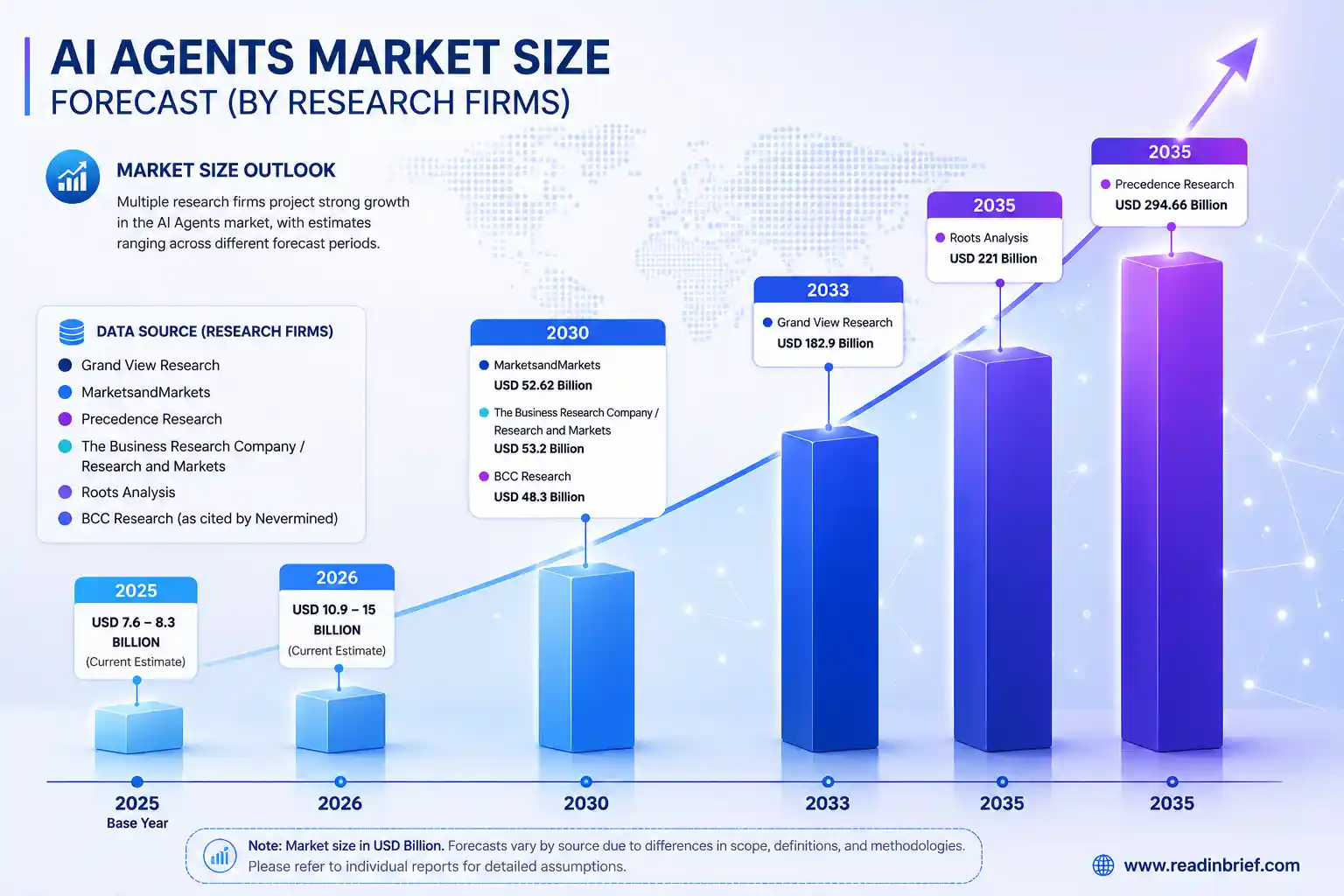
There is no single, universally agreed AI Agents Market Size. Multiple credible research firms have published estimates, and they differ by a meaningful margin because they use different base years, different market boundaries (some include only standalone agent software, others include agent-enabling infrastructure or adjacent agentic AI categories), and different forecast methodologies.
Research Source | Base Year | Market Size | Forecast Year | Forecast Value | CAGR |
|---|---|---|---|---|---|
2025 | USD 7.6 billion | 2033 | USD 182.9 billion | 49.6% (2026-2033) | |
2025 | USD 7.84 billion | 2030 | USD 52.62 billion | 46.3% (2025-2030) | |
2025 | USD 7.92 billion | 2035 | USD 294.66 billion | 43.57% (2026-2035) | |
2025 | USD 8.29 billion | 2030 | USD 53.2 billion | 44.9% | |
Roots Analysis | 2026 | USD 15 billion | 2035 | USD 221 billion | 34.64% |
BCC Research (as cited by Nevermined) | 2025 | USD 8 billion | 2030 | USD 48.3 billion | 43.3% |
Sources: Grand View Research, "AI Agents Market Size, Share And Trends Report, 2026-2033" (2026); MarketsandMarkets, "AI Agents Market Report" and April 2025 press release; Precedence Research, "AI Agents Market Size to Hit USD 294.66 Billion by 2035" (2026); The Business Research Company via Research and Markets, "AI Agents Market Report 2026" (2026); Roots Analysis, "AI Agents Market Size, Share & Industry Growth 2035" (2026); BCC Research estimate as compiled by Nevermined (2026).
Why Do the Estimates Differ?
Three factors explain most of the spread between these numbers.
Market definition
Some reports size only standalone, purchasable "AI agent" software products. Others fold in adjacent categories such as agent orchestration platforms, agentic AI security tooling, or enterprise agentic AI spend embedded inside broader software suites. Grand View Research and MarketsandMarkets both publish separate, related reports on "agentic AI" and "enterprise agentic AI," and the figures in those adjacent reports are not directly comparable to their AI-agents-specific numbers.
Base year and forecast window
A report with a 2033 forecast horizon will show a larger absolute end-value than one forecasting only to 2030, even if the underlying annual growth rate is similar, simply because compounding has more years to work. Comparing a "2030 forecast" figure against a "2035 forecast" figure without adjusting for the different time horizons is a common source of confusion.
Segment inclusion and regional scope
Firms differ on whether they include consumer-facing agents, industrial and robotics-adjacent agents, or agent-related professional services revenue (implementation, consulting, and support) inside the total addressable market figure.
Readers comparing these numbers should check the base year, forecast year, and stated market definition in the original report before drawing conclusions about which estimate is "more accurate." None of these figures should be treated as a single, official number for the industry; each is a private research firm's paid-report estimate, built on its own methodology.
AI Agents Market Forecast
AI Agents Market Growth Forecast Table
Year | Estimated Market Size | Source |
|---|---|---|
2025 | USD 7.6-8.3 billion (range) | Grand View Research; MarketsandMarkets; Research and Markets |
2026 | USD 10.9-15 billion (range) | Grand View Research; Research and Markets; Roots Analysis |
2027 | Calculated estimate based on reported CAGR (approximately USD 15-18 billion using MarketsandMarkets' 46.3% CAGR from its 2025 base) | Calculated estimate; not separately published by the source |
2030 | USD 48.3-53.2 billion (range) | MarketsandMarkets; The Business Research Company / Research and Markets; BCC Research |
2033 | USD 182.9 billion | Grand View Research |
2034 | USD 139.19 billion (agentic AI market, a related but distinct category) | Fortune Business Insights |
2035 | USD 221-294.7 billion (range) | Roots Analysis; Precedence Research |
Only the 2025, 2026, 2030, 2033, and 2035 figures above come directly from published reports. The 2027 figure is explicitly labeled as a calculated estimate based on a reported CAGR, not a separately reported data point, in line with this article's methodology of never presenting a derived number as original source data. No reliable 2032 forecast specific to the "AI agents" category (as distinct from "agentic AI") was found in the sources reviewed for this article, so that year has been omitted rather than estimated.
It is also worth flagging again that the 2034 figure in the table refers to the "agentic AI market" as sized by Fortune Business Insights, a related but not identical category to "AI agents." The two terms are often used loosely in secondary coverage, but the underlying primary reports treat them as separate market definitions. See the "AI Agents vs the Broader Generative AI Market" section below for more on how these categories relate.
Market Growth Rate
AI Agents Market CAGR
Reported CAGRs for the AI agents market cluster tightly in a high range, typically between 43% and 50% for shorter forecast windows (2025-2030), and somewhat lower, between roughly 34% and 46%, for longer windows extending to 2033-2035. Grand View Research reports a 49.6% CAGR from 2026 to 2033. MarketsandMarkets reports 46.3% from 2025 to 2030. Precedence Research reports 43.57% from 2026 to 2035. Roots Analysis, using a larger 2026 base figure, reports a lower 34.64% CAGR to 2035.
Growth is accelerating for a combination of technical and commercial reasons. On the technical side, foundation models have become materially better at multi-step reasoning and tool use in a short period, which expands the range of tasks an agent can reliably complete without failing partway through. On the commercial side, enterprise software vendors are racing to embed agent capability into existing products rather than requiring customers to buy separate point solutions, which accelerates distribution. Gartner's prediction that agentic AI could drive up to 30% of enterprise application software revenue by 2035, surpassing USD 450 billion, up from about 2% in 2025, illustrates how quickly incumbent vendors expect this shift to move through existing software categories (Source: Gartner, August 2025 press release).
At the same time, several factors could compress future CAGR figures below what is currently forecast. Gartner's own research flags that over 40% of agentic AI projects risk cancellation by the end of 2027 due to unclear ROI, escalating costs, or inadequate risk controls, which would slow real-world revenue realization even where technical capability continues to improve. Research firms will likely revise their CAGR figures over the next few forecast cycles as more production-scale deployment data becomes available; the figures presented in this article reflect the most recently published estimates as of mid-2026 and should be expected to change in future report updates.
What Is Driving the AI Agents Market?
Several converging forces explain both current adoption and the high forecast growth rates.
Generative AI adoption as a foundation
Stanford HAI's 2026 AI Index reports that organizational AI adoption reached 88%, and that generative AI reached about 53% of the population faster than either the personal computer or the internet did. This broad base of familiarity with generative AI tools is a precondition for agent adoption, since most enterprise agent products are built on top of the same underlying language models.
Enterprise automation pressure
Businesses are under continuous pressure to cut operating costs and improve throughput without proportionally increasing headcount. AI agents that can handle end-to-end tasks, rather than just answering a question, extend automation into workflows that previously required a human in the loop at every step.
Improved reasoning models and lower inference costs
As frontier labs have improved reasoning capability and, in parallel, reduced the cost per token of inference, the economics of running an agent that may make many model calls to complete one task have become more favorable for production use.
Cloud AI infrastructure and API ecosystems
Major cloud providers have built agent orchestration and deployment tooling directly into their platforms, lowering the technical barrier for enterprises to build or buy agent-based automation.
MCP and interoperability standards
The Model Context Protocol gives agents a standardized way to connect to enterprise tools, data sources, and each other, reducing the custom integration work that previously slowed agent deployments. Gartner projects that 75% of API gateway vendors will offer MCP features by the end of 2026 (Source: cited via synvestable.com, referencing Gartner, 2026).
Specific automation use cases
Customer service automation, AI coding agents, sales and marketing automation, AI-assisted research, and enterprise copilots are the categories most frequently cited across research reports as near-term revenue drivers, and several of these (notably coding and customer service) already show measurable enterprise deployment rather than pilot-only usage.
AI Agents Market Segmentation
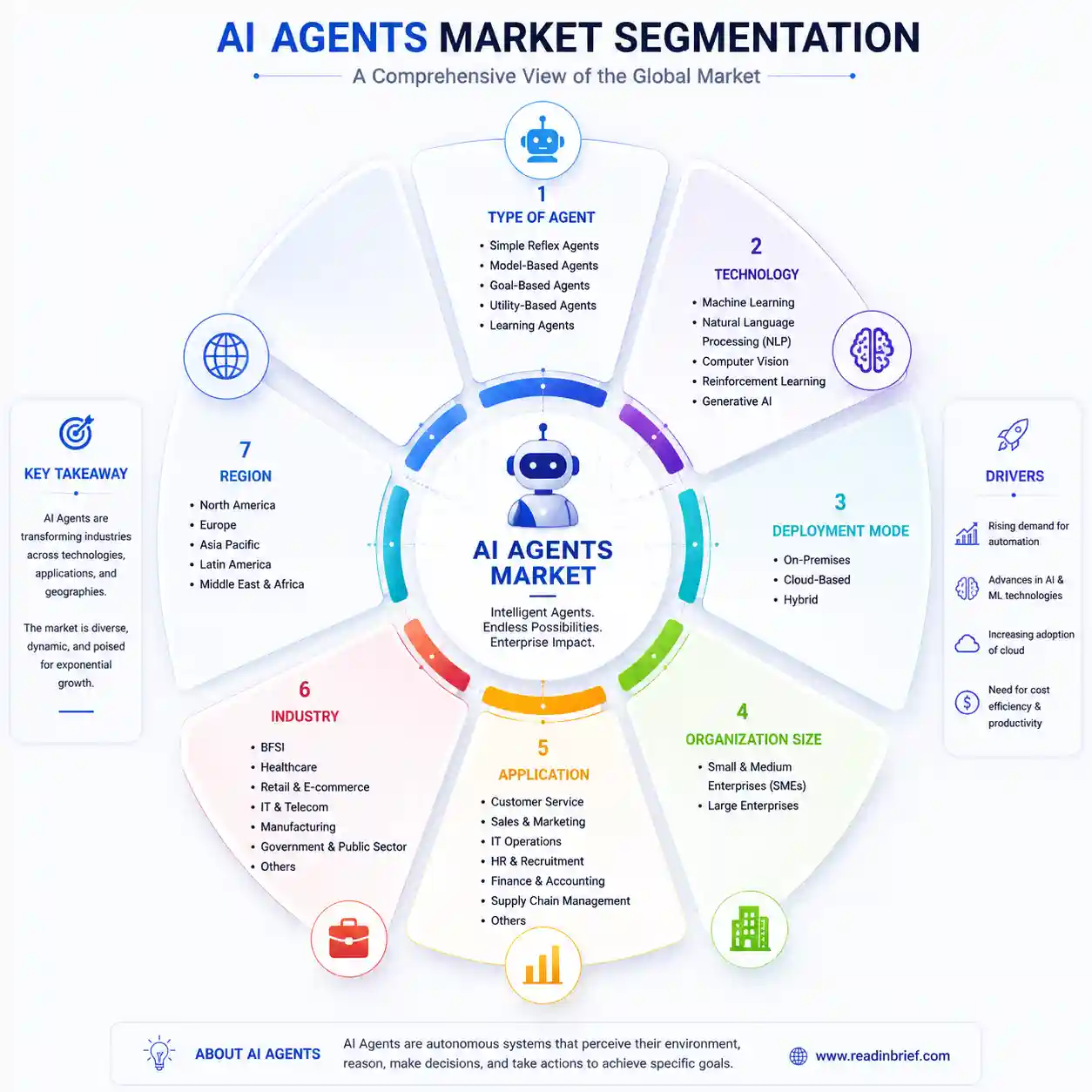
By Agent Type
Single-agent systems held the largest share in 2025, at 59.2% according to Grand View Research, reflecting the fact that most current production deployments still involve one agent handling one workflow.
Multi-agent systems are growing faster than single-agent systems in most forecasts, as MarketsandMarkets projects a 48.5% CAGR for this segment specifically, because complex workflows increasingly benefit from specialized agents coordinating with each other.
Autonomous agents, which operate with minimal human checkpoints, are expanding fastest in narrow, well-defined domains such as coding and structured data processing, where errors are easier to detect and reverse.
Conversational agents remain the largest deployed category by volume, largely because customer service was the first widely adopted use case.
Task-specific agents are the segment Gartner tracks most closely for enterprise application embedding, forecasting 40% of enterprise apps will include them by the end of 2026.
Growth drivers for this segment differ by type: single-agent adoption is driven by ease of deployment and lower integration risk, while multi-agent adoption is driven by demand for handling genuinely complex, cross-functional workflows. The main adoption barrier for multi-agent systems is orchestration complexity and the difficulty of debugging failures that emerge from agent-to-agent interaction rather than a single model's output.
By Technology
Machine learning held the largest technology-segment share in 2025, at 30.5% (Grand View Research).
Natural Language Processing (NLP) underpins most conversational and document-processing agents.
Generative AI is the technology most responsible for the current wave of agent capability, since large language models provide the reasoning and language backbone most agents are built on.
Computer vision is a smaller but growing segment, relevant to agents that need to interpret screenshots, documents, or physical environments.
Reinforcement learning remains a specialized technique, more common in agent training pipelines than in commercial product marketing, but increasingly relevant as vendors fine-tune agents for specific task success rates.
By Deployment
Cloud deployment dominates current AI agent adoption, reflecting the broader enterprise shift to cloud infrastructure and the practical reality that most foundation models are only accessible via cloud APIs. On-premise deployment is more common in regulated industries such as financial services, healthcare, and government, where data residency or compliance requirements limit cloud use. Hybrid deployment, combining cloud-hosted models with on-premise data and tool access (often mediated through protocols like MCP), is an emerging pattern for enterprises that want cloud-grade model capability without moving sensitive data off-premise.
By Enterprise Size
Large enterprises currently account for the largest share of AI agent spending, consistent with Grand View Research's finding that the enterprise end-use segment held the largest revenue share in 2025. Small and mid-sized enterprises (SMEs) are a growing segment, particularly for ready-to-deploy, low-code agent products that do not require in-house AI engineering talent. Startups are adopting agents both as customers (to automate internal operations cheaply) and as builders (many of the fastest-growing AI companies today are themselves agent-product startups).
By Application
Customer service and virtual assistants held the largest application share in 2025 across multiple reports, including both Grand View Research and MarketsandMarkets. Other significant application areas include sales, marketing, software development (coding agents), research, finance, cybersecurity, human resources, operations, and data analysis. MarketsandMarkets specifically highlights coding and software development as the agent-role segment with the highest projected CAGR, at 52.4% through 2030.
By Industry
Financial services (BFSI), healthcare, retail and ecommerce, manufacturing, IT and telecommunications, education, government, legal, media, and transportation are the industries most frequently cited in segmentation data. MarketsandMarkets notes that BFSI end users are projected to register the largest market size within the forecast period, reflecting the sector's combination of high transaction volume, strong automation budgets, and relatively mature data infrastructure. Healthcare and legal are cited across multiple reports as high-potential but slower-adopting verticals, due to regulatory and liability sensitivity around autonomous decision-making.
Regional Market Analysis
Region | Market Position | Key Drivers | Major AI Ecosystem |
|---|---|---|---|
North America | Largest market (39.6% share in 2025, Grand View Research) | Concentration of foundation-model developers, hyperscaler infrastructure, early enterprise budget commitment | OpenAI, Anthropic, Google, Microsoft, Amazon, Salesforce, IBM |
Europe | Established but smaller market than North America | EU AI Act compliance driving structured governance adoption, strong enterprise software base | SAP, Mistral AI, UK and German enterprise AI ecosystems |
Asia Pacific | Fastest-growing region (multiple sources) | Large digital workforce, government AI investment (notably China and India), rapid enterprise cloud adoption | Alibaba, Baidu, and a fast-growing developer ecosystem in India and Japan |
Middle East and Africa | Smaller but rising market, driven by national AI strategy investment | Sovereign AI initiatives, government digital transformation programs | Emerging regional cloud and AI infrastructure investment |
Latin America | Early-stage but expanding market | Growing enterprise software adoption, increasing regional cloud provider presence | Enterprise adoption led by regional subsidiaries of global platforms |
This table reflects qualitative market position language used by the cited research firms; readers should note that country-level percentage market-share figures beyond the North America headline number were not consistently available across the sources reviewed for this article and have therefore been omitted rather than estimated.
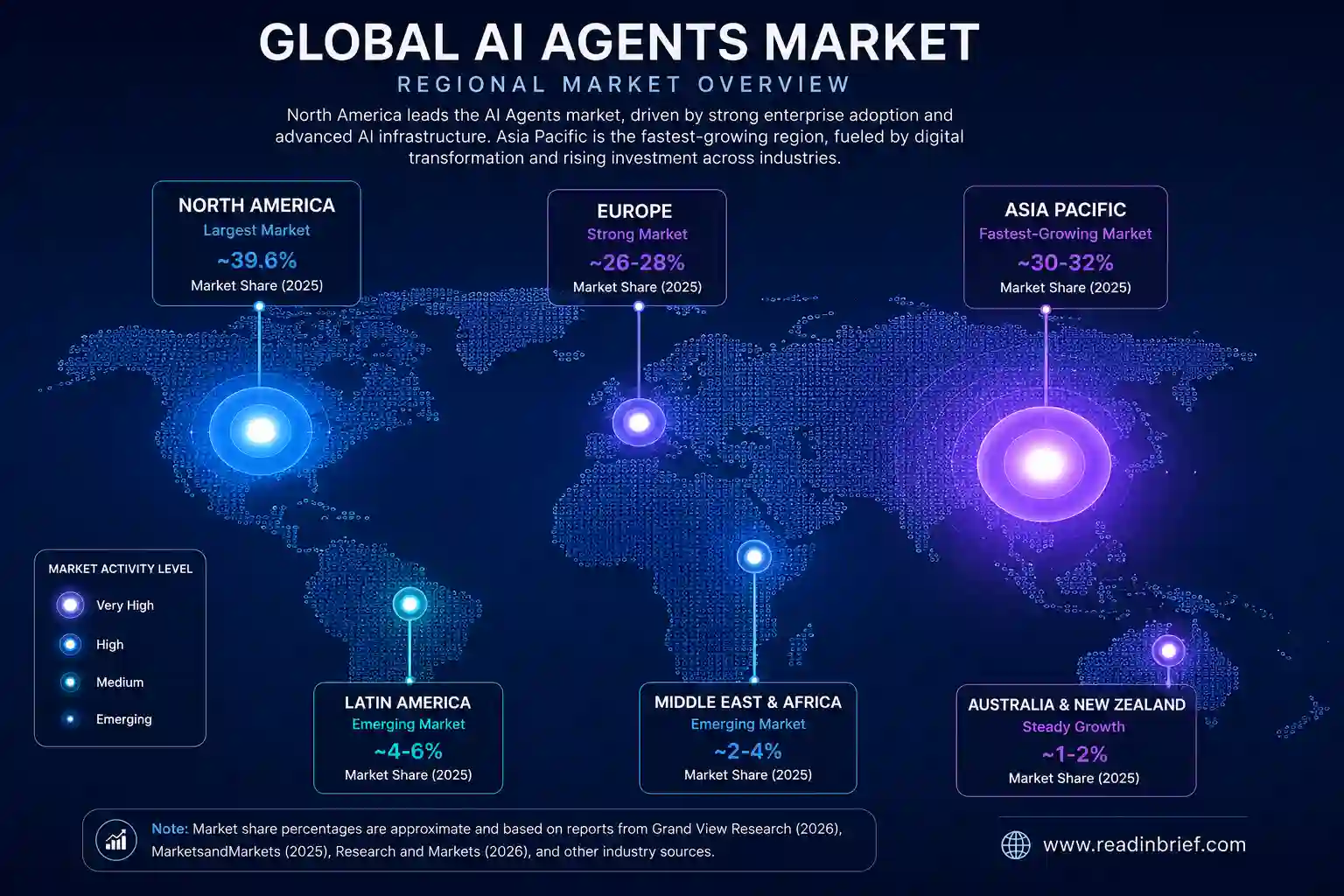
United States AI Agents Market
The United States is the largest single national market within the broader North America region, and it anchors North America's overall 39.6% global revenue share reported by Grand View Research for 2025. In the adjacent agentic AI category, Fortune Business Insights estimates the U.S. market specifically at USD 2.33 billion in 2026. This U.S. leadership reflects several structural advantages: the concentration of leading foundation-model developers (OpenAI, Anthropic, Google, Meta), massive AI infrastructure capital expenditure by hyperscalers, and a dense venture capital ecosystem. According to Crunchbase data cited across multiple funding trackers, including The Agent Report, roughly 88% of AI venture dollars in the first half of 2026 went to U.S.-based companies, out of a global total exceeding USD 360 billion for that half-year period.
On regulation, the U.S. approach remains comparatively less centralized than the EU's, with policy activity occurring more at the state level and through sector-specific guidance (such as NIST's AI Risk Management Framework) than through a single comprehensive federal AI law. This lighter-touch environment is frequently cited by industry commentators as one reason enterprise experimentation has moved quickly in the U.S., though it also means governance maturity varies significantly by company, consistent with Deloitte's finding that only 21% of surveyed organizations globally have a mature governance model for autonomous agents.
Europe AI Agents Market
Europe's AI agents market is smaller in absolute revenue terms than North America's but is shaped distinctly by the EU AI Act, which introduces risk-based obligations for AI systems, with high-risk system requirements beginning to take effect from August 2026 according to industry compliance trackers. This regulatory structure is pushing European enterprises toward more formal governance processes for agentic systems earlier than in less-regulated markets, which some analysts frame as a compliance burden and others frame as an adoption accelerant once trusted, audited agent products become available.
Germany, the United Kingdom, and France represent the largest national markets within the region, with enterprise adoption concentrated in manufacturing (Germany), financial services (UK), and the public sector across several countries. Data privacy requirements under the EU's existing data protection framework continue to shape how agents are allowed to access and process personal data, adding an additional compliance layer beyond the AI Act itself.
Asia Pacific AI Agents Market
Asia Pacific is the region most consistently identified as the fastest-growing market for AI agents, even though its current global revenue share remains smaller than North America's. Precedence Research states the region accounts for around 20% of the broader AI agents market with a CAGR of nearly 35%. IDC has forecast that AI investment in the Asia-Pacific region will grow 1.7 times faster than overall digital spending, creating an estimated USD 1.6 trillion economic impact by 2027 (Source: IDC, as cited by Insentra, 2026).
China's AI ecosystem, anchored by companies including Alibaba and Baidu alongside a growing set of frontier model developers, continues to expand agent capability, though most funding-tracker data shows Chinese AI venture funding concentrated in a small number of frontier labs rather than broadly distributed across agent startups.
India has a large and growing developer base actively building on agent frameworks and foundation-model APIs, positioning it as a significant services and implementation hub even where it is not yet a leading source of frontier model development. Japan and South Korea show strong enterprise appetite for automation-driven agent adoption, consistent with both countries' existing high levels of industrial automation investment.
Competitive Landscape
The competitive landscape spans foundation model developers, cloud platforms, enterprise software incumbents, and a fast-growing layer of agent-native startups.
Foundation model and platform providers: OpenAI, Anthropic, Google (including Google DeepMind), Microsoft, Meta, and Amazon all offer agent-building frameworks, APIs, or agent products, and their underlying models power a large share of third-party agent products as well.
Enterprise software incumbents: Salesforce (Agentforce), ServiceNow, Oracle, SAP, and IBM have each embedded agent capability into existing enterprise software suites, aiming to convert existing customer relationships into agent revenue rather than compete purely on new customer acquisition. Salesforce has reported that its Agentforce product generates roughly USD 540 million in annual recurring revenue from about 18,500 deals, according to industry analysis compiled by New Market Pitch (2026), illustrating that large incumbents are already generating meaningful, disclosed revenue from agent products, distinct from the aggregate market-size estimates discussed earlier.
Infrastructure and automation platforms: NVIDIA supplies the compute infrastructure underlying most agent training and inference. UiPath has extended its robotic process automation base into agentic capability. Open-source and developer-facing frameworks including LangChain, CrewAI, and Microsoft's AutoGen are widely used by developers building custom agents rather than buying pre-packaged products.
No credible, verified market-share breakdown by company was found across the sources reviewed for this article; company-level market share figures cited in secondary blog content were not traceable to a named primary research report and have therefore been excluded. MarketsandMarkets does note that OpenAI, Google, and Amelia were identified as leading players by market footprint in its research, without publishing specific percentage shares for each.
AI Agent Startup Ecosystem
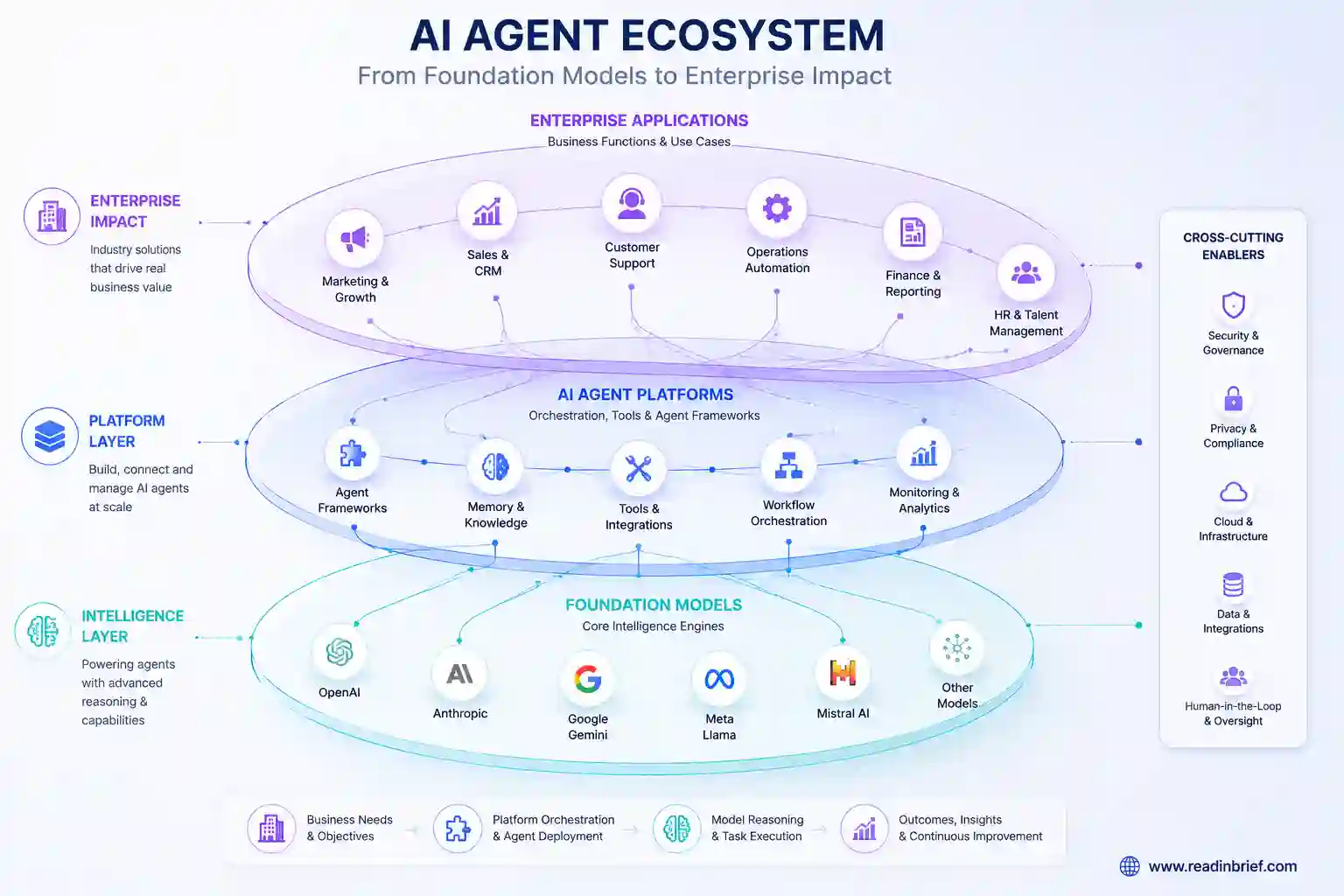
The startup layer of the AI agents market has attracted extraordinary venture capital interest. Crunchbase data cited across multiple 2026 funding trackers puts global venture funding at USD 510 billion in the first half of 2026 alone, already ahead of 2025's full-year total of roughly USD 440 billion, with AI absorbing more than 70% of Q2 2026 capital. Agentic AI-specific funding is reported to have reached approximately USD 2.66 billion across 44 rounds through April 2026, compared with about USD 1.09 billion in the same period the prior year, according to funding data compiled by Unicorn Screener (2026).
Named examples of well-funded AI agent startups referenced across multiple funding trackers include Sierra (customer service agents, founded by former Salesforce co-CEO Bret Taylor), Cognition AI (coding agents), Harvey (legal AI agents), Glean (enterprise search and agent platform), and Hightouch (marketing automation agents, which raised a USD 150 million Series D in 2026). Vertical, domain-specific agents (legal, coding, sales, compliance) are consistently described across multiple sources as commanding stronger valuation multiples than general-purpose, horizontal agent products, because they can demonstrate clearer, more measurable return on investment within a single well-defined workflow.
Investors have also become more selective: average round sizes for later-stage agentic AI startups have risen sharply even as the number of very small, thinly differentiated agent-wrapper startups receiving funding has declined, according to trend commentary from Gravity's funding tracker (2026).
Major AI Agent Use Cases
Use Case | What the Agent Does | Business Benefit | Adoption Potential |
|---|---|---|---|
Customer support | Resolves tickets, authenticates users, processes refunds and returns | Faster resolution times, reduced need for human escalation on routine issues | High; most mature and widely deployed use case |
Software development | Writes, reviews, and debugs code, manages pull requests | Faster development cycles, reduced routine coding workload | High; among the fastest-growing agent-role segments |
Sales | Qualifies leads, drafts outreach, updates CRM records | More consistent pipeline coverage, reduced manual data entry | Medium-high; growing steadily |
Marketing | Researches audiences, generates campaign creative, executes multi-channel campaigns | Faster campaign execution, more personalized outreach at scale | Medium-high |
Finance | Processes invoices, reconciles accounts, flags anomalies | Reduced manual processing time, improved audit consistency | Medium; strong fit in BFSI, the largest projected end-user segment per MarketsandMarkets |
Healthcare | Supports documentation, scheduling, and administrative workflows | Reduced administrative burden on clinical staff | Medium; slower due to regulatory and liability sensitivity |
Research | Synthesizes literature, drafts summaries, supports analysis | Faster initial research cycles | Medium; strong among knowledge-work-heavy organizations |
Cybersecurity | Monitors network traffic and logs, initiates threat response | Faster detection and response to incidents | Medium-high; cited by Gartner as an early task-specific agent example |
Data analytics | Cleans data, builds reports, surfaces anomalies | Reduced manual reporting workload | Medium-high |
HR | Screens candidates, answers policy questions, onboards employees | Reduced administrative load on HR teams | Medium |
Ecommerce | Assists with product discovery, order status, and returns | Improved customer self-service rates | Medium-high |
Operations and supply chain | Optimizes routing, tracks inventory, forecasts demand | Improved efficiency and reduced manual planning effort | Medium-high; cited by Amazon and manufacturing case studies |
Enterprise AI Agent Adoption
Enterprises are moving from experimentation toward production, but at very different speeds depending on which survey and which definition of "adoption" is used. This is one of the more confusing areas of AI agent data, because headline adoption figures range from roughly 50% to nearly 90% depending on what exactly is being measured.
McKinsey's November 2025 State of AI survey found that 88% of organizations report using AI in at least one business function, but only 23% report scaling agents in at least one function, with another 39% still experimenting; in no single function did more than about 10% of organizations report having scaled agents. PwC's April 2025 survey found 79% of U.S. executives say their companies are already adopting AI agents in some form. Deloitte's 2026 enterprise survey of 3,235 leaders across 24 countries found that roughly three-quarters of enterprises expect to use agentic AI at least moderately within two years, while only 21% currently have a mature governance model for autonomous agents.
This gap between stated adoption intent and scaled production deployment is the central theme across nearly every enterprise survey reviewed for this article. Organizations are experimenting broadly and budgeting aggressively (88% of executives plan to increase AI-related budgets because of agentic AI, according to data compiled by GetPanto, 2026), but relatively few have moved a given agent workflow into full production with measurable, sustained ROI. Integration challenges (legacy systems not designed for agentic interaction), governance challenges (unclear accountability when an agent acts autonomously), and security considerations (agent permissions, prompt injection risk, and audit visibility) are the most frequently cited barriers to moving from pilot to production across the sources reviewed.
AI Agents vs Traditional AI
Factor | Traditional AI | Generative AI | AI Agents |
|---|---|---|---|
Primary function | Classification, prediction, pattern recognition | Content generation (text, images, code) | Autonomous, multi-step task execution |
Autonomy | Low; typically a single-step output | Low to medium; produces output per prompt | Medium to high; can plan and execute across steps |
Reasoning | Rule-based or statistical, limited multi-step reasoning | Improved reasoning within a single response | Multi-step planning and reasoning across a task |
Memory | Typically none beyond the model's training | Limited to context window per session | Increasingly persistent across sessions in production systems |
Tool usage | Rare; usually a closed system | Emerging (plugins, browsing) | Core capability; calls external tools and APIs routinely |
Data access | Predefined datasets | Training data plus optional retrieval | Live access to enterprise systems, often via protocols like MCP |
Workflow execution | No; produces a prediction or classification only | Limited; produces a draft or output for a human to act on | Yes; can complete an end-to-end workflow with defined checkpoints |
Human involvement | High; humans interpret and act on output | Medium; humans review and use generated content | Variable; ranges from human-in-the-loop to largely autonomous |
Business applications | Fraud detection, forecasting, recommendation engines | Content creation, drafting, summarization | Customer service resolution, coding, research, operations automation |
AI Agents vs the Broader Generative AI Market
It is important not to confuse AI-agents-specific market estimates with figures for the broader generative AI market, the "agentic AI" market, or "autonomous agents" market, because different research firms use these terms with different scope. Generative AI refers broadly to models that produce new content (text, code, images) in response to a prompt. Agentic AI is a broader umbrella term that some firms use to describe any AI system exhibiting goal-directed, multi-step autonomous behavior, which can include AI agents but sometimes also includes agent-enabling infrastructure, orchestration platforms, and agentic AI security tooling.
AI agents, more narrowly, usually refers to deployable software products (single or multi-agent) that perform defined tasks. Autonomous agents and multi-agent systems are sub-categories within the AI agents space, distinguished by the degree of human oversight and the number of coordinating agents involved.
Fortune Business Insights, for example, sizes the "agentic AI market" at USD 7.29 billion in 2025, a figure close to but distinct from Grand View Research's USD 7.6 billion "AI agents market" figure for the same year; the closeness is partly coincidental and partly a reflection of overlapping but not identical market definitions. Readers building financial models, investment theses, or competitive strategy from these figures should always check which specific report and market definition a cited number comes from before treating two similarly-named markets as interchangeable.
Key AI Agent Technology Trends
Agentic AI and multi-agent systems
The industry is shifting from single agents handling isolated tasks toward coordinated systems of specialized agents, a trend MarketsandMarkets highlights with its 48.5% projected CAGR for the multi-agent systems segment.
Model Context Protocol (MCP) and agent-to-agent communication
MCP has become a widely adopted standard for connecting agents to enterprise data and tools since Anthropic introduced it in November 2024, with adoption reported in the tens of millions of monthly SDK downloads and thousands of active public servers by mid-2026. Separate agent-to-agent communication standards are also emerging to let independently built agents coordinate directly.
Computer use and browser agents
Agents capable of directly operating a computer interface, reading a screen, and clicking through applications, rather than only calling defined APIs, have improved substantially, illustrated by the OSWorld benchmark gains Stanford HAI reports.
AI coding agents
Coding remains one of the most mature and fastest-growing agent-role categories, reflected in MarketsandMarkets' 52.4% projected CAGR for the coding and software development agent role.
Voice agents
Voice-based agents for customer service and sales are an active growth area, though most public market-size data treats voice agents as a sub-segment rather than a separately sized market.
AI memory and long-context models
Persistent memory across sessions and larger context windows are both cited across technical sources as key enablers of more reliable, longer-running agent workflows.
Reasoning models and small language models
Larger reasoning-focused models are improving multi-step task accuracy, while smaller, cheaper models are increasingly used for narrower, well-defined agent sub-tasks to control inference cost.
Edge AI agents and open-source agent frameworks
Running lighter agent workloads on local or edge devices is an emerging trend, alongside continued growth of open-source frameworks such as LangChain and Microsoft's AutoGen, which developers use to build custom agents outside of vendor-packaged products.
Enterprise agent platforms
Vendors including Salesforce, ServiceNow, Microsoft, and Google are building dedicated enterprise agent platforms and orchestration layers rather than leaving agent-building purely to developer frameworks, an approach Google reinforced by introducing its Gemini Enterprise Agent Platform in 2026, according to industry trackers.
AI Agents Market Challenges
Several recurring challenges appear across nearly every research report and enterprise survey reviewed for this article.
Hallucinations and reliability
Even as task-success rates climb, Stanford HAI's own framing is that AI systems are not yet "generally reliable," noting that the same models capable of winning gold at the International Mathematical Olympiad can still fail simple, structured tasks such as reading an analog clock correctly.
Security and prompt injection
Because agents can take real actions rather than just producing text, security risks extend beyond content quality to include the risk of an agent being manipulated into taking an unintended or harmful action, an emerging attack surface that agentic AI security-focused market reports (such as MarketsandMarkets' agentic AI security report, forecasting growth from USD 1.65 billion in 2026 to USD 13.52 billion by 2032) are specifically built to address.
Agent permissions and governance
Deciding what systems and data an agent may access, and under what conditions it must ask for human approval, remains an unresolved operational question at most enterprises, consistent with Deloitte's finding that only 21% have a mature governance model.
Cost and latency
Agents that make multiple model calls per task can be significantly more expensive to run than a single-turn generative AI interaction, and multi-step workflows introduce latency that can undermine real-time use cases.
Integration complexity
Deloitte's research notes that legacy enterprise systems were not designed for agentic interaction, forcing many current implementations to rely on brittle API integrations rather than native agent-friendly interfaces.
Observability and evaluation
Measuring whether an agent is actually completing tasks correctly, and diagnosing why a multi-agent workflow failed, is harder than evaluating a single-turn model response, and standardized evaluation practices are still maturing.
Human oversight
Determining the right level of human-in-the-loop checkpoints, enough to catch failures without erasing the efficiency gains of automation, remains an open design question across nearly every enterprise deployment discussed in the sources reviewed.
AI Governance and Regulation
Regulation is likely to shape both the pace and the geography of AI agent adoption over the next several years. The EU AI Act introduces risk-based obligations that apply differently depending on how an AI system is classified, with high-risk system requirements beginning to take effect from August 2026 according to industry compliance trackers; this is likely to push European enterprises toward more formal agent governance processes earlier than markets with lighter regulatory requirements. In the United States, the NIST AI Risk Management Framework provides a voluntary structure that many enterprises reference for internal AI governance, though there is no single comprehensive federal AI law equivalent to the EU AI Act as of mid-2026.
Beyond formal regulation, enterprise-level AI governance (data privacy controls, model and agent audit trails, and defined escalation paths for agent errors) is increasingly treated as a competitive differentiator rather than a purely defensive compliance exercise. Deloitte's research frames the gap between adoption intent and governance maturity as the central risk facing the market: enterprises are moving quickly to experiment with agentic AI, but governance frameworks, accountability structures, and formal risk controls are consistently reported as lagging behind deployment ambition across the surveys reviewed in this article.
Investment and Funding Trends
Capital flowing into the broader AI ecosystem, and into AI agents specifically, reached record levels in 2026. Stanford HAI's 2026 AI Index reports global corporate AI investment of USD 581.7 billion, a 130% year-over-year increase, with generative AI investment specifically reaching USD 170.9 billion, up 404% year-over-year. Crunchbase data cited across multiple funding trackers puts total global venture funding at USD 510 billion for the first half of 2026 alone, already exceeding 2025's full-year total of roughly USD 440 billion, with AI companies absorbing more than 70% of Q2 2026 capital and, according to one tracker, USD 242 billion in Q1 2026 alone (about 80% of all global VC funding that quarter).
Within this broader AI investment surge, agentic AI-specific startup funding is reported at approximately USD 2.66 billion across 44 rounds through April 2026, compared with roughly USD 1.09 billion in the same period the prior year (Source: Unicorn Screener, 2026, citing industry funding data). Funding concentration is notable: OpenAI and Anthropic alone are reported to have absorbed 43% of all H1 2026 global venture funding, according to Crunchbase-sourced tracking compiled by The Agent Report and Gravity (2026), reflecting how much of the broader "AI funding boom" is concentrated in frontier model labs rather than distributed evenly across the agent-application layer. Vertical, workflow-specific agent startups (legal, marketing, compliance, coding) are consistently reported to command stronger valuation multiples and larger later-stage rounds than general-purpose, horizontal agent products.
Strategic partnerships and acquisitions are also reshaping the competitive landscape, exemplified by Cognition's acquisition of Windsurf, reported to have more than doubled Cognition's annual recurring revenue and contributed to financing talks reportedly targeting a USD 25 billion valuation as of April 2026 (Source: Unicorn Screener, 2026). Readers should treat all company-specific valuation and funding figures in this section as reported by the cited secondary sources rather than verified against primary investor relations disclosures, and should check current figures directly with the companies involved for investment decisions.
AI Agents Market Opportunities
Several areas are consistently identified across research reports as high-potential opportunities within the broader AI agents market.
Vertical AI agents built for a single industry or workflow (legal, healthcare, financial compliance) are repeatedly cited as the fastest-growing sub-segment, with MarketsandMarkets projecting a 62.7% CAGR for vertical agents through 2030, compared with 46.3% for the overall market.
Healthcare and financial agents represent large addressable markets constrained mainly by regulatory and liability sensitivity rather than technical readiness, suggesting significant future upside once governance and audit frameworks mature.
Developer and coding agents continue to show some of the strongest near-term commercial traction, reflected in both funding data (Cognition, among others) and segment-level CAGR projections.
Voice AI agents are an expanding opportunity as voice interfaces become more natural and lower-latency, particularly in customer service and sales contexts.
AI shopping and agentic commerce agents represent an emerging category; Grand View Research separately sizes the "agentic commerce market" at USD 5.7 billion in 2025, growing to USD 65.5 billion by 2033 at a 35.7% CAGR, driven by AI agents capable of executing autonomous transactions on a consumer's behalf.
Enterprise workflow and multi-agent orchestration platforms represent an infrastructure-layer opportunity, as enterprises increasingly need tools to manage, monitor, and govern multiple coordinating agents rather than just building individual agents.
Cybersecurity agents are an early, Gartner-cited example of task-specific agent deployment, and the related agentic AI security market is itself forecast by MarketsandMarkets to grow from USD 1.65 billion in 2026 to USD 13.52 billion by 2032.
Personal AI assistants for individual consumers remain a large but less precisely sized opportunity, referenced qualitatively across sources (including a widely cited, though not independently verified in this review, projection of 2.2 billion AI assistants in use by 2030 compiled by LitsLink, 2026) rather than backed by a single authoritative market-sizing report.
AI Agents Market Forecast to 2030 and Beyond
Published forecasts extending to 2030 are reasonably consistent in direction, if not in exact magnitude: MarketsandMarkets projects USD 52.62 billion, The Business Research Company projects USD 53.2 billion, and BCC Research projects USD 48.3 billion, a fairly tight cluster once the underlying market definitions are aligned. Forecasts extending further, to 2033-2035, diverge more widely (from roughly USD 182.9 billion to USD 294.7 billion), reflecting the fact that small differences in assumed CAGR compound into much larger differences in absolute value over a longer horizon.
Beyond the explicitly published forecast years, current trends suggest continued growth in multi-agent orchestration, vertical specialization, and enterprise embedding of agent capability into existing software categories, consistent with Gartner's five-stage model of enterprise agentic AI evolution (from AI assistants in nearly all applications by 2025, to task-specific agents in 40% of applications by 2026, to collaborative multi-agent implementations by 2027, and further stages through 2028 and beyond). This should be read as analyst interpretation of a directional trend, not as a specific published market-size forecast for years beyond those explicitly covered in the table above.
What Could Slow AI Agent Market Growth?
Several factors could cause actual market growth to fall short of current forecasts.
Regulation
Stricter or more fragmented regulatory requirements, particularly as EU AI Act high-risk provisions take effect from August 2026, could slow deployment timelines in some markets even as they may increase long-term trust in others.
Security incidents
A high-profile security failure involving an autonomous agent taking a harmful or costly unintended action could slow enterprise risk appetite broadly, similar to how security incidents have historically slowed adoption curves for other emerging enterprise technologies.
Poor reliability in production
Stanford HAI's own data shows agents still fail a meaningful share of structured tasks even on benchmarks specifically designed to measure agent capability; continued reliability gaps could slow the transition from pilot to full production deployment.
High inference costs
Multi-step agent workflows that require many model calls per completed task can be expensive to run at scale, and cost pressure could slow expansion into lower-margin use cases.
Enterprise resistance and unclear ROI
McKinsey's finding that only 23% of organizations have scaled agents in even one function, combined with Gartner's forecast that over 40% of agentic AI projects will be cancelled by 2027, both point to a real risk that enthusiasm outpaces realized business value in the near term.
Integration problems
Legacy enterprise systems not designed for agentic interaction remain a structural barrier that will take time and investment to resolve, according to Deloitte's research.
Data privacy concerns
As agents require broader access to enterprise and customer data to function effectively, data privacy and access-control concerns could slow adoption in privacy-sensitive sectors and regions.
Future of the AI Agents Market
The most credible evidence available through mid-2026 supports a multi-year evolution from today's largely single-agent, task-specific deployments toward increasingly coordinated, multi-agent workflows, and eventually toward what some industry commentary describes as "autonomous digital workforces." Gartner's own staged model anticipates this progression through 2028, with collaborative multi-agent implementations becoming more common by 2027 and a meaningful share of day-to-day work decisions (Gartner forecasts at least 15%) being made autonomously by 2028.
Beyond 2028, credible, specific, source-backed forecasts become sparser, and most available commentary shifts from published market-sizing data to analyst and industry interpretation. What can be said with reasonable confidence, grounded in the data reviewed for this article, is that enterprise governance capability, regulatory clarity (particularly the practical impact of the EU AI Act's phased implementation), and measurable production ROI will likely determine how much of the currently forecast growth is actually realized, rather than technical capability alone, which has already advanced faster than most enterprises have been able to absorb into safe, governed production use.
FAQ
1. What is the AI agents market size?
Estimates for 2025-2026 range from about USD 7.6 billion to USD 15 billion depending on the research firm and market definition, with Grand View Research citing USD 7.6 billion for 2025 and Roots Analysis citing USD 15 billion for 2026 using a broader scope.
2. How big will the AI agents market be by 2030?
Forecasts to 2030 cluster between roughly USD 48.3 billion (BCC Research) and USD 53.2 billion (The Business Research Company), with MarketsandMarkets at USD 52.62 billion.
3. What is the CAGR of the AI agents market?
Reported CAGRs range from about 34.6% to 49.6%, depending on the forecast window and research firm; most 2025-2030 estimates fall between 43% and 46%.
4. Why is the AI agents market growing?
Growth is driven by enterprise automation demand, rapid improvement in reasoning models and tool-calling capability, falling inference costs, cloud AI infrastructure expansion, and standards like MCP that simplify connecting agents to enterprise tools and data.
5. Which region dominates the AI agents market?
North America dominates, with a 39.6% revenue share in 2025 according to Grand View Research, driven by concentrated foundation-model development and enterprise AI budgets.
6. Which region is growing fastest in the AI agents market?
Asia Pacific is consistently cited as the fastest-growing region across multiple research firms, including Grand View Research and Precedence Research.
7. What industries use AI agents most?
Customer service and virtual assistants represent the largest current application segment, with financial services (BFSI), coding and software development, sales, and marketing also showing strong adoption.
8. What is driving AI agent adoption in enterprises?
Cost and efficiency pressure, competitive pressure to automate workflows, improved agent reliability, and growing executive budget commitment are the most commonly cited drivers, though McKinsey data shows scaled production adoption still lags broader experimentation.
9. What is the difference between generative AI and AI agents?
Generative AI produces content (text, images, code) in response to a prompt with limited autonomy, while AI agents plan and execute multi-step tasks, call external tools, and can operate with reduced human involvement across a workflow.
10. Are AI agents the next major AI market?
Multiple research firms project AI agents as one of the fastest-growing segments within the broader AI market, though actual realized growth will depend on how quickly enterprises resolve governance, reliability, and integration challenges.
11. Who are the major companies in the AI agents market?
OpenAI, Anthropic, Google, Microsoft, Meta, and Amazon lead on foundation models and platforms, while Salesforce, ServiceNow, Oracle, SAP, and IBM lead on embedding agents into enterprise software, alongside a fast-growing layer of startups such as Sierra, Cognition, Harvey, and Glean.
12. What percentage of enterprises are using AI agents?
This depends heavily on definition: PwC found 79% of U.S. executives report adopting agents in some form, while McKinsey found only 23% have scaled agents in even one business function, illustrating the gap between experimentation and production use.
13. How much is being invested in AI agent startups?
Agentic AI-specific startup funding reached approximately USD 2.66 billion across 44 rounds through April 2026, according to funding trackers, within a broader global AI venture funding environment exceeding USD 500 billion in the first half of 2026.
14. What could slow the growth of the AI agents market?
Regulation, security incidents, unclear ROI, high inference costs, legacy system integration challenges, and data privacy concerns are the most frequently cited risks to current growth forecasts.
15. What is the Model Context Protocol (MCP) and why does it matter for AI agents?
MCP is an open standard, introduced by Anthropic in November 2024 and now governed via the Linux Foundation's Agentic AI Foundation, that lets AI agents connect to external tools and data sources in a standardized way, reducing the custom integration work previously required for each new agent-to-tool connection.
Conclusion
The AI Agents Market Size sits at an unusual point for enterprise technology forecasting: nearly every credible research firm agrees the category is growing at an exceptional rate, yet no two firms agree on the exact current value, because "AI agent" itself is still being defined differently across reports. Current 2025-2026 estimates span roughly USD 7.6 billion to USD 15 billion, and forecasts for 2030 and beyond diverge even further as small differences in assumed CAGR compound over time. What is consistent across sources is the direction: AI Agents Market Growth is being driven by real technical progress (agents moving from roughly 12% to 66% task success on standardized computer-use benchmarks within about 18 months, per Stanford HAI) combined with aggressive enterprise budget commitment and a historic surge in AI capital investment.
The AI Agents Market Forecast through 2030 and beyond should be read with real caution, however. McKinsey's finding that only 23% of organizations have scaled agents in even one business function, alongside Gartner's forecast that more than 40% of agentic AI projects will be cancelled by 2027, both point to a meaningful gap between adoption intent and realized business value. North America currently leads the market, Asia Pacific is growing fastest, and Europe's path will be shaped significantly by how enterprises adapt to the EU AI Act's phased implementation. Vertical, workflow-specific agents, particularly in coding, customer service, and compliance-heavy sectors, appear to be capturing disproportionate investor and enterprise interest relative to general-purpose horizontal agent products.
For business leaders, investors, and technology decision-makers, the practical takeaway is not to anchor on any single market-size figure, but to track the underlying drivers: enterprise governance maturity, reliability benchmarks like OSWorld, regulatory implementation timelines, and disclosed company-level revenue (such as Salesforce's Agentforce figures), which together offer a more grounded picture of how this market is actually developing than any single forecast number can provide on its own.
Read Also:
AI Agents for Dental Clinics: Automating Patient Intake and Reminders
Why AI Agents Are the New Coworkers in Digital Enterprises
Comments (0)
No comments yet. Be the first to share your thoughts!