AI Agents for Dental Clinics: Automating Patient Intake and Reminders

Author
Ravi Prajapati

See how AI agents automate dental patient intake, scheduling, and reminders, costs, HIPAA compliance, top tools, and a 2026 implementation roadmap.
Most front desks are running on borrowed time. A hygienist walks up needing a same-day slot moved. Two lines are ringing. A new patient is standing at the counter with a stack of paperwork. And somewhere in a voicemail box, three missed calls are quietly turning into three lost patients.
This isn't a staffing failure. It's a math problem. The average dental practice deals with a 12-20% no-show rate, insurance verification for nearly every patient, and after-hours inquiries that never stop, all while running with fewer front-desk staff than clinics had five years ago. Add rising patient expectations for instant, 24/7 responses, the same experience they get booking a flight or ordering dinner, and the gap between what a front desk can realistically do and what patients now expect keeps widening.
This is where AI agents are starting to earn their place in dental operations. Not as a gimmick bolted onto a website, but as a working layer that answers the phone at 9pm, fills out the medical history form before the patient arrives, and sends the reminder that turns a no-show into a kept appointment. This guide walks through what these systems actually do, where they genuinely help, what they cost, where they fall short, and how to roll one out without disrupting the practice you already run.
What Are AI Agents?
An AI agent is software that can carry out a multi-step task on its own, adjusting its actions based on what happens along the way, not just answering a single question and stopping. Where a chatbot replies to a message, an agent can hold a conversation, make a decision inside that conversation (should this go to the waitlist or get booked directly?), take an action in another system (write to the practice management software), and follow up later without a human re-prompting it each time.
That distinction (one-shot response versus multi-step, decision-making workflow) is the difference that matters for a dental practice evaluating AI tools in 2026, because a lot of software still markets basic automation as "AI."
Capability | Traditional Software | Chatbot | AI Agent |
|---|---|---|---|
Follows a fixed script | Yes | Mostly | No, adapts to context |
Understands natural language | No | Partially | Yes |
Makes decisions mid-conversation | No | Limited | Yes |
Takes multi-step action (book, verify, update record) | No | Rarely | Yes |
Works across channels (voice, SMS, web, email) | Rarely | Sometimes | Typically yes |
Learns from outcomes over time | No | Limited | Often, with guardrails |
Needs constant human supervision | N/A | Frequently | Reduced, not eliminated |
Callout: An agent isn't "smarter" software. It's software with more autonomy. That autonomy is the whole value proposition, and it's also exactly why oversight and clear boundaries matter (more on that in Section 10).
Why Dental Clinics Need AI Agents
Several pressures are converging on dental front offices at once, and none of them are going away on their own.
Appointment volume keeps climbing while front-desk headcount often stays flat or shrinks.
Administrative burden is heavy: insurance verification, intake forms, and recall lists all compete for the same one or two people answering the phone.
Patient expectations have shifted. Patients now expect to book, reschedule, and get answers outside business hours, the same way they do with every other service they use.
Staff shortages and turnover mean practices frequently operate under-resourced at the front desk for stretches at a time.
After-hours inquiries go unanswered. A patient in pain at 8pm who can't reach anyone often just calls the next practice that picks up.
Missed calls are a bigger leak than most owners realize. A single busy week can produce dozens of missed calls, and every one is a potential booking walking to a competitor.
Insurance verification eats hours that could go toward patient-facing work.
Manual follow-ups fall through the cracks: recall lists sit untouched, and lapsed patients quietly stop coming back.
No-shows remain one of the largest controllable revenue leaks in dentistry. Industry data puts average no-show rates somewhere in the 12-20% range, though figures vary widely by source and patient population, with high-Medicaid practices seeing considerably higher rates and top-performing practices getting well under 5%.
Administrative costs keep rising as software, staffing, and compliance overhead all grow year over year.
None of these problems are new. What's changed is that AI agents are now capable enough, and cheap enough, to actually address the volume, not just the occasional edge case.
How AI Agents Transform Dental Clinics
AI Patient Intake
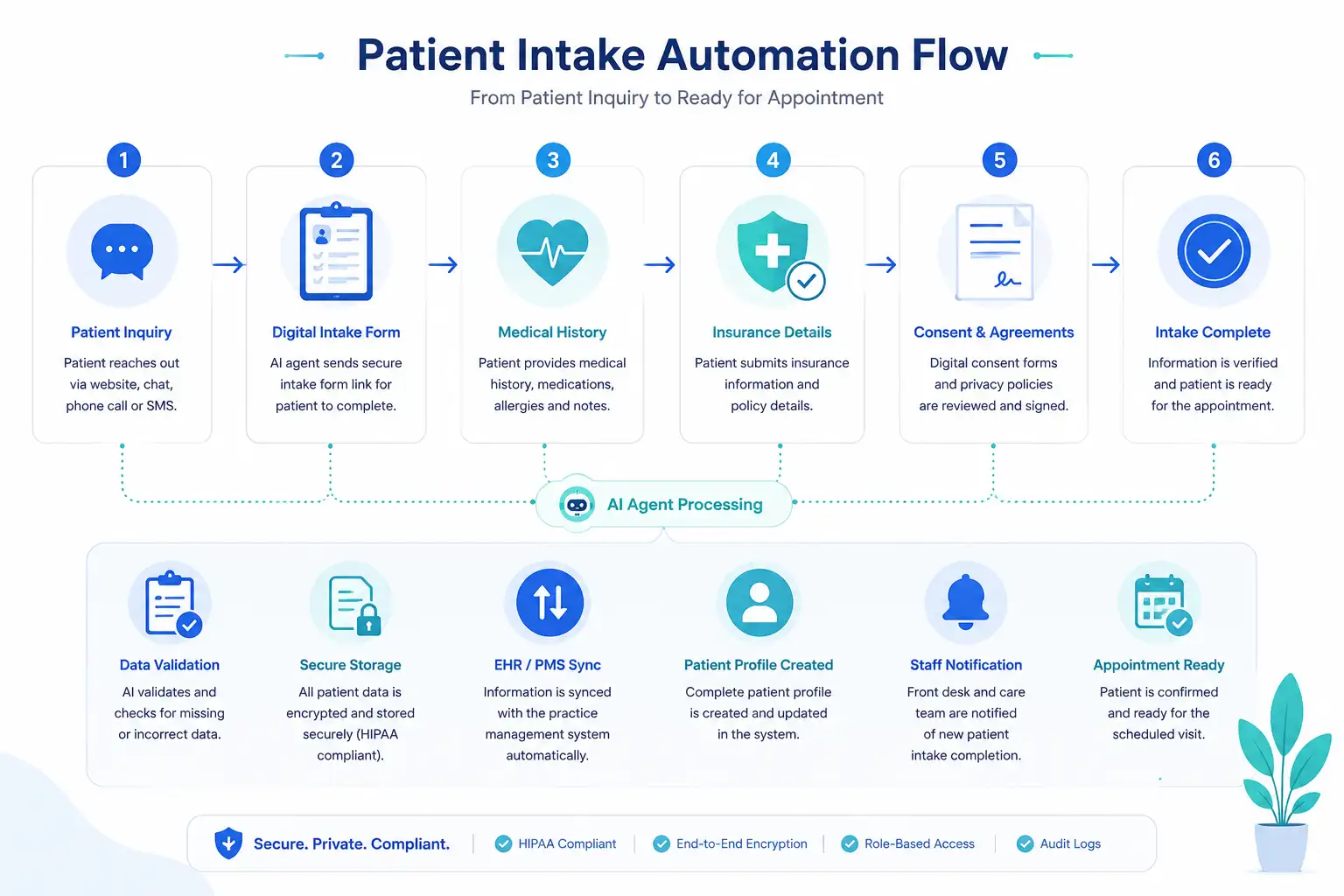
Instead of a clipboard and a pen, patients complete intake through a conversational interface, text, voice, or a digital form, that collects medical history, current medications, insurance details, and consent, then flags anything that needs clinical attention before the patient sits in the chair. Multilingual support lets an agent conduct that same intake in a patient's preferred language, and completed intake data can write directly into the patient's chart instead of being re-typed by staff after the visit.
Typical intake workflow:
AI Appointment Scheduling
Booking becomes a 24/7 function rather than something that only happens during office hours. An agent can check real dentist and hygienist availability, offer the next open slot, handle a reschedule request without hold time, manage a waitlist automatically, and triage an emergency call to the front of the queue instead of the back of a voicemail box.
AI Appointment Reminders
Reminders go out across SMS, email, voice call, and increasingly WhatsApp, personalized with the patient's name, appointment type, and provider. Confirmation links let a patient confirm or reschedule with one tap, and a missed-appointment follow-up can go out automatically the same day to try to recover the slot or rebook.
Reminder channel choice makes a measurable difference. SMS reliably outperforms email and phone-call reminders on response and confirmation rates, largely because text messages get opened far more often and far faster than email. A well-timed sequence, roughly a week out, a couple of days out, and the morning of, combined with a phone call for anyone still unconfirmed, is the pattern that shows up repeatedly across industry benchmarking.
AI Call Answering
Voice AI agents now hold natural, two-way phone conversations rather than routing callers through a rigid phone tree. They can book an appointment, answer common questions about hours, insurance, or services, route true emergencies to a human immediately, and collect the caller's information before handing off, so staff pick up a warm lead instead of a cold voicemail.
AI Insurance Verification
An agent can check patient eligibility against payer systems, verify coverage details, estimate patient-owed benefits ahead of the visit, and support preauthorization requests, work that traditionally consumes a significant share of front-desk time per patient.
AI Billing Support
Beyond scheduling, agents can send invoice reminders, share secure payment links, flag outstanding balances, and check claims status, reducing the back-and-forth that billing follow-up usually requires.
AI Follow-up Care
After the visit, an agent can send post-treatment care instructions, medication reminders, review requests, satisfaction surveys, and recall reminders when it's time for the next cleaning, closing the loop without staff manually tracking every patient's timeline.
Benefits of AI Agents for Dental Clinics
Benefit | Explanation | Example | Business Impact |
|---|---|---|---|
Reduced no-shows | Multi-channel, well-timed reminders catch patients before they forget | SMS + email + call sequence for an unconfirmed hygiene visit | Fewer empty chairs, more recovered production |
Higher revenue | Missed calls become booked appointments instead of lost patients | After-hours caller gets booked instead of voicemail | Direct top-line recovery |
Less paperwork | Digital/conversational intake replaces clipboards | Medical history pre-filled before patient arrives | Faster check-in, fewer transcription errors |
Staff productivity | Repetitive calls and forms shift off the front desk | Staff handle only flagged or complex cases | More time for in-person patient care |
Patient satisfaction | Instant answers instead of hold music | Patient books at 9pm without waiting for a callback | Better reviews, stronger retention |
24/7 availability | Coverage doesn't stop when the office closes | Weekend booking and rescheduling | Captures demand outside business hours |
Faster response | No queue for simple questions | Instant answer to "do you take my insurance?" | Higher call-to-booking conversion |
Reduced errors | Structured data collection instead of handwriting | Insurance ID entered once, correctly | Fewer claim rejections |
Scalability | Same system handles 10 calls or 200 | Multi-location groups standardize front-desk experience | Consistent service without proportional headcount growth |
Cost savings | Automates work that would otherwise require added staff | One agent covers after-hours and overflow calls | Lower marginal cost per patient interaction |
Real-World Use Cases
Small solo practice
A single-dentist office uses a call-answering agent purely for after-hours and overflow coverage, forwarding calls to it only when the front desk is busy or the office is closed, so it complements existing staff rather than replacing them.
Large dental service organization (DSO):
A multi-location group standardizes call handling and reminders across every clinic through one platform, so a patient calling any location gets the same booking experience and the group gets centralized reporting on no-shows and call volume.
Orthodontics
Long treatment plans with recurring adjustment visits benefit heavily from automated recall and reminder sequences, since orthodontic patients are booked far in advance and are prone to forgetting appointments scheduled months earlier.
Cosmetic dentistry
Higher-value consultations benefit from lead-capture agents that qualify inquiries from the website or social media and get a consultation on the books before the prospective patient loses interest.
Pediatric dentistry
Reminder agents that message the parent, not the child, and account for school schedules and multiple siblings booked together reduce the specific friction pediatric scheduling creates.
Emergency dental clinics
Call-answering agents that can distinguish a true emergency from a routine inquiry and route accordingly are especially valuable where speed of response is the entire value proposition.
Dental implant centers
Longer sales cycles and higher treatment values make consultation follow-up and financing-question handling a strong fit for conversational agents that nurture a lead over several touches.
Best AI Agents and Tools for Dental Clinics
The dental AI landscape splits into two layers: patient engagement platforms (scheduling, reminders, recall, reviews) and voice/conversational AI (call answering, booking by phone). Most practices end up combining one of each, plus a general-purpose automation layer for anything custom.
Tool | Best For | Features | Pricing (approx., 2026) |
|---|---|---|---|
Weave | Solo/small practices wanting one all-in-one vendor | VoIP phone + texting + reminders + reviews + payments in one dashboard, caller pop-up with patient history | ~$300–$500/month, phone included |
NexHealth | Practices prioritizing deep, real-time PMS sync | Bidirectional EHR/PMS sync, online scheduling, digital forms, month-to-month billing on non-enterprise plans | ~$350+/month, quote-based |
Solutionreach | Mid-size and multi-location groups with mature recall needs | Deep recall/reactivation campaign automation, 400+ PMS integrations, patient surveys | ~$400–$600/month, annual contract typical |
Dental Intelligence (incl. Modento) | Practices wanting engagement plus benchmarking data | Patient communication, digital forms, consent management, practice analytics | Quote-based |
Luma Health | Larger health systems/DSOs | Scheduling, waitlist optimization, referral management, multi-location coordination | Quote-based, enterprise-oriented |
Voice AI platforms (e.g., Retell AI, Bland AI, and dental-specific voice agents) | Practices wanting a dedicated phone-answering agent | Natural-conversation call answering, booking, FAQ handling, emergency routing; typically layered on top of an existing phone system via call forwarding | Varies widely, per-minute or flat monthly, often $300–$900/month for dental-specific offerings |
Zapier / Make | Practices needing custom automation between tools that don't natively connect | No-code workflow automation connecting forms, CRMs, and communication tools | Free tier to ~$100+/month depending on volume |
A word of caution on this category: pricing is almost always quote-based and varies by call volume, number of locations, and which PMS you're integrating with. Get a demo using your actual practice management system and your actual call volume before comparing quotes, a generic demo rarely reflects real-world sync behavior, and several vendors in this space have documented complaints about sync lag or difficulty exporting your own data if you switch later. Ask about data portability and contract cancellation terms before you sign, not after.
AI Agent Workflow Example
A representative end-to-end workflow looks like this:
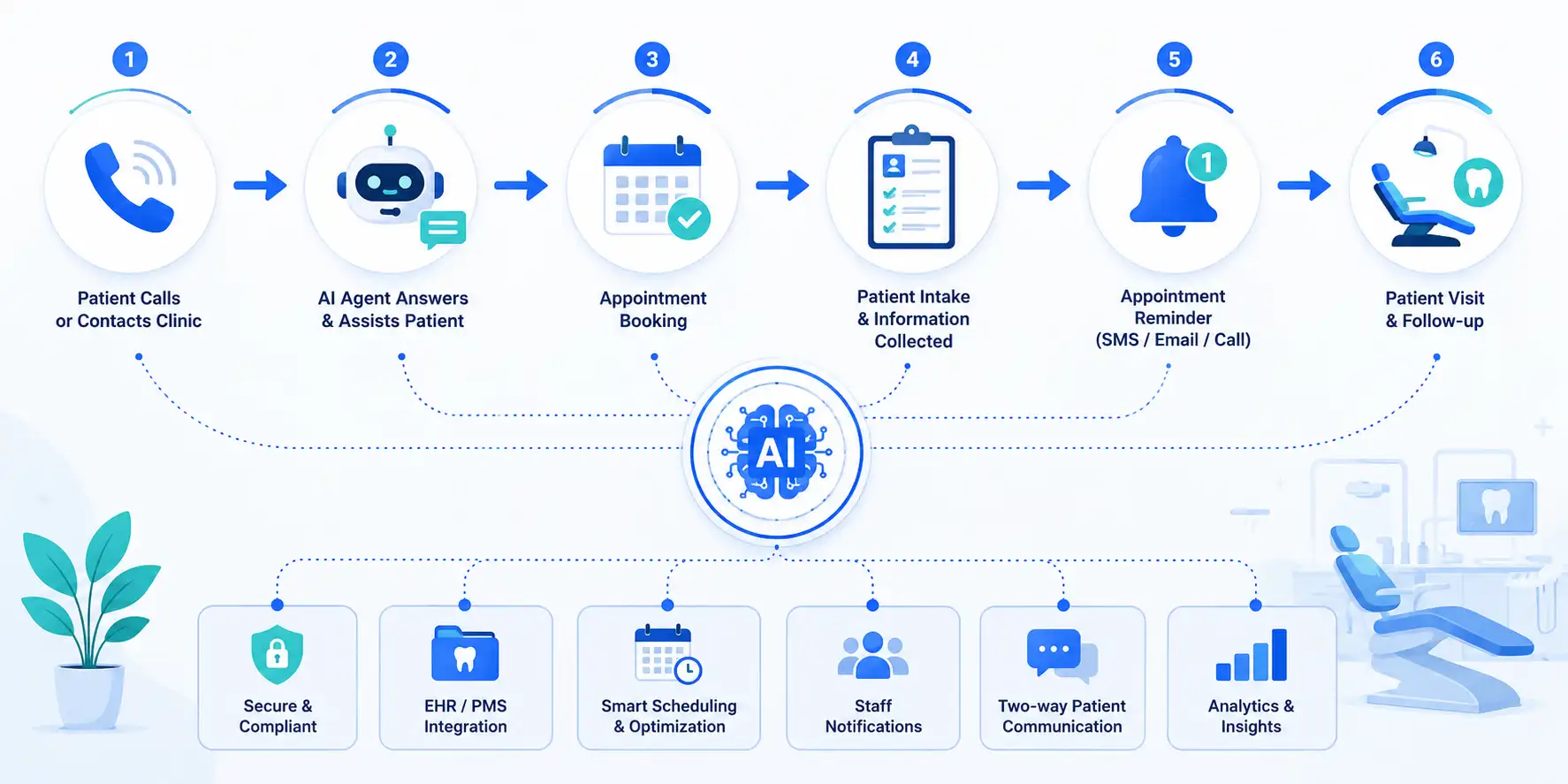
Each arrow in that chain is a place where a task used to require a phone call, a form, or a sticky note, and where an agent can now execute the step and hand off only the exceptions to staff.
Integration with Dental Practice Management Software
Any AI agent is only as useful as its connection to the systems dental practices already run on. The major PMS platforms an agent typically needs to talk to include:
Dentrix
Open Dental
Curve Dental
CareStack
Eaglesoft
Practice-Web
Integration depth varies significantly between vendors. Some platforms only read appointment data; others write patient bookings, confirmations, and intake data directly back into the PMS in real time. That is the difference between an agent that requires double data entry and one that genuinely removes work. In healthcare-specific integrations, you'll also see references to FHIR and HL7, the standard data formats used to exchange clinical information between systems, alongside more general API, CRM, and cloud integration connections. When evaluating a vendor, ask specifically whether their sync is one-way or bidirectional, and whether it happens in real time or on a delay. Some platforms have reported sync delays of 30-45 minutes, which matters if your scheduling relies on it being current.
HIPAA, GDPR, and Security
Any AI agent that touches patient scheduling, intake, or communication is handling Protected Health Information (PHI), which puts it squarely inside HIPAA's requirements, and inside GDPR if you serve patients in the EU/UK.
Core requirements to verify with any vendor:
A signed Business Associate Agreement (BAA). This is non-negotiable. If a vendor won't sign one, they are not a compliant option for handling patient data, regardless of what their marketing says.
Encryption in transit and at rest, typically TLS for data in motion and AES-256 for stored data.
Role-based access controls so staff only see the patient data relevant to their role.
Audit logs that record who accessed what patient data and when.
Clear data retention and deletion policies.
Every component in the pipeline needs its own BAA coverage, not just the platform you're buying, but the underlying speech-to-text engine, the language model, and the telephony carrier, if those are separate vendors. A gap in any one of them can create compliance exposure even if the main platform is covered.
Human oversight for anything ambiguous. Compliant AI still needs an escalation path to a person for edge cases the system shouldn't handle alone.
The stakes are real: HHS has reported hundreds of large healthcare data breaches in recent years affecting hundreds of millions of records, and HIPAA civil penalties can run from tens of thousands to over two million dollars per violation category depending on the tier of negligence involved. This is genuinely a "read the contract" category of decision, not a "trust the sales page" one.
This section is general information, not legal advice. Confirm compliance specifics with a healthcare attorney or compliance consultant before signing with any vendor.
Challenges and Limitations
AI agents are genuinely useful, but they are not a complete replacement for judgment, and it's worth being honest about where they fall short.
Incorrect responses still happen. No conversational AI is error-free, and a wrong answer about insurance coverage or medication interactions carries real consequences in a healthcare context.
Complex or emotionally sensitive patient questions, a scared patient, a complicated treatment concern, are still better handled by a person, and a well-designed agent should recognize that and hand off rather than push through.
Compliance risk grows with every added vendor in the pipeline, as noted above.
Data quality problems compound. An agent pulling from a messy or outdated PMS record will make decisions on bad information.
Integration isn't always as smooth as the demo. Sync delays and PMS compatibility gaps are common enough that they show up repeatedly in independent reviews.
Staff adoption takes real effort. A tool the front desk doesn't trust or understand gets quietly worked around.
Training and ongoing maintenance are real, recurring costs, not a one-time setup and forget.
Human supervision remains necessary. The practices that get the best results treat these agents as staff augmentation with oversight, not unsupervised autopilot.
None of this is a reason to avoid AI agents. It's a reason to roll them out in stages, starting with lower-risk workflows (reminders) before higher-stakes ones (clinical intake triage), and to keep a clear escalation path to a human at every step.
Cost of Implementing AI Agents for Dental Clinics
Costs vary substantially by practice size, call volume, and whether you're buying an off-the-shelf platform or building something custom.
Practice size | Typical monthly platform cost | Notes |
|---|---|---|
Small (solo/1-2 providers) | ~$100–$400/month | Often covers reminders + basic call answering; ROI usually clears with just 1-2 recovered no-shows/missed calls per month |
Medium (multi-provider, single location) | ~$300–$600/month | Fuller feature set, recall automation, deeper PMS sync, review management |
Enterprise/DSO (multi-location) | Custom, quote-based | Pricing shifts to per-location or workflow-volume models; centralized reporting typically included |
Custom-built agent (via API/automation platforms) | Variable, API usage costs plus development time | Higher upfront investment; more control over exact workflow |
Additional cost factors to budget for:
Implementation/onboarding, which can range from same-day (simple call-forwarding voice agents) to several weeks (deep PMS integrations for multi-location groups)
API usage costs if you're using a custom-built agent on top of a language model
Ongoing maintenance and monitoring
Training time for front-desk staff
On ROI: across the vendors and case studies reviewed for this piece, a recurring pattern is that a single recovered no-show or previously-missed call often covers a meaningful chunk of the monthly platform cost for a small-to-mid-size practice, but exact figures vary by vendor, and vendor-published ROI numbers should be treated as a ceiling, not a guarantee, until you've validated them against your own call volume and average production per appointment.
How to Implement AI Agents for Dental Clinic
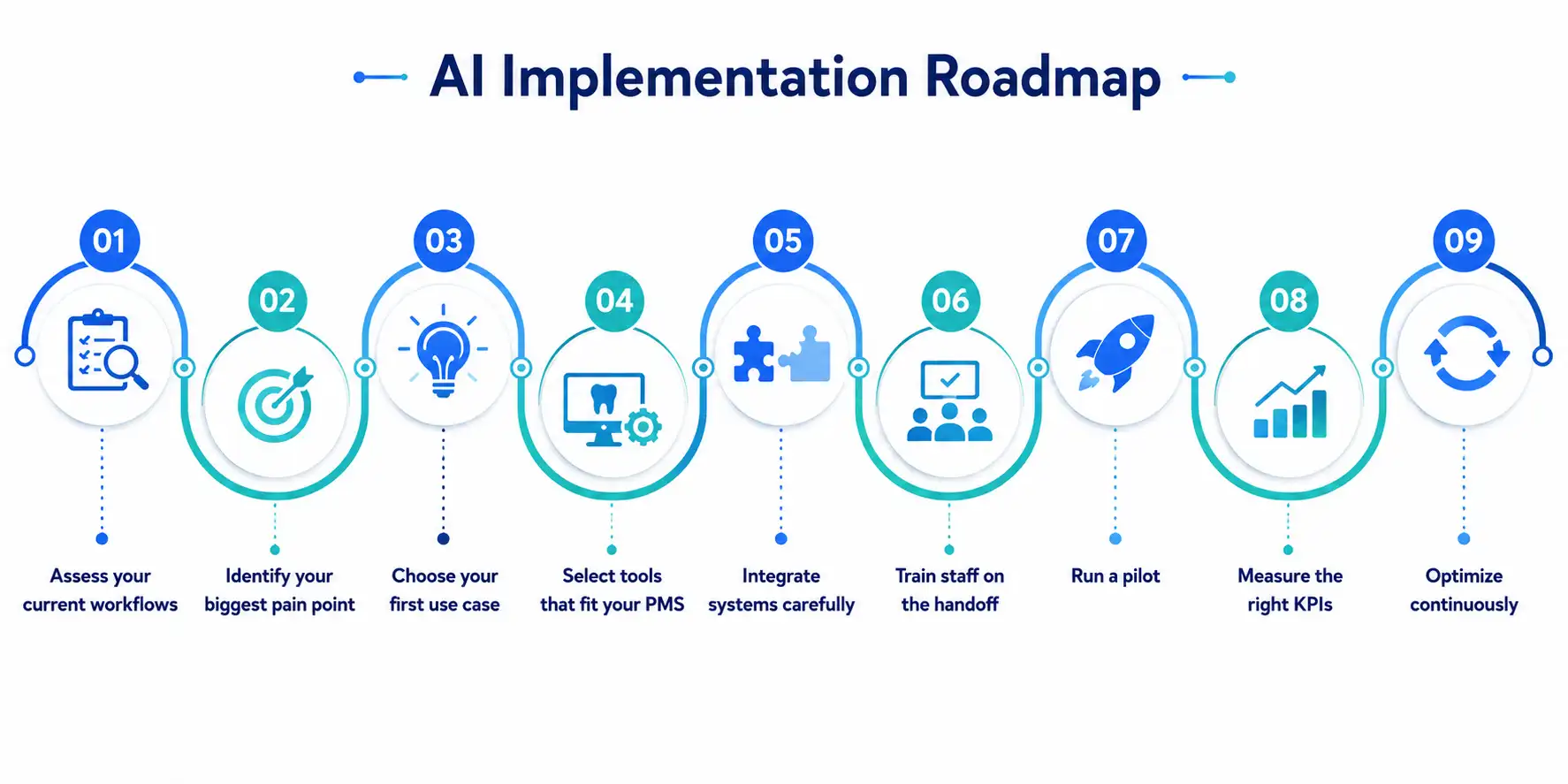
Assess your current workflows
Map out where time actually goes, call volume, missed calls, no-show rate, average intake time.
Identify your biggest pain point
Don't try to automate everything at once; find the one leak costing you the most.
Choose your first use case
Reminders and after-hours call answering are the lowest-risk, fastest-payoff starting points for most practices.
Select tools that fit your PMS
Confirm real integration depth, not just a listed logo, before committing.
Integrate systems carefully
Test the sync with your actual PMS and real appointment types before going live practice-wide.
Train staff on the handoff
Front-desk teams need to understand exactly what the agent handles and what still comes to them.
Run a pilot
Start with one workflow, one location, or one call type before expanding.
Measure the right KPIs
No-show rate, missed-call recovery, average intake time, and patient satisfaction, not just "did we adopt AI."
Optimize continuously
Review outcomes monthly and adjust reminder timing, scripts, and escalation rules based on real results.
The Future of AI in Dentistry
Several trends are shaping where this technology heads next:
Voice AI is maturing fast, moving from stilted IVR-replacement scripts toward genuinely natural phone conversations.
Agentic AI, systems that chain multiple decisions and actions together without a human prompting each step, is extending from single tasks (reminders) toward full patient journeys (intake through recall).
Predictive scheduling using patient no-show history and behavioral patterns is starting to inform which patients get extra reminder touches or a follow-up call.
Personalized care communication, tailoring reminder tone, channel, and timing to individual patient preferences rather than one-size-fits-all sequences.
Multimodal AI combining voice, text, and image (like photos of a dental concern submitted before a visit) into a single intake experience.
Digital twins and AI treatment planning remain further out and clinically supervised, but are an active area of dental technology research.
Ambient AI, passive documentation of patient interactions to reduce charting burden, is an emerging category worth watching for front-office and clinical use alike.
The throughline across all of these: AI agents are moving from single-purpose point tools toward connected systems that manage an entire patient relationship, while the compliance, oversight, and human-judgment requirements around them are not going away, and arguably matter more as the systems get more autonomous.
FAQs
Can AI replace dental receptionists?
No, the practices getting the best results use AI to absorb repetitive, high-volume work (reminders, after-hours calls, basic scheduling) while keeping staff for judgment calls, complex patient needs, and in-person interaction.
Is AI HIPAA compliant?
AI itself isn't inherently compliant or non-compliant. Compliance depends on whether the vendor signs a Business Associate Agreement and implements required safeguards like encryption, access controls, and audit logs. Verify this vendor by vendor.
How much does an AI dental agent cost?
Typically $100-$600+/month for small-to-mid-size practices depending on features and call volume, with enterprise/DSO pricing quoted separately.
Can AI answer phone calls?
Yes, modern voice AI agents can hold natural conversations, book appointments, answer FAQs, and route emergencies to staff, usually layered onto an existing phone system via call forwarding.
Can AI integrate with Dentrix?
Most major dental AI platforms integrate with Dentrix, but integration depth (read-only vs. real-time bidirectional write-back) varies significantly by vendor. Always confirm this specifically.
How does AI reduce no-shows?
Primarily through multi-channel, well-timed reminder sequences (SMS tends to outperform email and voice calls) and by making rescheduling frictionless enough that patients change the appointment instead of just skipping it.
Is AI safe for patient data?
It can be, provided the vendor and every component in their pipeline (LLM, speech-to-text, telephony) is covered by a signed BAA and follows HIPAA's technical and administrative safeguards.
Can small clinics afford AI?
Yes, entry-level reminder and call-answering tools start well under $500/month, and the ROI math for even a small practice often clears with just one or two recovered no-shows or missed calls per month.
Do AI agents work with practice management software other than Dentrix?
Yes, most platforms also integrate with Open Dental, Eaglesoft, Curve Dental, CareStack, and others, though again with varying depth.
What's the difference between a chatbot and an AI agent?
A chatbot typically answers one message at a time from a script; an agent can carry out a multi-step task, booking, verifying, updating records, following up, adjusting its actions based on what happens along the way.
How long does implementation take?
Simple call-forwarding voice agents can go live in days; deep PMS integrations for multi-location groups can take several weeks of testing before a confident full rollout.
Will patients accept talking to an AI agent?
Acceptance is generally high for scheduling and reminders, especially when it means faster service and no hold time, but clinics should keep an easy, visible path to a human for anyone who prefers it.
Can AI handle dental emergencies?
A well-designed agent should recognize emergency language and route the call to a person immediately rather than attempting to resolve it. This triage function is one of the most valuable and highest-risk parts of call-answering AI.
Does AI reduce staff workload or just add another tool to manage?
Done well, it reduces workload by absorbing repetitive calls and forms; done poorly (wrong use case, poor integration, no training) it becomes another system staff have to babysit. Implementation quality is the deciding factor.
What happens if the AI gives a wrong answer to a patient?
This is why human oversight and an escalation path matter: well-implemented systems are scoped narrowly (scheduling, reminders, basic FAQs) rather than given open-ended clinical authority.
Is voice AI or chat AI better for a dental practice?
Most practices benefit from both: voice for phone-based booking and emergency triage, chat/SMS for reminders, confirmations, and intake, since patients use different channels for different needs.
Conclusion
AI agents aren't a replacement for your front desk. They're relief for the parts of it that are already breaking under volume: the calls that go to voicemail, the reminders that don't go out consistently, the intake forms that get filled out twice. The clinics seeing real results treat this as staff augmentation with clear boundaries and human oversight, not a fully autonomous system left to run unsupervised.
If you're starting from zero, don't try to automate everything at once. Pick one workflow. Appointment reminders or after-hours call answering are usually the lowest-risk, fastest-payoff starting points. Get it working well, measure the actual impact on your no-show rate or missed-call recovery, and expand from there.
Read Also:
Why AI Agents Are the New Coworkers in Digital Enterprises
Different Types of Intelligent Agents in Artificial Intelligence
Comments (0)
No comments yet. Be the first to share your thoughts!