Why AI Doesn't Have a Data Problem, It Has a Trust Problem

Author
Ravi Prajapati

AI projects don't fail from bad data. New research shows 84% of failures trace back to trust, leadership, and unclear goals, not the dataset.
Quick overview
Most AI projects are described as failures of data quality, model accuracy, or infrastructure. The research says otherwise. RAND Corporation's analysis of more than 2,400 enterprise AI initiatives found that AI projects fail at roughly twice the rate of regular IT projects, and that 84 percent of those failures trace back to leadership decisions rather than technical limitations. The pattern shows up again in MIT's Project NANDA research, which found that 95 percent of generative AI pilots produce no measurable return for the businesses that built them, not because the models didn't work, but because the organizations around them never resolved what the AI was supposed to do or who was accountable for it. The common thread across nearly every failed AI rollout isn't the dataset. It's trust: whether people trust the system, trust the leadership deploying it, and trust each other enough to define what success even looks like before switching it on.
Every conversation about AI failure starts in the same place: the data. It was incomplete, it was biased, it was poorly labeled, it wasn't representative of the real world. And to be fair, bad data is a real and well-documented problem. But treating it as the root cause misses something more uncomfortable, and more useful.
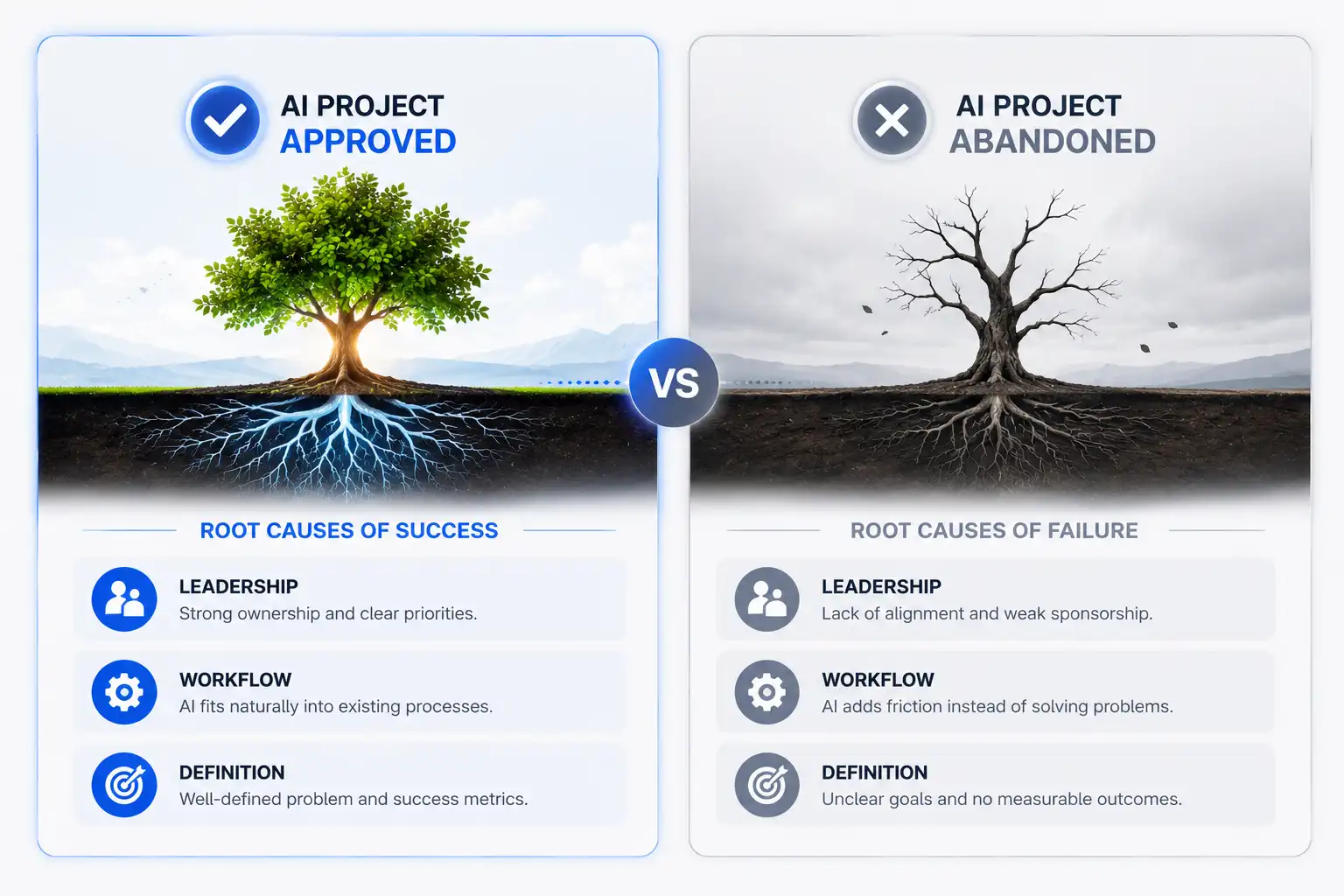
Organizations don't fail at AI because they can't find good data. They fail because nobody agreed on what the AI was for, because leadership pulled support halfway through, because different teams quietly distrusted each other's numbers long before a model ever touched them. Data quality is the symptom that gets measured. Trust is the disease that doesn't show up on a dashboard.
This matters right now because the gap between how much organizations are spending on AI and how little of it is working has become impossible to ignore. Enterprises poured $684 billion into AI initiatives in 2025 alone, and by the industry's own estimates, the vast majority of that spend produced no measurable business return. If the problem were simply bad data, better data pipelines would have fixed it by now. They haven't, because the problem was never really about the pipeline.
Is AI actually failing because of bad data?
Not primarily, no. It's easy to blame data because data is visible, measurable, and fixable in a way that organizational dysfunction isn't. But the research consistently points elsewhere. RAND's root-cause analysis of AI project failures identifies misaligned purpose as the leading driver, meaning leaders and technical teams never agreed on the actual problem the AI was meant to solve. Weak data foundations show up on the list too, but they rank behind unclear success metrics and fading executive sponsorship, not ahead of them.
Gartner's 2025 research found that 85 percent of failed AI projects cite poor data quality as a root cause. That statistic sounds like it settles the debate until you notice the second half of it: only 12 percent of organizations actually have data of sufficient quality to support AI applications in the first place. In other words, most companies knew, or should have known, their data wasn't ready before they started. They built anyway, because the pressure to be seen doing something with AI outweighed the discipline to wait until the foundation was solid. That's not a data problem. That's an incentive and trust problem, dressed up as a technical one.
If it's not the data, what is it?
It's the absence of a shared, honest answer to a much harder question: what is this system actually optimizing for, and does everyone affected by it agree that's the right thing to optimize for?
Trust breaks down in AI projects in a few consistent, well-documented ways:
Leadership says one thing and funds another. A project gets announced with ambitious goals, then loses executive attention within two quarters. Teams learn quickly that the initiative isn't a real priority, and they stop investing real effort in making it work.
Success was never defined. Projects that define quantified success metrics before approval succeed 54 percent of the time. Projects that skip that step succeed only 12 percent of the time, according to the same enterprise AI research. Without a defined target, there's nothing for anyone to actually trust the system against. Success becomes whatever someone decides to call it after the fact.
The people expected to use the system were never consulted. This is where the trust gap becomes most visible to the public, not just inside companies. A national survey conducted for U.S. healthcare AI adoption found that the public remains skeptical of AI in medical decisions, not because the technology lacks accuracy, but because people want to be consenting collaborators in how it's used, not subjects it's used on. The barrier isn't the model's precision. It's whether the humans affected by the model were ever asked what they wanted from it.
Does the public actually trust AI right now?
Not much, and the data is unusually consistent across countries and demographics. Pew Research's 2026 findings show that only 44 percent of Americans report a lot or some trust in AI systems, while 47 percent report not much trust or none at all. That's close to an even split on something a huge share of the population now uses daily.
The gap widens sharply depending on what the AI is being used for. YouGov survey data found that just 15 percent of Americans trust AI applications in financial services, compared with 48 percent who say they don't trust it much or at all. People are far more comfortable trusting AI to recommend a song or a show than to make a decision that touches their money or their health.
Globally, the picture is more complicated than simple fear. Stanford HAI's 2026 AI Index found that the share of people worldwide who say AI offers more benefits than drawbacks actually rose from 55 percent in 2024 to 59 percent in 2025. But in the same period, the share who say AI products make them nervous also climbed, to 52 percent. People aren't rejecting AI outright. They're holding two things at once: genuine interest in what it can do, and genuine unease about who's steering it and why. That's not indecision. That's a rational response to a technology whose builders haven't clearly answered what it's optimizing for.
Why does this framing actually matter?
Because it changes what companies spend their time fixing. A team that believes it has a data problem spends its budget on cleaning pipelines, buying better tooling, and hiring more data engineers. Those things can help, but they don't touch the actual failure points identified in RAND's research: unclear ownership, undefined success criteria, and leadership support that evaporates under budget pressure.
A team that recognizes it has a trust problem spends its time differently. It defines what the system is optimizing for, in plain language, before writing a line of code. It brings in the people who will actually use or be affected by the system, not just the executives approving the budget. It treats a clear, honestly communicated purpose as the actual prerequisite for AI success, ahead of the dataset.
This reframing also explains something that pure data-quality arguments can't: why well-funded AI projects at sophisticated companies, with access to excellent data, still fail at nearly the same rate as under-resourced ones. Money buys better data. It doesn't automatically buy agreement on what the system is for, or trust that leadership will stand behind it past the first difficult quarter.
What should organizations actually do differently?
A few patterns separate the minority of AI projects that succeed from the majority that don't, and none of them start with the dataset.
Define success in numbers everyone agrees on, before approval, not after launch. Projects with quantified success metrics defined upfront succeed at more than four times the rate of those without.
Keep the people affected by the system in the room, not just the people funding it. Trust isn't built by explaining a system to people after it's deployed. It's built by asking them what they need from it beforehand.
Treat fading executive sponsorship as a five-alarm signal, not a normal part of project lifecycle. If leadership stops actively defending a project's priority, the project is already failing, regardless of what the model's accuracy metrics say.
Be honest, publicly, about what the system is optimizing for. Efficiency, cost reduction, speed, whatever it is, say it plainly. Vague language about "improving outcomes" or "enhancing experiences" is where trust quietly erodes, because people can sense when they're not being told the real goal.
The takeaway
AI doesn't need better data nearly as urgently as it needs organizations willing to have an honest conversation about what they're building it to optimize for, and who gets a say in that decision. The data problem is real, but it's downstream. Fix the trust problem, the shared purpose, the honest communication, the people actually consulted, and the data work becomes something teams know how to do. Skip it, and no dataset, however clean, will save the project.
Read Also:
Comments (0)
No comments yet. Be the first to share your thoughts!