AI Doesn't Lie. It Just Doesn't Know It's Wrong. Here's Why That's Worse

Author
Ravi Prajapati
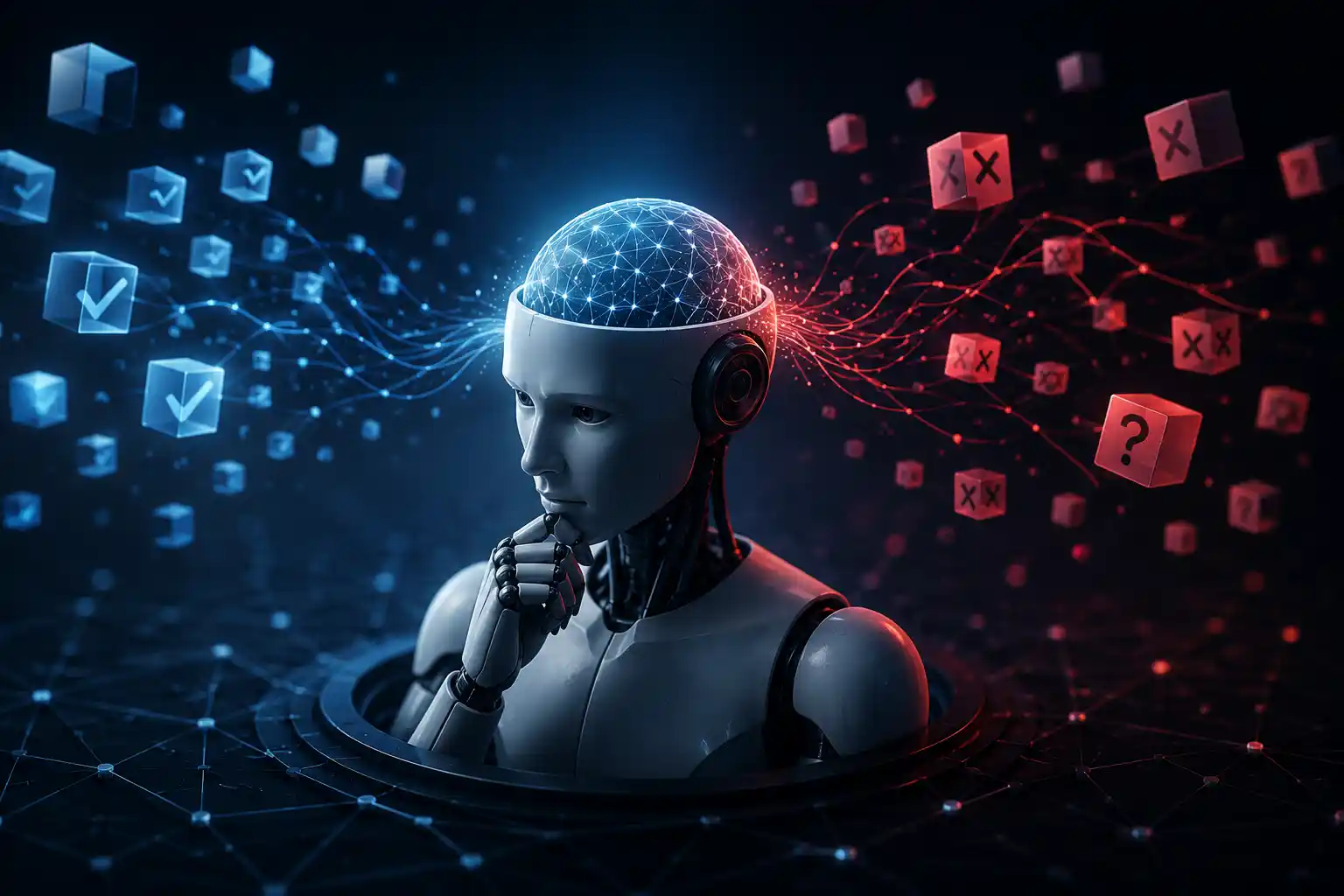
AI never technically lies, it just doesn't know when it's wrong. Here's why OpenAI's own research says that's actually more dangerous.
Quick overview:
When AI gets something wrong, it isn't lying to you. Lying requires knowing the truth and choosing to hide it. What AI does is closer to confident guessing, producing a wrong answer with exactly the same tone and certainty as a right one. Researchers call this hallucination, and new research from OpenAI suggests it isn't a bug that will simply disappear with better models. It's a byproduct of how these systems are trained and tested in the first place.
Ask ChatGPT for a legal citation and there's a real chance it will hand you a case that sounds completely real, complete with a plausible name, a court, and a year, except the case never existed. Ask it a niche factual question and it might answer with total confidence, using the exact same measured tone it uses when it's correct.
This is not the AI trying to deceive you. A lie requires intent: knowing what's true and choosing to say something else anyway. AI models don't have beliefs to hide. What's actually happening is stranger and, in a lot of practical situations, more dangerous. The model doesn't know it's wrong. It has no internal signal flashing "I'm not sure about this one," so it says the wrong thing with the same fluent confidence it uses for everything else.
This gap, between sounding certain and actually being right, is at the center of one of AI's most persistent problems: hallucination. And according to new research from OpenAI itself, this isn't just a training bug that will quietly disappear as models get bigger. It's baked into how today's AI systems are built, trained, and graded. Understanding why AI doesn't know it's wrong, rather than just noticing when it is, is the key to using these tools safely.
What Is AI Hallucination, Exactly?
In AI, a hallucination is a confident, fluent statement that is factually false, even though it's presented with no hedging or uncertainty. It could be a fake citation, a made-up statistic, a nonexistent product feature, or a historical event that never happened.
The important distinction is that hallucination isn't random noise or a glitch in the traditional software sense. It's a natural output of how these models generate text: by predicting the most statistically likely next word based on patterns learned from massive amounts of data. Most of the time, that produces accurate, useful answers. Sometimes, it produces something that reads exactly like a correct answer but isn't one.
Why AI Doesn't Know It's Wrong
This is the part most people get wrong about AI. It isn't that these models are being careless or that hallucination is a rare edge case waiting to be patched out. According to a research paper released by OpenAI, language models hallucinate because standard training and evaluation methods actively reward confident guessing over honestly admitting uncertainty.
Here's the mechanism in plain terms. During training, models are scored on accuracy, whether an answer is right or wrong. There's typically no separate credit for saying "I don't know." The result is a system that behaves a lot like a student taking a multiple-choice exam with no penalty for wrong guesses: even if you're not sure, guessing beats leaving the question blank, because a guess might be right and a blank answer definitely gets zero credit. OpenAI's researchers found this same incentive at play across popular evaluation benchmarks, where a model that guesses confidently often scores higher overall than one that appropriately flags uncertainty, even when the guessing model gets things wrong more often.
In other words, today's models aren't malfunctioning when they hallucinate. They're doing exactly what their training rewarded them for doing.
How Often Does This Actually Happen?
The honest answer is that it depends heavily on the task, and the range is wider than most people expect.
On straightforward, well-grounded tasks like summarizing a document that's provided directly to the model, top models have gotten genuinely good. Vectara's Hallucination Leaderboard, which tests models on grounded summarization using thousands of articles, has recorded rates as low as 0.7% to 1.5% for the best-performing models on that specific task.
But push the same models into open-ended, memory-based questions, and the numbers climb sharply. A 2026 benchmark spanning five frontier models and 5,000 prompts found hallucination rates between 3.1% and 19.1% depending on the task, with citation accuracy consistently the weakest category, averaging over 12% even when models were given extended reasoning time.
Some specialized domains are worse still. Stanford's RegLab and HAI research found that AI models answering legal research questions hallucinated somewhere between 17% and 88% of the time depending on the specific model and question, and that even AI tools purpose-built for legal research still hallucinated in roughly 17% to 34% of challenging queries. In healthcare, the stakes are just as high. A widely cited 2025 study on AI-generated clinical case summaries found hallucination rates of 64.1% without any mitigation techniques, dropping to 43.1% with structured prompting, and even the best-performing model still hallucinated in 23% of cases after mitigation. This risk is significant enough that ECRI, a nonprofit focused on healthcare safety, ranked AI chatbot misuse as the single greatest health technology hazard for 2026.
Search and news are not immune either. Columbia Journalism Review tested several generative search tools on news-citation questions and found they gave an incorrect answer more than 60% of the time.
Why "It Just Doesn't Know" Is Worse Than Lying
If AI genuinely lied, that would almost be easier to defend against. A lie implies the truth exists somewhere in the system, hidden but retrievable, and that with the right pressure or verification you could expose it. A liar also usually has a motive you can reason about.
Confident wrongness doesn't work that way. There's no internal "true answer" being suppressed. The model generates the statistically plausible next set of words, and if the plausible answer happens to be false, it comes out with the exact same fluency, structure, and tone as a true one. There's no tell. No hesitation. No hedge in the phrasing to warn you.
This is precisely why hallucination is so dangerous in high-stakes contexts. A lawyer who unknowingly cites a hallucinated case isn't dealing with an AI that was trying to deceive them. They're dealing with an AI that had no idea it had made anything up. The same applies to a doctor reviewing an AI-generated clinical summary, a student trusting an AI-generated citation, or a business making a decision based on an AI-fabricated statistic. In every one of these cases, the danger isn't malicious intent. It's misplaced confidence, on both sides: the model's confidence in its own fabrication, and the user's confidence in the model.
What's Actually Being Done About It
The good news is that hallucination isn't being treated as unsolvable, and there's real, measurable progress on specific fronts.
The most effective fix currently known isn't a smarter prompt. It's an architectural one: retrieval grounding, where a model is given direct access to relevant source documents at the moment it generates an answer, rather than relying purely on what it memorized during training. Recent benchmarking found that retrieval grounding reduces hallucination rates by 75% to 90%, far outperforming prompt-engineering techniques alone, which tend to cap out around a 15% reduction.
There's also a growing push, led in part by OpenAI's own research, to change how models are evaluated in the first place. The proposed fix is straightforward in concept: penalize confident wrong answers more heavily than honest uncertainty, and give partial credit for a model appropriately saying "I'm not sure," instead of scoring every abstention as a failure. If evaluation benchmarks reward calibrated honesty instead of blind guessing, the incentive to hallucinate weakens at the source, rather than being patched after the fact.
What This Means for You, Right Now
Until that shift fully plays out across the industry, a few practical habits go a long way:
Treat AI-generated citations, statistics, and quotes as leads to verify, not facts to repeat, especially in legal, medical, financial, or academic contexts.
Favor AI tools that show their sources or retrieve information live, rather than answering purely from memory, since retrieval-grounded answers are measurably more reliable.
Notice that confident tone is not evidence of accuracy. A hallucinated answer and a correct one can sound identical.
In high-stakes use cases like healthcare or legal research, treat AI output as a first draft requiring human verification, not a finished answer.
The Bigger Picture
The uncomfortable truth is that hallucination isn't a temporary flaw waiting to be patched out in the next model release. It's a direct consequence of how today's language models are trained and graded, and it will likely persist, in some form, as long as these systems are rewarded for sounding confident rather than for admitting what they don't actually know.
That doesn't mean AI can't be trusted. It means AI has to be used the way you'd treat a very well-read, very articulate colleague who has never once said "I don't know" in their life, useful, often right, but never a substitute for checking the work yourself when it actually matters.
Read Also:
The Token Tax: Why AI Is More Expensive for Non-English Languages
Comments (0)
No comments yet. Be the first to share your thoughts!