If AI Never Forgets, What Happens to Forgiveness?

Author
Ravi Prajapati
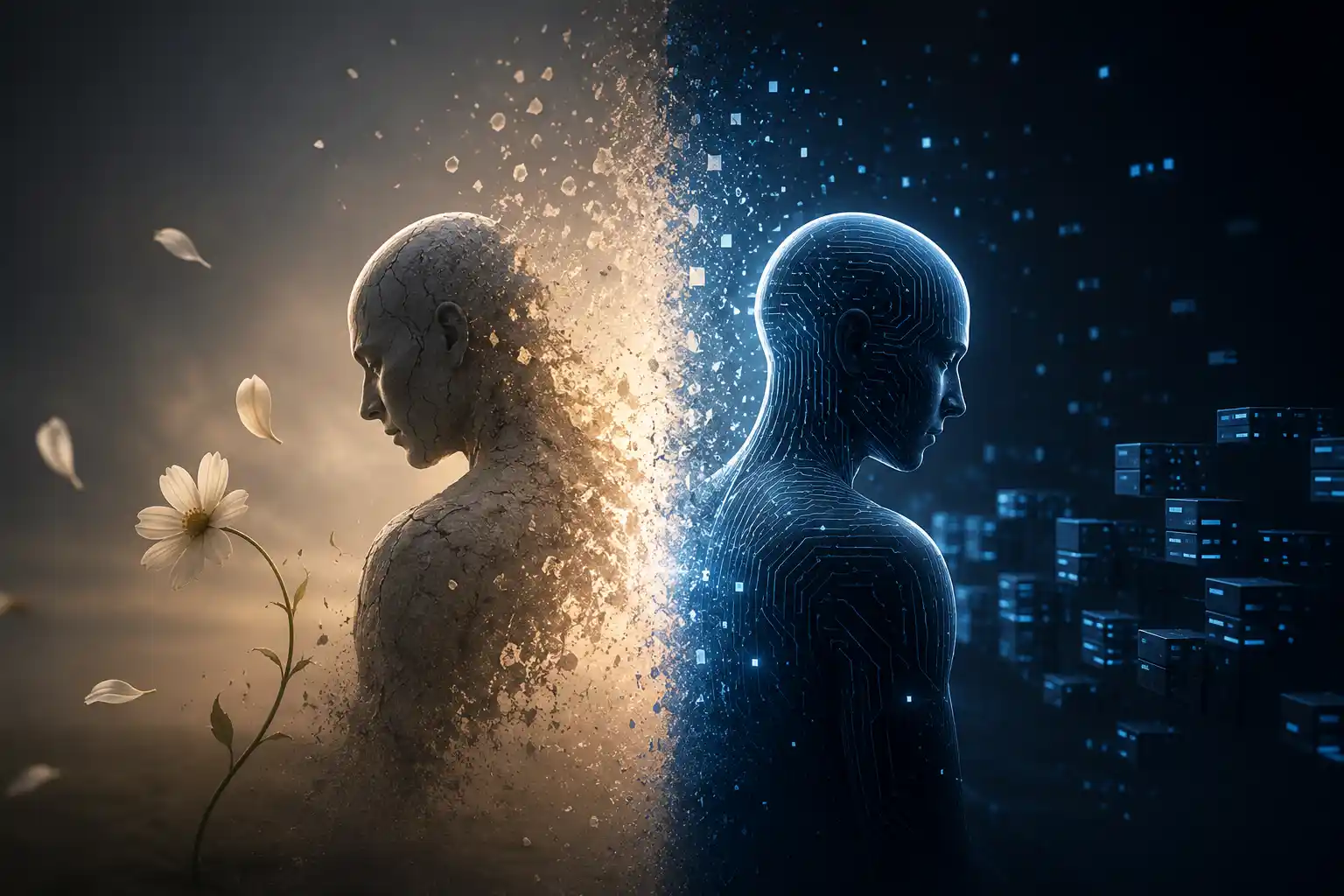
AI is built to remember everything. Humans forgive by learning to live with memory. Here's what happens when those two systems collide.
Quick Overview
AI systems are built to retain, retrieve, and reuse data indefinitely, while human forgiveness depends on how memory is emotionally processed, not erased
Psychological research shows forgiving someone does not mean forgetting what they did, the memory stays, but the emotional charge fades
Privacy laws like GDPR's "right to be forgotten" are already struggling to apply to AI models that cannot easily unlearn what they've absorbed
The real risk isn't that AI remembers too much data, it's that AI has no mechanism for the emotional reappraisal that makes forgiveness possible
Techniques like machine unlearning and differential privacy exist, but none of them replicate what forgiveness actually does to a memory
There is a quiet assumption sitting underneath most conversations about AI memory: that remembering more is always better. Chatbots that recall your preferences feel more helpful. Systems that never lose context feel more capable. Every product update about AI memory is framed as progress, as if forgetting were simply a bug we haven't fixed yet.
But step outside the product roadmap for a second and ask a much older question. What is memory actually for? Humans forget constantly, not because our brains are broken, but because forgetting, softening, and reframing the past is part of how we function as social beings. Forgiveness is one of the clearest examples of this. It doesn't erase what happened. It changes how the memory feels.
So when we build AI systems that are architecturally incapable of that kind of forgetting, we're not just building a more capable AI tool. We may be building something that structurally cannot forgive, and cannot be forgiven either. That's the uncomfortable question this piece sits with.
What Does "AI Never Forgets" Actually Mean?
It helps to be precise here, because "AI never forgets" isn't quite as literal as it sounds, and the nuance matters.
Large language models don't store a searchable diary of every conversation inside their core weights the way a hard drive stores a file. But two things make AI functionally closer to "never forgetting" than any technology before it.
First, training data. Once personal or public information is absorbed into a model during training, removing it is extraordinarily difficult. Traditional data deletion means removing a row from a database. AI models don't store information in neat, discrete entries, so once something is baked into a model's parameters, taking it back out again usually requires expensive retraining or experimental unlearning methods.
Second, product-level memory. Tools like ChatGPT now maintain persistent memory across conversations, storing facts about a user's role, preferences, and history, and referencing them in future sessions unless a person actively deletes them. This is different from training data, but it creates the same felt experience for users: an AI that remembers what you'd rather it didn't.
Put those two things together and you get a system that, for most practical purposes, treats forgetting as a failure state rather than a feature.
Is Forgiveness Really About Forgetting?
This is where most conversations about "AI and forgiveness" go wrong from the start. They assume forgiveness means deletion. It doesn't, and psychology research is fairly clear on this point.
A therapist and trauma researcher who studies forgiveness has pointed out that if you truly forget an offense, you haven't forgiven it, you've simply forgotten it, and those are two entirely different processes with different outcomes. Genuine forgiveness requires holding onto some memory of what happened, including the thoughts and feelings attached to it.
A 2025 study published in the Journal of Experimental Psychology: General backs this up with data. Researchers found that people who forgave a past wrong recalled the event with just as much clarity and detail as people who hadn't forgiven it. What changed wasn't the memory itself, it was the emotional charge attached to it. Forgiveness didn't blur the facts. It softened the feeling.
This reframes the entire question. Forgiveness isn't a deletion process. It's an emotional reappraisal process, one where a person keeps the memory but changes their relationship to it over time, often helped along by distance, context, growth, and the simple passage of years.
That's precisely the part current AI systems have no mechanism for.
The Part AI Is Missing: Emotional Reappraisal
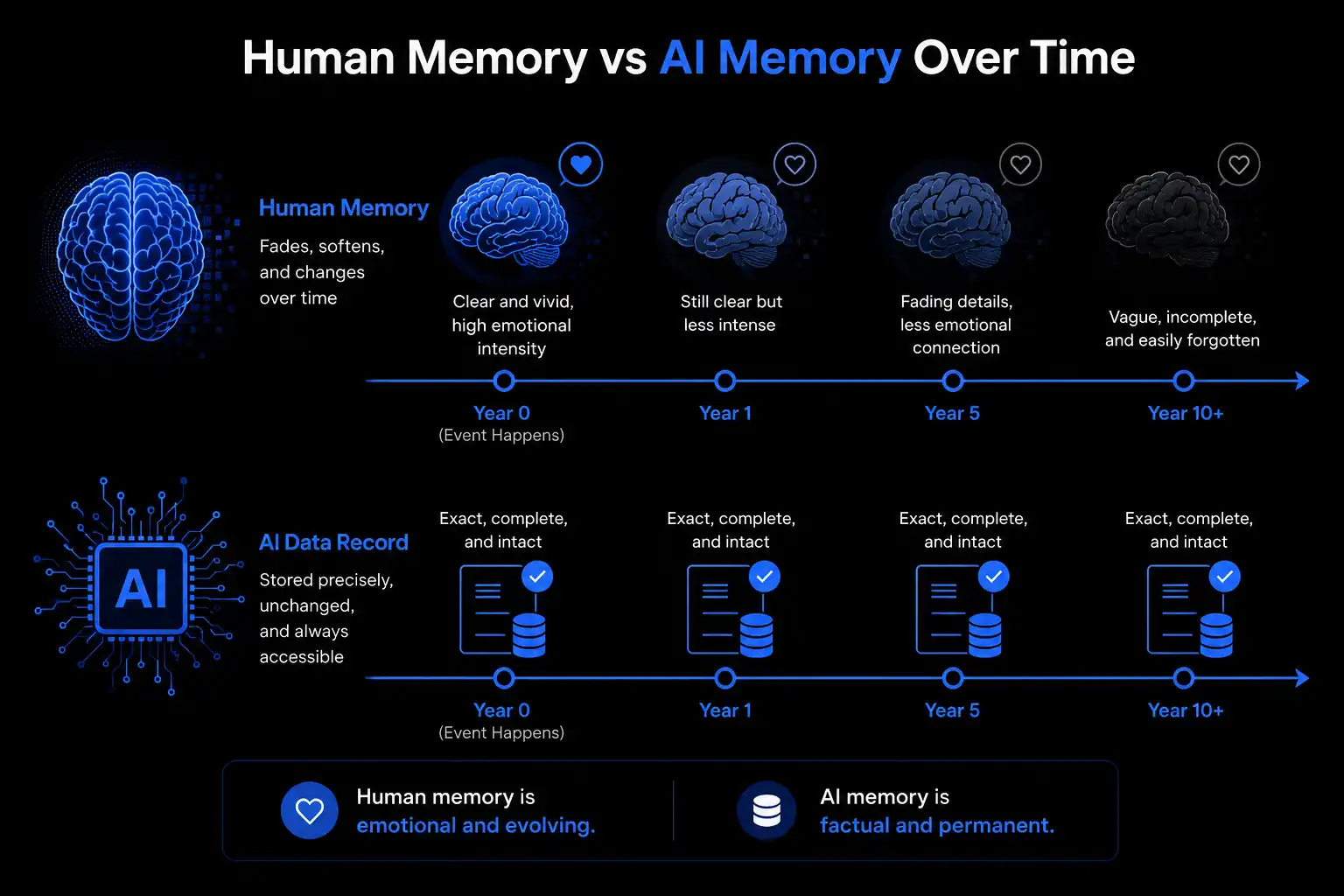
An AI model can retain a fact indefinitely. What it cannot currently do is anything resembling what a human mind does when it revisits a painful memory five years later and feels differently about it, not because the facts changed, but because the person did.
Human forgiveness is deeply tied to context drift. We change, the people around us change, and our understanding of a situation matures. A wrong someone did to us at 22 often looks different at 35, not because we've forgotten it, but because we've grown around it.
AI systems don't grow around anything. A fact stored in memory today carries the same weight and framing in ten years unless someone actively intervenes to change it. There's no natural softening, no maturing perspective, no benefit of the doubt earned through time. Data just sits there, precise and unweathered, exactly as sharp as the day it was recorded.
This is arguably the real risk. Not that AI remembers too much information, but that it remembers everything with the same emotional flatness, forever, with no built-in path toward the kind of reappraisal that makes moving on possible for humans.
Why the "Right to Be Forgotten" Is Already Struggling
Regulators saw a version of this problem coming years before generative AI existed. The European Union's GDPR includes a "right to be forgotten," giving individuals the ability to request that their personal data be deleted. It has worked reasonably well for search engines and structured databases.
It is working far less well for AI. Once personal data has been absorbed into a large language model's training, legal analysts have pointed out that erasure becomes nearly impossible without costly retraining or experimental unlearning techniques, since the information isn't stored as a removable record.
Even where technical fixes exist, they come with tradeoffs. Differential privacy adds mathematical noise during training so no single person's data can be cleanly traced or reconstructed, but it can reduce a model's accuracy. Federated learning avoids centralizing raw data in the first place, but once a person's data has shaped a shared model, removing its specific influence still generally requires retraining, with no guarantee of full erasure.
In other words, the legal right to be forgotten already exists on paper. What's missing is a reliable technical way to actually honor it inside a system built to generalize from everything it has ever seen.
Can AI Be Designed to Forget on Purpose?
There's active research trying to solve exactly this, under the umbrella of machine unlearning, techniques designed to let a trained model "forget" specific data without full retraining.
Some newer frameworks take inspiration directly from biology, building selective forgetting policies that mimic how human memory naturally deprioritizes old or low-importance information over time, partly to support regulatory compliance and partly to keep systems from being bloated with irrelevant history.
This is genuinely promising work. But it's worth being honest about what it actually replicates and what it doesn't. Machine unlearning can remove or suppress a specific piece of data. What it cannot do is replicate the emotional reappraisal that defines human forgiveness, because that process was never really about the data in the first place. It was about how the rememberer's relationship to that data changes over time.
You can delete a data point. You cannot currently code the process of someone genuinely feeling differently about it than they did before.
Read Also: AI Is Diagnosing Patients: What Happens When It Gets It Wrong?
What Happens to Forgiveness in a World That Never Forgets?
Pull these threads together and a specific, uncomfortable shape starts to emerge.
Human systems have always relied on a kind of soft forgetting to function. Communities move on from old conflicts. People get second chances after mistakes. Reputations recover. None of this happens because information is truly erased, it happens because the emotional and social weight attached to that information fades, gets recontextualized, or simply stops being the first thing people think of.
An AI-mediated world threatens to remove that softening layer entirely. If a hiring algorithm has access to a decade-old mistake with the same clarity and weight as something that happened last week, it isn't wrong about the facts, it's simply missing the part where a human would have adjusted for time, growth, and context. If a chatbot remembers every frustrated message you've ever sent it, it may optimize for caution around you long after you've changed your behavior.
This is where AI Founders keep circling back to the deeper question. It's not really about how much data AI can store. It's about whether we're building systems that account for the fact that people are not static, that our worst moments shouldn't define us forever, and that forgetting, imperfectly and unevenly as it works, has been doing important social work all along.
Read Also: Why AI Doesn't Have a Data Problem, It Has a Trust Problem
Frequently Asked Questions
Does AI actually forget anything?
Not by default. Data absorbed into a model's training is extremely difficult to remove without retraining, and product-level memory features persist until a user actively deletes them.
Does forgiveness require forgetting?
No. Psychological research consistently shows that forgiving someone does not erase the memory of what happened. It changes the emotional intensity attached to that memory while the facts remain just as clear.
Can AI models be made to forget specific data?
Partially. Techniques like machine unlearning, differential privacy, and federated learning can reduce or obscure specific data's influence on a model, but none of them fully guarantee erasure, and none replicate the emotional reappraisal involved in human forgiveness.
Is the "right to be forgotten" enforceable against AI companies?
It exists legally under frameworks like GDPR Article 17, but enforcement against trained AI models remains technically difficult, since data embedded in model parameters isn't stored as a discrete, removable record.
Read Also: When AI Makes a Mistake That Kills Someone, Who Goes to Prison?
Why It Matters
AI doesn't need to develop empathy to become genuinely dangerous to how forgiveness works in society. It just needs to keep doing exactly what it's designed to do: remember everything, precisely, forever, without the natural softening that human memory provides for free.
The question worth sitting with isn't whether AI can be taught to forgive. It's whether we're building systems that leave room for people to change, or systems that quietly assume everyone stays exactly who they were the day the data was recorded.
Sources referenced:
Comments (0)
No comments yet. Be the first to share your thoughts!