The Hidden Cost of Adding AI to a 10-Year-Old Enterprise System

Author
Ravi Prajapati
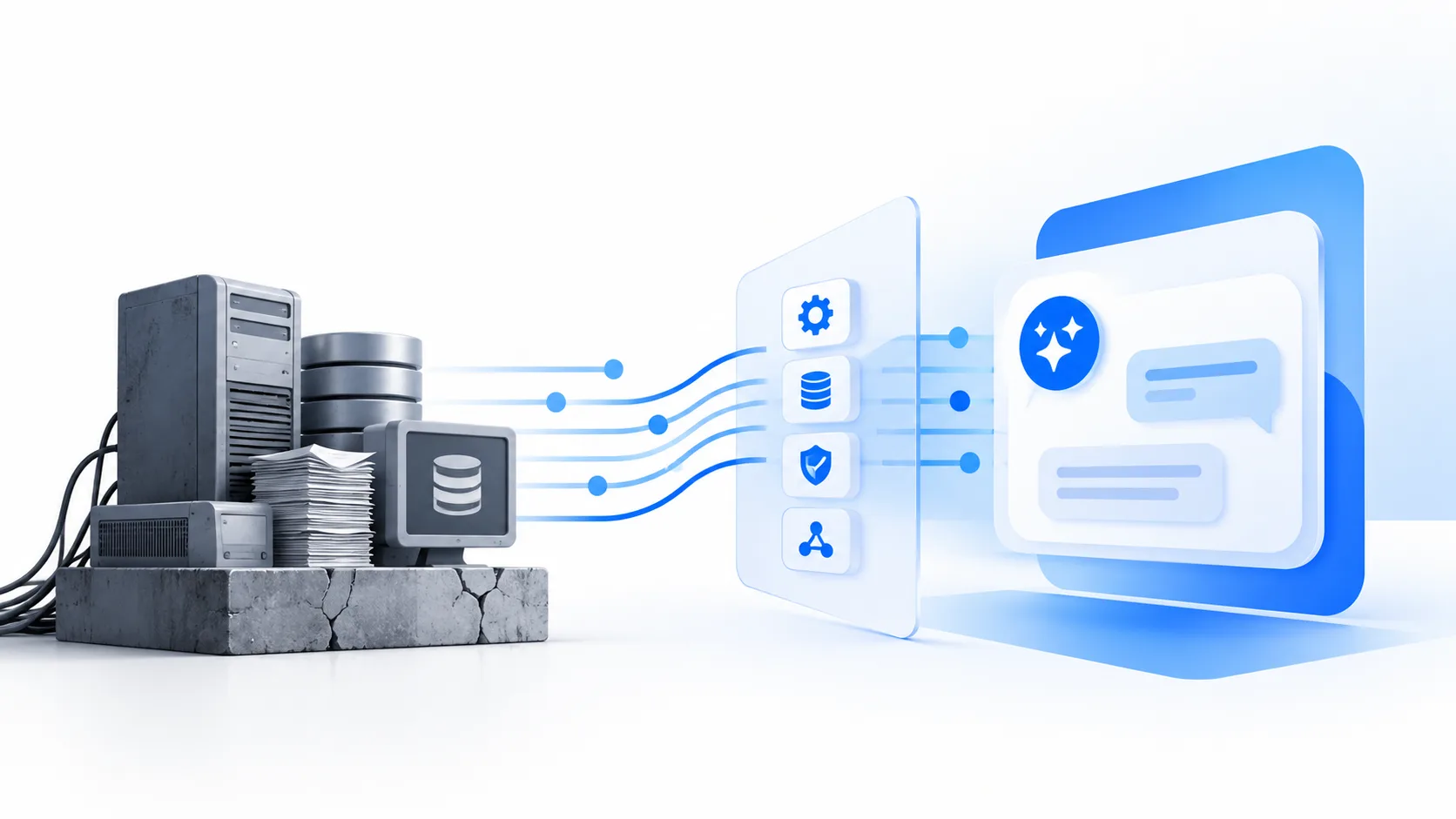
AI modernization costs go far beyond models and APIs. See how legacy integration, data, technical debt, security and dual-run costs affect AI ROI.
Adding AI to an old enterprise system can look surprisingly cheap in a prototype.
Connect an LLM API. Add a retrieval layer. Build a chatbot or agent. Give it access to a few internal systems. Within weeks, there may be something impressive enough to demonstrate to leadership.
Then production begins.
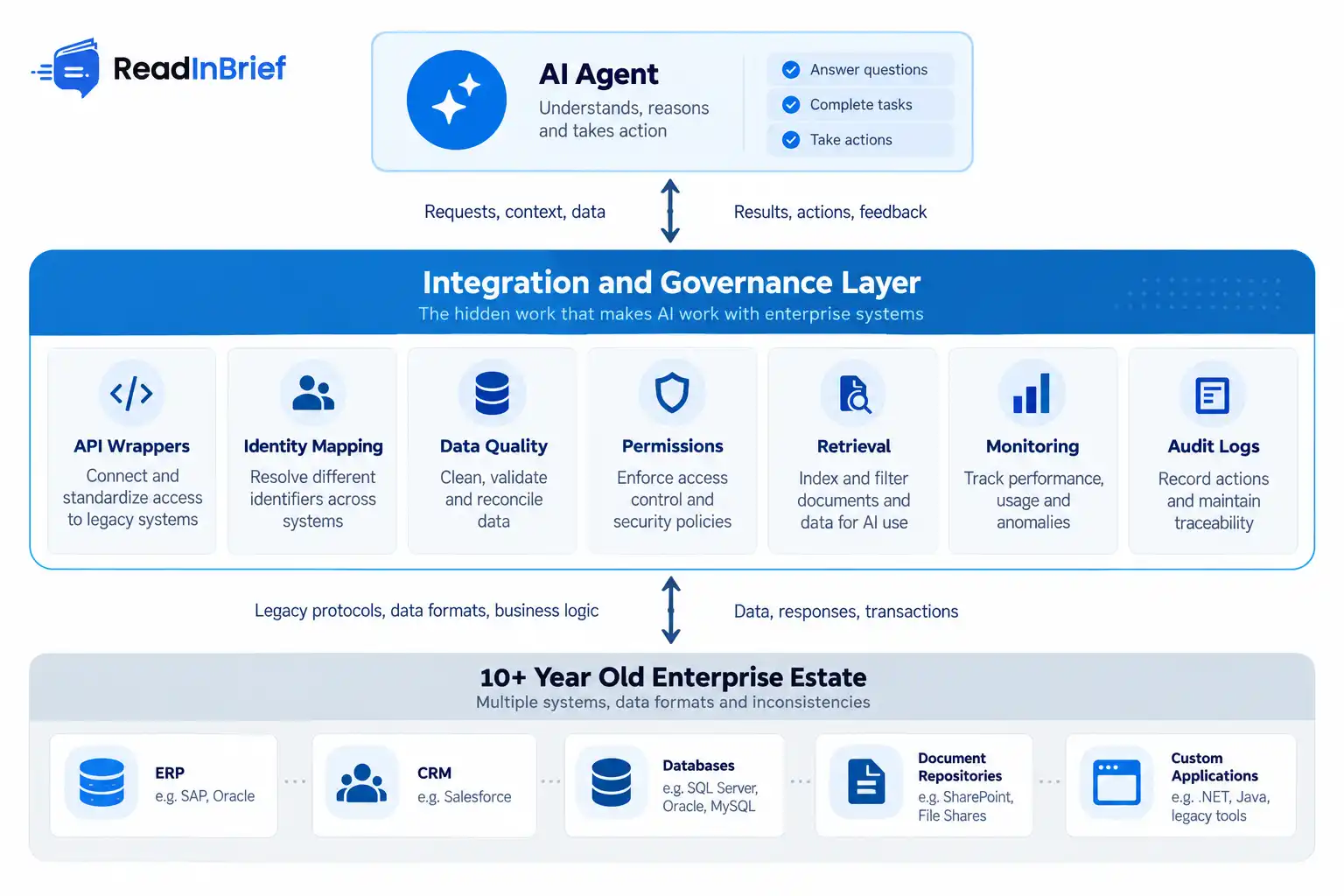
The AI needs reliable data from systems that were never designed for it. Old APIs need wrappers. Permissions need redesigning. Outputs need monitoring. Legacy business rules have to be understood. Every model change needs testing against workflows that may already contain years of exceptions.
Suddenly, the cost of the model is one of the smaller numbers in the project.
This is the hidden problem with AI modernization costs: enterprises often budget for the AI they want to add, but underestimate the technical debt, integration work and operational controls required by the system underneath it.
Quick Answer: What Does It Really Cost to Add AI to a Legacy System?
The real cost of adding AI to a legacy enterprise system is not simply model usage, development or cloud infrastructure. It includes the cost of making legacy data accessible, exposing old business logic safely, building integration layers, improving security and permissions, evaluating AI outputs, monitoring production behavior and maintaining both the old and new technology stacks.
For a relatively healthy legacy application, adding AI around the existing system may be economically sensible. For a tightly coupled, poorly documented system with weak APIs and unreliable data, AI can create another expensive layer without removing the underlying technical debt.
That distinction should be made before approving the AI project.
The $50,000 AI Project Can Sit on Top of a Much Bigger Problem
Imagine a 10-year-old claims management platform.
The company wants an AI assistant that can summarize claims, retrieve policy information, identify missing documents and recommend the next action to an employee.
The initial scope might include:
an LLM or model API
a retrieval-augmented generation layer
vector storage
a conversational interface
several integrations
prompt and workflow development
On paper, this looks like an AI application.
In reality, the engineering team may discover that policy information is spread across multiple databases, some claims are stored using inconsistent schemas, important business rules live inside application code, APIs were designed for the original user interface rather than autonomous access, and authorization works at the application level rather than at the individual data or action level.
The team isn't just building an AI assistant anymore.
It is partially modernizing the enterprise system so AI can use it safely.
That difference changes the economics.
McKinsey described a similar pattern in its 2026 analysis of technology budgets. Companies that fund modernization and AI while continuing to operate the same legacy platforms can end up paying for both layers. They maintain the old environment while adding models, applications, governance and controls above it, increasing rather than reducing operational burden.
Why Old Enterprise Systems Make AI More Expensive
A system being 10 years old does not automatically make it a bad candidate for AI.
A well-maintained application with clean APIs, strong documentation, reliable data and clear service boundaries can remain useful for decades.
The problem is architectural condition, not age alone.
Legacy applications commonly accumulate tightly coupled dependencies, duplicated logic, dead code, undocumented business rules and inconsistent data structures. AWS notes that modernization projects frequently begin with significant effort simply to understand how an existing codebase works because documentation can be limited and business logic may be distributed across services and modules.
AI does not make those dependencies disappear.
In some cases, it makes them more visible.
AI Needs Data That Legacy Systems Were Never Designed to Expose
Traditional enterprise software often assumes that users will interact through predetermined screens and workflows.
AI agents operate differently.
They may need to search across systems, combine structured and unstructured information, retrieve contextual records, call tools and act across several applications.
A customer-service agent, for example, might need information from:
CRM
ERP
billing
support tickets
product documentation
identity systems
historical email or knowledge repositories
If those systems expose clean APIs with consistent identifiers and permission models, integration is manageable.
If they do not, every connection becomes engineering work.
AI Makes Data Quality an Execution Problem
Poor data has always been expensive.
With AI agents, the consequences can become more immediate because the system may not simply display the data. It can reason over it and potentially act on it.
If two systems disagree about a customer's contract status, which record should an agent trust?
If a product database contains obsolete descriptions, should those documents be available to retrieval?
If the CRM identifies a customer differently from the billing platform, how does the AI know they are the same entity?
An AI layer does not resolve these questions automatically.
Someone has to.
The Seven Costs That Usually Hide Behind the AI Budget
A useful way to estimate AI modernization costs is to stop treating “AI development” as one budget line.
For planning purposes, I use a simple analytical model:
The AI-on-Legacy Cost Stack
Total AI modernization cost = AI capability + integration + data readiness + security/governance + evaluation + legacy remediation + ongoing dual-run cost
This is a planning model, not an industry-standard accounting methodology. Its purpose is to prevent teams from approving the visible AI layer while ignoring the infrastructure required underneath it.
Cost layer | What enterprises often budget for | What can be overlooked |
|---|
AI capability | Models, prompts, RAG, agents | Evaluation and model-change testing |
Integration | API development | Legacy adapters, orchestration, undocumented dependencies |
Data | Vector database, embeddings | Cleaning, ownership, identity matching, access rules |
Security | Authentication | Fine-grained permissions, prompt attacks, data leakage controls |
Governance | Basic logging | Auditability, approval rules, policy enforcement |
Legacy remediation | Often excluded | Refactoring, documentation, API exposure, dependency cleanup |
Operations | Model/API fees | Monitoring, incident handling, duplicated infrastructure and support |
The last two rows are where many business cases become uncomfortable.
Hidden Cost #1: Understanding the System Before AI Can Use It
The first cost may appear before a model is connected to anything.
Teams need to understand the system.
Ten years of enterprise development can leave behind thousands of classes, database tables, batch jobs, integrations, scheduled processes and business rules.
Some may still matter.
Some may be obsolete.
Some may exist because of a customer requirement nobody remembers.
IBM describes dead code, poorly structured code after multiple team handovers and duplicated logic caused by weak documentation as recurring patterns that inflate modernization scope.
In one IBM example involving roughly one million lines of legacy code, structural analysis reduced the modernization scope by approximately 30% by identifying code that did not need to be carried forward.
AI coding tools can help analyze old applications, generate documentation and identify dependencies. But enterprises still need people who understand what the software is supposed to do.
Code explains implementation.
It does not always explain intent.
Hidden Cost #2: Building an Integration Layer AI Can Actually Trust
AI prototypes frequently work with carefully selected data and manually configured tools.
Production systems cannot depend on that luxury.
An enterprise agent may need APIs for customer lookup, inventory, billing, documents, transactions or workflow execution. If those interfaces do not exist, teams must build them.
That means more than exposing database queries as endpoints.
Production-grade interfaces need authentication, authorization, validation, error handling, rate limits, versioning, observability and clear contracts about what an AI system is allowed to do.
For older systems, organizations may also need anti-corruption layers or service wrappers that translate between modern AI workflows and legacy data structures.
The cost is not merely connecting two systems.
The cost is creating a stable boundary around a system that never expected an AI agent to become one of its users.
Hidden Cost #3: Cleaning Data Before RAG or Agents Touch It
RAG is often presented as a straightforward way to connect enterprise knowledge to an LLM.
The technical pipeline can indeed be straightforward:
documents → chunking → embeddings → vector search → model
The organizational reality is harder.
Which documents are authoritative?
Which are obsolete?
Who owns them?
Can every employee see every retrieved document?
What happens when a document contains customer information?
How are updates synchronized?
How do you prevent deleted content from continuing to appear in the retrieval index?
A vector database does not solve knowledge governance.
It can make poorly governed information easier to retrieve.
For an old enterprise system, data preparation can therefore become a substantial part of AI modernization costs.
Hidden Cost #4: Rebuilding Permissions for AI Agents
Human users typically operate through screens that restrict what they can see and do.
Agents operate through tools and APIs.
That changes the security boundary.
An employee may have permission to view a refund screen but require managerial approval before completing a $20,000 refund. If an agent gets direct access to the underlying refund API, the organization needs to reproduce those controls at the agent and service layers.
This becomes particularly important as enterprises move from copilots that recommend actions to agents that execute them.
The NIST Generative AI Profile emphasizes managing generative AI risk throughout the lifecycle rather than treating it as a one-time model-selection problem. NIST organizes AI risk management around governance, mapping, measurement and management activities.
The cost of implementing those controls belongs in the AI business case.
It should not appear six months later as an unexpected “security requirement.”
Hidden Cost #5: Testing AI Against Years of Business Exceptions
Traditional software tests deterministic behavior.
If input A produces output B today, it should generally produce output B tomorrow.
Generative AI complicates this assumption.
A model can change. Prompts can change. Retrieval results can change. The same model may produce different wording or reasoning paths.
That means an AI feature connected to an old enterprise system needs two kinds of testing.
Software testing
Does the API work?
Does authentication work?
Does the integration fail safely?
Does the workflow complete?
AI evaluation
Does the model retrieve the correct information?
Does it hallucinate?
Does it follow business rules?
Does it escalate when uncertain?
Does it behave correctly across unusual cases?
A decade-old application may contain thousands of edge cases accumulated through production experience.
Those exceptions become part of the evaluation problem.
This is why a successful proof of concept is weak evidence of production readiness.
The demo proves that the happy path works.
Enterprise AI economics are often determined by everything outside the happy path.
Hidden Cost #6: Running the Old and New Worlds at the Same Time
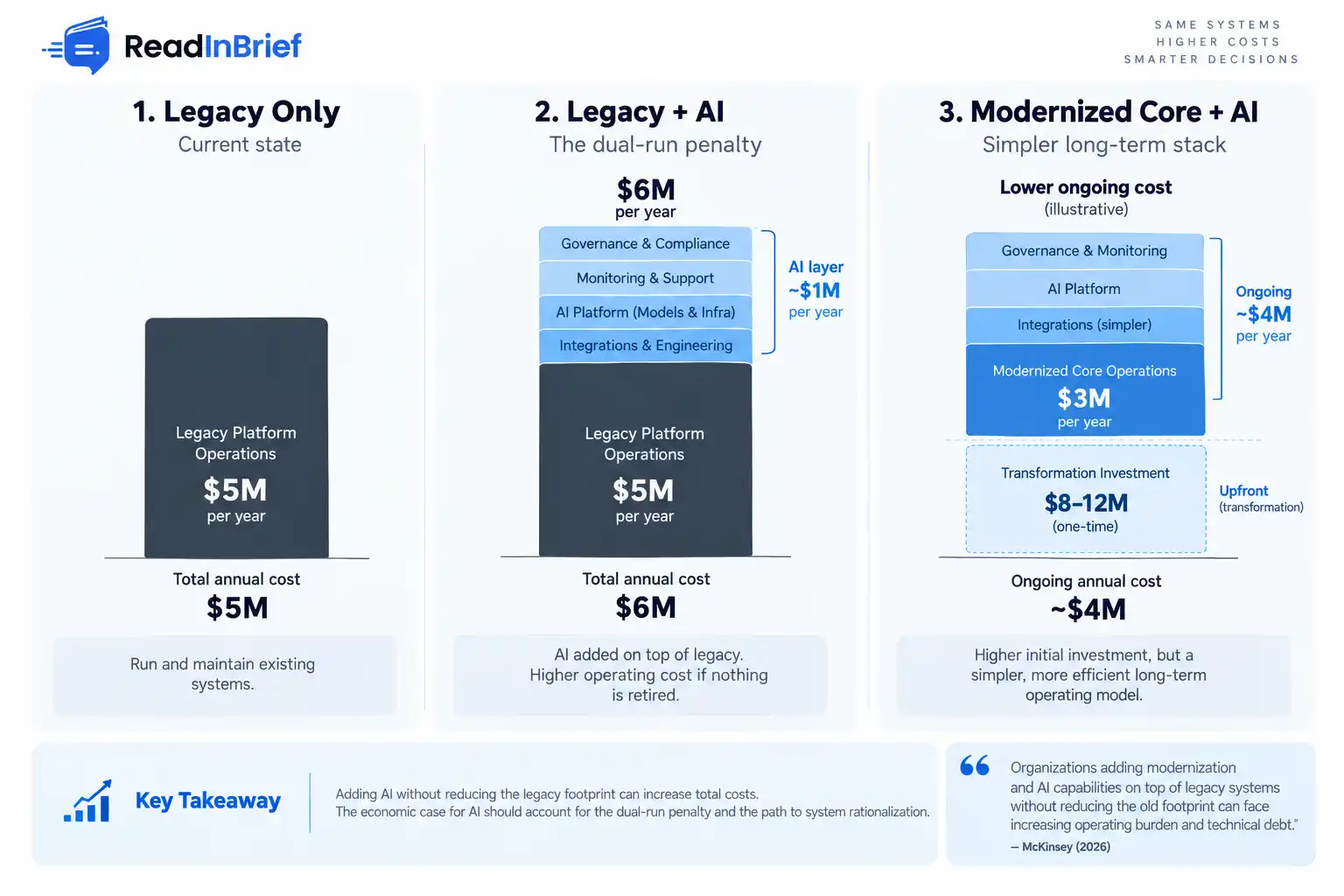
One of the most important AI modernization costs is also one of the easiest to miss.
You may not remove anything.
Suppose a company spends $5 million annually operating a legacy platform.
It adds an AI layer costing another $1 million per year across infrastructure, engineering, models, monitoring and governance.
If the AI does not allow the company to retire applications, simplify workflows or reduce legacy maintenance, the technology estate now costs $6 million rather than $5 million.
That does not mean the AI investment is bad. It may create more than $1 million in value.
But the economic case needs to acknowledge the additional operating layer.
McKinsey calls attention to this problem in its 2026 technology-budget research: organizations adding modernization and AI capabilities on top of legacy systems without reducing the old footprint can face increasing operating burden and technical debt.
This is the dual-run penalty.
And it is central to deciding whether to augment or modernize.
Hidden Cost #7: Technical Debt Starts Charging Interest on AI
Technical debt has always slowed software delivery.
AI can amplify its economic impact.
IBM reported in 2026 that 81% of executives in its research said technical debt was already constraining AI success. Sixty-nine percent said technical debt could make some initiatives financially untenable by adding 15% to 22% to delivery timelines.
IBM also reported that enterprises fully accounting for technical-debt remediation in AI and modernization business cases anticipated up to 29% greater returns than organizations that overlooked those costs.
These figures should be interpreted as IBM research rather than universal benchmarks, but the underlying economic mechanism is important.
Every AI feature that depends on a fragile legacy component inherits some of its complexity.
AI does not erase technical debt.
Sometimes it starts paying interest on it.
When Does Adding AI Around a Legacy System Make Economic Sense?
Adding AI without fully modernizing the underlying application can be a rational strategy.
The key is whether the legacy core is stable enough to become a system of record while AI provides a new system of interaction or intelligence around it.
Good candidates typically have:
reliable underlying transactions
understandable business rules
acceptable security
accessible data
APIs or realistic integration paths
manageable technical debt
no urgent platform end-of-life problem
For example, a stable ERP may not need to be replaced simply because employees want a conversational interface for finding purchase orders.
An AI layer could provide significant value without rewriting the ERP.
When AI becomes an expensive patch
The economics change when the underlying application has:
severe security weaknesses
unsupported frameworks
fragile integrations
inconsistent data
undocumented critical logic
frequent outages
limited test coverage
no reliable API boundary
expensive specialist dependencies
architectural constraints blocking new business requirements
In these cases, adding AI can become another workaround attached to a system that already needs modernization.
Deloitte's analysis of AI and legacy modernization makes an important point: AI can help enterprises rethink processes and reengineer the digital core, but simply carrying old processes and architecture forward does not necessarily remove the constraints that created technical debt.
AI Wrapper vs Modernization vs Hybrid: What Changes the Economics?
Factor | Add AI around legacy | Modernize first | Hybrid |
|---|
Initial cost | Usually lower | Usually higher | Medium |
Time to first AI value | Faster | Slower | Medium |
Legacy technical debt | Remains | Reduced | Reduced selectively |
Integration burden | Can become high | Lower after modernization | Targeted |
Business disruption | Lower initially | Potentially higher | Controlled |
Long-term complexity | Can increase | Usually lower | Depends on boundaries |
Best fit | Stable legacy core | Fundamentally constrained core | Mixed estate |
The right answer is often hybrid.
Keep the stable transactional core.
Modernize the parts creating disproportionate cost or risk.
Put APIs around what remains.
Then add AI where it creates measurable value.
McKinsey's 2026 work on enterprise architecture similarly describes the choice between incremental agentic-AI integration and broader architectural transformation rather than treating modernization as one universal strategy.
Better Way to Calculate AI Modernization Costs
A useful business case needs to calculate more than implementation cost.
I suggest evaluating the economics through four buckets.
1. Build Cost
Include:
AI application engineering
model integration
RAG or knowledge architecture
agent orchestration
APIs and middleware
data preparation
security engineering
testing and evaluation
user interface changes
2. Run Cost
Include:
model inference
cloud infrastructure
vector/search infrastructure
observability
AI evaluation
security monitoring
integration maintenance
application support
human review where required
3. Legacy Carry Cost
This is the number that often disappears from the AI proposal.
Include:
existing licenses
infrastructure
legacy support teams
specialist skills
manual operations
technical-debt remediation
recurring incidents
duplicated integrations
old vendor contracts
4. Change Cost
Finally, account for the cost of changing how the business operates:
employee training
workflow redesign
governance
process documentation
adoption
compliance reviews
operating-model changes
This gives a more useful equation:
Total Cost of AI = Build + Run + Legacy Carry + Change
Then compare that with:
AI Value = labor capacity released + revenue impact + avoided cost + risk reduction + faster cycle times + capabilities that were previously impractical
Do not approve the project because the first number looks small.
Approve it when the relationship between the two is credible.
The Legacy-AI Burden Ratio
CIOs also need a quick way to identify when an AI project is becoming a disguised modernization program.
For planning purposes, ReadInBrief proposes a simple analytical metric:
Legacy-AI Burden Ratio = legacy-enablement spending ÷ total AI program spending
“Legacy-enablement spending” includes work that would not be necessary if the underlying systems already had clean data, modern APIs, adequate documentation, strong identity controls and maintainable architecture.
This is not a validated industry benchmark. It is a planning tool.
A low ratio suggests most investment is creating the intended AI capability.
A rising ratio suggests the organization is increasingly spending its AI budget repairing prerequisites.
The absolute percentage matters less than the trend and the reasons behind it.
If every new AI use case requires another custom adapter, another data-cleaning project and another security exception, leadership should question whether continued augmentation is still cheaper than modernization.
AI Can Also Reduce Modernization Cost
There is an important counterargument.
AI is not only creating new requirements for legacy systems.
It can also make modernization itself cheaper.
Generative AI and agents are increasingly being used for code analysis, dependency mapping, documentation, test generation, code conversion and migration.
McKinsey reported from its modernization work that generative AI approaches could accelerate modernization timelines by 40% to 50% and reduce costs associated with technology debt by around 40% in the examples it discussed.
AWS is applying generative AI to legacy analysis and mainframe transformation through AWS Transform, while Microsoft has published work using AI agents for COBOL migration and mainframe modernization.
This creates an interesting economic loop.
Legacy systems make AI harder to deploy, but AI can make legacy systems cheaper to modernize.
That is why “AI or modernization?” is often the wrong framing.
AI can be part of the modernization method.
A Practical CIO Decision Framework
Before approving AI on top of a 10-year-old enterprise application, ask these eight questions.
1. Is the underlying system operationally healthy?
If the application already suffers frequent outages, security problems or severe maintainability issues, AI should not become a distraction from fixing the core.
2. Can the required data be accessed reliably?
Identify every data source the AI requires and determine its owner, quality, freshness, access method and permission model.
3. Are the business rules understood?
If nobody can explain why the legacy system makes certain decisions, allowing AI to automate around those decisions creates additional uncertainty.
4. Do stable integration boundaries exist?
APIs are preferable, but the broader requirement is a controlled interface that can be secured, monitored and changed without destabilizing the core.
5. What happens when the AI is wrong?
The answer determines how much evaluation, monitoring and human approval you need.
6. What legacy cost disappears if the AI succeeds?
If the answer is “none,” explicitly include the dual-run penalty in ROI calculations.
7. Are we fixing the same legacy problem repeatedly?
Repeated custom integrations, manual data cleanup and security exceptions are evidence that selective modernization may have better economics.
8. Could AI reduce the modernization cost itself?
Use AI-assisted analysis, documentation, testing and migration when evidence shows it can reduce effort without compromising validation.
Three Scenarios Show Why the Answer Is Different for Every System
Scenario A: Stable ERP, Poor User Experience
A 12-year-old ERP reliably handles transactions but has an outdated interface and slow search.
Employees spend significant time locating information.
The APIs are stable and the data is reliable.
Likely direction: AI augmentation may make economic sense. Keep the transactional core and add conversational retrieval or workflow assistance around it.
Scenario B: Fragile Claims Platform
A 10-year-old claims application has undocumented rules, inconsistent customer identifiers, unsupported libraries and frequent production incidents.
Leadership wants to add an autonomous claims agent.
Likely direction: selective modernization should probably precede high-autonomy AI. Otherwise, the AI project may inherit and amplify the system's weaknesses.
Scenario C: Large Mainframe With Valuable Business Logic
A 25-year-old mainframe performs critical transactions reliably, but development is expensive and specialist knowledge is declining.
Replacing everything at once creates substantial operational risk.
Likely direction: use AI-assisted analysis and documentation, expose stable capabilities through controlled services, and modernize incrementally according to business value.
These are illustrative scenarios, not real case studies.
The important lesson is that system age does not determine the strategy. Architecture, risk and economics do.
When Should You Stop Adding AI and Modernize the Core?
There is no universal percentage or age at which a system must be replaced.
But several signals should trigger a deeper modernization review:
integration work costs more than the AI capability itself
every AI use case requires new custom data cleanup
security teams cannot enforce granular permissions
testing business rules requires manual reconstruction
the underlying platform is unsupported
production incidents regularly originate in legacy dependencies
AI does not allow any legacy cost to be retired
specialist availability is declining
business requirements cannot be implemented without architectural workarounds
If several of these conditions exist simultaneously, the AI project may be telling you something important.
The enterprise does not have an AI problem. It has an architecture problem that AI has exposed.
Before You Approve the AI Budget
The most useful financial question is not:
“How much will the AI feature cost?”
Ask:
“What does our technology estate need to become before this AI feature can operate reliably at scale?”
Then separate the answer into three categories:
Work required specifically for this AI use case
This belongs in the AI project's cost.
Work required because of accumulated technical debt
This should be visible as modernization or remediation spending rather than hidden inside AI engineering.
Work that improves the platform for future AI use cases
This is reusable infrastructure and should be evaluated as a platform investment.
That distinction improves decision-making because the first AI project often pays for foundations that later projects reuse.
Without separating those costs, the first project can appear unjustifiably expensive while later projects appear artificially cheap.
The Real Economics of AI on Legacy Systems
Adding AI to a 10-year-old system can absolutely create value.
But an LLM cannot turn poor architecture into good architecture simply because it provides a better interface.
AI can hide complexity from users.
It cannot eliminate complexity from the technology estate.
That is why AI modernization costs need to include more than tokens, developers and cloud infrastructure. The real calculation includes integration, data readiness, security, evaluation, technical debt and the cost of operating old and new systems simultaneously.
There is also good news.
AI is increasingly capable of helping teams understand, document, test and modernize the legacy systems creating those costs in the first place.
The strongest strategy may therefore be neither “modernize everything before using AI” nor “put AI around everything and leave the core alone.”
It is to identify where the existing system remains economically sound, modernize the parts creating disproportionate cost and risk, and use AI where it can create measurable value without adding another decade of technical debt.
The cheapest AI prototype is not necessarily the cheapest AI system to own.
That is the number enterprise leaders need to calculate.
Frequently Asked Questions About AI Modernization Costs
How much does it cost to add AI to a legacy enterprise system?
There is no reliable universal price because cost depends more on the condition of the underlying architecture than its age. Enterprises should budget for model and application development plus integrations, data preparation, security, evaluation, monitoring, legacy remediation and change management. A prototype cost alone is therefore a poor predictor of total production cost.
Why does adding AI to legacy software become expensive?
Legacy software can lack modern APIs, clean data, documentation, granular permissions and automated testing. AI applications often need all of them. The project therefore starts paying for integration and modernization work that would be unnecessary on a healthier architecture.
Should a company modernize its legacy system before adding AI?
Not always. A stable system with reliable data and usable integration boundaries can remain the transactional core while AI is added around it. Modernization becomes more compelling when the legacy platform is insecure, fragile, unsupported or requires repeated expensive workarounds for each new AI capability.
Does RAG avoid the need to modernize legacy systems?
No. RAG can make enterprise information accessible to an LLM, but it does not automatically fix outdated documents, inconsistent data, poor access controls or unclear ownership. Retrieval architecture can reduce some integration challenges while leaving the underlying governance problems intact.
Can AI agents increase technical debt?
Yes. An agent can add another dependency layer, integration surface and operational system to maintain. If organizations continually build AI wrappers around weak architecture without removing underlying problems, the technology estate can become more complex rather than less complex.
Can AI reduce legacy modernization costs?
Potentially. AI-assisted tools are increasingly used for code understanding, documentation, dependency analysis, test generation and migration. McKinsey, AWS, IBM and Microsoft have published examples of AI being used to accelerate modernization work. Results vary by codebase, architecture, tools and validation requirements, so organizations should verify savings in their own environment.
What is the biggest hidden cost of enterprise AI?
For many legacy environments, it is the work required to make existing systems usable by AI: exposing reliable data, building interfaces, reconstructing business rules, implementing permissions and testing edge cases. Ongoing dual-run costs can become equally important if AI is added without retiring any legacy expense.
How should CIOs calculate ROI for AI modernization?
Calculate the full cost across build, run, legacy carry and organizational change. Then compare it with measurable labor capacity, revenue improvement, avoided cost, risk reduction and cycle-time improvements. Also identify which AI investments create reusable infrastructure for later use cases rather than attributing the entire platform cost to the first deployment.
Read Also:
AI in Prior Authorization: How Healthcare Teams Can Reduce Manual Review
Should CIOs Modernize Legacy Systems or Put AI Around Them?
Your AI Strategy Doesn't Need More Use Cases. It Needs Better Priorities
Why AI Pilots Work but AI Integration Fails in Production
AI Agents Need an Intervention Capacity Test Before Autonomy Scales
Comments (0)
No comments yet. Be the first to share your thoughts!