AI in Prior Authorization: How Healthcare Teams Can Reduce Manual Review

Author
Ravi Prajapati

Learn how AI in prior authorization can reduce manual review, automate documentation workflows, improve processing, and support healthcare teams.
Prior authorization is supposed to confirm that a proposed treatment, procedure, medication, or service meets a health plan's coverage requirements before care is delivered. In practice, it often creates a large administrative workload for healthcare providers, clinical teams, and payers.
The problem is not simply the number of authorization requests. Staff may need to determine whether authorization is required, find payer-specific requirements, gather clinical documentation, complete forms, submit requests, track status, respond to requests for additional information, and manage denials or appeals.
This is where AI in prior authorization can have practical value.
AI can help healthcare teams identify requirements, extract relevant clinical information, detect missing documentation, prepare submissions, prioritize work queues, and monitor authorization status. The strongest implementations do not treat AI as an autonomous clinical decision-maker. They use it to reduce repetitive administrative work while keeping humans responsible for exceptions, clinical judgment, and high-impact decisions.
Quick Answer: How Can AI Improve Prior Authorization?
AI can reduce manual prior authorization work by reading clinical documents, identifying payer requirements, extracting relevant patient information, checking submissions for missing evidence, preparing authorization packets, routing cases, and flagging exceptions for human review. The goal should be automation of administrative steps, not uncontrolled automation of clinical decisions.
That distinction matters because prior authorization directly affects access to care.
The administrative burden remains substantial. Recent AMA prior authorization research reports that physicians continue to see prior authorization as a major source of workload and care delay. In its 2026 reporting, the AMA said physicians averaged roughly 40 prior authorizations per week, while 95% reported that prior authorization delays access to necessary care.
AI therefore has a useful role, but the right question is not:
"Can AI automate prior authorization?"
A better question is:
"Which parts of prior authorization can AI safely automate, and which decisions still require human oversight?"
Why Prior Authorization Creates So Much Manual Work
Prior authorization is not one task. It is a chain of interconnected administrative and clinical activities.
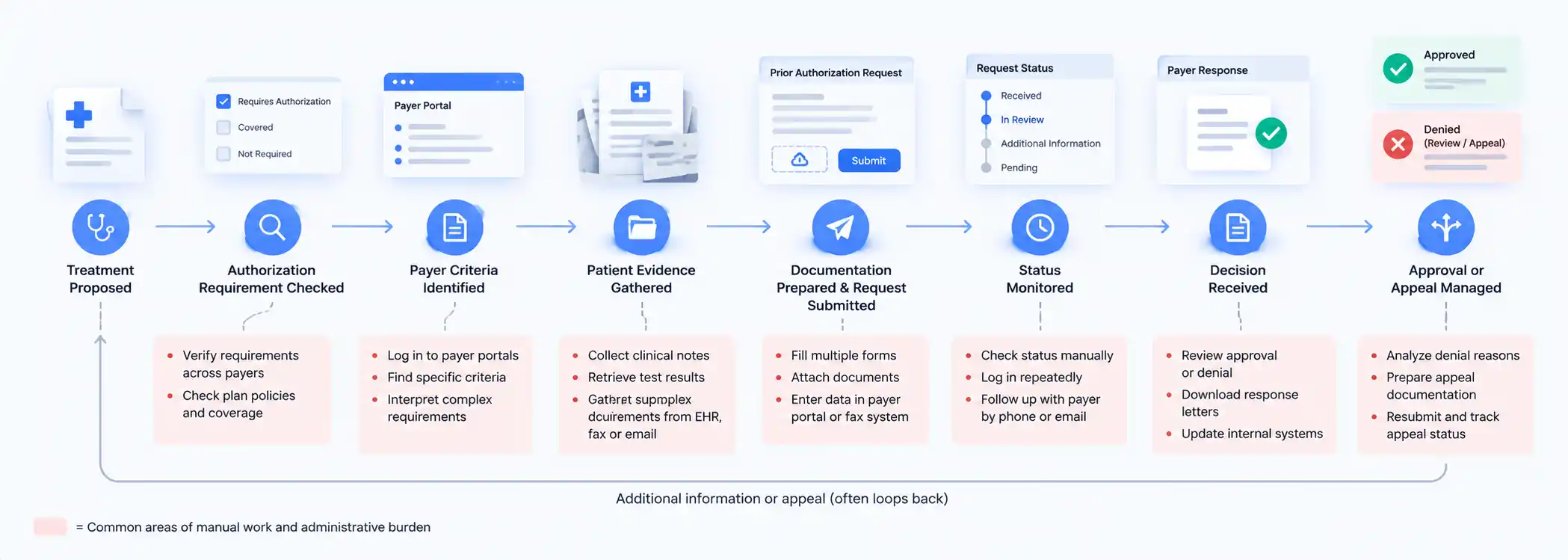
A simplified workflow can look like this:
Treatment proposed → authorization requirement checked → payer criteria identified → patient evidence gathered → documentation prepared → request submitted → status monitored → additional information handled → decision received → denial or appeal managed
Each transition can create manual work.
A staff member may need to move between an electronic health record, payer portal, fax system, email, document repository, phone system, and internal work queue.
The burden is measurable. The AMA's 2024 prior authorization survey found that practices completed an average of 39 prior authorizations per physician each week and spent around 13 hours of physician and staff time on them. Forty percent of physicians reported having staff who worked exclusively on prior authorization.
This means the automation opportunity extends beyond making an approval or denial decision.
Much of the opportunity lies in reducing the administrative work surrounding that decision.
Where AI Fits Into the Prior Authorization Workflow
AI works best when the prior authorization process is separated into individual tasks rather than treated as one large automation problem.
Some tasks are repetitive and information-heavy. Others involve ambiguity, medical necessity, policy interpretation, or patient-specific clinical judgment.
That creates different levels of automation potential.
Prior Authorization Task | AI Potential | Human Role |
|---|---|---|
Detect whether authorization may be required | High | Review uncertain cases |
Identify payer requirements | High | Validate ambiguous policies |
Extract clinical information | High | Verify critical evidence |
Find missing documentation | High | Resolve clinical gaps |
Prepare forms/submissions | High | Approve before submission where required |
Prioritize work queues | High | Handle escalations |
Monitor request status | High | Intervene when necessary |
Draft responses to information requests | Medium-High | Clinical validation |
Predict likely administrative issues | Medium | Investigate flagged cases |
Determine medical necessity | Lower / high risk | Qualified clinical oversight |
Final denial affecting care | High risk | Appropriate human review |
The important design principle is straightforward:
Use AI most aggressively where the work is repetitive and reversible. Increase human involvement as clinical consequence, uncertainty, or patient impact rises.
This produces a more realistic automation strategy than attempting straight-through automation for every authorization.
1. Determining Whether Prior Authorization Is Required
One surprisingly expensive part of the process occurs before the request itself.
Staff may need to determine whether a particular procedure, medication, diagnostic service, or treatment requires authorization under a patient's specific plan.
Rules can differ by payer, plan, service, location, diagnosis, and other conditions.
An AI-assisted system can combine structured benefit information with payer rules and contextual patient data to surface the likely requirement.
Instead of searching multiple sources manually, staff could receive:
whether prior authorization appears necessary;
which payer policy applies;
what information is required;
what documentation is missing; and
whether the case needs manual verification.
The system should also show the source of the requirement rather than simply returning an unexplained answer.
That traceability becomes important when payer policies change.
2. Extracting Relevant Information From Clinical Records
Prior authorization often requires information that already exists somewhere in the patient's record.
The problem is finding it.
Relevant evidence might appear in progress notes, diagnostic reports, medication histories, laboratory results, previous treatments, imaging reports, referral notes, or discharge documentation.
Natural language processing and large language models can help locate and structure this information.
For example, instead of having a coordinator manually review a long patient record, an AI system could identify:
Requested treatment: specified procedure
Relevant diagnosis: extracted diagnosis and code
Previous treatment: identified from clinical history
Treatment duration: extracted from notes
Supporting test: relevant result identified
Missing requirement: recent documentation not found
The employee then validates the extracted information rather than finding everything manually.
That changes the nature of the work from searching and copying to reviewing and correcting.
3. Checking Documentation Before Submission
Incomplete submissions create avoidable rework.
A useful AI system can compare the available authorization packet against payer requirements before the request is sent.
Suppose a payer requires:
confirmed diagnosis;
documented conservative treatment;
treatment duration;
relevant imaging;
specialist recommendation.
The system could automatically evaluate the packet and return:
Requirement | Status |
|---|---|
Diagnosis documented | Found |
Previous conservative treatment | Found |
Treatment duration | Found |
Imaging report | Missing |
Specialist recommendation | Found |
The system does not need to decide whether treatment should be approved.
It is performing a narrower but valuable function: documentation completeness checking.
This can be one of the safer areas to begin using AI because the output can be validated before submission.
4. Generating Prior Authorization Documentation
Generative AI can help prepare administrative content using information already available in the patient's record.
It might draft a clinical summary, populate authorization fields, organize supporting evidence, prepare a cover note, or draft a response to a request for additional information.
The crucial safeguard is grounding.
The model should generate content from approved source records rather than fill missing information with plausible language.
A useful design pattern is:
Source evidence → structured extraction → draft → evidence mapping → human validation → submission
Every material statement should be traceable to its underlying record.
This reduces one of the biggest risks of using generative AI in healthcare administration: creating convincing but unsupported information.
5. Prioritizing Authorization Work Queues
Not every authorization requires the same amount of attention.
Healthcare teams may have hundreds or thousands of open cases with different deadlines, patient consequences, payer requirements, and levels of complexity.
AI can help prioritize cases using operational signals such as:
approaching deadlines;
incomplete documentation;
payer response received;
additional information requested;
patient appointment date;
case age;
authorization expiration;
likelihood that human intervention is needed.
This does not necessarily require generative AI. Rules, machine learning, and workflow automation may be more appropriate for many prioritization tasks.
That is an important point when designing AI-enabled healthcare systems:
Do not use an LLM simply because an LLM is available.
Use deterministic logic when the rule is deterministic.
Use machine learning when prediction is required.
Use language models when understanding or generating unstructured language creates meaningful value.
6. Tracking Status and Payer Responses
A significant amount of prior authorization work consists of asking:
What happened to the request?
Teams may manually log into payer portals, check statuses, review messages, or make phone calls.
Where integrations permit it, automation can monitor responses and update internal work queues.
AI can then classify payer messages into categories such as:
Approved
Additional information required
Pending review
Denied
Peer-to-peer required
Administrative correction required
Each category can trigger a different workflow.
This is where AI becomes more valuable when combined with interoperability rather than deployed as a standalone chatbot.
AI Alone Will Not Fix Prior Authorization
Prior authorization is partly an AI problem, but it is also an interoperability, workflow, data-quality, policy, and system-integration problem.
An advanced model cannot compensate for missing clinical data, outdated payer rules, inaccessible portals, inconsistent coding, poor integrations, or unclear responsibility.
This is why healthcare organizations should avoid evaluating an AI prior authorization solution solely on model accuracy.
The complete system matters.
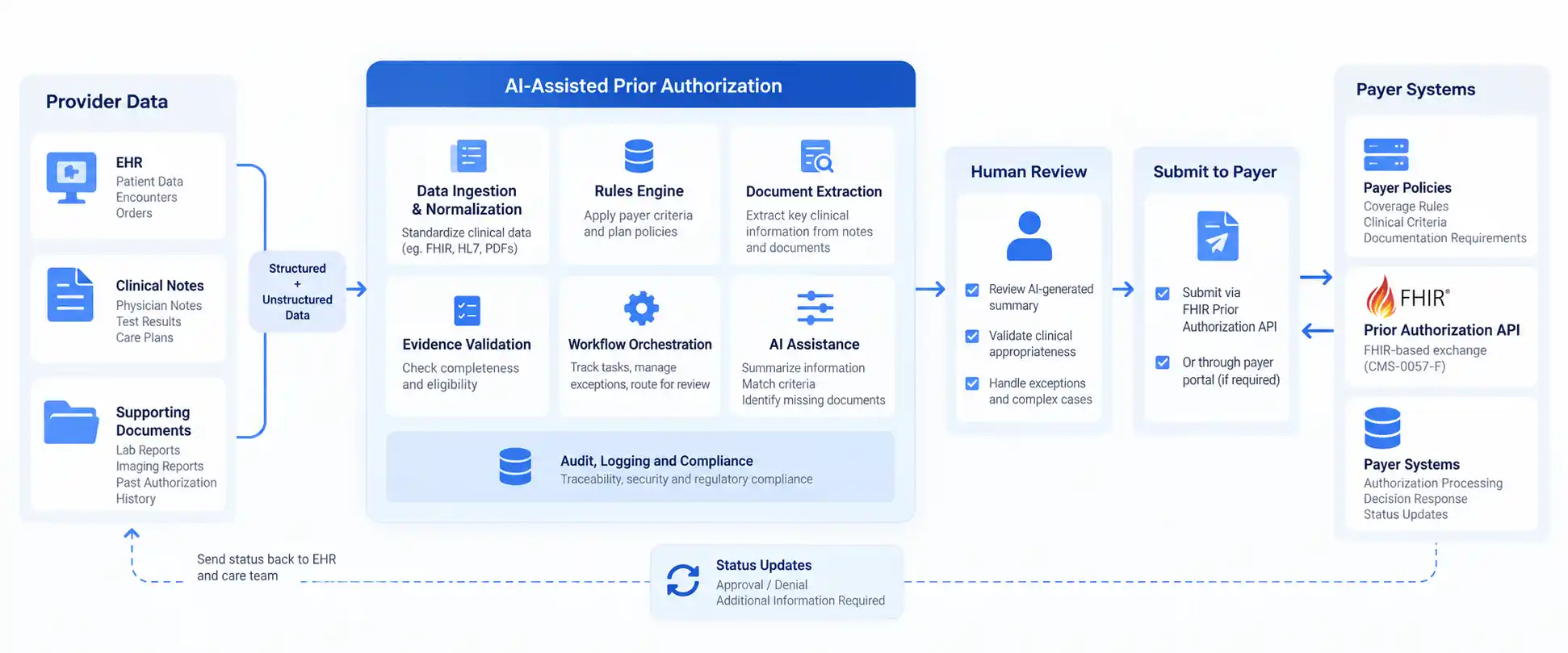
A practical architecture may involve:
EHR + payer data + authorization rules + interoperability APIs + workflow engine + document processing + AI extraction + human review + audit logging
The AI component may be only one part of the system.
Why FHIR and Prior Authorization APIs Matter
The regulatory environment is also pushing the industry toward more structured data exchange.
The CMS Interoperability and Prior Authorization Final Rule (CMS-0057-F) requires impacted payers to implement a number of interoperability and prior authorization provisions. Operational requirements generally began in 2026, while API requirements generally have compliance dates beginning in 2027.
CMS describes requirements for FHIR-based APIs, including a Prior Authorization API, designed to improve electronic exchange between payers and providers.
That changes the long-term automation opportunity.
Rather than building AI systems that imitate employees navigating fragmented portals, organizations can increasingly combine structured interoperability with AI for the parts of the process that still involve unstructured clinical information and reasoning.
A Practical Framework for Deciding What to Automate
Healthcare organizations need a way to decide which prior authorization tasks should be automated first.
A useful planning model is the RACE Framework: Repetition, Ambiguity, Consequence, Evidence.
This is an analytical planning model rather than a clinically validated methodology.
Repetition
How frequently is the task performed?
High-volume repetitive tasks create stronger automation economics.
Examples include extracting demographic data, checking standard fields, monitoring status, and routing responses.
Ambiguity
How much interpretation does the task require?
A simple status classification may have low ambiguity. Determining whether complex clinical evidence satisfies a nuanced medical policy has much higher ambiguity.
Automation should decrease as unresolved ambiguity increases.
Consequence
What happens if the system is wrong?
Incorrectly routing an administrative document may be recoverable.
An incorrect determination that delays necessary patient treatment may have far greater consequences.
Higher consequence should trigger stronger human oversight.
Evidence
Can the AI's output be verified against an authoritative source?
If the system says a patient completed a previous therapy, reviewers should be able to see exactly where that evidence appears in the medical record.
The more traceable the evidence, the safer it becomes to automate supporting work.
RACE Automation Matrix
Task | Repetition | Ambiguity | Consequence | Evidence Traceability | Suggested Approach |
|---|---|---|---|---|---|
Extract patient demographics | High | Low | Low | High | Automate |
Detect missing documents | High | Low-Medium | Medium | High | Automate + review exceptions |
Draft clinical summary | High | Medium | Medium | High | AI + human validation |
Classify payer response | High | Low-Medium | Medium | High | Automate + escalation |
Interpret complex coverage criteria | Medium | High | High | Medium | Human-led AI assistance |
Final adverse determination | Medium | High | Very high | Variable | Strong human oversight |
This framework prevents organizations from asking whether they should "automate prior authorization" as a whole.
Instead, they can evaluate each component separately.
Human-in-the-Loop Prior Authorization Is More Realistic Than Full Autonomy
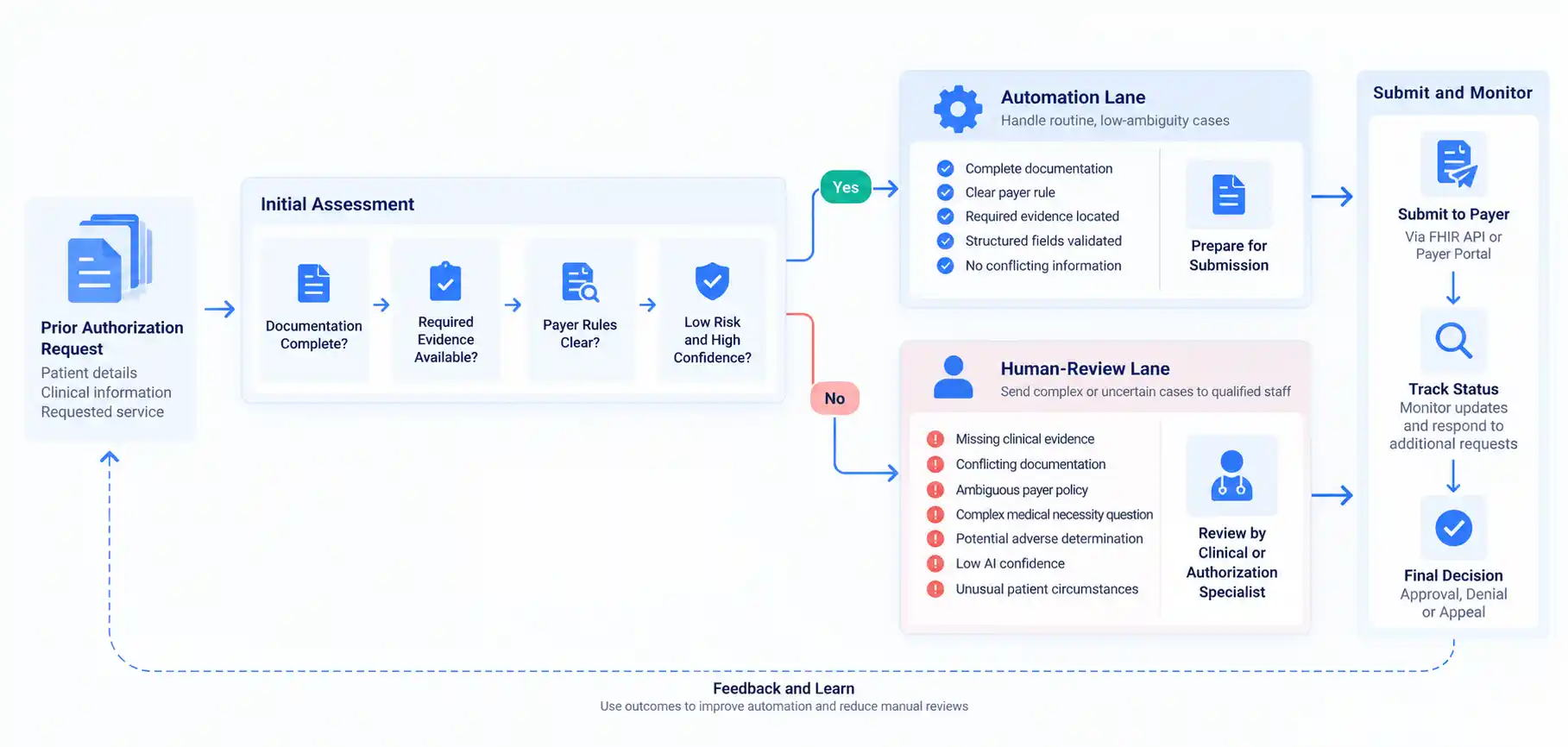
The most practical near-term model is likely to be exception-based human review.
Instead of having people process every case manually, automation handles predictable administrative steps and sends uncertain or high-risk cases to qualified staff.
For example:
Automation lane
Complete documentation
Clear payer rule
Required evidence located
Structured fields validated
No conflicting information
→ Prepare for submission or designated approval workflow.
Human-review lane
Missing clinical evidence
Conflicting documentation
Ambiguous payer policy
Complex medical necessity question
Potential adverse determination
Low AI confidence
Unusual patient circumstances
→ Route to appropriate reviewer.
The objective is not eliminating people.
It is using their attention where judgment adds the most value.
What AI Should Not Be Allowed to Do Unchecked
The benefits of automation should not obscure the consequences of poor implementation.
Prior authorization can influence whether and when patients receive treatment. That makes opaque or poorly governed automation especially problematic.
The AMA's research illustrates why clinicians are cautious. Its 2024 survey reported that 61% of physicians were concerned that AI could increase prior authorization denial rates.
That concern should shape system design.
AI should not become an invisible layer that produces adverse decisions without adequate evidence, transparency, review, or accountability.
Healthcare organizations should establish safeguards around:
Evidence provenance: What information produced the recommendation?
Confidence: How certain is the system?
Policy versioning: Which payer rule was applied?
Human escalation: When must a person review the case?
Auditability: Can the organization reconstruct what happened?
Model monitoring: Does performance change over time?
Access control: Who can view or alter protected information?
Error correction: Can staff override an incorrect extraction or recommendation?
Accountability: Who remains responsible for the final action?
Automation without these controls can simply make a bad process faster.
How Healthcare Teams Can Start Using AI in Prior Authorization
Organizations do not need to begin with fully automated authorization.
A lower-risk implementation path is usually more sensible.
Phase 1: Measure the Existing Workflow
Start by measuring where employees actually spend time.
Track:
authorization volume;
time per request;
common payer types;
submission channels;
documentation search time;
incomplete submission rate;
requests for additional information;
denial and appeal workflow;
status-checking effort;
turnaround time;
manual touches per authorization.
Without a baseline, it becomes difficult to prove that AI improved anything.
Phase 2: Automate Low-Risk Administrative Tasks
Good initial candidates may include document classification, data extraction, status categorization, work-queue routing, requirement retrieval, and completeness checks.
These workflows can create measurable efficiency without delegating consequential clinical judgment.
Phase 3: Introduce AI-Assisted Documentation
Once data retrieval is reliable, AI can help summarize clinical evidence and prepare authorization documentation.
Require source grounding and reviewer validation.
Phase 4: Integrate With Core Systems
Connect automation to the EHR, payer interfaces, document repositories, workflow systems, and relevant interoperability APIs.
Avoid creating another standalone dashboard that employees must manually maintain.
Phase 5: Move Toward Exception-Based Operations
Once accuracy, integrations, controls, and governance have matured, allow predictable cases to require less manual handling while routing uncertain cases to people.
This is where the largest operational benefit may emerge.
How Should Healthcare Organizations Measure AI Prior Authorization ROI?
Hours saved are useful, but they are not enough.
A better scorecard combines operational, financial, clinical-access, and quality measures.
Category | Metrics |
|---|---|
Productivity | Manual minutes per authorization, touches per case |
Speed | Submission time, authorization turnaround time |
Quality | Incomplete submission rate, extraction error rate |
Rework | Additional-information requests, resubmissions |
Outcomes | Approval/denial workflow metrics, appeal rates |
Workforce | Staff hours spent on repetitive administrative work |
Automation | Straight-through processing rate |
Safety | Escalation accuracy, critical error rate |
Adoption | Reviewer acceptance/correction rate |
A healthcare organization that saves five minutes per request but increases incomplete submissions has not necessarily improved the process.
The goal should be less administrative effort without reducing accuracy, transparency, or appropriate patient access.
The Bigger Opportunity: Move From Document Automation to Workflow Intelligence
Many early AI projects focus on summarizing documents.
Prior authorization presents a broader opportunity.
The system can eventually understand where a case is in the process, what evidence exists, what evidence is missing, what requirement applies, what action should happen next, and when human intervention is necessary.
That creates a shift:
Document AI → Task automation → Workflow orchestration → Exception management
The strongest systems may therefore look less like standalone "AI assistants" and more like intelligent workflow infrastructure.
This distinction is important for healthcare leaders evaluating vendors.
Ask not only:
"Which model do you use?"
Ask:
"How does the system fit into our authorization workflow?"
"Can every important output be traced to its source?"
"How are payer policy changes handled?"
"Which decisions require human review?"
"How does the system integrate with our EHR and payer interfaces?"
"What happens when the model is uncertain?"
Those questions reveal far more about production readiness than model benchmarks alone.
AI in Prior Authorization: The Practical Takeaway
AI can meaningfully reduce manual prior authorization work, but the greatest opportunity is not replacing clinical judgment with algorithms.
It is removing repetitive administrative effort surrounding clinical decisions.
Healthcare teams should start with high-volume, evidence-verifiable activities such as information extraction, requirement checking, documentation completeness, work-queue prioritization, response classification, and status monitoring.
As CMS interoperability requirements make structured payer-provider exchange more practical, AI can increasingly focus on the areas where it is most useful: understanding unstructured information, coordinating workflows, and identifying exceptions.
The target operating model is therefore not necessarily fully autonomous prior authorization.
It is:
automation by default for predictable administrative work, evidence at every step, and qualified human review where ambiguity or consequence demands it.
That is a more achievable and defensible path to reducing prior authorization burden.
Frequently Asked Questions
What is AI in prior authorization?
AI in prior authorization refers to using technologies such as natural language processing, machine learning, document intelligence, and generative AI to automate or assist administrative authorization tasks. These can include extracting clinical information, identifying documentation requirements, checking completeness, preparing submissions, classifying payer responses, and routing cases for review.
Can AI fully automate prior authorization?
Some administrative components can potentially achieve high levels of automation, but full end-to-end autonomy is more complicated. Cases involving ambiguous clinical information, complex coverage policies, missing evidence, unusual circumstances, or consequential adverse decisions may require qualified human review. A human-in-the-loop model is therefore more appropriate for many production environments.
How can AI reduce prior authorization workload?
AI can reduce workload by retrieving information from medical records, identifying payer requirements, detecting missing documents, populating forms, drafting summaries, categorizing payer responses, monitoring status, and prioritizing work queues. This reduces time employees spend searching, copying, checking, and routing information.
What are the risks of using AI for prior authorization?
Major risks include inaccurate data extraction, unsupported generated content, outdated payer rules, automation bias, insufficient transparency, privacy or security failures, and inappropriate automated decisions. Organizations should use source grounding, human escalation, audit logs, policy versioning, access controls, monitoring, and clear accountability.
How does FHIR affect prior authorization automation?
FHIR provides standardized mechanisms for exchanging healthcare information. CMS's interoperability requirements include FHIR-based APIs intended to support electronic data exchange between providers and impacted payers, including prior authorization information. Structured interoperability can reduce reliance on manual portal and document workflows and make AI-assisted automation more practical.
What prior authorization tasks should healthcare teams automate first?
Start with high-volume, repetitive, verifiable tasks. Examples include document classification, clinical data extraction, requirement retrieval, completeness checking, status monitoring, and work-queue routing. Tasks involving ambiguous medical necessity or potentially harmful adverse decisions should receive stronger human oversight.
How should organizations evaluate an AI prior authorization system?
Evaluate workflow integration, source traceability, accuracy, exception handling, policy updates, interoperability, security, auditability, human-review controls, implementation effort, and measurable operational results. Model performance alone is not enough to determine whether a system is ready for production healthcare workflows.
Read Also:
AI Agents for Dental Clinics: Automating Patient Intake and Reminders
Comments (0)
No comments yet. Be the first to share your thoughts!