Why AI Pilots Work but AI Integration Fails in Production

Author
Ravi Prajapati

Most AI pilots impress in demos, then stall in production. Here's why AI integration in production fails and what actually makes AI systems production-ready.
Quick Overview
AI pilots succeed because they run in narrow, controlled conditions: curated data, a small user group, limited integrations, and forgiving success criteria. Production removes every one of those guardrails at once. AI integration in production fails less often because of bad models and more often because of unhandled data drift, brittle system integrations, undesigned failure paths, unmonitored cost and quality, and workflows that were never redesigned around what the AI can actually do. A pilot proves a model can work. Production has to prove the whole system works, repeatedly, safely, and affordably.
A pilot gets approved because it works. The demo runs clean, the accuracy numbers look good, and a room full of stakeholders nods along. Then the project moves toward AI integration in production, and the story changes. Costs climb faster than anyone modeled. Latency shows up where nobody was watching for it. An upstream API changes its response format and nothing downstream notices for three days. Users behave in ways the test group never did. Security asks a question nobody had an answer for.
None of this means the model got worse. It means the model met the real system it was always going to have to live inside, and that system was never part of the pilot.
Why AI Pilots Often Look More Successful Than They Really Are
A pilot is, by design, the easiest version of the problem. That's not a criticism of the teams running it. It's the whole point of a pilot: isolate the capability, prove it can work, and do that quickly enough to get budget for the next stage. But the conditions that make a pilot fast also make it a poor predictor of production behavior.
Pilots typically run on a small, hand-picked user group instead of the full population that will eventually depend on the system. They work against selected or manually cleaned datasets rather than the messy, live data a production system has to ingest. They touch one or two systems instead of the ten or twenty a real workflow runs through. A human is usually nearby to catch mistakes, which means failure modes never have to be designed, only tolerated. Success criteria tend to be flexible ("the model did well on this batch of examples") rather than tied to a business outcome. And transaction volume is a fraction of what production will see, which matters more than it sounds like it should.
That last point explains a lot of the surprise that shows up later. A 92% success rate looks excellent in a 50-ticket pilot. In a workflow processing 100,000 tickets a month, that remaining 8% is roughly 8,000 cases a month that need a human, an escalation path, or a policy decision: a very different operational load than "the model got a few wrong."
None of this is a knock on the pilot. It did what pilots are supposed to do: prove the capability is real. The mistake is treating that proof as evidence the system is ready for production, when it never had to survive the conditions production creates.
The Pilot-to-Production Gap in AI
The clearest way to see the gap is side by side.
Dimension | AI Pilot | Production AI |
|---|---|---|
Data | Selected, cleaned, static | Live, inconsistent, constantly changing |
Users | Small, cooperative test group | Real users at scale, including hostile or confused ones |
Integration | One or two systems, often manual handoffs | Multiple enterprise systems, real-time dependencies |
Reliability | Demonstration-level, best effort | Continuous, on a defined SLA |
Security | Loosely controlled, low stakes | Enterprise access control, audit, and compliance requirements |
Monitoring | Manual review by the project team | Continuous, automated, alerting on defined thresholds |
Failure Handling | A person steps in when something looks wrong | A defined operational process with ownership |
Cost | Often untracked or treated as secondary | Must be sustainable at real transaction volume |
Performance | Small, predictable load | Real traffic, concurrency, and peak demand |
Governance | Informal, project-level | Auditable, enforceable, tied to policy |
Success Metric | Model accuracy on a test set | A measurable business outcome |
Every row on the right side of that table is a system requirement, not a model requirement. That's the core of the pilot-to-production gap in AI: production doesn't ask the model to get smarter. It asks the surrounding system (data pipelines, integrations, monitoring, governance, cost controls, failure handling) to exist at all.
Why AI Integration in Production Fails
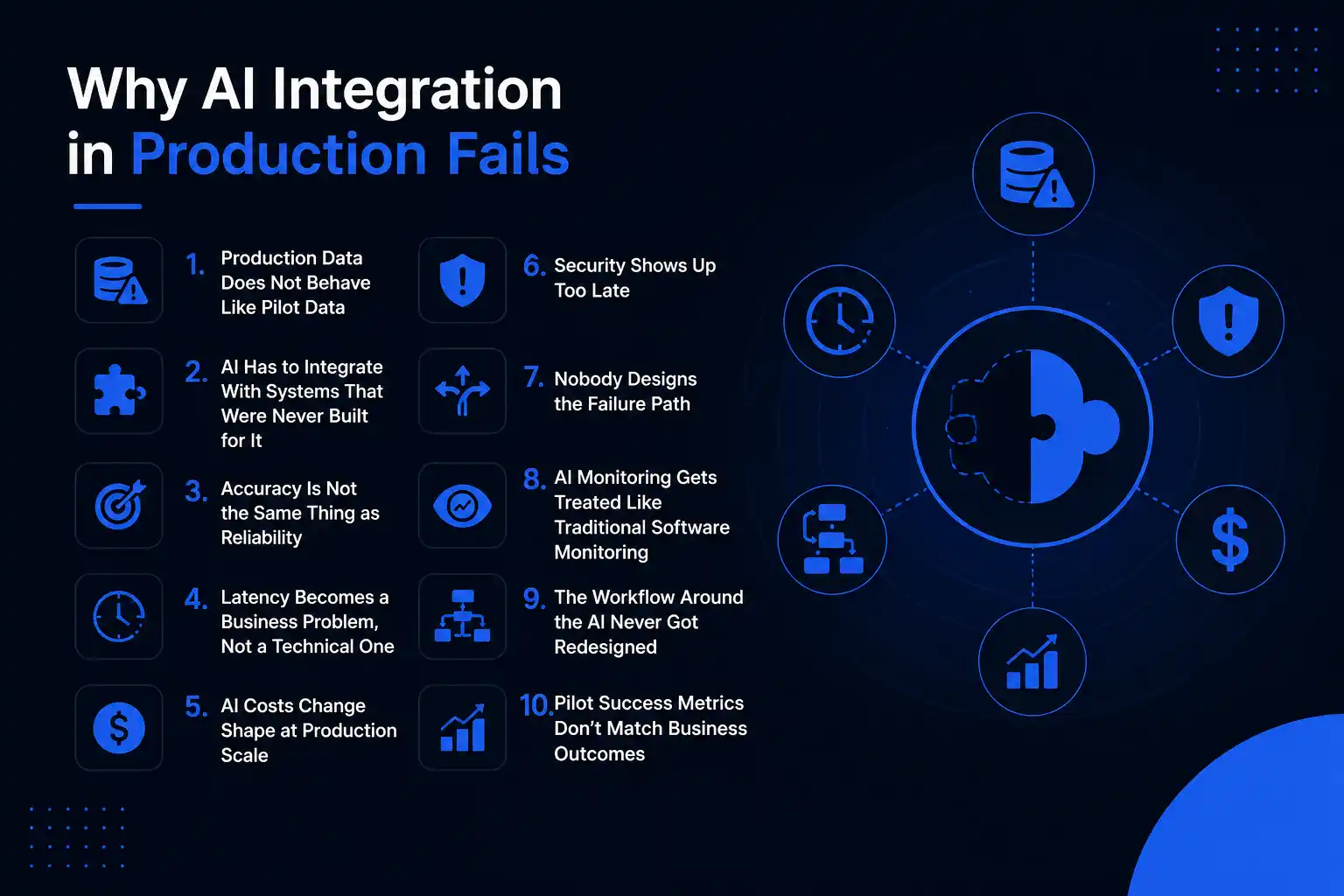
This is where the real work sits. Each of the following is a place where a pilot's assumptions quietly stop holding.
1. Production Data Does Not Behave Like Pilot Data
Pilot data is usually chosen because it's clean. Production data is whatever actually shows up: fields that are sometimes empty, formats that change without notice, records that were accurate six months ago and aren't anymore. A model trained or prompted against a stable, curated dataset can degrade as the live inputs drift away from that baseline, a problem practitioners generally call data drift.
Production systems also have to deal with permission boundaries the pilot never enforced, unclear data lineage (where did this number actually come from, and can you prove it), and inputs that need to be current to the minute rather than current as of last month's export. A model that looked accurate in testing can produce confidently wrong answers once the data underneath it shifts, and nothing in a typical pilot is designed to catch that.
2. AI Has to Integrate With Systems That Were Never Built for It
In most enterprises, the AI model is a small part of the architecture it has to operate inside. It has to talk to CRMs, ERPs, identity systems, legacy databases, and internal tools that were built years before anyone imagined a model calling them. Some of those systems have brittle APIs.
Some have none, and require screen scraping or manual export. Event-driven systems expect predictable message shapes; a model's output isn't always predictable in that sense. A pilot usually integrates with one clean system, often through a purpose-built connector. Production has to survive the other nineteen systems the pilot never touched.
3. Accuracy Is Not the Same Thing as Reliability
"The model answered correctly during testing" and "the system can handle a hundred thousand unpredictable requests safely" are different claims, and pilots only prove the first one. Reliability is about what happens at the edges: the input nobody anticipated, the output that's technically plausible but wrong, the retry logic when a downstream call times out, the graceful degradation when the model is unavailable. Language models are also non-deterministic by nature (the same prompt can produce different outputs on different runs), which is a property pilots rarely stress-test because pilots don't run enough volume to expose it. Production does.
4. Latency Becomes a Business Problem, Not a Technical One
A response that takes four seconds in a demo is a minor annoyance. A response that takes four seconds inside a live customer call, a checkout flow, or a support agent's screen is a workflow problem: the human or system on the other end has already moved on, or the interaction has already timed out.
Pilots rarely test latency under concurrent load, because pilots rarely have concurrent load. Production does, and the model that seemed instant in a one-on-one demo can slow to a crawl once real traffic multiplies calls to retrieval systems, tool integrations, and the model itself.
5. AI Costs Change Shape at Production Scale
A pilot's inference bill is a rounding error. A production system running continuous inference, embeddings generation, vector search, retries, and human review at real volume is a recurring operating cost that has to be modeled like any other infrastructure line item. Gartner has pointed to escalating costs as one of the direct reasons generative AI projects get abandoned after the proof-of-concept stage, alongside poor data quality and unclear business value, and it has separately noted that transformative generative AI use cases can run into the tens of millions of dollars once an organization moves past narrow productivity gains.
The useful reframe here is to stop measuring cost per model call and start measuring cost per successful business outcome: what it actually costs, including retries, escalations, and human review, to resolve one ticket, approve one claim, or complete one transaction end to end.
6. Security Shows Up Too Late
Security review in a pilot is often a formality, because the pilot doesn't touch sensitive data or make consequential decisions. Production does both. The OWASP Top 10 for LLM Applications lists prompt injection as the top risk facing LLM-based systems, alongside sensitive information disclosure, supply chain vulnerabilities, and what it calls excessive agency, meaning a model has been given more permission or autonomy than the surrounding controls can safely support. None of these risks are visible in a pilot with five test users and no write access to real systems. They become visible the moment a production AI system can read customer records, write to a database, or take an action on someone's behalf, which is exactly when it's hardest to retrofit security in.
7. Nobody Designs the Failure Path
This is the one organizations skip most often, and it tends to matter most. What happens when the model is uncertain? What happens when an upstream API fails mid-request? What happens when the AI generates a recommendation that isn't safe to act on? Who receives that exception, and how fast do they need to respond?
A pilot doesn't need answers to these questions, because a person is already watching. Production needs an actual designed path: escalation rules, human-in-the-loop checkpoints for high-stakes decisions, fallback behavior when confidence drops, retry logic with limits, and a queue for exceptions that has an owner, not just a destination. NIST's AI Risk Management Framework frames this as a lifecycle problem rather than a one-time check: risk management has to continue through deployment, use, and ongoing evaluation, not stop once the model is judged accurate enough to ship.
8. AI Monitoring Gets Treated Like Traditional Software Monitoring
Uptime and response time are necessary, but they don't tell you whether the AI is still doing its job well. Production AI systems need monitoring for things traditional application monitoring was never built to track: output quality, hallucination rates, retrieval quality in RAG systems, model and data drift, token consumption and cost per interaction, failed tool calls, how often users have to correct the AI's output, and how often cases escalate to a human.
A system can be "up" in the traditional sense (responding, no errors in the logs) while quietly getting worse at the actual task. Without that layer of monitoring, nobody notices until the business metric moves.
9. The Workflow Around the AI Never Got Redesigned
Bolting an AI call onto a workflow that was already inefficient rarely fixes the inefficiency. It usually just adds a new step to a process that still has the same handoffs, the same approval bottlenecks, and the same manual review it had before. McKinsey's 2025 State of AI survey found that among organizations seeing the most value from AI, the common thread wasn't a better model. It was a willingness to set growth or innovation goals alongside efficiency and to actually redesign how work gets done, rather than layering AI on top of the existing process. Organizations that skip that redesign step tend to get a modest, forgettable improvement instead of the outcome they built the business case around.
10. Pilot Success Metrics Don't Match Business Outcomes
A pilot measures "87% answer accuracy." Production has to answer a different question: did support resolution time actually go down, and without pushing more cases into escalation? Model accuracy and revenue impact are not the same measurement. Automation rate and exception workload are not the same measurement. Response quality and customer satisfaction are related, but they're not interchangeable. An organization that never translates its pilot metric into a business metric has no real way to know, once it's in production, whether the system is working.
A Realistic Production Scenario
Consider a company piloting an AI customer support agent against 500 curated tickets. It performs well: clean language, correct resolutions, fast responses. The team is happy. It moves to production and starts processing 50,000 real customer conversations a month.
Now it runs into incomplete customer records that were never a problem in the curated set. Conversations happen in multiple languages the pilot didn't test. Some customers are angry, and the model's calm, helpful tone reads as dismissive rather than professional. A payment API times out under real concurrent load in a way it never did during a handful of test calls. Refund requests arrive that don't fit any of the patterns the pilot covered.
Some customers ask for things the model isn't permitted to approve, and there's no clear escalation path for that yet. Ambiguous questions (the kind a human agent would ask a follow-up about) get answered anyway, because nobody built in a mechanism for the model to say "I need more information" instead of guessing.
The model itself hasn't gotten worse. The environment got more realistic, and the system around the model was never built to absorb that realism.
Model Success vs. System Success
It's worth separating these explicitly, because a lot of pilot-to-production failure comes from optimizing only the first one.
Model success is usually measured by accuracy, precision, recall, benchmark performance, or subjective response quality.
System success is measured by reliability under real load, latency, cost per outcome, security posture, escalation rate, actual business impact, user adoption, maintainability over time, compliance, and how quickly the system recovers when something breaks.
A team can hit every model-success target and still AI strategies fail at system success, because the two are measuring different things. Production AI needs both: a capable model inside a system that can carry it reliably.
The Production AI Readiness Test
Before moving a pilot into production, it's worth working through these questions as a group, not individually. A gap in any one category tends to surface as a production incident later.
Data readiness
Where does production data actually come from, and how current does it need to be?
What happens when a required field is missing or malformed?
Integration readiness
Which systems does this workflow actually touch end to end, not just the one the pilot connected to?
What's the fallback when one of those integrations is unavailable?
Reliability
What's the target response time and success rate under real concurrent load, not pilot-level load?
How does the system behave when the model is nondeterministic on the same input twice?
Security
What data can this system read, and what can it write or act on?
Has anyone tested it against prompt injection or unauthorized tool use?
Governance
Who approves what the AI is allowed to do, and how is that enforced technically, not just in policy?
Is there an audit trail for what the system decided and why?
Observability
Beyond uptime, what output-quality signals are being tracked continuously?
How would the team know if quality degraded gradually rather than failing outright?
Cost economics
What's the fully loaded cost per successful outcome, including retries and human review?
Does that cost hold up at ten times pilot volume?
Human intervention
Where exactly does a human need to be in the loop, and why there specifically?
How fast does a human need to respond once a case is escalated?
Failure recovery
What happens when the model, the retrieval layer, an API, or a downstream system fails?
Is there a rollback path if the system needs to be pulled from production quickly?
Business metrics
What business outcome is this system actually supposed to move, in numbers?
How will that be measured after launch, not just during the pilot?
Ownership
Who owns this system once it's live, not who built it, but who's on call for it?
What happens when engineering, security, and the business process owner disagree about a tradeoff?
Scaling
What breaks first at ten times current volume: cost, latency, human review capacity, or something else?
Has that been tested, or assumed?
A technology leader who can't answer most of these with specifics, rather than intentions, has a pilot that isn't ready for production yet, regardless of how good the model looked in the demo.
Who Actually Owns Production AI
Production AI is not a data science deliverable. By the time a system is live, it typically involves the AI or ML team that built the model logic, software engineering that built the surrounding application, a DevOps or platform team running the infrastructure, security reviewing access and risk, legal and compliance signing off on regulatory exposure, a data team responsible for the pipelines feeding it, product defining what the system is supposed to do, operations running the day-to-day process, and the business process owner who's accountable for the outcome the system is meant to improve.
Unclear ownership across that list is itself a production risk. When an AI system fails at 2 a.m. and nobody is sure whether that's a data science problem, an infrastructure problem, or a business process problem, the response is slow precisely when speed matters most. Assigning ownership after launch is too late; it needs to be settled before the system takes its first real production request.
Before You Move From Pilot to Production: A Checklist
Has the system been tested against real, messy production data, not the cleaned pilot dataset?
Have all the actual production integrations been tested, including the ones the pilot skipped?
Has security reviewed data access, prompt injection exposure, and what the system is permitted to do autonomously?
Are permissions scoped to what the system actually needs, not broader defaults?
Is there continuous monitoring for output quality and cost, not just uptime?
Is there a defined, tested failure path for every major failure mode, not just the ones encountered during the pilot?
Is there a clear escalation process with an owner and a response-time expectation?
Has cost per successful outcome been modeled at real production volume?
Has the system been load-tested at expected peak concurrency?
Is there a governance process that can actually enforce policy, not just document it?
Is there a tested rollback plan if the system needs to be pulled from production?
Are business KPIs defined and instrumented, separate from the pilot's model-accuracy metric?
Is ownership assigned across engineering, security, and the business process owner, in writing?
The Real Insight Behind the Pilot-to-Production Gap
Getting a model to work is, at this point, the easy part. MIT's Project NANDA found in its July 2025 study of enterprise generative AI that despite $30 to $40 billion in enterprise investment, roughly 95% of organizations were seeing no measurable profit-and-loss return from generative AI initiatives, with only a small slice of integrated pilots extracting real value. The researchers were explicit that this divide wasn't primarily about model quality. It tracked back to whether organizations had built systems that could learn, adapt, and hold up inside real workflows. McKinsey's 2025 survey tells a similar story from a different angle: 88% of organizations now use AI in at least one function, but roughly two-thirds haven't begun scaling it across the enterprise, and only about 39% report any enterprise-level EBIT impact at all.
Getting AI to work reliably inside a real organization, repeatedly, safely, affordably, and under real governance, is a harder engineering and operational problem than getting a model to answer correctly in a demo. That's not a discouraging conclusion. It's a useful one, because it points at what actually needs to change.
The organizations that close the pilot-to-production gap tend to stop treating production as the final step and start treating it as a design constraint from day one. Data pipelines, integration points, failure handling, security posture, cost economics, and governance aren't things to add after the pilot succeeds. They're the difference between a model that works and an AI integration in production that actually holds up once real users, real data, and real volume show up.
Frequently Asked Questions
Why do AI pilots fail in production?
Pilots succeed under conditions production doesn't have: curated data, small user groups, limited integrations, and a human nearby to catch mistakes. Production removes those guardrails and exposes gaps in data quality, system integration, failure handling, monitoring, and cost that the pilot was never designed to test.
What is the difference between an AI pilot and production AI?
A pilot proves a model can produce good results under controlled conditions. Production AI has to prove the entire system (data pipelines, integrations, security, monitoring, and governance) can operate reliably at real scale, continuously, and inside a real organization's constraints.
What are the biggest AI integration challenges?
The recurring ones are data that behaves differently in production than in testing, integration with legacy systems never designed for AI, undefined failure and escalation paths, cost that scales faster than expected, and workflows that were never redesigned around what the AI can actually do.
How do you move an AI project from pilot to production?
Start by defining production-scale requirements for data, integration, security, and monitoring before scaling up, not after. Use a structured readiness review across data, reliability, security, governance, cost, and ownership, and tie success to a measurable business outcome rather than the pilot's model-accuracy score.
What makes an AI system production-ready?
A production-ready AI system has tested integrations with the real systems it depends on, a defined failure and escalation path, continuous monitoring beyond uptime, enforced security and access controls, a sustainable cost per successful outcome, and clear ownership across engineering, security, and the business.
How should companies measure production AI success?
Business outcomes, not model metrics. Resolution time, escalation rate, cost per successful outcome, and adoption tell you more about whether an AI system is working than accuracy on a test set ever will.
Why is enterprise AI integration difficult?
Because the model is only one part of a much larger system. Enterprise AI has to work inside legacy infrastructure, satisfy security and compliance requirements, hold up under real user behavior and transaction volume, and produce outcomes that can be measured and defended, none of which a pilot is built to test.
Read Also:
Why AI Doesn't Have a Data Problem, It Has a Trust Problem
Agentic AI Trust: How Do You Know Who You're Talking To?
Comments (0)
No comments yet. Be the first to share your thoughts!