MCP vs API: What Changes in the AI Agent Era?

Author
Ravi Prajapati
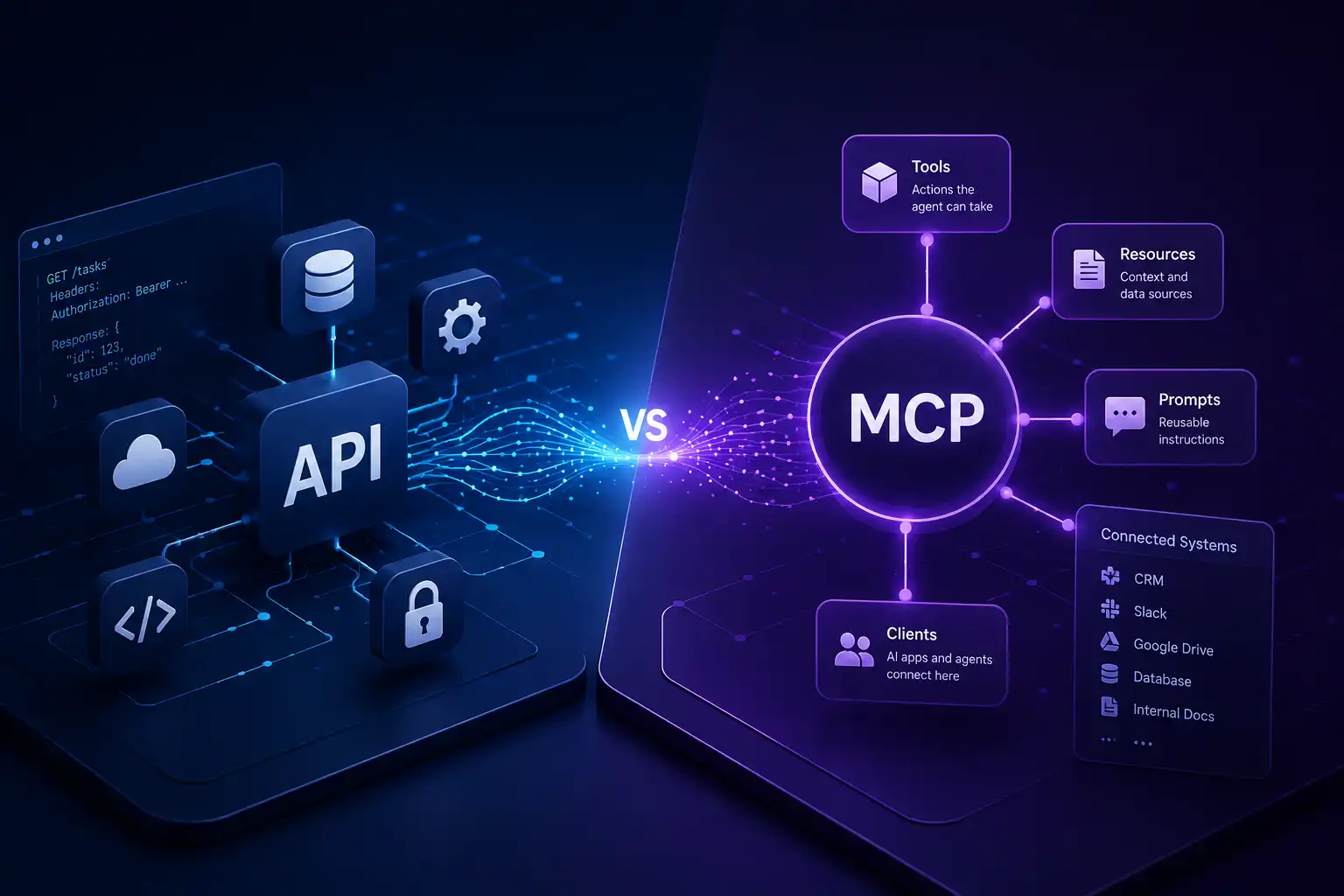
MCP vs API explained: how the Model Context Protocol works with REST APIs, not against them, plus architecture, security risks, and a decision framework.
An API lets one software system request data or actions from another, with each service defining its own interface. MCP (Model Context Protocol) is an open standard that lets AI applications discover and use external tools and context through one uniform protocol. MCP does not replace APIs; MCP servers typically call existing APIs behind the scenes.
APIs solved a specific problem: they gave one piece of software a reliable, documented way to talk to another. That model has powered the internet economy for two decades, and nothing about it is broken.
AI agents introduce a different problem. An agent that drafts emails, updates a CRM, checks a calendar, and files tickets does not just need to call services. It needs to discover what tools exist, understand what each one does, pull in relevant context, and work across many systems without every single connection becoming a bespoke engineering project. Traditional API integration was never designed for a consumer that decides at runtime which capability to use.
This is the gap the Model Context Protocol (MCP) was built to fill. Introduced by Anthropic in November 2024 and now governed by the Linux Foundation's Agentic AI Foundation, MCP has been adopted by ChatGPT, Gemini, Microsoft Copilot, Cursor, VS Code, and thousands of other products in under two years.
So the real question behind every "MCP vs API" search is this: if APIs already connect software, why does the AI agent ecosystem need another protocol? The answer is more interesting, and more practical, than a simple head-to-head comparison.
MCP vs API: The Short Answer
An API is a general-purpose interface that lets one software system request data or actions from another. MCP (Model Context Protocol) is an open standard that defines how AI applications discover and use external tools, data, and context through a single, consistent protocol. MCP does not replace APIs. In most real deployments, an MCP server sits in front of existing APIs and translates them into a format AI applications understand natively.
The simplest mental model:
API = a way for software systems to communicate.
MCP = a standardized way for AI applications to discover and use external context, tools, and capabilities.
This is a simplification. MCP is technically a protocol with API-like characteristics, and the two routinely work together in the same architecture. The rest of this article explains where each fits.
What Is an API?
An API (Application Programming Interface) is a contract that defines how one program can request something from another. The requesting program does not need to know how the other system works internally. It only needs to know what to ask for and what format the answer will arrive in.
In practical web development, most APIs follow a client-server pattern over HTTP. The client sends a request to an endpoint, a specific URL representing a resource or action. The server processes it and returns a response, usually as JSON.
A weather app illustrates the whole idea in one line:
GET /weather?city=Ahmedabad
The app sends this request to a weather service's API. The service looks up current conditions and returns structured data: temperature, humidity, forecast. The flow is always the same:
Application → API request → service → API response → application
A few terms worth knowing:
REST APIs are the dominant style. They use standard HTTP methods (GET, POST, PUT, DELETE) against resource-based URLs and typically exchange JSON.
GraphQL is an alternative that lets clients specify exactly which fields they want in a single query, reducing over-fetching.
Authentication controls who can call the API, commonly through API keys, OAuth tokens, or signed requests.
Schemas and contracts (such as OpenAPI specifications) document what endpoints exist, what parameters they accept, and what they return.
SDKs are language-specific libraries that wrap an API so developers can call functions instead of constructing raw HTTP requests.
None of this is going anywhere. Every mobile app, web application, and backend service you use today runs on APIs, and that will remain true in the agent era.
What Is Model Context Protocol (MCP)?
One-sentence definition: MCP is an open protocol that standardizes how AI applications connect to external tools, data sources, and systems.
Technical definition: MCP is an open, JSON-RPC-based protocol in which an AI application (the host) runs clients that connect to servers exposing three kinds of capabilities: tools the model can invoke, resources that provide context, and reusable prompts. The protocol defines discovery, invocation, transport, and authorization in a uniform way, so any compliant client can use any compliant server.
Anthropic open-sourced MCP in November 2024 to address a problem every team building AI assistants had hit independently: connecting a model to real systems meant writing custom glue code for each combination of AI application and external service. Ten AI apps and a hundred tools could, in the worst case, mean a thousand separate integrations.
The protocol's designers drew inspiration from the Language Server Protocol, which solved a structurally similar problem for code editors. Before LSP, every editor needed a custom plugin for every programming language. After LSP, a language server written once worked across all compatible editors. MCP applies the same logic to AI tooling: build a server for your CRM once, and any MCP-compatible AI application can use it.
In December 2025, Anthropic donated MCP to the Agentic AI Foundation (AAIF), a directed fund under the Linux Foundation co-founded by Anthropic, Block, and OpenAI, with support from Google, Microsoft, AWS, Cloudflare, and Bloomberg. That move matters for enterprises: the protocol is no longer controlled by a single vendor.
People often describe MCP as "USB-C for AI applications," a universal connector replacing a drawer full of proprietary cables. The analogy captures the standardization benefit well, but it undersells one thing: USB-C is a passive physical standard, while MCP defines active behaviors like capability negotiation, structured tool results, and user consent flows. It is a protocol, not just a plug shape.
How Does MCP Work?
MCP defines a small set of roles and capability types. Understanding five terms covers most of the architecture.
MCP Host
The host is the AI application itself: a chat interface, an IDE assistant, an agent runtime. The host coordinates everything, manages security and user consent, and decides which servers to connect to.
MCP Client
For each server connection, the host runs an MCP client. The client maintains the session with one server, handles the protocol messages, and relays capabilities back to the host. One host can run many clients simultaneously, one per connected server.
MCP Server
A server is a program that exposes capabilities to AI applications. A GitHub MCP server might expose repository search and issue creation. A database server might expose query tools and schema resources. Servers can run locally (communicating over stdio) or remotely (over HTTP). Critically, what a server does behind the scenes is its own business: it may call REST APIs, run SQL, read files, or invoke SDKs.
Tools
Tools are actions the AI application can invoke on the model's behalf: search a CRM, create a task, query a database, send a message. Each tool ships with a name, a description, and a typed input schema, which is what allows a model to understand what the tool does and how to call it correctly.
Resources
Resources are contextual data a server makes available for reading: documents, database records, files, application state. Where tools are verbs, resources are nouns. They give the AI application material to reason over without executing an action.
Prompts
Prompts are reusable, server-defined templates and workflows, such as a standardized code review prompt or a report-generation flow, that users or applications can invoke. Tools, resources, and prompts remain the three core server primitives in the current specification (version 2026-07-28), which also added an extensions framework covering optional capabilities like long-running Tasks and interactive MCP Apps.
Put together, the flow looks like this:
User
  ↓
AI Application / Agent (MCP Host)
  ↓
MCP Client
  ↓
MCP Server
  ↓
API / Database / SaaS / Files / Internal Systems
The user asks for something. The host, guided by the model, determines that an external capability is needed. The relevant client sends a standardized request to its server. The server does the actual work, often by calling an ordinary API, and returns a structured result the model can use.
MCP vs API: Key Differences
The comparison below is deliberately balanced. MCP does not win every row, because it is not trying to do everything an API does.
Factor | Traditional API | MCP |
|---|---|---|
Primary purpose | General software-to-software communication | Connecting AI applications to tools and context |
Typical consumer | Applications written by developers | AI applications and the models inside them |
Communication model | Request/response per endpoint, service-defined | JSON-RPC messages over stdio or HTTP, protocol-defined |
Discovery | Read the docs; machine discovery varies by API | Built in; clients list available tools, resources, and prompts at runtime |
Tool exposure | Endpoints, described in external documentation | Self-describing tools with schemas the model can read |
Context access | Not a native concept; each API handles data differently | First-class resources and prompts |
Integration standardization | Every API differs in auth, format, and conventions | One protocol across all compliant servers |
AI-agent suitability | Requires custom glue per API | Designed for agent consumption |
Auth and security | Mature, battle-tested patterns (OAuth, keys, mTLS) | OAuth-based authorization; newer, still hardening with each revision |
Reusability | SDK reuse within one service's ecosystem | One server reusable across all MCP-compatible AI apps |
Developer effort | Well understood; enormous existing tooling | Lower per-AI-integration once a server exists; server must be built first |
Underlying systems | Is often the underlying system | Frequently wraps APIs, databases, and files |
Latency and volume | Excellent for high-volume, low-latency service traffic | Adds a layer; not built for high-frequency machine-to-machine calls |
Best use cases | Apps, backends, public platforms, deterministic workflows | AI assistants, agents, copilots, multi-tool workflows |
Two rows deserve emphasis. On raw performance and maturity, APIs remain the better choice for deterministic, high-volume communication between services. On agent integration, MCP's runtime discovery and self-describing tools remove work that every AI team otherwise duplicates.
MCP vs REST API: Are They Competing Technologies?
Not directly, and the comparison is slightly category-confused, which is worth unpacking because so many people search for it.
REST is an architectural style for networked services. It defines conventions: resources identified by URLs, standard HTTP verbs, stateless requests. A REST API is a service designed around those conventions for any client that speaks HTTP.
MCP is a protocol for a specific relationship: AI application to external capability. It defines message formats, capability discovery, and interaction patterns for that relationship, and it says nothing about how the capability is implemented.
Which means the two usually stack rather than compete:
AI Agent
  ↓ MCP
CRM MCP Server
  ↓ REST API
CRM Platform
The agent speaks MCP. The MCP server speaks REST to the CRM. The CRM's REST API required zero changes to participate in the agent ecosystem; someone simply wrote an MCP server in front of it.
This architecture matters for a practical reason. Companies have spent twenty years building, securing, and scaling REST APIs. MCP lets them expose that investment to AI applications through a thin standardized layer instead of rebuilding anything. Interestingly, the protocol has also been converging with ordinary web infrastructure: the 2026-07-28 revision made MCP stateless by default precisely so that standard HTTP load balancers, gateways, and caches can route MCP traffic like any other web traffic.
Why Traditional APIs Worked Well Before the AI Agent Era
Consider a developer who wants their application to create a task in a project-management platform. The workflow is familiar:
Read the API documentation.
Configure authentication and store credentials safely.
Identify the right endpoint, say
POST /tasks.Build the request with the correct fields.
Parse the response.
Handle errors, rate limits, and retries.
Write the application logic that decides when to create a task.
This works because the developer makes every decision at build time. The application will only ever call the endpoints it was programmed to call, with the logic it was programmed to have. The integration is a known quantity: predictable, testable, optimizable.
That assumption, decisions made at build time by a human, is exactly what breaks when the consumer of the integration is a model.
What Changes When AI Agents Enter the Picture?
A useful enterprise agent might need access to Gmail, Slack, GitHub, a CRM, calendars, databases, cloud storage, internal documentation, analytics, and support systems. And unlike a conventional application, the agent decides at runtime which of these to use, in what order, based on a natural-language request it has never seen before.
Without a standard, connecting M AI applications to N external systems requires up to M × N custom integrations, because every AI app implements tool calling slightly differently and every external API has its own conventions. Each integration also needs AI-specific glue: translating the API's surface into tool definitions the model can understand, formatting responses so the model can reason over them, and handling errors in a way an agent can recover from.
A standard collapses that multiplication. Each AI application implements the protocol once (M implementations). Each external system gets one server (N implementations). M + N instead of M × N.
To be clear about what MCP does not do: it does not write the server for you, it does not design good tool descriptions for you, and it does not eliminate authentication, permissions, or testing. The integration work still exists. What disappears is the duplication of that work across every AI application that wants the same capability.
What Problem Does MCP Actually Solve?
Breaking the value down into specific problems keeps the discussion honest.
1. Standardized tool discovery
Traditionally, developers hard-code which functions an AI app can call. With MCP, a client asks a server what tools it offers and receives structured definitions at runtime. Limitation: discovery only surfaces what a server chooses to expose, and poorly described tools confuse models just as poorly documented APIs confuse developers.
2. Standardized tool invocation
Every AI framework historically had its own function-calling format. MCP defines one invocation pattern with typed schemas and structured results. Limitation: the host still needs logic for consent, error handling, and result presentation.
3. Context and resource access
APIs return data on request but have no shared concept of "context for a model." MCP's resources and prompts give servers a uniform way to offer background material. Limitation: deciding which context is relevant remains the application's problem.
4. Reusable integrations
A traditional integration is welded to one application. An MCP server built for GitHub works in Claude, ChatGPT, Cursor, VS Code, and any other compliant host. This is the strongest network effect in the ecosystem: more than 10,000 active public MCP servers existed by late 2025, per Anthropic's donation announcement.
5. Less AI-specific glue code
Teams previously wrote adapters translating each API into each framework's tool format. A compliant server makes that translation once, for everyone. Limitation: someone still has to build and maintain the server.
6. Portability across AI applications
Enterprises can switch or mix AI hosts without rebuilding their integration layer. Limitation: portability applies to the integration surface, not to prompts, agent logic, or model behavior, which remain host-specific.
7. Easier capability expansion
Adding a capability to an agent becomes "connect another server" rather than "start another integration project." Limitation: every added server expands the security surface, which the security section below takes seriously.
API vs MCP: A Real-World Example
Take a hypothetical sales AI agent that needs to check CRM records, read relevant emails, check calendar availability, search internal sales documentation, and create follow-up tasks.
Traditional API approach
The engineering team integrates five separate APIs: the CRM's REST API, an email API, a calendar API, an internal search service, and a task platform's API. Each has its own authentication, schema, and quirks. On top of that, the team writes tool definitions for their chosen AI framework, response formatters, and orchestration logic. If they later move from one AI framework to another, much of the AI-facing layer gets rewritten.
MCP approach
If compatible servers exist for these systems, and for popular SaaS platforms they increasingly do, the team connects five servers to their MCP-compatible host. The model discovers each server's tools automatically. The team's engineering effort concentrates on agent behavior, permissions, and evaluation rather than plumbing.
Hybrid reality
Look inside those five MCP servers and you will find the same five APIs from the first scenario. The CRM server calls the CRM's REST API. The calendar server calls the calendar API. Nothing about the underlying services changed.
The APIs did not disappear. The interface presented to the AI system changed.
Does MCP Replace APIs?
No.
Several concrete reasons:
Existing APIs remain critical infrastructure. Every website, mobile app, and microservice architecture depends on them, and none of those consumers benefit from speaking MCP.
Backend-to-backend integration still belongs to APIs. Two services exchanging millions of deterministic requests per hour need the performance and maturity of direct API communication, not a protocol layer designed for model-mediated interaction.
MCP servers depend on APIs. Remove the API layer and most MCP servers have nothing to call. The protocol is a consumer of APIs at least as much as an alternative to them.
MCP's relevance is concentrated at one layer: where AI applications meet external capabilities. That layer barely existed three years ago, which is why a new standard could emerge there without displacing anything.
If an analogy helps: APIs are the roads connecting services. MCP gives AI applications a consistent map and set of driving rules for using those roads. The map does not replace the roads, and the roads are useless to an agent without something like the map. Like all analogies here, it breaks down if pushed too far, since MCP also defines behaviors no map has, but the layered relationship is the right intuition.
When Should You Use a Traditional API?
Direct API integration remains the right default for:
Deterministic application workflows
If your code always calls the same endpoints with predictable logic, a protocol for dynamic discovery adds nothing.
Backend service integration
Microservices, data pipelines, and server-to-server communication need throughput and low latency, not model-readable tool descriptions.
Mobile and web applications
A React frontend or Android app talks to your backend over REST or GraphQL. No AI application sits in that path.
High-volume transactions
Payment processing, telemetry ingestion, and similar workloads are optimized API territory.
Public developer platforms
If you want the broadest possible developer audience, a well-documented API serves everyone, including future MCP servers built on top of it.
Anything that is not AI-mediated
This covers most software, and will for a long time.
When Should You Use MCP?
MCP earns its place when an AI application is the consumer:
AI assistants that need external context
A support copilot reading knowledge bases and ticket history benefits directly from resources and tools.
Agents using multiple tools
The more systems an agent touches, the more the M + N economics favor a standard.
Developer assistants and coding agents
IDE assistants in VS Code, Cursor, and similar tools use MCP to reach repositories, issue trackers, and documentation.
Enterprise copilots
One set of internal MCP servers can serve every approved AI application in the company, with consistent governance.
Local AI tools needing controlled resource access
MCP's stdio transport lets a local server expose specific files or databases to an AI app without opening network services.
Prerequisites worth stating plainly: you need an MCP-compatible host, servers for your target systems (existing or built), and a real security review before anything touches production data. MCP without those is just a spec document.
When Should You Use MCP and APIs Together?
For most organizations deploying AI agents against real business systems, this is not an edge case. It is the default architecture:
AI Agent
  ↓
MCP
  ↓
MCP Server
  ↓
REST / GraphQL / SDK / Database
  ↓
Business System
Three practical examples:
Internal CRM copilot
A company wants sales staff to query and update the CRM conversationally. Rather than granting the AI host raw API credentials, they build an internal MCP server that exposes a curated set of tools (search accounts, log activity, draft follow-up) and enforces role-based permissions. The server calls the CRM's existing REST API with scoped credentials. The API layer, and its security model, stays exactly where it was.
SaaS vendor exposing an AI surface
A project-management platform already has a public REST API. To meet customers inside ChatGPT, Claude, and Copilot, it ships an official MCP server wrapping that API. One server, every major AI host, zero changes to the core platform.
Engineering organization with mixed consumers
The data team's services expose APIs consumed by dashboards, pipelines, and now an internal analytics agent. The dashboards keep calling the APIs directly. The agent goes through an MCP server that adds query guardrails and audit logging. Same underlying services, two appropriate interfaces.
The pattern generalizes: APIs serve deterministic consumers directly, MCP serves model-mediated consumers through a governed layer, and both run on the same infrastructure.
Why MCP Is Especially Relevant to AI Agents
Agentic systems stress every weakness of ad-hoc integration. An agent working through a multi-step task needs to discover available capabilities, understand them well enough to choose correctly, invoke several tools in sequence, pull context between steps, and do all of this across systems that were never designed together. MCP standardizes each of those touchpoints, which is why agent platforms adopted it faster than any other category.
One clarification the hype often skips: MCP connects capabilities. The model and the agent system determine how those capabilities are selected and orchestrated. The protocol contributes no reasoning, planning, memory, or autonomy. A badly designed agent with excellent MCP servers is still a badly designed agent. What MCP changes is that the connection layer stops being the bottleneck, and stops being rebuilt for every project.
MCP vs Function Calling / Tool Calling
These terms get tangled, so here is the clean separation.
Function calling (tool calling) is a model capability. Given a list of tool definitions, a model can output a structured request to invoke one, such as create_task with specific arguments. The model never executes anything; it emits intent.
Tool schemas are the definitions the model reads: name, description, typed parameters.
MCP operates one layer out. It standardizes where tool definitions come from (servers), how the application discovers them, and how invocation requests are transported, executed, and returned.
External APIs sit one layer further out still, doing the actual work.
The full flow ties them together:
Model decides to use a tool (function calling)
  ↓
AI application receives the tool request
  ↓
MCP client forwards it to the appropriate MCP server
  ↓
Server executes, often by calling an external API
  ↓
Result returns through the client to the application and model
Function calling and MCP are complements, not competitors. Function calling is how a model expresses intent; MCP is how an application ecosystem fulfills that intent consistently.
MCP vs RAG: Different Problems
Retrieval-Augmented Generation (RAG) is a technique for improving model outputs by retrieving relevant documents, typically via embeddings and vector search, and injecting them into the prompt. It answers the question: how does the model get the right knowledge for this query?
MCP answers a different question: how does an AI application connect to external tools and data sources in a standard way?
They intersect naturally. A RAG pipeline can be exposed as an MCP tool (search_knowledge_base), letting any compliant AI application use it. MCP resources can feed documents into a retrieval system. But MCP is not a retrieval technique, and RAG is not an integration protocol. Teams evaluating "MCP or RAG" are usually asking the wrong question; most serious deployments use both.
Is MCP Secure? Security Risks Businesses Should Understand
This is the section where honest coverage matters most, because the security research on MCP is substantial and not reassuring by default.
The most important distinction: what the protocol provides versus what implementers must build around it. The specification defines OAuth-based authorization, requires user consent flows for tool execution, and has hardened with each revision (the 2025-06-18 release classified MCP servers as OAuth resource servers and added a dedicated security best practices section; the 2026-07-28 release tightened authorization further). None of that makes a deployment secure on its own.
The documented risk categories:
Prompt injection through tool results. When an agent reads external content, a document, a web page, a ticket, that content enters the model's context. Malicious instructions embedded there can steer the agent into unintended tool calls, including exfiltrating data through legitimate tools. Security researchers have demonstrated this class of attack against production agents, and Microsoft's developer guidance treats it as a primary MCP threat.
Tool poisoning. Attackers embed hidden instructions in a tool's own metadata, its description or parameter definitions, which models read but users typically never see. Academic work in 2025 and 2026, including the MCPTox benchmark built on real-world MCP servers, found that leading models followed poisoned tool instructions at high rates and rarely refused, with more capable models sometimes more vulnerable because they follow instructions better.
Rug pulls. A server behaves legitimately during review, then quietly changes its tool definitions after being trusted. Because many clients re-fetch definitions dynamically, an approved server is not a permanently safe server.
Excessive permissions and confused deputies. An MCP server holding broad credentials becomes a high-value target, and an agent with wide tool access can be manipulated into misusing legitimate authority.
Supply-chain risk. Thousands of community servers exist. Installing an unvetted server is running someone else's code with access to your data, the same trust problem as any package ecosystem, amplified by credential access.
A practical checklist for teams deploying MCP:
Vet and pin server sources; prefer official or audited servers, and monitor for definition changes.
Apply least privilege everywhere: scoped API credentials per server, minimal tool sets per agent, per-user authorization rather than shared service accounts.
Require human approval for consequential actions (sending messages, modifying records, spending money).
Log every tool invocation with inputs and outputs, and make the logs reviewable.
Treat all tool results as untrusted input; where possible, isolate agents that read external content from tools that can act on sensitive systems.
Test agents against injection scenarios before production, not after.
Establish an internal review process for adding new servers, the same way you review new dependencies.
The honest summary: MCP gives security teams a standard surface to govern, which is genuinely better than dozens of bespoke integrations with inconsistent controls. It also concentrates risk at that surface. Neither the protocol nor any vendor makes agent security automatic.
What MCP Means for Enterprises
For enterprises, MCP's appeal is mostly organizational rather than technical. Internal AI assistants need access to CRM, ERP, HR systems, knowledge bases, databases, analytics, and support platforms. Before a standard existed, each AI initiative negotiated that access separately, and platform teams fielded the same integration requests repeatedly.
The realistic benefits:
One integration layer, many AI applications. An internal MCP server for the data warehouse serves every approved copilot, present and future.
Governance at a chokepoint. Access policies, credential handling, and audit logging live in the server layer, not scattered across projects.
Vendor flexibility. Because MCP is governed by the Linux Foundation's Agentic AI Foundation rather than any single AI vendor, and every major host supports it, the integration layer survives a change of AI provider.
Faster experimentation. New agent ideas connect to existing servers in days rather than waiting on integration sprints.
The realistic challenges, all reported by early enterprise adopters and researchers:
Identity and authorization. Mapping "which user, through which agent, may perform which action" onto OAuth flows and existing IAM systems is genuinely hard, and the protocol's authorization model is still maturing.
Shadow MCP servers. Developers can spin up local servers trivially. Without policy, ungoverned servers with production credentials appear, the new shadow IT.
Tool sprawl and quality. Fifty connected servers exposing hundreds of tools degrade agent performance and multiply risk. Curation is an ongoing job.
Observability and audit. Regulators will not accept "the agent decided to" as an explanation. Logging, tracing, and review tooling around MCP is improving but young.
Enterprises that treat MCP as a governed platform capability, with an owning team, a server review process, and real audit infrastructure, are positioned well. Those that treat it as a plugin free-for-all are accumulating incidents.
Who Is Supporting MCP?
Adoption claims age quickly, so the following reflects verifiable positions as of mid-2026.
Anthropic created MCP and supports it across Claude products, Claude Code, and the Claude API.
OpenAI adopted MCP in March 2025 across its Agents SDK, Responses API, and ChatGPT. CEO Sam Altman announced it simply: "People love MCP and we are excited to add support across our products." A competitor adopting a rival's standard was the ecosystem's decisive moment.
Google confirmed Gemini support in April 2025, with DeepMind CEO Demis Hassabis calling it a rapidly emerging open standard for the agentic era, and Google Cloud has since built MCP support into its developer tooling.
Microsoft supports MCP across Copilot, Visual Studio Code, and Azure services, and publishes MCP security guidance for developers.
The Linux Foundation now governs the protocol through the Agentic AI Foundation (established December 2025), co-founded by Anthropic, Block, and OpenAI with backing from Google, Microsoft, AWS, Cloudflare, and Bloomberg.
Developer tools and SaaS platforms including Cursor, Replit, Sourcegraph, Linear, GitHub, and Zapier ship MCP integrations, and an official community registry now indexes public servers.
Scale indicators from primary sources: Anthropic reported more than 10,000 active public MCP servers at the time of the Linux Foundation donation, and MCP's maintainers reported roughly half a billion monthly SDK downloads across the official TypeScript and Python SDKs by July 2026.
MCP Limitations: What the Hype Often Misses
A balanced assessment requires naming what MCP has not solved.
Security is the headline limitation. As covered above, the attack surface is real, documented, and only partially mitigated by the protocol itself.
Server quality is wildly inconsistent. Anyone can publish a server. Tool descriptions range from excellent to actively misleading, and a model is only as effective as the descriptions it reads.
Context overhead is real. Every connected server's tool definitions consume context window. Hosts have developed mitigations (lazy loading, tool search), but connecting many servers still carries a cost in tokens, latency, and model confusion.
The protocol is still moving. Five specification revisions shipped between November 2024 and July 2026, including a foundational rework of the transport layer. A formal deprecation policy now exists, which helps, but teams should expect continued churn and version negotiation complexity.
Enterprise authorization remains the hardest unsolved area. Fine-grained, per-user, per-tool permissioning across organizational boundaries is where most serious deployments report friction.
Debugging distributed agent behavior is immature. When an agent misbehaves across a chain of host, client, server, and API, pinpointing the failure is harder than debugging a conventional integration.
None of these are fatal. All of them are reasons to deploy deliberately rather than enthusiastically.
The Future of MCP in the AI Agent Ecosystem
What follows is analysis, not fact.
The strongest argument that MCP becomes the durable interoperability layer for AI applications: the network effects are already compounding. Every new server increases the value of every compliant host, all three major AI labs are invested, and neutral governance under the Linux Foundation removes the biggest historical reason cross-vendor standards fail. Standards with this breadth of adoption at this stage (HTTP, OAuth, LSP) have tended to entrench.
The counterarguments deserve equal weight. Agent architectures are young, and a protocol designed around today's host-client-server model may fit tomorrow's multi-agent systems awkwardly; complementary protocols for agent-to-agent communication are already emerging. Security incidents at scale could stall enterprise adoption. And the history of technology includes dominant early standards that were later displaced by simpler alternatives once the problem was better understood.
Plausible near-term developments, based on the protocol's public roadmap and current ecosystem activity: richer server registries and marketplaces, hardened identity and fine-grained permission systems, enterprise gateway products that centralize MCP governance, and SaaS vendors treating an official MCP server as a standard product surface alongside their API.
Could MCP become a common interoperability layer for AI applications? The evidence currently points that way, with security and enterprise authorization as the two variables most likely to change the trajectory.
MCP vs API: Which Should You Choose?
Situation | API | MCP | Both |
|---|---|---|---|
Building a mobile application | ✔ | ||
Connecting backend services | ✔ | ||
Building an AI assistant with external context | ✔ | often ✔ | |
Building a multi-tool AI agent | ✔ | usually ✔ | |
Exposing a public developer platform | ✔ | add MCP for AI reach | |
Connecting an agent to internal CRM | ✔ | ||
AI coding assistant integrations | ✔ | ||
High-volume deterministic transactions | ✔ | ||
Enterprise AI copilot across systems | ✔ |
As a decision tree:
Are you building a traditional application integration? → Start with an API.
Are you exposing capabilities or context specifically to AI applications? → Consider MCP.
Does your AI integration depend on existing SaaS or backend services? → MCP in front of those APIs is the likely architecture.
Treat this as a starting heuristic. Real decisions should weigh your host platform, security requirements, and whether quality servers already exist for your systems.
5 Common Misconceptions About MCP
1. "MCP replaces APIs." It layers on top of them. Most MCP servers are API clients themselves, and non-AI software has no reason to stop using APIs directly.
2. "MCP makes an AI model autonomous." MCP transports capability information and invocations. Reasoning, planning, and orchestration come from the model and agent framework, not the protocol.
3. "MCP is only for Claude." It launched at Anthropic, but ChatGPT, Gemini, Copilot, Cursor, VS Code, and many other hosts support it, and the Linux Foundation now governs it.
4. "Every API should become an MCP server." Only capabilities that AI applications will consume benefit. Wrapping a high-volume internal service in MCP for its own sake adds latency and surface area for nothing.
5. "Connecting an MCP server makes an agent secure." The opposite risk is more accurate: each server extends the attack surface. Security comes from vetting, least privilege, approval flows, and logging, none of which the protocol provides automatically.
APIs Aren't Going Away, but the AI Integration Layer Is Changing
The MCP vs API framing suggests a contest that does not exist. APIs remain the fundamental mechanism of software communication, and they are the machinery running underneath most MCP servers in production today. What has changed is the arrival of a new kind of software consumer, one that discovers and selects capabilities at runtime, and that consumer needed an interface designed for how it works.
The key shift is worth stating precisely. The API era asked: how does my application call this service? The agent era asks: how can an AI application discover, understand, and safely use capabilities across many services? MCP is the ecosystem's current answer to the second question, now backed by every major AI lab and governed neutrally under the Linux Foundation.
APIs remain fundamental to software communication. MCP introduces a standardized integration layer designed around the needs of AI applications and agents. In many architectures, the future is unlikely to be MCP versus API. It will be MCP working with APIs.
Which leaves one question worth sitting with: if AI agents become a primary interface for software, will every major business platform eventually need an AI-native integration layer?
Frequently Asked Questions About MCP vs API
What is the difference between MCP and API?
An API is a general interface for software-to-software communication, defined individually by each service. MCP is one open protocol that standardizes how AI applications discover and use external tools, data, and context. APIs serve any programmatic client; MCP specifically serves AI applications, and MCP servers frequently call APIs internally to do their work.
Is MCP an API?
Technically, MCP is a protocol, a set of rules for communication, rather than a specific service interface. An MCP server does expose a programmatic interface, so in the broadest sense it is API-like. The practical distinction: an API's design is unique to each service, while MCP defines one uniform interaction model that all compliant servers and clients share.
Does MCP replace REST APIs?
No. REST APIs continue to power web applications, mobile apps, and backend integrations, none of which involve MCP. In AI architectures, MCP typically sits in front of REST APIs: an MCP server receives standardized requests from an AI application and fulfills them by calling the underlying REST API. The two work at different layers.
Why do AI agents need MCP?
Agents decide at runtime which tools to use, so they need to discover capabilities, read machine-usable descriptions, and invoke tools across many systems consistently. Without a standard, every AI application requires custom integration code for every external system. MCP reduces that M × N problem to M + N by defining one protocol both sides implement once.
Can MCP use REST APIs?
Yes, and this is the most common production pattern. An MCP server acts as a translation layer: it exposes standardized tools to AI applications and implements them by calling REST APIs, GraphQL endpoints, SDKs, or databases behind the scenes. Existing APIs need no changes to participate in the MCP ecosystem.
What is an MCP server?
An MCP server is a program that exposes capabilities to AI applications through the Model Context Protocol: tools the model can invoke, resources that provide context, and reusable prompts. Servers can run locally or remotely, and they typically wrap existing systems such as SaaS APIs, databases, or file systems. Over 10,000 public servers existed by late 2025.
What is an MCP client?
An MCP client is the component inside an AI application that maintains a connection to one MCP server, handling protocol messages, capability discovery, and tool invocations. The host application runs one client per connected server, so an assistant connected to GitHub, Slack, and a database runs three clients simultaneously.
Is MCP only for Claude?
No. Anthropic created MCP, but it is an open standard now governed by the Linux Foundation's Agentic AI Foundation. ChatGPT, Gemini, Microsoft Copilot, Cursor, VS Code, and many other AI applications support it, and OpenAI, Google, and Microsoft are all invested in its governance and development.
Is MCP open source?
Yes. The specification, official SDKs (TypeScript, Python, C#, and others), and reference servers are open source. In December 2025, Anthropic donated the protocol to the Agentic AI Foundation, a directed fund under the Linux Foundation, ensuring vendor-neutral, community-driven governance going forward.
Is MCP secure?
The protocol includes OAuth-based authorization and consent requirements, but security depends heavily on implementation. Documented risks include prompt injection through tool results, tool poisoning via malicious metadata, over-permissioned servers, and supply-chain threats from unvetted community servers. Safe deployment requires server vetting, least-privilege credentials, human approval for sensitive actions, and audit logging.
What is MCP in agentic AI?
In agentic AI, MCP serves as the standardized connection layer between agents and the external world. It handles tool discovery, invocation, and context retrieval so agents can work across many systems through one protocol. It does not provide reasoning, planning, or autonomy; those come from the model and the agent framework built around it.
MCP vs function calling: what's the difference?
Function calling is a model capability: given tool definitions, the model outputs structured requests to invoke them. MCP operates around that capability, standardizing where tool definitions come from, how applications discover them, and how invocations are executed against external servers. They work together: function calling expresses the model's intent, and MCP fulfills it.
MCP vs RAG: what's the difference?
RAG (Retrieval-Augmented Generation) is a technique for retrieving relevant documents and injecting them into a model's prompt to improve answers. MCP is an integration protocol connecting AI applications to tools and data sources. They solve different problems and combine well: a RAG pipeline can be exposed as an MCP tool that any compliant AI application can call.
Should developers learn MCP in 2026?
For developers working on AI applications, agents, or integrations, yes. MCP is supported by every major AI platform, governed by the Linux Foundation, and increasingly expected knowledge for agent engineering roles. Building a basic server takes a weekend with the official SDKs. Developers outside AI-adjacent work can reasonably wait, since traditional API skills remain fully relevant.
Sources / Further Reading
Model Context Protocol official specification (2026-07-28): https://modelcontextprotocol.io/specification/2026-07-28
MCP official blog, "The 2026-07-28 Specification": https://blog.modelcontextprotocol.io/posts/2026-07-28/
Anthropic, "Donating the Model Context Protocol and establishing the Agentic AI Foundation": https://www.anthropic.com/news/donating-the-model-context-protocol-and-establishing-of-the-agentic-ai-foundation
MCP specification releases and changelogs (GitHub): https://github.com/modelcontextprotocol/modelcontextprotocol/releases
TechCrunch, "OpenAI adopts rival Anthropic's standard for connecting AI models to data" (March 2025): https://techcrunch.com/2025/03/26/openai-adopts-rival-anthropics-standard-for-connecting-ai-models-to-data/
Microsoft Developer Blog, "Protecting against indirect prompt injection attacks in MCP": https://developer.microsoft.com/blog/protecting-against-indirect-injection-attacks-mcp/
arXiv, "Model Context Protocol Threat Modeling and Analyzing Vulnerabilities to Prompt Injection with Tool Poisoning" (2026): https://arxiv.org/abs/2603.22489
Comments (0)
No comments yet. Be the first to share your thoughts!