Agentic AI vs Generative AI: What's the Real Difference?

Author
Ravi Prajapati
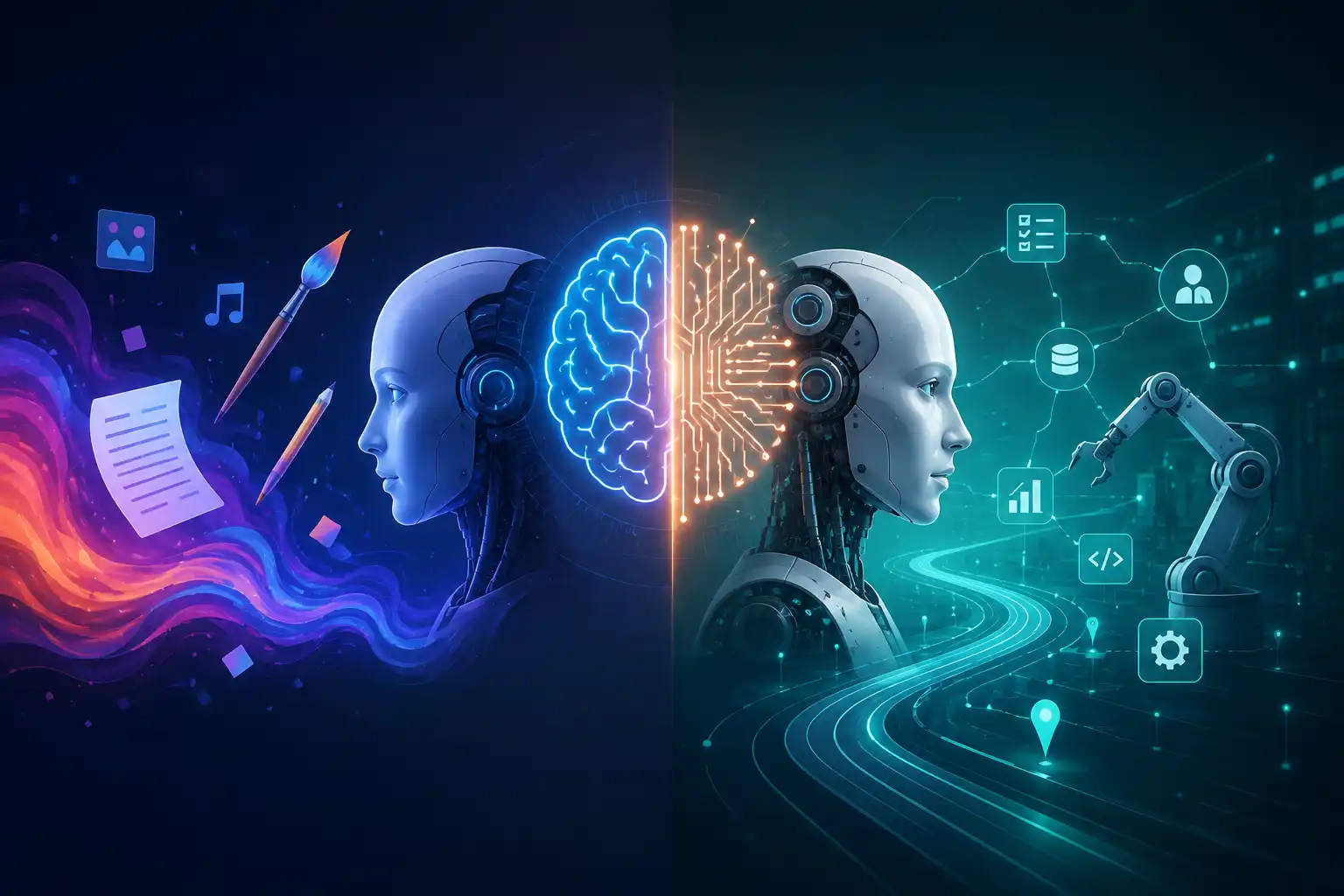
Agentic AI vs Generative AI explained with examples, a comparison table, and use cases to help you choose the right approach for your business.
A customer messages a support chatbot: "I want a refund for my last order."
A generative AI tool reads the message and writes a polite, well-formatted reply explaining the refund policy. That's it. The response ends there. A human still has to open the order, check the payment, process the refund, and update the customer record.
An agentic AI system does something different. It reads the request, checks the order status, verifies the payment, issues the refund through the payment gateway, updates the CRM, and sends a confirmation email — without a human clicking a single button.
Same starting point. Completely different outcome.
That gap is the core of the agentic AI vs generative AI debate, and it's becoming one of the most important distinctions in enterprise technology. Generative AI changed how we create content. Agentic AI is changing how work actually gets done.
In this article, you'll learn what separates the two, how each one works under the hood, where businesses are using them today, and how to decide which one — or which combination — fits your goals.
What Is Generative AI?
Generative AI is a class of artificial intelligence that creates new content — text, images, audio, video, or code — based on a prompt.
It doesn't take action in the world. It produces an output and stops. The person on the other end decides what happens next.
How Generative AI Works
Most generative AI tools are built on large language models (LLMs) or diffusion models, both trained on massive datasets.
Large language models (like the ones powering ChatGPT or Claude) are built on a transformer architecture. Transformers learn statistical relationships between words, allowing the model to predict the most likely next word or token, one at a time, based on the prompt and everything generated so far.
Diffusion models (used in tools like Midjourney or Adobe Firefly) work differently. They start with random noise and gradually refine it into a coherent image, guided by the text prompt.
In both cases, the workflow is a straight line: you send a prompt, the model processes it, and it returns an output.
Prompt
  ↓
LLM (or diffusion model)
  ↓
Generated Output
There's no persistent memory of past actions, no independent planning, and no ability to check whether the output is actually correct in the real world. The model doesn't know if the email it wrote was ever sent, or if the code it generated actually runs.
Strengths of Generative AI
Excellent at drafting, summarizing, translating, and brainstorming
Fast and relatively low-cost per task
Easy to integrate into existing apps through a simple API call
Requires no complex orchestration to get useful output
Limitations of Generative AI
Cannot independently verify facts or take real-world action
No persistent memory across sessions unless a system is built around it
Output quality depends heavily on prompt quality
Can hallucinate — produce fluent but incorrect information
Popular Examples
ChatGPT, Claude, Gemini, Midjourney, Adobe Firefly, and GitHub Copilot are all generative AI tools at their core. Some of these tools now have agentic features layered on top — more on that distinction below.
What Is Agentic AI?
Agentic AI refers to AI systems designed to pursue a goal with a degree of autonomy — planning steps, using tools, checking their own work, and adjusting course, largely without step-by-step human instruction.
Where generative AI answers a prompt, agentic AI pursues an objective.
The Building Blocks of an Agentic System
An agentic AI system typically combines several components on top of an LLM:
Goal interpretation — breaking a high-level request into a concrete objective
Planning — decomposing that objective into an ordered sequence of steps
Reasoning — deciding which action makes sense given the current state
Tool use — calling APIs, databases, browsers, or other software to take real action
Memory — retaining context from earlier steps, and sometimes from past sessions
Feedback loops — checking the result of an action and correcting course if it failed
Monitoring — tracking progress toward the goal until it's complete or a human is looped in
Some tasks call for a single agent. More complex workflows use multi-agent systems, where specialized agents — a research agent, a drafting agent, a review agent — coordinate to complete a larger process.
Goal
  ↓
Planner
  ↓
Reasoning
  ↓
Tool Selection
  ↓
Execution
  ↓
Memory Update
  ↓
Next Action (loop until done)
  ↓
Goal Completed
That loop — plan, act, observe, adjust — is what allows agentic AI to complete multi-step tasks that would otherwise require a human at every checkpoint.
It's worth being precise here: agentic AI is not a separate model type from generative AI. It's an architecture built around an LLM, adding planning, memory, and tool access so the model can act rather than just respond.
Agentic AI vs Generative AI: Comparison Table
Dimension | Generative AI | Agentic AI |
|---|---|---|
Purpose | Create content | Complete tasks and goals |
Output | Text, image, audio, video, code | Completed actions and outcomes |
Autonomy | Low — waits for a prompt each time | High — acts across multiple steps |
Planning | None built-in | Core capability |
Memory | Session-based or none | Persistent across steps/sessions |
Decision-making | Single-step prediction | Multi-step, conditional decisions |
Reasoning | Pattern completion | Goal-directed reasoning |
Workflow execution | Manual, human-driven | Automated, self-driven |
Goal orientation | Responds to a prompt | Pursues a defined objective |
Learning within a task | No adaptation mid-task | Adjusts plan based on outcomes |
External tool use | Rare, usually none | Central to operation |
API/system integration | Optional | Typically required |
Task complexity handled | Single, bounded tasks | Multi-step, cross-system tasks |
Human involvement | Required at every step | Required at checkpoints or exceptions |
Real-time decisions | Not applicable | Yes, based on live data |
Business automation fit | Content and drafting tasks | End-to-end process automation |
Enterprise readiness | Mature, widely deployed | Early stage, growing fast |
Scalability | Scales per request | Scales across workflows |
Relative cost | Lower per task | Higher — more compute and orchestration |
Typical examples | ChatGPT, Midjourney, Copilot | Customer service agents, coding agents, research agents |
Key advantage | Speed and creativity | End-to-end execution |
Key disadvantage | No real-world action | Higher complexity, higher failure risk |
Real-World Examples of Generative AI vs Agentic AI
Customer Support
Generative AI: Drafts a response to a customer complaint for a human agent to review and send.
Agentic AI: Reads the complaint, checks the order in the system, issues a refund or replacement, and closes the ticket.
Software Development
Generative AI: GitHub Copilot suggests a function as a developer types.
Agentic AI: A coding agent reads a bug report, locates the relevant files, writes a fix, runs the test suite, and opens a pull request.
Healthcare
Generative AI: Summarizes a patient's visit notes into a clean clinical summary.
Agentic AI: Monitors patient data, flags an abnormal lab result, schedules a follow-up appointment, and notifies the care team.
Finance
Generative AI: Writes a plain-language explanation of a quarterly earnings report.
Agentic AI: Monitors transactions for fraud patterns, freezes a suspicious account, and opens a case file automatically.
Retail and Ecommerce
Generative AI: Generates product descriptions for a new catalog.
Agentic AI: Tracks inventory across warehouses and automatically places reorders when stock crosses a threshold.
Manufacturing
Generative AI: Drafts a maintenance report from sensor logs.
Agentic AI: Detects a machine anomaly, schedules a technician, and adjusts the production line to prevent downtime.
Human Resources
Generative AI: Writes a job description from a hiring manager's notes.
Agentic AI: Screens incoming applications, schedules interviews with qualified candidates, and sends rejection or next-step emails.
Marketing
Generative AI: Produces ad copy variations for A/B testing.
Agentic AI: Runs the A/B test, analyzes results, reallocates budget to the winning variant, and reports performance weekly.
Education
Generative AI: Generates practice questions on a topic.
Agentic AI: Tracks a student's progress over weeks, adapts difficulty, and flags a tutor when the student is struggling.
Travel
Generative AI: Suggests a sample itinerary for a trip.
Agentic AI: Books flights and hotels that match a budget, monitors for schedule changes, and rebooks automatically if a flight is canceled.
Logistics
Generative AI: Summarizes shipment delays for a report.
Agentic AI: Reroutes a shipment in real time when a delay is detected and updates the customer automatically.
Legal
Generative AI: Drafts a first version of a standard contract clause.
Agentic AI: Reviews a contract against a compliance checklist, flags risky clauses, and routes it to the right reviewer.
Real Estate
Generative AI: Writes a property listing description.
Agentic AI: Matches buyers to new listings that fit their criteria and schedules viewings automatically.
Government
Generative AI: Drafts a public-facing FAQ from policy documents.
Agentic AI: Processes routine benefit applications end-to-end, verifying documents and flagging exceptions for human review.
Example Scenario: "I Want to Change My Flight"
Generative AI response: "I understand you'd like to change your flight. You can do this through the 'Manage Booking' section of our website, or I can share the change fee policy if that helps."
It's helpful. It's also just words — the customer still has to go do the work.
Agentic AI response: The system checks the booking, finds available flights matching the customer's new dates, confirms the change fee, processes the payment difference, rebooks the seat, and sends an updated confirmation — all inside the same conversation.
This is the clearest illustration of the agentic AI vs generative AI difference: one explains what to do, the other does it.
When Should Businesses Use Generative AI?
Generative AI is the right tool when the goal is content creation, ideation, or communication support, and a human will review the output before it goes anywhere.
Good fits include:
Drafting marketing copy, emails, or reports
Summarizing documents or meetings
Brainstorming ideas or outlines
Assisting developers with code suggestions
Creating images or design concepts
When Should Businesses Use Agentic AI?
Agentic AI makes sense when a process involves multiple steps, touches several systems, and needs to run without constant human input.
Good fits include:
End-to-end customer service resolution
Multi-step data processing and reporting
Autonomous monitoring and alerting
Workflow automation across CRMs, ERPs, and ticketing systems
Tasks that need to run continuously, including outside business hours
When Should Both Work Together?
In practice, most mature systems use both. A generative model drafts content; an agentic layer decides when to send it, to whom, and follows up based on the response.
Decision Matrix
If your task requires... | Use |
|---|---|
A single piece of content, reviewed by a human | Generative AI |
Fast experimentation with wording or ideas | Generative AI |
Multi-step execution across systems | Agentic AI |
Continuous monitoring and autonomous response | Agentic AI |
Content creation and automated distribution | Both, combined |
High-stakes decisions needing human sign-off | Agentic AI with a human-in-the-loop checkpoint |
Enterprise Benefits of Agentic AI
Businesses adopting agentic AI are reporting measurable gains, though the picture is uneven across organizations.
According to McKinsey's 2025 State of AI survey of nearly 2,000 organizations, 88 percent of respondents say their organizations regularly use AI in at least one business function, and 62 percent say their organizations are at least experimenting with AI agents. Functions further along in adoption are seeing real returns: McKinsey found that software engineering and IT teams report 10–20 percent cost reductions from AI deployment, while marketing and product development show revenue gains above 10 percent.
But scaling remains the hard part. The same survey found that only 23 percent of organizations are actively scaling an agentic AI system in at least one business function, with another 39 percent still experimenting.
Gartner projects the gap will close quickly. It forecasts that 40 percent of enterprise applications will be integrated with task-specific AI agents by the end of 2026, up from less than 5 percent in 2025. Looking further out, Gartner expects at least 15 percent of day-to-day work decisions to be made autonomously through agentic AI by 2028, up from 0 percent in 2024, and 33 percent of enterprise software applications to include agentic AI by that same year.
Deloitte's 2026 State of AI in the Enterprise survey of 3,235 leaders across 24 countries adds a workforce angle: by 2027, 74 percent of respondents expect their companies to be using AI agents at least "moderately," with 23 percent expecting extensive use. Most companies aren't buying off-the-shelf bots either — 85 percent expect to customize agents to fit the specific needs of their business.
The practical benefits organizations are chasing include:
Round-the-clock execution — agents don't need shifts or breaks
Faster resolution times for support and operational tasks
Lower operating costs in functions with high transaction volume
Better decision support, surfacing anomalies humans might miss
Scalability without proportional headcount growth
Challenges and Risks
None of this comes free. The same reports that highlight the upside are equally clear about the risks.
Hallucinations and reliability. Because agentic systems are built on LLMs, they inherit the same tendency to produce confident but incorrect output — except now that output can trigger a real action, not just a sentence.
Security and prompt injection. Giving an AI system access to tools and data expands the attack surface. A cleverly crafted input can potentially manipulate an agent into taking unintended actions.
Governance gaps. Deloitte found that only 21 percent of surveyed companies have a mature governance model for autonomous AI agents, even though 73 percent name data privacy and security as their top AI risk.
Project failure rates. Gartner is blunt about the current state of the market: it expects more than 40 percent of agentic AI projects to be canceled by the end of 2027 due to escalating costs, unclear business value, or inadequate risk controls.
Human oversight requirements. Autonomy doesn't mean zero supervision. Most enterprise deployments still require a human checkpoint for high-stakes or irreversible actions.
Cost. Multi-step agent workflows call more model requests and more tool calls than a single generative prompt, which adds up at scale.
Ethics and accountability. When an autonomous system takes an action — issuing a refund, freezing an account, rebooking a flight — someone still has to be accountable for the outcome. That's an organizational question as much as a technical one.
None of these challenges make agentic AI a bad bet. They make it a technology that needs deliberate governance, not blind rollout.
Future Trends: Where Agentic AI Is Headed
The infrastructure for agentic AI is maturing quickly, with several frameworks emerging as the plumbing behind enterprise agents:
OpenAI's Agents SDK and Google's Agent Development Kit for building and orchestrating agents
Microsoft AutoGen and LangGraph for multi-agent coordination and stateful workflows
CrewAI for role-based multi-agent collaboration
Model Context Protocol (MCP), an open standard for connecting AI models to external tools and data sources
Analysts are increasingly framing this as a shift toward "digital workers" — agents assigned to a function the way an employee would be, with accountability and defined scope, rather than a chatbot bolted onto a website.
Gartner's data and analytics predictions reinforce that trajectory: it expects GenAI and AI agent adoption to create the first serious challenge to mainstream productivity tools in three decades, prompting a $58 billion market shakeup through 2027. Longer term, it sees agentic ecosystems moving beyond single tasks — Gartner's best-case scenario has agentic AI driving close to 30 percent of enterprise application software revenue by 2035, up from about 2 percent in 2025.
Expect the next few years to bring more multi-agent orchestration — specialized agents handing off work to each other — and more enterprise investment in the governance layer needed to trust these systems with real decisions.
Common Myths About Agentic AI, Corrected
Myth: Agentic AI will replace most human jobs
Reality: Deloitte's research found leaders describing agents as "force multipliers" that extend what existing teams can do, rather than wholesale replacements. Most current deployments handle routine, well-defined tasks while escalating exceptions to people.
Myth: Generative AI is now outdated
Reality: Agentic AI is built on top of generative models. Every agent still relies on an LLM to reason and generate language. Generative AI isn't obsolete — it's a component inside a larger system.
Myth: AI agents "think" the way humans do
Reality: Agents follow structured loops of planning, action, and observation based on statistical prediction. They don't have goals, understanding, or awareness in the human sense, even when their output looks purposeful.
Myth: Every AI agent is fully autonomous
Reality: Autonomy exists on a spectrum. Most production systems today keep a human in the loop for high-risk or high-cost decisions, and only expand autonomy as trust and track record build up.
Myth: Agentic AI doesn't need large language models
Reality: The planning, reasoning, and language understanding inside an agent are almost always powered by an LLM. Without one, there's no reasoning engine to drive the loop.
Agentic AI vs Generative AI vs LLMs: How the Terms Relate
It helps to think of these as nested concepts rather than separate categories:
A large language model is the underlying engine trained to predict and generate language.
Generative AI is the broader category of systems — including LLMs, diffusion models, and others — that produce new content from a prompt.
Agentic AI is an architecture that wraps an LLM (or several) with planning, memory, and tool access so it can pursue a goal autonomously.
So an AI agent is generative AI, plus a control system for turning generated reasoning into real-world action.
Featured Snippet Answers
What is Agentic AI?
Agentic AI is an AI system that autonomously plans, decides, and executes multi-step tasks toward a goal, using tools and memory rather than just responding to a single prompt.
What is Generative AI?
Generative AI is AI that creates new content — text, images, audio, or code — in response to a prompt, without taking independent action afterward.
What is the difference between Agentic AI and Generative AI?
Generative AI produces content and stops; a human decides what happens next. Agentic AI plans and executes multi-step tasks on its own, using tools, memory, and reasoning to reach a goal.
Can Generative AI become Agentic AI?
Yes. Adding planning, memory, and tool access to a generative model — an LLM, for example — turns it into the reasoning core of an agentic system.
FAQ
1. What is Agentic AI?
An AI system that autonomously plans and executes multi-step tasks to reach a defined goal, using tools, memory, and feedback loops.
2. What is Generative AI?
AI that generates new content — text, images, audio, code — from a prompt, without acting further on its own.
3. Is ChatGPT Agentic AI?
By default, ChatGPT is generative AI — it responds to prompts. When it's connected to tools, plugins, or an agent framework that lets it plan and execute multi-step tasks, it functions as an agent.
4. Can ChatGPT become an AI Agent?
Yes, when paired with tool access, memory, and an orchestration layer — such as OpenAI's Agents SDK — a model like ChatGPT can operate agentically.
5. Do AI Agents use LLMs?
Almost always. The LLM provides the reasoning and language understanding; the agent framework adds planning, memory, and tool execution around it.
6. Which is better, Agentic AI or Generative AI?
Neither is universally better — they solve different problems. Generative AI is better for content creation reviewed by a human. Agentic AI is better for multi-step task execution.
7. Can businesses combine both?
Yes, and most mature systems do. Generative AI often produces the content or analysis; agentic AI decides when and how to act on it.
8. What industries benefit most from Agentic AI?
Customer support, finance, logistics, healthcare, and software development show some of the clearest early returns, largely because their workflows involve repeatable, multi-step processes.
9. Is Agentic AI expensive?
It typically costs more than a single generative AI call, since it involves multiple reasoning steps, tool calls, and orchestration. Costs vary widely based on task complexity and how many agents are involved.
10. Will Agentic AI replace SaaS?
More likely, agentic AI will change how SaaS products work internally rather than eliminate them — many platforms are embedding agents directly into their existing software.
11. Are AI agents safe to deploy in production?
They can be, with the right guardrails — human checkpoints for high-stakes actions, monitoring, and access controls. Deployed without governance, they carry meaningful risk.
12. What's the difference between a single agent and a multi-agent system?
A single agent handles one workflow end-to-end. A multi-agent system splits the work across specialized agents — for example, a research agent and a writing agent — that coordinate to complete a larger task.
13. Does Agentic AI require custom development?
Often, yes. Most surveyed enterprises report customizing agents to fit specific internal workflows rather than deploying generic, off-the-shelf agents.
14. What is the Model Context Protocol (MCP)?
MCP is an open standard that lets AI models connect to external tools, data sources, and applications in a consistent way, making it easier to build agentic systems that can act across different software.
15. How do businesses measure ROI on Agentic AI?
Common metrics include task completion rate, time saved per process, error/exception rate, and direct cost or revenue impact in the specific function where the agent operates.
Conclusion
Generative AI and agentic AI aren't competitors — they're two layers of the same technology stack, built for different jobs.
Generative AI is the fastest way to create content, get a first draft, or explore ideas. It's mature, affordable, and easy to bolt onto almost any product today.
Agentic AI is what turns that content and reasoning into completed work — across systems, without a human clicking through every step. It's earlier in its adoption curve, harder to govern, and more expensive to run, but it's where the next wave of enterprise value is concentrated.
For developers: start by understanding how planning, memory, and tool-calling layer on top of the LLMs you already know.
For business leaders: match the tool to the task — don't force agentic complexity onto a job that only needs a good draft.
For startups: the biggest opportunities right now are in narrow, well-defined agentic workflows, not general-purpose autonomous systems.
For enterprises: governance and human-in-the-loop checkpoints matter as much as the technology itself — the organizations pulling ahead are the ones treating agentic AI as an operating model change, not just a new tool.
The direction is clear: AI is moving from producing answers to completing work. The businesses that understand the distinction between generative and agentic AI — and deploy each where it actually fits — will be the ones that capture the value, instead of just experimenting with it.
Read Also:
AI Agents Market Size & Statistics
AI Agents for Dental Clinics: Automating Patient Intake and Reminders
AI Agents vs AI Workflows: What's the Difference?
Comments (0)
No comments yet. Be the first to share your thoughts!