AI Agents vs AI Workflows: What's the Difference? (A Complete Guide)

Author
Ravi Prajapati
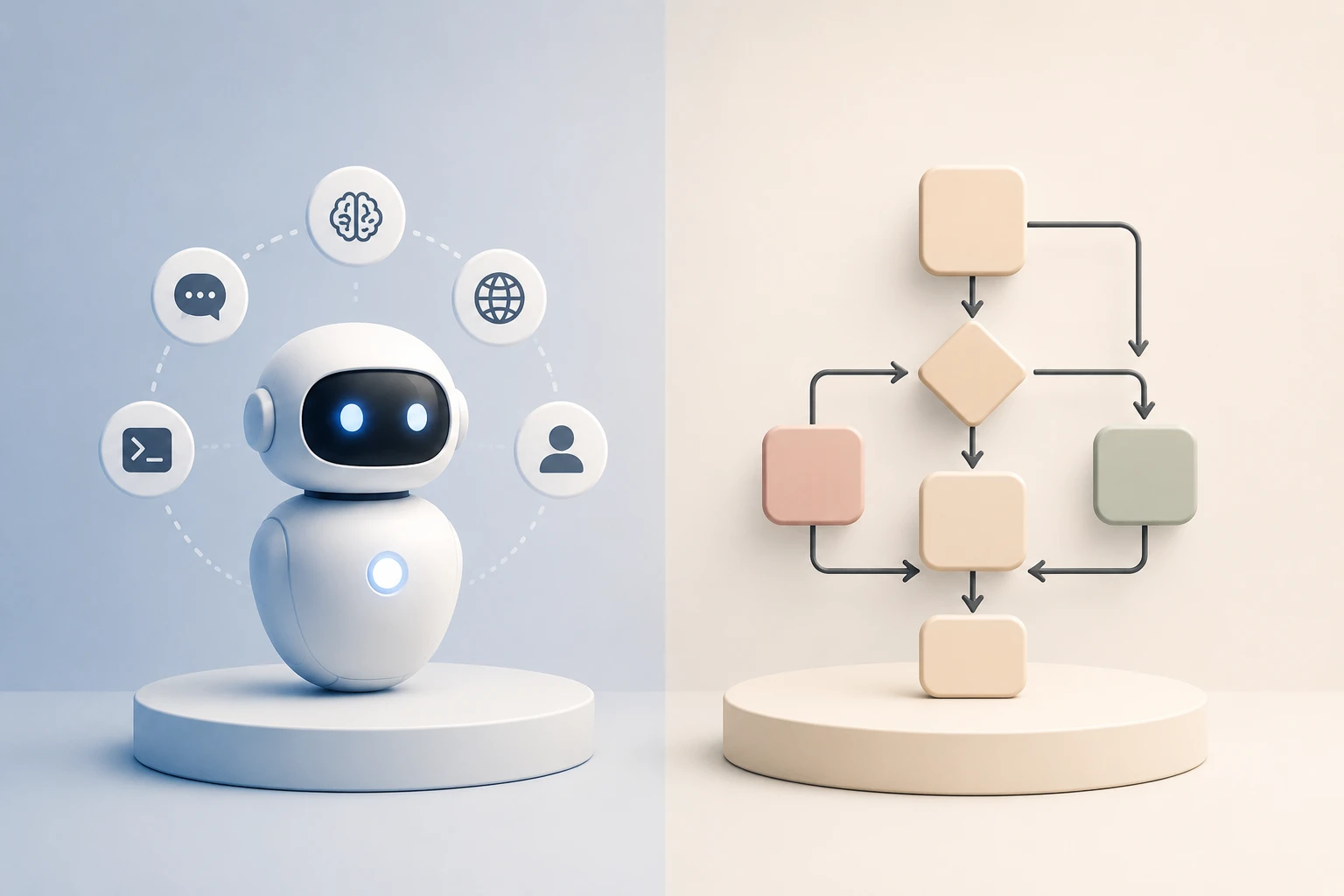
Learn the difference between AI agents and AI workflows, how they work, key use cases, benefits, and which is best for automation in 2026.
You have heard both terms tossed around in the same breath: AI agents and AI workflows. Developers use them interchangeably. Business leaders confuse them in slide decks. Even experienced AI practitioners sometimes blur the line between the two.
But the difference is not just semantic. Understanding what separates an AI agent from an AI workflow shapes how you build, deploy, and scale intelligent systems. It changes the tools you choose, the risks you take on, and the outcomes you can realistically promise stakeholders.
This guide breaks it all down clearly so that whether you are building, buying, or evaluating AI systems, you know exactly what you are working with.
What Is an AI Workflow?
An AI workflow is a structured, predefined sequence of steps in which AI plays a role at one or more stages. The overall logic, the order of operations, and the decision boundaries are set in advance by a human designer or developer. AI is a component inside a larger, deterministic process.
Think of it like a factory assembly line. Each station does a specific job. The belt moves in one direction. If something breaks at station three, the process stops or reroutes as designed. No station improvises.
A Practical Example of an AI Workflow
Imagine a customer support ticket system:
A user submits a support ticket via a web form.
A classifier model (AI step one) reads the ticket and labels it as "billing," "technical," or "general."
A routing rule (logic step) sends billing tickets to the billing queue and technical tickets to the engineering queue.
A language model (AI step two) generates a suggested reply for the agent to review and send.
The human agent approves or edits the reply and closes the ticket.
This is an AI workflow. The AI handles classification and drafting. The structure, routing, and approval are all predefined. The system cannot decide on its own to, say, issue a refund or escalate a ticket outside the defined rules. It does what the workflow says to do.
Key Characteristics of AI Workflows
Deterministic structure
The same input will follow the same path through the system every time, unless a human changes the rules.
Human-defined decision boundaries
Developers decide in advance what the system can and cannot do. The AI does not expand its own scope.
Predictable and auditable
You can trace exactly why an output was produced. This makes AI workflows ideal for regulated industries where explainability matters.
Composable with existing tools
AI workflows slot into existing software pipelines using APIs, webhooks, or automation platforms like n8n, Zapier, Make, or Apache Airflow.
Lower risk tolerance required
Because outputs are more predictable, AI workflows are appropriate for production systems handling sensitive tasks where a mistake is costly.
What Is an AI Agent?
An AI agent is an autonomous system that perceives its environment, reasons about a goal, and takes sequences of actions to achieve that goal, often without being told exactly how to proceed step by step.
Unlike a workflow, an AI agent is not simply executing a predetermined script. It is deciding what to do next based on what it observes. It can use tools, browse the web, write and execute code, call APIs, retrieve documents, and chain its own reasoning across multiple steps to reach an outcome.
The word "agent" comes from the Latin "agere," meaning to act. An AI agent acts on behalf of a user or system to accomplish a task.
A Practical Example of an AI Agent
You give an AI agent the goal: "Research the top five competitors in the B2B SaaS project management space and produce a comparison report."
The agent might:
Decide to search the web for "best B2B project management software 2026."
Visit five competitor websites, read their pricing and features pages.
Notice one competitor recently raised a funding round and decide (on its own) to include that context.
Draft a structured comparison table.
Identify that it is missing data on integrations, search again, fill the gap.
Produce a final report with citations.
No human told it to check funding news. No human told it to search again when it found a gap. The agent reasoned through the task and adapted its approach based on what it found. That autonomy is the defining characteristic.
Key Characteristics of AI Agents
Goal-directed autonomy
The agent is given an objective, not a script. It decides how to achieve the objective.
Dynamic planning
Agents plan, act, observe the result, and replan. This is often called the "ReAct" loop (Reason + Act).
Tool use
Modern AI agents use tools: web search, code execution, file reading, API calls, memory retrieval, and more. The agent chooses which tool to use and when.
Context awareness
Agents track state across multiple steps. They remember what they have already done and use that memory to inform the next action.
Non-deterministic path
Two runs of the same agent on the same task may take different paths to the same (or similar) outcome. This flexibility is a feature and a risk simultaneously.
Higher potential, higher unpredictability
Agents can accomplish tasks that no fixed workflow could handle because the task itself may not be fully defined in advance.
AI Agents vs AI Workflows: Side by Side Comparison
Dimension | AI Workflow | AI Agent |
|---|---|---|
Structure | Fixed, predefined sequence | Dynamic, decided at runtime |
Autonomy | Low (rule-bound) | High (goal-directed) |
Decision-making | Human-defined logic | Model-driven reasoning |
Adaptability | Rigid (changes need redeployment) | Flexible (adapts mid-task) |
Predictability | High | Lower |
Risk level | Lower | Higher |
Best for | Repetitive, structured tasks | Open-ended, complex tasks |
Observability | Easy to trace | Requires dedicated monitoring |
Cost per task | Lower (fewer LLM calls) | Higher (multi-step reasoning) |
Time to build | Faster (known steps) | Longer (more engineering required) |
Human oversight | Often built in | Must be explicitly designed in |
Where the Confusion Comes From
The terms are genuinely blurry at the edges, and here is why.
Modern agents are often embedded inside workflows
A workflow might handle the overall process logic while an AI agent handles one particularly complex task within that workflow. So you end up with an agent inside a workflow, and people describe the whole thing by whichever label feels more impressive.
"Agentic" is a spectrum, not a binary
A system that asks a clarifying question before proceeding is slightly more agentic than one that does not. A system that decides which tools to use is more agentic than one that calls a fixed set of APIs. There is no bright line where a sophisticated workflow becomes a true agent.
Marketing inflates the term
"AI agent" sounds better in a product pitch than "AI-assisted workflow." This leads to tools that are essentially complex workflows being marketed as agents, which muddies the conceptual waters for everyone.
The most honest framing: workflows are about execution; agents are about judgment. When you need reliable execution of a known process, use a workflow. When you need judgment to navigate an unknown or partially known problem, use an agent.
Multi-Agent Systems: When Agents Work Together
A single AI agent has limits. It can only hold so much context. It can only specialize so much. The most powerful AI systems today are increasingly multi-agent systems, where multiple specialized agents collaborate to complete complex tasks.
In a multi-agent architecture:
An orchestrator agent receives a high-level goal and breaks it into subtasks.
Specialist agents handle each subtask (one for web research, one for code generation, one for writing, one for quality review).
Results are passed between agents and synthesized into a final output.
This mirrors how high-performing human teams work. You do not hire one person to do everything. You build a team with complementary skills and a coordinator who manages the flow.
Multi-agent systems combine workflow-like coordination at the top level with agent-like autonomy at the task level. Understanding the agent vs. workflow distinction helps you design these architectures well.
When Should You Use an AI Workflow?
Choose an AI workflow when:
The process is well-understood and repeatable
If you can draw a clear flowchart of the steps, a workflow is the right tool. Content moderation pipelines, document classification, data extraction, invoice processing, and automated reporting all fit this profile.
Auditability is essential
If you need to explain exactly why a decision was made, a workflow with defined logic is far easier to audit than an agent whose reasoning happened inside a multi-step language model chain.
Cost efficiency matters
Workflows typically make fewer LLM calls per task because the structure is defined. If you are processing thousands or millions of items, the cost difference between a well-designed workflow and a free-running agent can be enormous.
Mistakes are expensive
In medical, legal, financial, or safety-critical contexts, the lower unpredictability of a workflow is worth the tradeoff in flexibility.
You need reliable SLAs
Agents can spend variable amounts of time on a task. Workflows run in more predictable time windows, which matters for latency-sensitive applications.
When Should You Use an AI Agent?
Choose an AI agent when:
The task is open-ended or not fully defined
If you cannot write a complete flowchart of the steps before the task runs because those steps depend on what the agent discovers along the way, an agent is required.
The task requires judgment across diverse information
Researching a topic, analyzing a situation, generating a strategy, debugging an unfamiliar codebase: these require the kind of contextual reasoning that agents excel at.
You want to automate work that currently requires a skilled human
Not a data entry clerk, but a research analyst, a software engineer, a customer success manager. If the job requires decision-making based on incomplete information, an agent is the appropriate model.
The task benefits from iteration
Agents can check their own work, notice gaps, and try again. For tasks where quality matters more than speed, this self-correction loop adds significant value.
You are exploring what is possible
Agents are better suited to exploratory tasks where the right approach is not known in advance, either by you or by the system.
Real-World Use Cases: Matching the Right Model to the Right Problem
AI Workflow Use Cases
Email marketing automation
A user fills a form, a classifier categorizes their interest, a template selector picks the right email, a personalization model fills in the name and product recommendations, and the email is sent. Structured, repeatable, auditable.
Invoice data extraction
An OCR pipeline reads uploaded invoices, a vision model extracts line items, amounts, and vendor names, a validation step checks for anomalies, and results are pushed to accounting software. Thousands of invoices processed daily with consistent accuracy.
Content moderation at scale
User-generated content is passed through a series of classifiers, each checking for different policy violations. Flagged content is routed to human reviewers; clean content is approved automatically. Fast, consistent, explainable.
Medical report summarization
A structured workflow takes lab results, applies a summarization model with a clinical system prompt, passes the output through a safety filter, and presents a draft to a physician for review before any action is taken. Highly controlled.
AI Agent Use Cases
Competitive intelligence research
An agent is tasked with researching a new market entry opportunity. It searches the web, reads competitor websites, pulls recent news, analyzes pricing, and produces a strategic briefing. The steps vary depending on what it finds.
Software debugging
A developer agent is given a bug report and access to a codebase. It reads the relevant files, traces the execution path, forms a hypothesis, writes a test to confirm it, proposes a fix, and documents the change. The debugging path is not known in advance.
Customer-facing AI assistant
An agent handling customer queries can look up order history, check inventory availability, process returns, draft personalized responses, and escalate edge cases to human support. Each conversation is different.
End-to-end travel planning
An agent is given "plan a five-day trip to Japan in October for two people, budget $4,000." It searches flights, checks hotel availability and reviews, builds a day-by-day itinerary, and returns a complete plan with booking links. No fixed flowchart could anticipate every variable.
Common Mistakes When Building AI Agents and Workflows
Mistake 1: Building an Agent When a Workflow Would Do
Agents are compelling. They feel like the future. But for structured, repetitive tasks, a workflow is faster to build, cheaper to run, and far easier to debug. Over-agentifying a simple task adds complexity without benefit.
If you can write the steps on a whiteboard before you build, use a workflow.
Mistake 2: Giving an Agent Too Much Autonomy Too Early
Agents without guardrails can take unexpected actions. An agent with write access to a production database and no constraints on what it can modify is a serious risk. Start agentic experiments with read-only access, narrow scope, and human-in-the-loop checkpoints. Expand autonomy as trust is established through observation.
Mistake 3: Ignoring Observability
Workflows are naturally observable because the steps are defined. Agent reasoning is harder to trace. If you cannot see what an agent did and why, you cannot debug it when it fails, and it will fail. Invest in logging, tracing, and replay capabilities from day one.
Mistake 4: Treating Agents as Infallible
Language models hallucinate. Agents make wrong decisions. Tool calls fail. Any agent system deployed in production needs fallback handling, error recovery, and human escalation paths for cases the agent cannot handle confidently.
Mistake 5: Conflating "Agentic" with "Expensive"
Agents do not have to be expensive. A well-designed agent that uses efficient tool calls, caches repeated lookups, and terminates early when confidence is high can be cost-competitive with poorly designed workflows that make redundant calls.
The Future: Hybrid Systems and the Rise of Orchestrated Intelligence
The most sophisticated AI systems being built today are neither pure workflows nor pure agents. They are hybrid orchestrations: structured at the top level, agentic at the task level.
An orchestrator defines the overall goal and breaks it into phases. Each phase might be handled by a specialized agent that has its own tools, memory, and reasoning loop. The outputs of each agent feed into the next phase. A final synthesis step combines everything into a coherent result.
This architecture captures the reliability of workflows where reliability matters (handoffs between stages, quality gates, output validation) while enabling the flexibility of agents where flexibility matters (open-ended research, creative tasks, complex problem-solving within a phase).
Google's own guidance on emerging agentic experiences notes that protocols like the Universal Commerce Protocol (UCP) are emerging that will allow Search agents to do more, signaling that the infrastructure for AI agents to interact with the web is actively developing.
We are moving toward a world where AI agents do not just answer questions but take actions: booking reservations, comparing specifications, filling forms, and completing multi-step tasks on behalf of users. Businesses that understand this shift, and prepare their content and systems for it, will be better positioned in both traditional search and AI-powered discovery.
Key Takeaways: AI Agents vs AI Workflows
Here is the clearest summary of everything covered in this guide:
An AI workflow is a predefined sequence of steps where AI handles specific tasks within a human-designed structure. It is deterministic, auditable, cost-efficient, and best suited for repetitive, well-understood processes.
An AI agent is an autonomous system given a goal, with the ability to reason, plan, use AI tools, and adapt its approach based on what it discovers. It is flexible, powerful, and better suited for open-ended, complex tasks that cannot be fully scripted in advance.
The right choice depends on your task. Not every problem needs an agent. Not every process belongs in a rigid workflow. The best AI systems match the tool to the task and combine both approaches when the problem demands it.
Content and observability matter regardless of which you build. Whether you are creating content for AI agents to consume or building AI systems to produce value, the underlying principle is the same: be clear, be accurate, be genuinely useful.
AI Agents vs AI Workflows: Frequently Asked Questions
Can an AI workflow contain AI agents?
Yes. It is common to use a workflow for overall process orchestration while embedding one or more agents to handle complex subtasks within that workflow. The agent handles the parts that require judgment; the workflow handles the parts that require consistency.
Are AI agents replacing AI workflows?
No. Agents and workflows are complementary. As agents become more capable, they handle more complex tasks. But many tasks are still best handled by well-designed workflows: structured, repeatable, and cost-efficient.
What tools are used to build AI workflows?
Common tools include n8n, Make (formerly Integromat), Zapier, Apache Airflow, Prefect, and custom implementations using LangChain or LlamaIndex in pipeline mode.
What tools are used to build AI agents?
Common frameworks include LangGraph, AutoGen, CrewAI, OpenAI Assistants API, Google Vertex AI Agent Builder, and Anthropic's Claude with tool use.
How does this relate to AI Overviews and AI Mode in Google Search?
AI Overviews and AI Mode use underlying systems that combine RAG-based retrieval (more workflow-like) with agentic reasoning to answer complex queries. Content that is well-structured, crawlable, and genuinely informative is more likely to be retrieved and cited in these AI-generated responses.
Is an AI chatbot an agent or a workflow?
It depends on the implementation. A simple chatbot with scripted responses is a workflow. A chatbot that can look up your order, check inventory, and process a return while carrying on a conversation is closer to an agent. Most production chatbots today exist somewhere on the spectrum between the two.
Read Also:
Different Types of Intelligent Agents in Artificial Intelligence
Why AI Agents Are the New Coworkers in Digital Enterprises
N-gram vs RNN vs LLM: A Complete Guide to Language Model Development
Comments (0)
No comments yet. Be the first to share your thoughts!