Why AI Strategies Fail When the Technology Works

Author
Ravi Prajapati
Most AI initiatives fail on strategy, data and workflow design, not model choice. Research-backed reasons why AI strategies fail, plus a framework leaders can use.
Your AI Works Fine. The Operating Model Around It Doesn't
A mid-sized company signs an enterprise licence in January. By March, three departments are running pilots: an invoice-reading assistant in finance, a writing tool in marketing, a retrieval chatbot in support. Everyone demos well. The board deck gets a slide.
By September, the invoice assistant is still in staging because nobody could get read access to the ERP without a security review that nobody owned. Marketing uses its tool, but the brand team still rewrites everything, so the approval cycle has not moved. Support's chatbot handles the easy tickets, leaving agents with only the hard ones, so average handle time went up. The CFO asks what the return was. Nobody can answer, because nobody wrote down what the number was supposed to be before they started.
Nothing in that story is a technology failure. The models worked. The vendor delivered. The demos were real.
So here is the question worth sitting with: if AI capability is improving this fast and costing this little, why are so many organisations still unable to convert it into anything that shows up in a business result?
The uncomfortable answer is that most companies bought a technology when what they actually needed to change was an operating model. Those are not the same purchase, and only one of them is available on a subscription.
Quick Overview
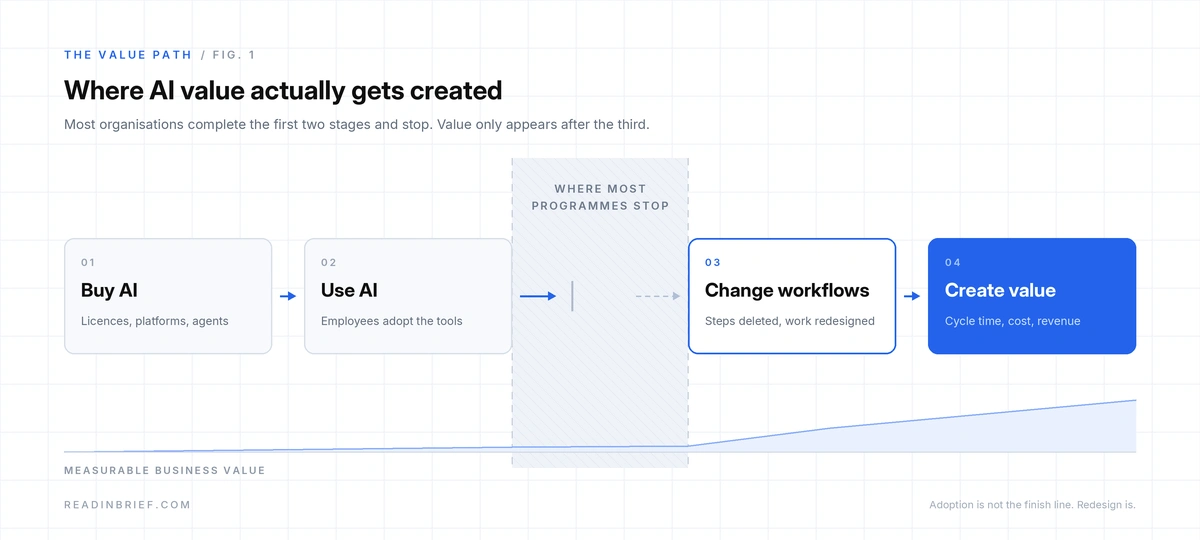
The failure is organisational, not technical. McKinsey's 2025 State of AI survey of 1,993 respondents found 88% of organisations regularly using AI in at least one function, but only 39% reporting any enterprise-level EBIT impact, and most of those put it below 5%.
Workflow redesign is the single strongest differentiator. McKinsey's high performers, roughly 6% of respondents, were nearly three times more likely to have fundamentally redesigned workflows, and that redesign ranked among the strongest contributors to real business impact of every factor tested.
Data readiness decides what is even possible. Gartner predicts organisations will abandon 60% of AI projects that are not supported by AI-ready data through 2026.
Adoption is no longer the bottleneck. Conversion is. BCG's 2026 AI at Work survey of 11,749 employees found 74% of frontline workers now use AI regularly, and 42% of those regular users save around eight hours a week. But 66% get little or no guidance on what to do with that time, and more than half never redirect it into higher-value work.
Measure outcomes, not activity. Seat counts, prompt volume and pilot counts tell you people are busy. They tell you nothing about whether the business is better off.
Tools still matter, but second. Model quality, latency, cost and integration depth genuinely affect outcomes. They just cannot be chosen sensibly before the business problem and the workflow have been defined.
What an AI Strategy Is Not
A surprising number of documents titled "AI Strategy" are actually procurement lists. Here is what does not qualify:
A catalogue of approved AI tools
An enterprise chat subscription rolled out to every employee
Copilot licences deployed org-wide
Six pilots running in six departments
A customer-facing chatbot
An agent built because a competitor announced one
Every item on that list is a purchase or a deployment. None of them is a strategy, because none of them specifies what will be different about how the business runs.
A real AI strategy is a chain, and it breaks at the weakest link:
Business objective → the workflow that objective depends on → the data that workflow generates and needs → the AI capability that fits → the people who will actually use it → the governance that keeps it safe → the measurable outcome that proves it worked
Most failed initiatives can be diagnosed by finding where that chain snapped. Usually it snapped at the third or fourth link, long before anyone thought to check.
Why AI Strategies Fail: The Root Causes
1. Starting with the technology instead of the problem
There is a meaningful difference between two questions.
"What can we do with AI?" produces a list of possibilities ranked by novelty. It leads to pilots that are interesting to build and impossible to justify.
"Which of our processes is expensive, slow, error-prone or decision-heavy, and what would it be worth to fix?" produces a list ranked by value. It leads to a small number of projects with a defensible business case.
Consider a specialty lender. The first question generates ideas about AI-drafted marketing copy and an internal knowledge assistant. The second question surfaces that underwriters spend 40% of their week extracting figures from inconsistently formatted financial statements before any judgment happens, and that this extraction step is the reason turnaround time is nine days rather than three. One of those framings leads somewhere.
Gartner's analysis of agentic AI landed on the same diagnosis. When the firm predicted that more than 40% of agentic AI projects will be cancelled by the end of 2027, the reasons it named were escalating costs, unclear business value and inadequate risk controls. Model capability did not make the list. Gartner analyst Anushree Verma noted that many projects are early-stage experiments driven by hype and often misapplied, and that many use cases positioned as agentic today do not require agentic implementations at all.
2. Pilot purgatory
A demo and a production system are different artefacts that happen to share a user interface.
A demo needs a curated dataset, a cooperative audience and one happy path. A production system needs live data access, permission models that respect who is allowed to see what, error handling for the cases that are not the happy path, latency budgets, an on-call owner, a re-prompting or retraining plan, security review, audit logging, and a place inside someone's workflow rather than a browser tab beside it.
That gap is where most initiatives die. McKinsey found nearly two-thirds of organisations had not begun scaling AI across the enterprise at all, and Informatica's CDO Insights 2026 study of 600 global data leaders found 57% naming data reliability as a key barrier to moving projects from pilot into production.
The most cited number here is MIT Project NANDA's July 2025 report, The GenAI Divide: State of AI in Business 2025, which concluded that roughly 95% of enterprise generative AI pilots delivered no measurable P&L impact. Treat the precise figure with care, since it rests on 52 interviews, 153 survey responses and 300 public deployments rather than a large representative panel. The mechanism is the durable part: the authors attribute failure to a learning and integration gap rather than model quality, noting that generic tools flexible enough to succeed with individuals stall inside workflows demanding memory, context and customisation.
3. Good models sitting on bad data
Model capability has improved faster than almost anyone predicted. Organisational data has not improved at all.
A retrieval system is only as good as the corpus behind it. If your policy documents exist in four versions across SharePoint, a legacy wiki and someone's Drive, and three are outdated, a more capable model retrieves wrong answers more fluently. If customer records sit in a CRM, a billing system and a support desk with no reliable joining key, no amount of context window tells the system whether two records are the same person. If permissions were never modelled properly, a helpful assistant becomes a data leak with a friendly tone.
Gartner's survey of 248 data management leaders found 63% of organisations either lacked the right data management practices for AI or were unsure whether they had them, and the 60% abandonment forecast follows directly. The distinction Gartner draws is worth internalising: AI-ready data is a stricter standard than analytics-ready data, because a quarterly reporting cadence does not serve a system making decisions continuously.
Increasingly capable models cannot repair fundamentally broken organisational data. They can only make the breakage harder to see.
4. AI bolted onto a workflow nobody redesigned
This is the most common and least visible failure, because it looks like success.
Insert AI into an inefficient process and you get a faster inefficient process. The steps that existed because of a limitation you have now removed are still there, because nobody went back and deleted them.
Old workflow: Customer emails a billing question → ticket lands in a shared queue → agent reads it, opens billing system, opens CRM, opens the knowledge base → drafts a reply → sends → customer replies with a follow-up → repeat.
AI added, workflow unchanged: Same queue, same three systems, but the agent now asks an assistant to draft the reply. Drafting time drops from six minutes to two. Total handle time barely moves, because drafting was never the bottleneck. The bottleneck was context assembly across three systems and the back-and-forth caused by incomplete first replies.
Workflow redesigned around the capability: Messages are classified and routed on arrival. For the top five recurring intents, a system with authenticated read access to billing and CRM assembles the full context, resolves the account, and either sends a complete, policy-compliant reply or hands the agent a ready-to-send draft with the account facts already in it. Agents move to a smaller queue of genuinely complex cases with more time per case. The measured target is not drafting speed. It is first-contact resolution and reopen rate.
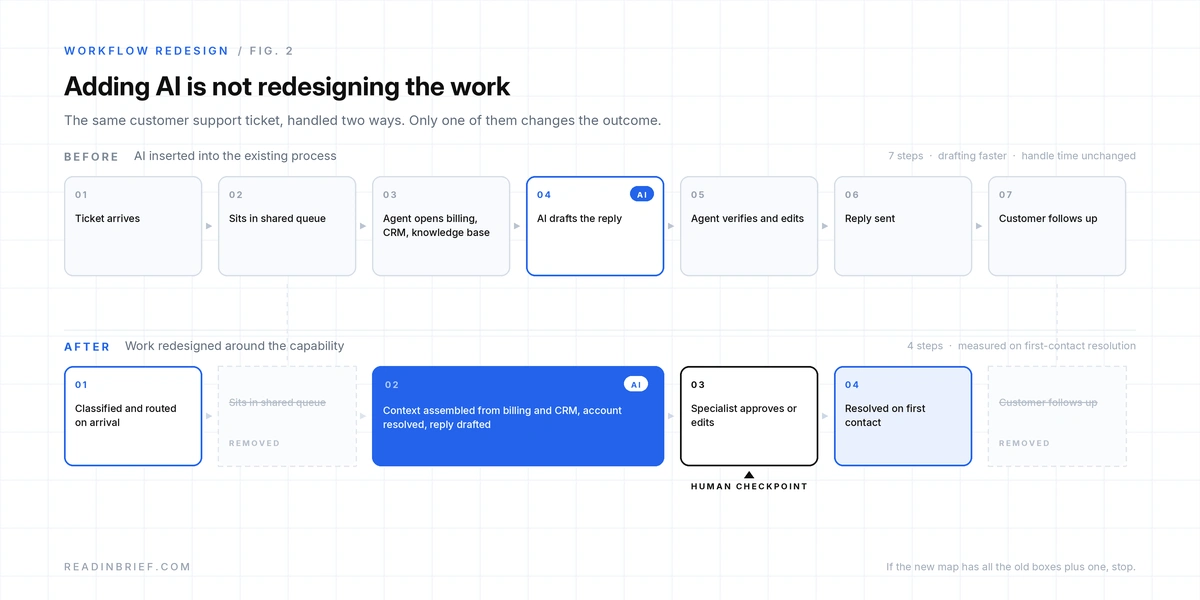
The second version is the one that shows up in financial results. McKinsey makes the point statistically: high performers were nearly three times as likely to have fundamentally redesigned workflows, and among 31 organisational variables tested, that redesign had one of the strongest unique contributions to high-performance status.
Deloitte's 2026 State of AI in the Enterprise, based on a survey of 3,235 leaders across 24 countries, splits the field cleanly. Around 34% are using AI to deeply transform, creating new products or reinventing core processes. Another 30% are redesigning key processes. The remaining 37% are applying AI at a surface level with little or no change to existing processes. All three groups capture some efficiency. Only the first two change the business.
5. Nobody owns the outcome
Ask who owns an AI initiative and you often get a list rather than a name: IT is building it, the innovation team sponsored it, the data team supplies the pipeline, the business unit will use it, a vendor is implementing it.
A list is not an owner. It is a diffusion of responsibility with a Gantt chart.
The owner needs to be the person whose numbers move if it works and whose numbers do not move if it does not. That is almost always a business leader, not a technologist. The head of claims owns the claims cycle time. The head of support owns resolution time. IT owns whether the system is secure, integrated and reliable, which is a different and equally real accountability.
McKinsey found high performers were three times more likely to strongly agree that senior leaders demonstrated ownership of and commitment to AI initiatives, and that those leaders were actively engaged in driving adoption rather than sponsoring from a distance. BCG's 2026 survey found the shortfall from the other direction: only a third of frontline employees said leadership communication about AI was clear, and just 28% saw a strong connection between what leaders said about AI and what the organisation actually did.
6. Treating adoption as a training problem
The standard response to weak adoption is a training programme. It is rarely sufficient, because most adoption failure is not a knowledge gap.
People revert to old methods for reasons that make sense to them. The tool sits in a separate window, so using it costs a context switch. Output quality is inconsistent enough that verification takes longer than doing the work. Nobody has said what happens if the AI is wrong and the employee shipped it, so the safe move is to not rely on it. Performance is still measured on the old activity, so the incentive points backwards. And in some teams, there is an unspoken calculation that visibly automating your own work is not obviously in your interest.
BCG's 2026 findings capture the resulting waste with unusual precision. Adoption has essentially been solved: 74% of frontline employees are now regular users, up 23 percentage points in a year. Time is genuinely being saved: 42% of frontline regular users report saving around eight hours a week. And then it evaporates, because 66% receive limited or no guidance on what to do with that time and more than half do not reinvest it into more strategic work. Saved time that nobody redirects is not a productivity gain. It is slack.
Deloitte's survey points at the same structural gap: leaders named insufficient worker skills as the biggest barrier to integrating AI into existing workflows, and the top response was educating the broader workforce, cited by 53%, while only around a third were redesigning roles or career paths. Education is easier than redesign. It is also less effective on its own.
7. Measuring activity instead of value
Vanity metrics are seductive because they always go up.
Weak signals | Signals that mean something |
|---|---|
Number of AI users or licences | Cycle time reduction on a named process |
Prompts per user per week | Cost per transaction, ticket or claim |
Number of pilots launched | Error and rework rate |
Number of AI tools deployed | Customer resolution time and reopen rate |
Time saved, self-reported | Hours saved and verifiably redeployed |
Employee satisfaction with the tool | Conversion rate, win rate, revenue per rep |
Model benchmark scores | Quality or compliance defect rate |
Usage is an input, not a return. A tool with 100% adoption and no measurable effect on any operating metric is a cost centre with excellent engagement scores. BCG's own guidance to CEOs puts it plainly: change the scoreboard and measure value rather than adoption, because individually saved time leaks out of the organisation unless it is tracked and deliberately reinvested.
The discipline that fixes this is unglamorous. Before building, write down the metric, its current baseline, the target, the measurement method, and the date you will check. If you cannot fill in the baseline, you are not ready to build.
8. Chasing every new tool
New models, copilots, agent frameworks and AI-native SaaS products arrive weekly, and each one arrives with a plausible internal champion.
The accumulation is real. Torii's 2026 SaaS Benchmark Report, covered by CIO Dive, found the average large enterprise running 2,191 applications, with more than 61% of discovered applications not formally approved or overseen by IT. AI experimentation is expanding that long tail rather than consolidating it. MIT's NANDA researchers found a parallel pattern inside firms, with employees in the large majority of organisations using personal AI tools regardless of what the official programme was doing.
The costs compound quietly: duplicated capability across three teams, integration work repeated three times, three separate data-processing agreements, three security reviews or none, and employees who cannot tell which tool they are supposed to use for what.
The design principle that helps is this. A good AI strategy should survive the replacement of any individual model or vendor. If swapping your foundation model would invalidate your strategy, you did not have a strategy. You had a supplier relationship. Standardise on capability layers, keep model choice pluggable, and let the workflow be the durable asset.
9. Scaling before governance can carry the weight
Governance is usually framed as the thing that slows AI down. In practice, the absence of it is what stops AI from scaling, because you cannot put a system into a high-consequence process if nobody can answer what happens when it is wrong.
The gap is measurable and widening. Deloitte found only one in five companies had a mature model for governing autonomous AI agents, even as agentic usage is set to rise sharply. BCG found half of respondents saying their companies lack clear governance for managing teams that combine people and AI. Informatica found 76% of data leaders saying their organisation's AI governance does not fully keep pace with how employees are already using AI. And McKinsey found 51% of organisations had experienced at least one negative consequence from AI use, with inaccuracy the most commonly reported.
Proportionate governance is not a compliance department. It is a short set of answers, written down before deployment: what data can this system see, who is accountable for its outputs, which decisions require a human in the loop and which do not, how we detect quality drift, what gets logged for audit, and what the rollback looks like. McKinsey found that having defined processes for when model outputs need human validation was among the top practices distinguishing high performers, which is a useful reframing. Governance done well is not a brake. It is what lets you take the foot off the brake.
Symptoms vs Root Causes
What Leaders See | Likely Root Cause | What to Investigate |
|---|---|---|
Low adoption despite licences being issued | The tool sits beside the workflow instead of inside it; verification costs more than the time it saves | Where in the process does the tool live? How many context switches does using it require? What happens to an employee who ships a wrong AI output? |
Poor or unprovable ROI | No baseline was captured and no owner was named before building | Was a success metric written down pre-build? Who is accountable for that metric today? |
Too many pilots, none in production | Pilots were selected for feasibility, not value; no gate exists between demo and deployment | What are the promotion criteria for a pilot? Who has authority to kill one? |
Persistent hallucination and accuracy concerns | Weak retrieval, stale or fragmented source content, missing permissions model | What is the actual corpus? Who owns its freshness? Can the system see documents the user should not? |
Employees quietly reverting to manual work | Output reliability is below the trust threshold, or incentives still reward the old method | What is the observed error rate? What are people measured on? What is the rework loop? |
Rising and unpredictable AI software costs | Tool sprawl and consumption-based pricing without a standard | How many overlapping AI tools exist? Who approved them? Which have owners and renewal dates? |
Projects stuck in testing indefinitely | Integration, security review and data access were treated as later problems | What is the specific blocker? Who owns the decision that unblocks it? How long has it been open? |
Time saved but costs unchanged | Saved capacity was never redirected or removed | Where did the hours go? Was headcount, queue size or scope explicitly reallocated? |
The Fatigue Loop: How One Failure Feeds the Next
Failures in AI programmes are not independent events. They form a circuit, and the circuit closes back on itself.
Tool-first purchase → scattered departmental pilots → shallow integration → parallel workflows (old process plus new tool) → low sustained adoption → unmeasurable ROI → budget scrutiny → organisational AI fatigue → "we must have picked the wrong platform" → back to tool-first purchase
Each link is caused by the one before it. Buying before defining means there is no single business problem to organise around, so pilots scatter to wherever enthusiasm lives. Scattered pilots are small, so nobody funds deep integration for any of them. Shallow integration means the AI cannot replace a workflow step, only sit alongside it, so the old process survives intact. A parallel process costs more effort than the old one, so adoption decays. Decayed adoption produces no signal in operating metrics, so ROI cannot be shown. Unprovable ROI invites scrutiny, and scrutiny after a year of visible effort produces fatigue.
The closing link is the one that matters most and gets noticed least. When a programme fails this way, the diagnosis reached in the room is almost always about the technology. The wrong vendor. The wrong model. The wrong agent framework. So the organisation runs a new evaluation, signs a new contract, and re-enters the loop at the top with lower credibility and less patience than before.
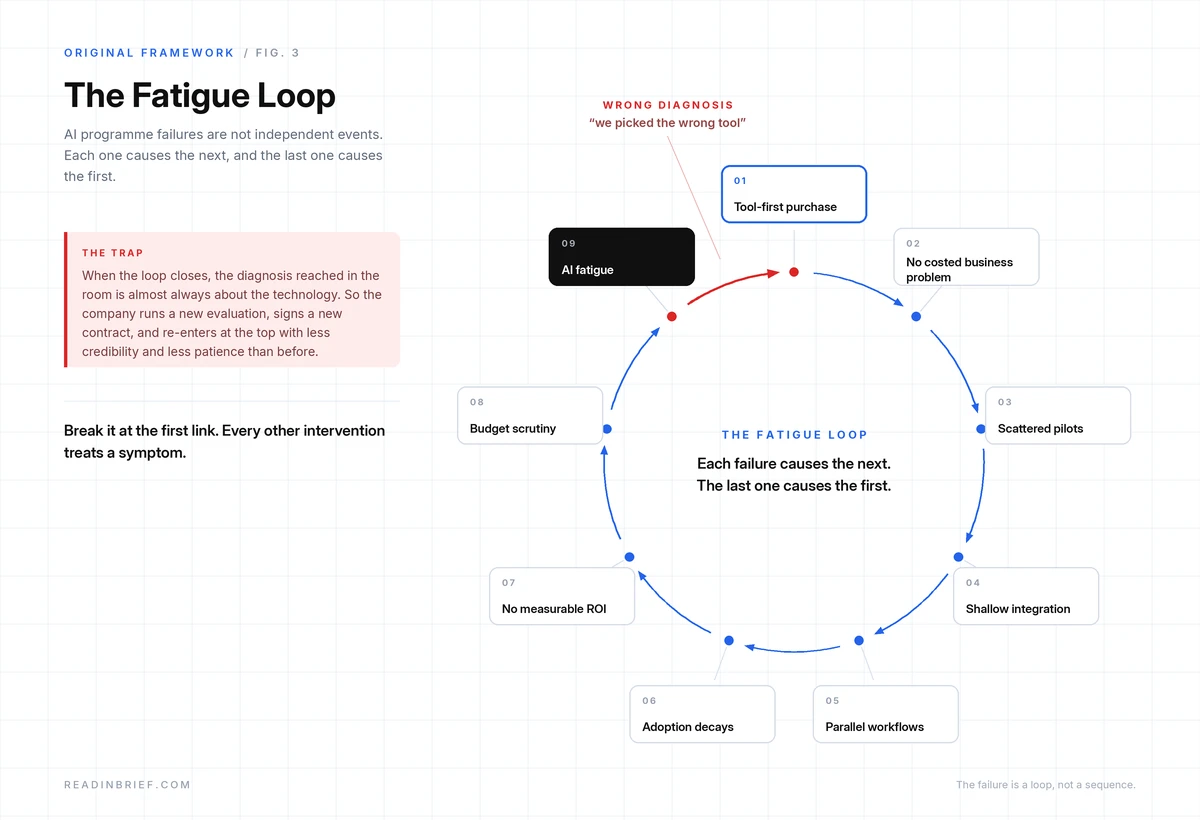
Breaking the loop requires cutting it at the first link, not the last. Every other intervention is treating a symptom.
What Stronger AI Programmes Do Differently
The organisations getting real returns are not doing anything exotic. They are doing a short list of unfashionable things consistently.
They start from a measurable business problem with a known cost. They concentrate on a small number of high-value workflows instead of spreading thin. They assess data readiness honestly before committing to a build, and are willing to say the data is not ready yet. They redesign the process rather than inserting AI into it. They give every initiative a named business owner whose numbers move. They define the success metric and capture the baseline before writing code. They build governance into the implementation rather than bolting it on before launch. They train people on the redesigned workflow rather than on generic tool features. They scale only after evidence, not after enthusiasm. And they keep model and vendor choices deliberately replaceable, reassessing on a schedule rather than on a news cycle.
BCG's 2026 survey produced the finding that summarises all of this most efficiently: employees with strategic clarity but limited tool access outperformed employees with strong tool access and no direction. Clarity beat capability.
The Proof Ladder: A Practical AI Strategy Framework
Seven rungs. You do not get to climb one until the rung below holds your weight. The point of the structure is that it gives you permission to stop, which most AI programmes badly need.
Rung 1: Name the Problem
Question to ask: Which process costs us the most in money, time, errors or delay, and what does that cost us per year?
What to do: Pick a specific process with an owner and a number attached. "Underwriting turnaround averages nine days against a competitor benchmark of four, and we lose an estimated 12% of applications to that delay." Not "improve underwriting."
Common mistake: Choosing a use case because it is technically interesting or because a vendor demoed it well.
Evidence of success: A business leader outside of technology can state the problem and its annual cost without notes.
Rung 2: Write the Value Hypothesis
Question to ask: If this works perfectly, what number changes, by how much, and what is that worth?
What to do: Write one sentence with a baseline, a target and a value. "Reducing underwriting turnaround from nine days to four should recover roughly 6% of lost applications, worth approximately X per year." Then write the counterfactual: what happens if we do nothing for twelve months?
Common mistake: Justifying with productivity language that never converts into a financial or operational figure.
Evidence of success: The finance function agrees the hypothesis is testable and would recognise the result if it happened.
Rung 3: Test the Data
Question to ask: Does the data this system needs exist, is it accurate, is it accessible, and is it permitted?
What to do: Run a two-week readiness probe on the actual data, not a sample someone prepared. Check completeness, freshness, joinability, and the permissions model. Decide explicitly whether to proceed, to fix the data first, or to pick a different problem.
Common mistake: Assuming a successful demo on curated data means production data will behave. It will not.
Evidence of success: You can state, with evidence, the percentage of cases where the required data is present, current and correct.
Rung 4: Redesign the Work
Question to ask: If this capability existed and were reliable, what steps would we delete, merge, reorder or reassign?
What to do: Map the process as it is, then design the target process with the AI capability assumed. Explicitly identify which steps disappear and which humans move to what. Decide the human checkpoints now, not later.
Common mistake: Adding AI as an extra step and calling it transformation. If the new map has all the old boxes plus one, stop.
Evidence of success: The redesigned process has fewer steps or fewer handoffs than the original, and someone can say precisely what the people freed up will do instead.
Rung 5: Deploy Narrow
Question to ask: What is the smallest slice of real production we can run this in, with real users and real consequences?
What to do: Ship to one team, one segment or one intent category, with full integration, real data access, security review complete and a named on-call owner. Narrow scope, production conditions. This is the opposite of a broad pilot on synthetic data.
Common mistake: Piloting wide and shallow. Ten departments running toy versions teaches you less than one team running the real thing.
Evidence of success: Real users are relying on it for real work without a parallel manual process running underneath.
Rung 6: Measure Against Baseline
Question to ask: Did the number from Rung 2 actually move, and can we attribute the movement?
What to do: Compare against the captured baseline over a period long enough to survive novelty effects. Track quality alongside speed, since degraded quality is how efficiency gains are usually paid for invisibly. Track where saved capacity went.
Common mistake: Declaring victory on usage metrics or on self-reported time savings that never appear in any operational number.
Evidence of success: A before-and-after on the operating metric, plus an explicit account of where freed capacity was redeployed.
Rung 7: Earn the Scale
Question to ask: What did we learn that generalises, and where does the same pattern apply next?
What to do: Scale only the parts with demonstrated value. Document the reusable components, the retrieval architecture, the evaluation harness, the governance pattern, so the second workflow costs less than the first. Set a review date to reassess models and vendors on capability, cost and risk.
Common mistake: Scaling on political momentum before the measurement came back, or rebuilding from scratch for every new use case.
Evidence of success: The second deployment is meaningfully faster and cheaper than the first, and there is a written list of what would cause you to switch models or vendors.
A Worked Example (Hypothetical)
Important: the following company and all figures are illustrative, not drawn from a real deployment.
The organisation: A hypothetical B2B software company with roughly 400 employees and a 30-person customer support team handling around 9,000 tickets a month.
Initial approach
They bought an AI support suite from their helpdesk vendor and enabled the deflection chatbot on the public help centre. It was pointed at the existing knowledge base. Rollout took three weeks. Adoption was announced internally as a win, and the chatbot handled around 18% of incoming conversations without a human.
Why it struggled
Six months in, support costs were flat and CSAT had fallen slightly.
The deflected 18% were overwhelmingly password resets and billing-date questions, which took agents under two minutes each and were never the cost driver. The expensive tickets, integration failures and data-sync errors, were untouched, because answering them requires reading the customer's actual account state across three systems, and the chatbot could only read published articles. Meanwhile the knowledge base had not been maintained in fourteen months, so the bot confidently cited a deprecated setup flow, which generated a new class of angry follow-up tickets.
The strategic failure is visible at Rung 1. Nobody asked which tickets were expensive. They asked which tickets were easy to automate. The two sets barely overlapped.
Redesigned approach
They restarted from the problem. Ticket analysis showed 4% of tickets, all integration-related, consumed 31% of total agent hours and drove almost all escalations.
Data first: They audited whether integration error logs, account configuration and sync status were accessible and reliable. Two of three were. The third required a two-month engineering fix, which they did before building anything.
Workflow redesigned: Integration tickets are now identified on arrival. The system pulls the customer's live sync status, recent error codes and configuration, and produces a diagnosis with the three most likely causes and the evidence for each. It does not send anything to the customer. A specialist reviews and sends.
Governance defined up front: No autonomous customer-facing responses on this category. Every output is logged with the retrieved evidence. Weekly sampling by a senior agent, with a defined threshold that triggers rollback.
People: Two agents moved into a dedicated integration specialist role with a redesigned queue, rather than absorbing the change into everyone's existing job.
Knowledge base: Assigned a named owner with a monthly freshness review, since the retrieval quality was capped by content quality regardless of model.
Metrics to monitor
Metric | Why it matters |
|---|---|
Median resolution time for integration tickets | The primary value hypothesis |
Escalation rate on that category | Tests whether speed came at the cost of quality |
Reopen rate within 7 days | Catches superficially closed tickets |
Agent hours per integration ticket | Converts directly to cost |
Diagnosis accuracy on sampled tickets | Quality guardrail; a leading indicator of trust |
Knowledge base staleness rate | The upstream constraint on everything |
Where freed agent capacity was reallocated | Otherwise the saving never lands |
Note what is absent: number of AI conversations, deflection rate, prompt volume. Those were the metrics that made the first attempt look successful for six months.
Tools Still Matter, Just Not First
None of this argues that technology selection is irrelevant. It plainly is not.
Model quality determines whether a reasoning-heavy task is feasible at all. Context window and retrieval quality determine how much organisational knowledge a system can actually hold in view. Latency determines whether a tool fits into a live customer conversation. Cost structure, particularly with consumption-based pricing, determines whether a use case is economic at ten thousand transactions rather than ten. API maturity, integration depth, data residency, security posture and vendor stability determine whether you can put it into production at all.
The argument is about sequence.
Correct order: business need → technical requirements derived from that need → evaluation of tools against those requirements
Common order: interesting new tool → search for a business problem it might solve → retrofit a justification
The second order is how organisations end up with capable technology serving no particular purpose.
There is also a strategic reason to hold tool decisions loosely. Frontier capability is converging fast. Stanford HAI's 2026 AI Index found the top US model leading the best Chinese models by just 2.7% as of March 2026. Its 2025 edition found the cost of querying a model at GPT-3.5-level performance on MMLU fell from $20.00 per million tokens in November 2022 to $0.07 by October 2024, a reduction of more than 280 times in roughly eighteen months. When capability converges and price collapses, the model stops being the differentiator. What you built around it becomes the differentiator.
Build, Buy or Integrate
There is no universally correct answer, only a set of trade-offs that resolve differently depending on the workflow.
Buy an existing AI product when the process is standard rather than distinctive, a mature product already fits it, speed matters more than control, and your internal AI engineering capacity is limited or better spent elsewhere. Most horizontal functions, meeting notes, transcription, generic document handling, fall here. The risk is lock-in and pricing changes on consumption-based contracts.
Integrate models or APIs into your own software when the workflow is specific to how you operate but the underlying capability is general. This is the default for most differentiating use cases, because it gives you control over the workflow, the data and the user experience while keeping the model layer replaceable. The cost is real engineering ownership: evaluation, monitoring, prompt and retrieval maintenance, version management.
Build something custom when the capability itself is a source of competitive advantage, the data is proprietary and central to the value, regulatory or sovereignty constraints rule out third-party processing, or the economics at your volume justify it. Be honest about the ongoing cost. Custom systems require permanent teams, not project teams.
Four questions usually settle it. Does this differentiate us or merely enable us? How sensitive is the data and what are the constraints on where it goes? Do we have, and will we keep, the internal capability to maintain this? And what is the switching cost if we are wrong?
A reasonable default for most mid-market organisations: buy for commodity functions, integrate for anything that touches your differentiating workflows, and build only where you can articulate why nobody could buy the same advantage next quarter.
Before You Invest in Another AI Tool, Ask These Questions
What specific business problem are we solving, and what does it cost us today?
What happens if we do nothing about it for the next twelve months?
Which workflow changes as a result, and which steps get deleted?
What data does this need, does it exist, is it current, and are we permitted to use it that way?
Who is the single business owner whose numbers move if this works?
How will employees actually use this inside their existing work, not beside it?
What is the one metric that determines success, and what is its baseline right now?
Which decisions require human oversight, and what happens when the system is wrong?
How does this integrate with the systems people already work in?
What evidence would justify scaling, and what evidence would justify stopping?
If we replaced this vendor or model in eighteen months, how much of the work survives?
If a proposal cannot answer questions 1, 5, 7 and 10, it is not ready for funding regardless of how good the demo was.
What Leaders Should Do Next
CEO or Founder
Pick two workflows, not twelve, and say so publicly. Name a business owner for each and make their AI outcome part of their performance review. Change the reporting scoreboard from adoption to operating results, and stop accepting seat counts in board updates. Be specific about where the company is heading with AI, since BCG's data shows strategic clarity outperforms tool access, and be consistent, since only 28% of employees currently see alignment between what leaders say about AI and what their organisation does.
CTO or CIO
Treat data access, permissions and integration as the programme, not as prerequisites to the programme. Establish one evaluation harness and one governance pattern that every use case reuses, so the second deployment is cheaper than the first. Keep the model layer abstracted and replaceable. Publish an inventory of AI tools in use, including the ones that arrived without your approval, and rationalise it. Define human-in-the-loop rules by risk tier before anything reaches production.
Business or Operations Leader
Map the process before anyone builds. Capture the baseline yourself, since nobody else will and you will need it in six months. Insist on knowing which steps disappear. Plan explicitly for where freed capacity goes, because unallocated saved time produces no savings. Set the quality guardrails, not just the speed targets, and sample outputs weekly at first. Say no to pilots that cannot name the metric they intend to move.
FAQ
What is an AI strategy?
An AI strategy is a plan connecting business objectives to the specific workflows, data, capabilities, people, governance and metrics required to improve them. It is not a list of tools or a set of pilots. A useful test: if you could hand the document to a new operations leader and they could tell you which processes will work differently in twelve months and how you will know it worked, it is a strategy. If it mostly names vendors, it is a procurement plan.
Why do AI strategies fail?
They mostly fail for organisational reasons rather than technical ones. The recurring causes are starting from the technology instead of a costed business problem, data that is fragmented or unreliable, workflows that are never redesigned around the new capability, no single business owner accountable for the outcome, adoption friction that training alone cannot fix, measurement based on activity rather than value, tool sprawl, and governance that arrives too late to permit scaling.
Why do AI projects fail to deliver ROI?
Usually because no baseline was captured before the build, so improvement cannot be attributed, and because saved time is never converted into anything financial. BCG's 2026 survey found 42% of frontline AI users saving around a workday each week, yet 66% received little or no guidance on what to do with it and over half never redirected it into strategic work. Time saved is only a return once capacity is deliberately reallocated or removed.
What are the biggest challenges in AI implementation?
Data readiness first: Gartner found 63% of organisations either lacking or unsure of appropriate data management practices for AI. Then integration and permissions, which is where pilots stall. Then workflow redesign, which Deloitte found 37% of organisations skip entirely. Then ownership, adoption friction and governance maturity, with Deloitte reporting only one in five companies has a mature governance model for autonomous agents.
How should companies measure AI ROI?
Choose one operating metric per initiative, record its baseline before building, and measure after a period long enough to outlast novelty effects. Useful metrics include cycle time, cost per transaction, error and rework rate, first-contact resolution, conversion rate and quality defect rate. Track a quality guardrail alongside any speed metric, since efficiency gains are often paid for with hidden quality loss. Then account explicitly for where freed capacity went.
Why do AI pilots fail to scale?
Because a demo and a production system have different requirements. Production needs live data access, permission models, error handling for edge cases, latency budgets, security review, audit logging, an on-call owner and a place inside an existing workflow. Pilots typically skip all of these. Informatica found 57% of data leaders citing data reliability as a key barrier to moving from pilot to production, and McKinsey found nearly two-thirds of organisations had not begun scaling AI at all.
Should businesses build or buy AI solutions?
Buy for commodity capabilities where a mature product fits and speed matters more than control. Integrate models or APIs into your own systems for workflows specific to how you operate, which covers most differentiating use cases, since it preserves control while keeping the model replaceable. Build custom only where the capability itself is a competitive advantage, the data is proprietary and central, or regulatory constraints require it. Custom systems need permanent teams, not project teams.
Do AI agents change any of this?
They raise the stakes rather than change the logic. Agents act rather than suggest, so data access, permissions, oversight and auditability become load-bearing rather than optional. Gartner expects over 40% of agentic projects to be cancelled by end-2027 on cost, unclear value and inadequate risk controls. BCG found half of respondents saying their organisation lacks clear governance for teams combining people and AI. The failure modes are the same, arriving faster and with more consequence.
Conclusion
The most reliable prediction about the next few years is that model capability will keep improving and keep getting cheaper, and that your competitors will have access to roughly the same capability you do at roughly the same price. Stanford's data already shows the frontier converging and inference costs collapsing by orders of magnitude. Whatever advantage exists in simply having access to a good model is being competed away in real time.
What is not being competed away is everything the model touches. Knowing precisely where in your business AI creates value, because you costed the processes rather than guessing. Having workflows redesigned around the capability rather than decorated with it. Having data that is accurate, joinable, current and correctly permissioned, which almost nobody has and which takes years rather than quarters to build. Having people who trust the outputs enough to change how they work, and incentives that reward them for doing so. Having measurement rigorous enough to tell the difference between activity and value. And having the discipline to scale only what has been proven and to stop what has not.
None of that is purchasable. All of it is slow. Which is precisely why it is durable.
The organisations pulling ahead are not the ones with the best model. They are the ones who understood earlier than everyone else that an AI strategy is a business strategy that happens to be enabled by technology, and that the hard part was never the technology at all.
Read Also:
AI Agents Market Size & Statistics
AI Code Assistant Market Size, Share & Global Forecast
AI Doesn't Lie. It Just Doesn't Know It's Wrong. Here's Why That's Worse
Comments (0)
No comments yet. Be the first to share your thoughts!