
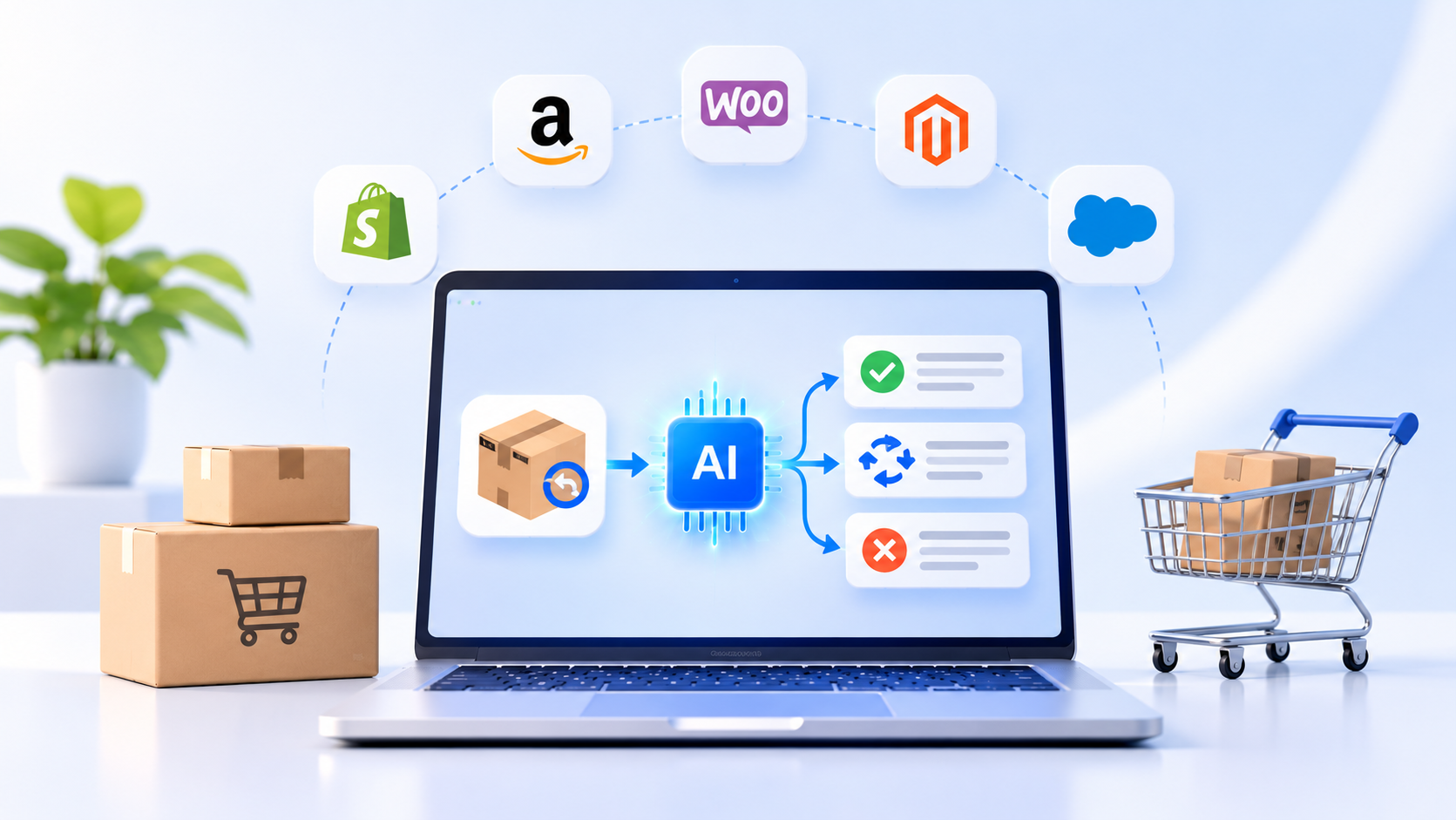
Compare AI returns management tools for policy retrieval, order lookup, refund approvals, fraud signals, and ecommerce integrations.
Introduction
Returns are not one task. A customer may ask whether an item is eligible, request an exchange, check a refund, report a damaged product, or challenge a return decision. Each case can require policy interpretation, order data, payment or shipment information, risk checks, inventory updates, and a customer-facing explanation.
AI returns management can reduce repetitive work, but “returns automation” describes several different product categories. A returns platform may run a self-service portal and issue labels. An AI support agent may resolve return questions inside email or chat. A reverse-logistics system may route returned inventory for inspection, restocking, resale, or disposal. Some enterprise suites connect several of these layers.
The right purchase depends on where the bottleneck sits. This guide compares tools by operational fit and explains how to evaluate policy retrieval, order lookup, refund approval, fraud signals, and integrations. Vendor capabilities and packaging change; confirm current feature availability, plan limits, security terms, and pricing with each provider.
What AI returns triage should do
A useful triage system should classify the customer’s intent, retrieve the relevant policy, find the correct order, determine what actions are permitted, and route exceptions to the right person. Depending on its integrations and permissions, it may offer an exchange, create a return, generate a label, issue store credit, or initiate a refund.
The important distinction is between recommending an action and executing it. A chatbot that explains the return policy is not equivalent to a system that checks eligibility against a live order and safely creates a return. Buyers should map every desired action to its data source, decision rule, approval requirement, and audit trail. This is a practical example of a bounded AI workflow; see AI agents vs. AI workflows for the broader distinction.
Tools to shortlist
1. Loop Returns: exchange-first returns for Shopify brands
Loop Returns is worth evaluating when a Shopify-focused brand wants to make exchanges or store credit a prominent alternative to cash refunds. Its returns experience and revenue-retention workflows are designed around reducing friction while encouraging customers to keep their spend with the retailer.
Test whether the portal handles your product variants, exchange inventory, return reasons, policy exceptions, and customer segments. Confirm which automation and fraud-related controls are included in the plan you are considering. Loop is less likely to be the universal answer for a retailer with complex multi-platform or enterprise reverse-logistics requirements.
2. ReturnGO: configurable return and exchange workflows
ReturnGO is a candidate for merchants that need configurable return rules, exchange and store-credit options, and automation across return scenarios. It is particularly relevant when the business wants to control how different return reasons, products, and customer situations are handled.
During evaluation, test the policy rule builder against edge cases: final-sale items, partial orders, gifts, late requests, damaged goods, and cross-border returns. Ask how the platform identifies potential abuse, what signals it uses, and whether a flagged case is held for review rather than automatically denied.
3. AfterShip Returns: returns within a broader post-purchase stack
AfterShip Returns is worth considering when returns need to connect with shipment tracking and other post-purchase operations. Its multi-platform orientation may appeal to merchants managing more than one storefront or looking for a broader logistics toolset.
Validate order matching across channels, carrier coverage in your markets, refund and exchange synchronization, and the exact integrations available for your ecommerce platform and helpdesk. Check plan limits and what happens when return volume exceeds the included allowance.
4. Narvar: enterprise post-purchase and returns operations
Narvar is a stronger candidate for large retailers with complex post-purchase operations, global logistics, and a need to coordinate returns with customer experience and risk management. Its portfolio spans returns and broader post-purchase capabilities; its newer agentic assistant, NAVI, is positioned to help resolve post-purchase interactions.
Enterprise buyers should test how policy enforcement, risk signals, escalation, and action permissions work across their systems. Confirm deployment requirements, supported integrations, geography, and commercial terms. A sales-led enterprise platform may be excessive for a small store with straightforward returns.
5. Happy Returns: physical drop-off and reverse logistics
Happy Returns is relevant when box-free, label-free return drop-off is an important part of the customer experience. Its physical network and return processing are central to its value, so it should be evaluated as an operational and logistics choice, not only as an AI triage tool.
Test coverage in the locations where customers live, item eligibility, drop-off procedures, consolidation, processing timelines, and how status updates reach your ecommerce and support systems. Ask which fraud or verification controls apply at the drop-off point and how exceptions are handled.
6. ReturnLogic: analytics and return operations
ReturnLogic is worth shortlisting when a retailer wants to understand return drivers and use operational data to improve policies, products, and customer experience. Analytics can help identify recurring reasons for returns, problematic SKUs, and opportunities to improve product information or fulfillment.
Check how return reasons are standardized, whether data can be segmented by product and channel, and how insights translate into workflow changes. Confirm the current integration and automation scope rather than assuming every capability is included in every package.
7. AI support agents: triage inside the customer conversation
For returns that arrive through email, chat, or messaging rather than a self-service portal, a support AI layer may be the missing piece. Tools such as Gorgias, Zendesk AI, Richpanel, Yuma, or eesel AI may help classify and respond to support requests when configured with the appropriate order and returns data.
This category should be evaluated separately from returns platforms. Ask whether the agent can only explain a policy, can initiate a return, or can actually issue a refund or exchange. Confirm the exact supported actions, approval controls, and helpdesk/ecommerce integrations.
Comparison framework
Capability | Questions to test | Why it matters |
Policy retrieval | Can it retrieve the current policy by product, region, order date, and customer type? Does it cite the policy passage? | Prevents inconsistent or outdated eligibility decisions. |
Order lookup | Can it securely match the customer to the correct order and line item? What happens with multiple orders or guest checkout? | Wrong-order actions can cause financial and customer-service errors. |
Refund approval | Can it calculate the eligible amount, distinguish refund from exchange/store credit, and enforce approval thresholds? | Automates routine cases while keeping high-value exceptions controlled. |
Fraud signals | What signals are considered: return frequency, item value, claims history, delivery evidence, or policy anomalies? | Risk indicators should inform review, not become opaque automatic denials. |
Integrations | Does it sync with Shopify, BigCommerce, Magento, marketplaces, payment systems, carriers, inventory, and helpdesk tools you use? | Disconnected systems create duplicate work and inconsistent records. |
Auditability | Can staff see the policy, order data, decision, action, and approval history? | Makes disputes and operational reviews easier to investigate. |
Human handoff | Can it route damaged, high-value, late, suspicious, or ambiguous cases to the right team? | Exceptions need accountable review rather than forced automation. |
Customer experience | Can the system explain the decision clearly and offer a practical next step? | A correct decision can still create frustration if it is poorly communicated. |
Run a realistic pilot before buying
1. Build a representative case set
Use anonymized historical cases that include standard returns, exchanges, late requests, damaged items, partial shipments, missing order details, suspected abuse, and policy exceptions. Include cases where the correct answer is “not enough information.”
2. Validate policy and order grounding
For each case, record whether the system retrieved the correct policy version and matched the correct order and item. Check whether the response makes unsupported assumptions or hides uncertainty.
3. Separate low-risk actions from sensitive actions
Define which actions can be automated, which require confirmation, and which require a human approval. For example, answering a policy question may be low risk; issuing a high-value refund or denying a claim may require additional controls.
4. Test fraud handling for fairness and explainability
Review the signals behind flagged cases. Look for false positives, missing context, and disproportionate impact on legitimate customers. Avoid a system that produces an unexplained risk score with no review path.
5. Measure end-to-end outcomes
Track first-response time, resolution time, percentage of cases resolved without an agent, refund or exchange error rate, escalation rate, customer satisfaction, repeat contacts, revenue retained through exchanges, and time spent correcting automation. Faster triage is not a success if it increases mistakes or repeat contacts.
Which type of tool fits your business?
A Shopify-first direct-to-consumer brand focused on retaining revenue may start with an exchange-oriented platform such as Loop or ReturnGO. A multi-channel merchant may prioritize AfterShip’s broader post-purchase connections. A large retailer with complex operations may evaluate Narvar. A brand whose returns depend on convenient physical drop-off should assess Happy Returns. A team seeking better visibility into return reasons should examine ReturnLogic analytics. If most requests arrive in a support inbox, evaluate a support AI agent alongside, rather than instead of, the returns platform.
These are shortlist directions, not universal rankings. The best fit depends on order volume, return rate, product category, geography, platform stack, logistics model, policy complexity, and tolerance for automated financial actions.
Risks and governance
Keep policy ownership clear
Assign an owner to each policy, define effective dates, and remove outdated versions from retrieval sources. A model cannot reliably enforce a policy that is contradictory or poorly maintained.
Use least-privilege access
Connect only the data and actions required for the workflow. Review role-based access, data retention, audit logs, security documentation, and whether connected-system permissions carry through to AI retrieval. For a related look at connecting AI systems to business tools, read MCP vs API: What Changes in the AI Agent Era?.
Require review for consequential exceptions
Set approval thresholds for high-value refunds, unusual claims, suspected fraud, damaged goods, and cases with legal or regulatory implications. Make it easy for staff to override automation and record why.
Communicate decisions transparently
Customers should receive a clear explanation of eligibility, next steps, and expected timing. If a case is under review, say so rather than presenting a risk-based hold as a final denial.
Frequently asked questions
Can AI automatically approve ecommerce returns?
It can automate routine eligibility checks and actions when policy, order data, and permissions are reliable. High-value, ambiguous, or suspicious cases should have defined review controls.
Is returns management software the same as an AI customer service agent?
No. A returns platform typically manages the return lifecycle, portal, rules, labels, exchanges, and status. A support agent handles conversations and may connect to the returns platform to retrieve information or perform approved actions.
How does AI help detect return fraud?
Systems may use patterns such as return frequency, claim history, order value, delivery evidence, or policy anomalies. Buyers should test explainability, false positives, and human review rather than relying on a score alone.
What integrations matter most?
Start with your ecommerce platform, order and payment systems, inventory, carriers, and helpdesk. Confirm that actions and status updates synchronize in both directions and that the exact connectors are supported on your plan.
How should we calculate ROI?
Compare time saved per return, support contacts avoided, refund and exchange accuracy, revenue retained, reverse-logistics cost, repeat contacts, and customer satisfaction. Include implementation and ongoing administration costs.
Conclusion
AI returns triage works best when it connects the customer’s request to the correct policy, order, permitted action, and review path. Choose tools by the operational layer they improve, then test the full workflow with real cases. The objective is not to automate every return indiscriminately. It is to resolve straightforward cases quickly, preserve customer trust, identify genuine exceptions, and give staff a reliable record of what happened.
Comments (0)
No comments yet. Be the first to share your thoughts!