Best AI Tools for Lead Qualification and CRM Automation

Author
Deval Shah
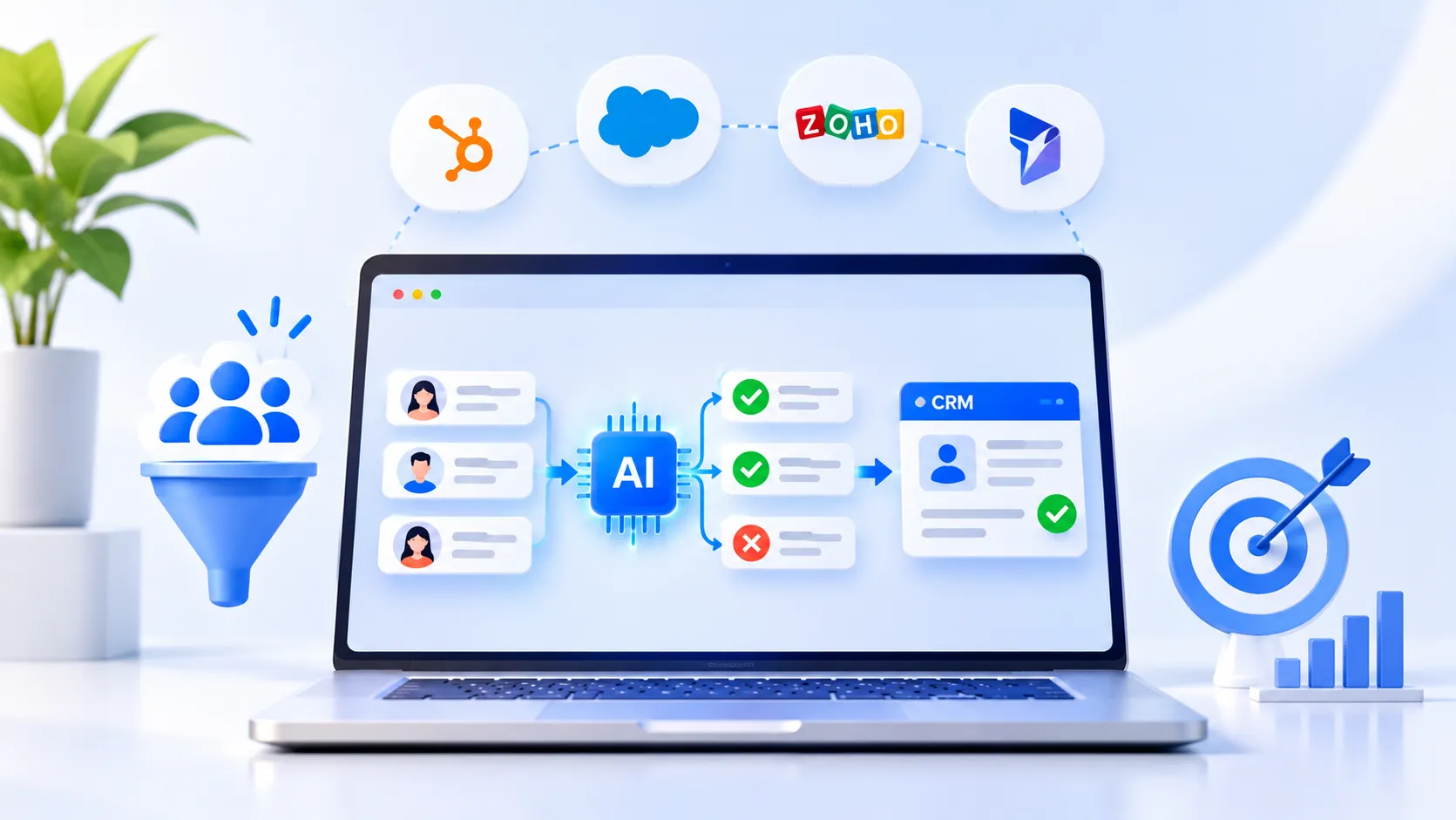
Compare AI lead qualification tools for scoring, enrichment, CRM write-back, routing, and human approvals. Learn how to evaluate accuracy and workflow fit.
Introduction
Inbound leads arrive through forms, chat, email, product trials, events, and partner referrals. Before sales can act, someone often has to identify the person and company, interpret the request, check fit, enrich missing details, score intent, assign an owner, and update the CRM. When those steps are manual, response time slows and records become inconsistent.
AI lead qualification and CRM automation can compress this work, but the category includes several different approaches: CRM-native AI, conversational agents, enrichment and routing platforms, workflow automation tools, and sales engagement systems. The best choice depends on where the team needs intelligence and where it needs reliable execution.
This guide compares representative platforms and gives buyers a practical framework for evaluating lead scoring, enrichment, CRM write-back, integrations, and human approvals. Product packaging changes frequently, so verify current capabilities, supported CRM editions, data coverage, security terms, and pricing with vendors.
What should an AI lead qualification workflow do?
A well-designed workflow should capture the inquiry, normalize the data, identify the account and contact, evaluate fit and intent, assign a score or qualification status, route the lead, and write the result to the CRM. It should preserve the original source and explain why a lead received a particular score or route. For a broader explanation of orchestrated AI processes, see AI agents vs. AI workflows.
The system should distinguish known facts from inferred information. A job title or company size retrieved from a trusted source is different from a model’s guess based on an email address or message. Where confidence is low, the workflow should ask a follow-up question or send the record for review rather than silently filling in a field.
AI tools to shortlist
1. Salesforce Agentforce and Einstein: qualification inside Salesforce
For organizations already standardized on Salesforce, its native AI and automation capabilities are a natural starting point. They can be evaluated for working with CRM records, sales workflows, lead prioritization, and agent-assisted tasks while keeping activity within the existing platform.
Test the exact capabilities available in your Salesforce edition and configuration. Ask whether the system can explain a score, use approved CRM and knowledge sources, respect field-level permissions, and require approval before changing ownership, status, or other consequential fields. Native alignment can reduce integration complexity, but licensing and configuration matter.
2. HubSpot Breeze: CRM-native prospecting and automation
HubSpot Breeze is worth evaluating for teams that manage marketing, sales, and service activity in HubSpot. Its AI capabilities can support prospect research and CRM-centered workflows, depending on the product and subscription configuration.
Use a pilot to verify how it qualifies inbound form submissions, enriches company and contact records, summarizes intent, and updates properties. Check whether automation can be restricted to approved fields and whether sales reps can review the reasoning before a lead is routed or marked qualified.
3. Qualified: conversational inbound conversion
Qualified is a candidate for B2B teams that want to engage website visitors in real time and convert high-intent conversations into sales opportunities. Its AI sales-agent positioning makes it relevant when qualification begins in a website conversation rather than after a form submission.
Evaluate the quality of follow-up questions, account identification, meeting handoff, CRM synchronization, and the agent’s ability to recognize when a visitor needs a human. Test whether the conversation captures qualification criteria consistently and whether the resulting CRM record includes a useful summary and source trail.
4. 6sense: account intelligence and intent signals
6sense is relevant when qualification depends on account-level fit and buying intent, particularly in account-based marketing and larger B2B sales motions. It can help teams prioritize accounts and understand signals beyond an individual form fill.
Ask how intent data is defined, how it maps to your target segments, and how signals reach CRM records and sales workflows. Treat intent as prioritization evidence, not proof that a specific person is ready to buy. Validate data coverage in your markets and the incremental value over existing CRM and analytics data.
5. LeanData: routing and operational orchestration
LeanData is a strong category candidate when the core problem is assigning inbound leads and accounts accurately across complex territories, teams, and ownership rules. Routing is often the operational step that turns a qualification result into timely action.
Test duplicate handling, account matching, territory logic, round-robin rules, SLA alerts, reassignment, and audit history. Confirm how it integrates with your CRM and whether exceptions can be reviewed without disrupting the routing process.
6. Clearbit / HubSpot data enrichment: completing the record
Data enrichment tools can append firmographic, technographic, or contact information to a lead record. Clearbit capabilities are now associated with HubSpot’s data and enrichment offering, so buyers should confirm the current product name, availability, data coverage, and packaging.
Evaluate match rates using your actual inbound records, especially personal email addresses, international companies, subsidiaries, and smaller businesses. Verify source freshness, confidence indicators, field-level write rules, and whether the tool can avoid overwriting more reliable first-party data.
7. Zapier, Make, and n8n: connecting the workflow
Workflow automation platforms can connect forms, enrichment services, AI models, and CRM actions when a native integration is missing or when a team needs a custom sequence. They are useful for prototyping and for orchestrating steps across multiple systems. For the underlying integration concepts, read MCP vs API: What Changes in the AI Agent Era?.
They are not automatically a complete lead qualification product. The team must design error handling, retries, duplicate prevention, permissions, monitoring, and governance. For sensitive or high-volume workflows, confirm whether the platform supports the required security, deployment, and operational controls.
Comparison framework: what to test
Capability | Evaluation questions | Why it matters |
Lead scoring | Can the tool apply explicit fit and intent criteria? Is the score explainable and calibrated against outcomes? | A score should prioritize sales attention, not create false precision. |
Enrichment | What are match rates, data sources, freshness, geography, and confidence levels? | Bad enrichment can contaminate CRM records and misroute leads. |
CRM write-back | Which objects and fields can it create or update? Can writes be restricted, logged, and reversed? | CRM data is operational infrastructure; uncontrolled writes create cleanup work. |
Routing | Can it match accounts, respect territories, detect duplicates, and enforce response SLAs? | The right lead must reach the right owner quickly. |
Human approvals | Can low-confidence, sensitive, or high-value changes require review? | Human checkpoints protect data quality and sales judgment. |
Integrations | Does it connect to your forms, CRM, marketing automation, enrichment, calendar, and support stack? | Disconnected systems create delays and incomplete records. |
Auditability | Can users inspect source data, model output, decision rules, and change history? | Teams need to troubleshoot and explain qualification decisions. |
Privacy and security | Are consent, retention, access controls, and regional data requirements supported? | Lead data can include personal information and commercially sensitive context. |
A practical evaluation pilot
1. Define qualification criteria first
Document the criteria sales actually uses: target industry, company size, geography, role, use case, urgency, budget signals, and disqualifiers. Separate mandatory requirements from signals that merely increase priority. Do not ask an AI system to infer a policy that the business has not agreed on.
2. Build a representative test set
Use a sample of historical inbound leads across channels and segments. Include complete and incomplete forms, duplicate contacts, existing customers, personal email addresses, international records, and ambiguous requests. Establish a human-reviewed baseline before testing tools.
3. Score accuracy and calibration
Compare the system’s qualification and routing decisions with the baseline. Track false positives, false negatives, missing data, and confidence calibration. Review results by channel and segment, not only as one aggregate number.
4. Inspect CRM changes
Test every proposed write-back: contact creation, account association, lead status, score, owner, lifecycle stage, and notes. Confirm duplicate prevention, field mapping, error handling, and whether the original inquiry remains accessible.
5. Measure business outcomes
Track speed-to-lead, percentage of leads routed correctly, sales acceptance rate, meeting conversion, duplicate rate, enrichment accuracy, time spent correcting records, and pipeline contribution. Include implementation, administration, and data costs when calculating ROI.
Which approach fits your team?
A Salesforce-centered organization should first evaluate native Salesforce AI and automation, then add specialist tools where a demonstrated gap remains. A HubSpot-centered team may prefer Breeze and native workflows for simpler operations. A high-traffic B2B website focused on conversational conversion should assess Qualified. Account-based teams may need 6sense signals, while complex routing operations may benefit from LeanData. Enrichment services and workflow platforms are best selected around verified gaps in data coverage or integration logic.
These are shortlist directions, not universal rankings. The right architecture depends on CRM, lead volume, qualification complexity, geography, data maturity, sales process, and the cost of an incorrect decision.
Risks and safeguards
Avoid opaque scoring
Make qualification criteria visible and reviewable. Sales should understand why a lead is prioritized and be able to correct inaccurate data or challenge a score.
Protect first-party data quality
Set source precedence and field ownership. Do not let enrichment overwrite verified information without a rule. Preserve timestamps and provenance for important fields.
Use least-privilege CRM access
Grant only the permissions required for each workflow. Separate read access from write access where possible, and require approval for ownership, lifecycle, or sensitive-field changes.
Keep a human path for exceptions
Escalate ambiguous, high-value, regulated, or low-confidence cases. Automation should make review faster, not make exceptions invisible.
Frequently asked questions
Can AI qualify inbound leads without a form?
Yes, if it can collect relevant information through a conversation or approved data sources. It should ask follow-up questions when key qualification criteria are missing and record the source of each answer.
Does AI lead scoring replace sales judgment?
No. Scoring can help prioritize attention, but sales teams should validate the criteria against conversion outcomes and retain the ability to review exceptions.
What is the difference between enrichment and qualification?
Enrichment adds or verifies information about a person or company. Qualification evaluates whether the lead fits the business’s target criteria and whether the inquiry indicates meaningful intent. A workflow may use enrichment as one input to qualification.
Should AI be allowed to update CRM records automatically?
Routine, low-risk updates can be automated after testing. Changes with downstream impact, low confidence, or sensitive data should use approval rules, audit logs, and rollback procedures.
How do we measure ROI?
Measure faster response, better routing, sales acceptance, conversion, data accuracy, and reduced manual work. Compare these gains with platform, data, integration, and administration costs.
Conclusion
AI lead qualification and CRM automation deliver value when they combine reliable data, transparent criteria, controlled write-back, and fast routing. Shortlist tools based on the layer they improve, then test them with real inbound records and agreed qualification rules. The goal is not to automate judgment blindly. It is to help sales respond faster, prioritize consistently, and maintain a CRM that people can trust.
Comments (0)
No comments yet. Be the first to share your thoughts!