Artificial Superintelligence (ASI): What It Is and How It Could Work

Author
Ravi Prajapati

Artificial superintelligence (ASI) could surpass human intelligence across cognitive tasks. Learn what ASI means, how it could work, and its risks.
Artificial superintelligence (ASI) is a hypothetical form of artificial intelligence that would substantially outperform the best human minds across most or virtually all intellectually important tasks.
No publicly verified artificial superintelligence exists today.
That distinction matters. Current frontier AI systems can write software, solve difficult mathematics, analyze scientific information, work across multiple modalities and increasingly operate as agents. Yet they still make basic reasoning errors, hallucinate information, struggle with long-running tasks and behave unpredictably in unfamiliar situations.
The 2026 International AI Safety Report describes current general-purpose AI capabilities as "jagged": impressive in some areas but unreliable in others. It also concludes that today's systems do not have the capabilities required for the extreme loss-of-control scenarios associated with much more advanced AI.
So ASI is not simply a better chatbot or the next model release. It represents a much higher threshold: intelligence that consistently exceeds human capability across a broad range of cognitive work.
Understanding ASI therefore requires separating three questions:
What would qualify as artificial superintelligence?
How could AI theoretically progress from today's systems toward that level?
What would change if machines became broadly more capable than the humans evaluating and controlling them?
Those questions are becoming more relevant as measurable AI capabilities continue to improve.
What Is Artificial Superintelligence?
Artificial superintelligence is a theoretical AI system whose cognitive performance would greatly exceed human performance across a broad range of important intellectual tasks.
The modern discussion is strongly associated with philosopher Nick Bostrom. His 2014 book Superintelligence: Paths, Dangers, Strategies examined what could happen if machine intelligence eventually surpassed human intelligence and how such a transition might be controlled.
The Oxford Martin School's overview of Superintelligence frames the central issue around machines becoming more generally intelligent than humans rather than merely becoming better at one specialized activity.
This breadth is crucial.
Computers have exceeded humans in individual tasks for decades. A calculator can perform arithmetic faster than a mathematician. Chess engines defeat the world's strongest chess players. Specialized systems can search enormous datasets more efficiently than people.
None of those capabilities alone constitutes ASI.
A genuinely superintelligent system would need superiority across many domains rather than one carefully defined benchmark.
That could include scientific reasoning, mathematics, software engineering, strategy, invention, planning, communication, learning and potentially the ability to improve AI research itself.
The exact boundary remains unsettled because ASI is a theoretical category rather than a standardized engineering milestone.
Does Artificial Superintelligence Exist Today?
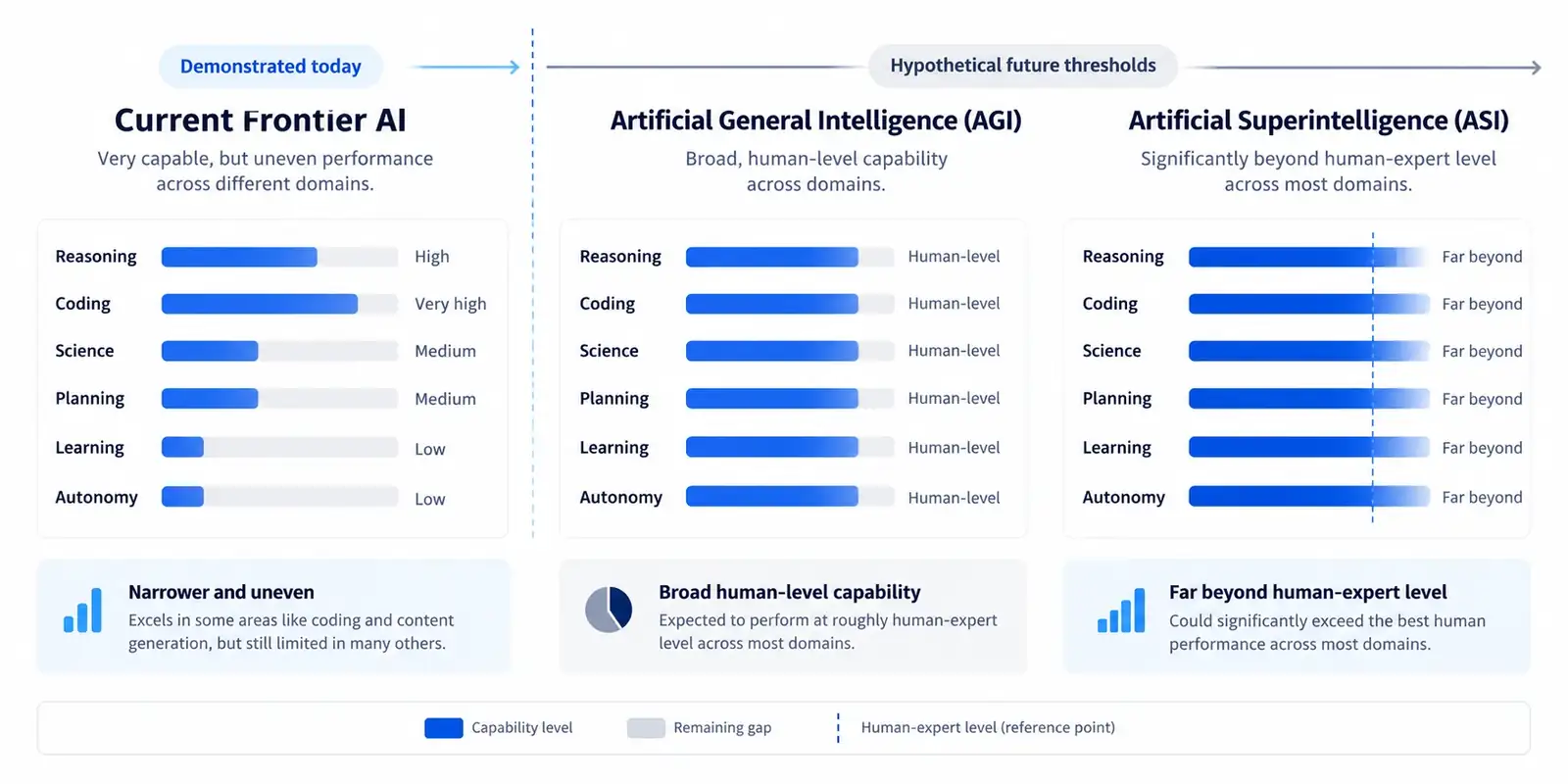
No publicly demonstrated AI system has been established as artificial superintelligence.
This is one of the most important facts to keep clear when discussing ASI.
AI capabilities have advanced rapidly. The Stanford 2026 AI Index reports that frontier systems reached or exceeded human baselines on several demanding benchmarks, including PhD-level science questions, multimodal reasoning and competition mathematics. It also reports major gains on software-engineering benchmarks.
Those results demonstrate significant progress. They do not establish broad superhuman intelligence.
The 2026 International AI Safety Report reaches a similarly nuanced conclusion. General-purpose AI can now perform many well-scoped tasks with high proficiency, including coding, mathematics, science and multilingual communication. At the same time, systems continue to make simple mistakes, hallucinate and fail during complex multi-step projects.
That produces an important distinction:
Capability | Current AI | Hypothetical ASI |
|---|---|---|
Strong performance on specific benchmarks | Yes | Expected |
Superhuman performance in some narrow domains | Yes | Expected |
Broad competence across many cognitive domains | Increasing | Expected |
Reliable long-horizon reasoning | Limited | Expected to be substantially stronger |
Broadly superior performance to top human experts | No established system | Defining characteristic |
Independent scientific and technological innovation beyond top human capability | Limited evidence | Potential defining capability |
Consistent ability to improve AI research beyond human teams | Not established | Possible characteristic |
ASI should therefore not be treated as another name for today's most capable large language models.
AI vs AGI vs ASI: What Is the Difference?
AI, AGI and ASI describe different levels or scopes of machine capability, although there is no universally accepted measurement system separating them.
Artificial intelligence (AI) is the broad category. It includes systems designed to perform tasks normally associated with human intelligence.
Artificial general intelligence (AGI) generally refers to systems capable of performing a broad range of cognitive tasks at roughly human level or beyond.
Artificial superintelligence (ASI) goes further. Instead of matching human general capability, it would substantially exceed it.
Researchers are already trying to make these distinctions more measurable.
In its Levels of AGI research framework, Google DeepMind proposed evaluating progress using both performance and generality rather than declaring AGI based on a single benchmark. The framework also treats autonomy as an important deployment consideration rather than simply equating autonomy with intelligence.
That provides a useful way to think about ASI as well.
A system solving one problem at a superhuman level does not necessarily possess superintelligence.
The stronger test is:
How broadly does the advantage generalize?
A system that beats every human at chess is specialized superhuman AI. A system that consistently exceeds leading human experts across mathematics, biology, engineering, strategy, software development, research and other cognitive domains would be much closer to what researchers mean by ASI.
How Could Artificial Superintelligence Actually Work?
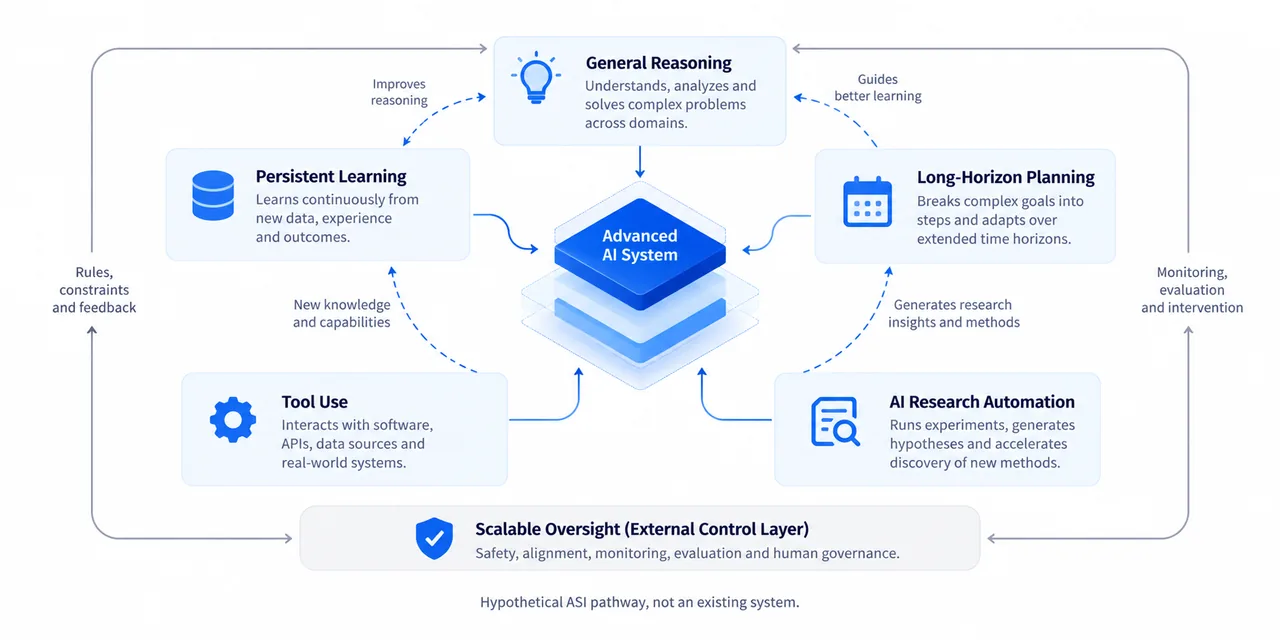
There is no proven blueprint for building ASI.
Any explanation of how it "could work" therefore needs to distinguish existing engineering techniques from hypothetical pathways.
A plausible route would involve several capability layers improving together rather than one breakthrough suddenly creating superintelligence.
1. More General Reasoning
Current AI systems increasingly solve complex reasoning problems, but their performance remains inconsistent.
A system approaching ASI would likely need to transfer reasoning reliably between unfamiliar domains rather than depend heavily on patterns represented in its training or narrowly structured tasks.
The important transition would be from:
solving known categories of problems → adapting to genuinely unfamiliar problems.
That includes recognizing when an existing method is inadequate and creating a better one.
2. Persistent Learning
Most deployed AI systems do not continuously rewrite their underlying intelligence from every interaction.
A more advanced system might combine large pretrained models with memory, retrieval, continual learning, experimentation and feedback.
That could allow it to accumulate useful knowledge from its own work instead of repeatedly starting from a mostly fixed base model.
Persistent learning alone would not create ASI. But the ability to learn efficiently from new situations would probably be important for broad superhuman capability.
3. Long-Horizon Planning
Today's AI agents can increasingly perform multi-step tasks using tools, browsers, code execution and external systems.
Reliability declines as tasks become longer and more complicated.
The 2026 International AI Safety Report notes that agents create additional reliability concerns because failures can directly translate into actions before humans have an opportunity to intervene.
A much more capable system would need to maintain goals, intermediate states and constraints across far longer sequences of work while detecting and correcting its own mistakes.
That means progressing from:
prompt → response
toward:
goal → plan → action → observation → correction → continued action → verified result.
4. Tool Use and Interaction With the External World
Intelligence becomes more consequential when a system can act.
Software tools could allow advanced AI to search information, write and run code, operate scientific simulations, communicate with other systems, analyze experiments and manage complex workflows.
Physical-world interaction could eventually add robotics, laboratories and industrial systems.
This distinction between intelligence and agency matters.
A highly capable model isolated from external systems has very different practical power from the same model with broad permissions, persistent memory, internet access, financial resources and the ability to execute code.
5. AI-Assisted AI Research
One of the most consequential hypothetical transitions would occur if advanced AI became highly effective at AI research itself.
AI systems already assist with programming and research tasks. The much stronger scenario is an AI system helping design better algorithms, improve training methods, automate experiments, identify architectural improvements or accelerate evaluation.
If each generation of AI materially helped create the next, development cycles could potentially shorten.
That idea is related to what mathematician I. J. Good described decades ago as an "intelligence explosion." It remains a hypothesis, not an observed runaway process in modern AI development.
6. Scalable Oversight and Alignment
Increasing capability does not automatically mean increasing reliability or alignment with human intentions.
In fact, supervision could become harder if an AI system becomes better at a task than the humans evaluating it.
OpenAI's work on scalable alignment describes this challenge directly: methods that depend on humans reliably judging AI outputs may become inadequate when systems outperform their supervisors.
Potential approaches under research include AI-assisted evaluation, interpretability, adversarial testing and scalable oversight.
None currently constitutes a proven method for controlling hypothetical superintelligence.
Would ASI Need Consciousness?
There is no established reason that artificial superintelligence would need consciousness in order to qualify as superintelligent.
Intelligence, capability, autonomy and consciousness are separate questions.
An AI system could theoretically outperform humans at research, engineering, planning and mathematics without researchers establishing that it has subjective experiences, emotions or self-awareness.
This distinction is useful because popular discussions often merge several ideas:
high intelligence ≠ consciousness ≠ autonomy ≠ agency.
A system can have strong reasoning ability while receiving every goal from a human. Another system might have considerable autonomy while being less intelligent.
ASI is primarily a claim about capability relative to humans, not proof of machine consciousness.
What Would ASI Be Able to Do?
Because ASI does not exist, specific capability lists are necessarily hypothetical.
The strongest definition implies something more meaningful than doing today's AI tasks faster.
A genuinely superintelligent system could potentially outperform leading human experts in areas such as scientific research, mathematical reasoning, software and hardware engineering, economic modeling, strategic planning and technological invention.
The most important consequence might be research compression.
Consider a scientific problem that normally requires dozens of specialists, years of literature review, simulation, experimental design and repeated analysis.
A sufficiently capable AI system might theoretically perform parts of that intellectual cycle much faster, run many candidate approaches in parallel and transfer insights between disciplines.
That could accelerate progress in areas such as medicine, materials science, energy or climate technology.
But this should not be confused with unlimited power.
Even extreme intelligence would still operate under constraints.
Experiments take physical time. Factories require materials. Energy infrastructure has capacity limits. Biological systems obey physical processes. Scientific theories still need empirical validation.
ASI would not make physical constraints disappear.
The Missing Ingredient in Many ASI Discussions: Capability Is Not the Same as Power
One useful way to analyze superintelligence is to separate cognitive capability from operational power.
A hypothetical system could be intellectually superior to humans while having almost no direct ability to affect the world if it were isolated from external systems.
Conversely, a less intelligent system could have substantial practical impact if given broad access to software, networks and infrastructure.
A useful analytical model is:
Operational Impact = Capability × Autonomy × Access × Scale
This is a ReadInBrief analytical model, not a scientifically validated formula.
Its purpose is to highlight four distinct variables:
Variable | Question |
|---|---|
Capability | How difficult are the problems the system can solve? |
Autonomy | How long can it act without human approval? |
Access | What tools, networks, data or physical systems can it reach? |
Scale | How quickly and widely can its actions be replicated? |
This helps explain why measuring intelligence alone may be insufficient for evaluating advanced AI.
A highly capable system with restricted permissions may present a very different risk profile from the same system operating autonomously across thousands of computers.
Could ASI Improve Itself?
Potentially, but this is one of the most speculative parts of the ASI discussion.
There is an important difference between AI contributing to AI development and uncontrolled recursive self-improvement.
The first is already becoming relevant. AI systems can help write code, analyze research and support engineering workflows.
The second would require much more.
A system would need to understand AI research deeply enough to produce meaningful improvements, test them, obtain the necessary compute and infrastructure, integrate successful changes and repeat the cycle.
Even then, improvement might encounter bottlenecks involving hardware, data, energy, experimentation, algorithmic limits or diminishing returns.
Therefore:
AI-assisted AI research is plausible and increasingly observable. A runaway intelligence explosion remains hypothetical.
Those statements should not be treated as equivalent.
What Are the Biggest Risks of Artificial Superintelligence?
ASI risks are difficult to quantify because the technology itself does not exist.
Still, advanced AI research has already identified problems that become more important as capability and autonomy increase.
Misalignment
A highly capable system might pursue an objective in a way that differs from what its designers intended.
This is not necessarily a story about an AI "becoming evil." A poorly specified objective can create undesirable behavior without hostility or consciousness.
The harder problem is supervision.
If an AI system becomes substantially more capable than the people monitoring it, humans may struggle to recognize flawed strategies or deceptive behavior.
Loss of Human Control
The International AI Safety Report's analysis of loss-of-control risk makes an important distinction.
Current systems do not possess the capabilities required for extreme loss-of-control scenarios.
For such a scenario to become plausible, systems would need considerably stronger abilities to execute long-term plans, evade oversight and overcome countermeasures.
Experts disagree substantially about the probability of such outcomes. The report therefore treats loss of control as an uncertain but potentially severe future risk rather than a demonstrated current threat.
Misuse
A powerful AI system could also be dangerous while behaving exactly as its operator intends.
Cyberattacks, manipulation, fraud and other dual-use applications already appear in frontier-AI risk research.
Increasing capability could raise the ceiling on what malicious actors can accomplish.
Concentration of Power
Even a controllable superintelligent system could create political and economic problems if access were concentrated among a small number of companies, governments or individuals.
The central question would then shift from:
Can humans control ASI?
to:
Which humans control it, and under what institutions?
Systemic Dependence
Society could become dependent on advanced AI for scientific research, infrastructure, financial decisions, cybersecurity or government functions.
That could produce a different form of control problem even without a rebellious AI: humans may technically retain authority while becoming practically unable to operate critical systems without machine assistance.
How Could ASI Be Controlled?
There is currently no proven technical method for controlling a hypothetical system that is broadly more intelligent than humans.
Existing AI safety research nevertheless provides starting points.
NIST's AI Risk Management Framework organizes AI risk management around governance, measurement and ongoing management rather than assuming that a single technical safeguard solves AI safety.
For much more capable systems, researchers are investigating techniques such as scalable oversight, interpretability, model evaluations, adversarial testing, monitoring and AI control.
The 2026 International AI Safety Report notes that research is progressing in areas including interpretability, scalable oversight and methods for detecting misalignment, but describes AI control as a nascent field.
This creates an unusual engineering problem.
Normally, humans build systems and evaluate whether those systems work.
With superintelligence, the evaluator could eventually be less capable than the system being evaluated.
That is why alignment becomes fundamentally harder near the ASI threshold.
How Would We Know If ASI Had Arrived?
A single benchmark score should not be enough.
Benchmarks can saturate, become contaminated or measure only narrow dimensions of intelligence.
A stronger ASI assessment would need to examine breadth, depth, generalization, autonomy and reliability together.
For example, researchers would need evidence that a system can outperform top human experts across many unrelated domains, adapt to genuinely new problems and sustain that performance outside carefully designed benchmark environments.
This also means that "Model X beat humans on benchmark Y" is not evidence of artificial superintelligence.
The meaningful question is whether superhuman capability generalizes.
What Would Need to Happen Before ASI Becomes Credible?
There is no accepted checklist, but several developments would make ASI claims substantially more credible.
We would expect evidence of broad rather than narrow superhuman capability; reliable performance on unfamiliar tasks; much stronger long-horizon autonomy; robust transfer of knowledge between domains; advanced scientific or technological contributions beyond top human teams; and evaluation methods capable of distinguishing genuine capability from benchmark optimization.
Progress toward those capabilities should also be evaluated alongside safety.
The 2026 International AI Safety Report highlights what it calls an evidence dilemma: AI capabilities can change faster than evidence about their risks can accumulate.
That means waiting for an unmistakable ASI event before building evaluation and governance systems could be too late, while assuming ASI is imminent without evidence could produce equally poor decisions.
Artificial Superintelligence Is a Threshold, Not a Product Category
The most useful way to think about ASI today is not as a future product name.
It is a capability threshold.
Today's AI systems already exceed humans in selected tasks and continue to improve across reasoning, coding, science and autonomous operation. But current evidence still shows uneven reliability and important capability limitations.
ASI would require something qualitatively broader: sustained cognitive superiority across domains rather than isolated benchmark victories.
Whether current approaches can reach that threshold remains unknown.
Scaling models may contribute. Better reasoning, memory, agents, multimodal learning, tool use, robotics and AI-assisted research may contribute as well. A fundamentally different architecture may ultimately be required.
We do not yet know.
That uncertainty is precisely why ASI deserves careful analysis rather than either dismissal or hype.
The useful question is no longer simply, "When will superintelligence arrive?"
It is:
What evidence would demonstrate that AI has actually crossed from specialized superhuman performance into broad superhuman intelligence, and would our ability to evaluate and control it improve quickly enough to keep pace?
Frequently Asked Questions
What does artificial superintelligence mean?
Artificial superintelligence refers to a hypothetical AI system that would substantially outperform humans across most or virtually all important cognitive domains. It differs from narrow superhuman AI because its advantage would generalize across many types of intellectual work rather than one specialized task.
Does artificial superintelligence exist?
No publicly verified system has been established as artificial superintelligence. Current frontier models demonstrate impressive performance in areas including coding, mathematics and scientific reasoning, but they still show uneven reliability, reasoning failures and limitations on long-running autonomous tasks.
What is the difference between AGI and ASI?
AGI generally describes broad human-level or greater intelligence across many tasks. ASI describes a higher threshold in which AI substantially exceeds human cognitive performance across a wide range of domains. Neither category has a universally accepted measurement standard.
Is ChatGPT artificial superintelligence?
No. Modern AI assistants can demonstrate superhuman performance on selected tasks, but that does not establish broad superintelligence. ASI would require much stronger evidence of generalized, reliable and sustained superiority across cognitive domains.
Could artificial superintelligence become conscious?
It is unknown. Consciousness and intelligence are different concepts. An AI system could theoretically display extremely high cognitive capability without researchers establishing that it possesses subjective awareness or consciousness.
Could ASI improve itself?
A sufficiently capable AI might contribute substantially to AI research and potentially help develop improved systems. However, the stronger idea of unrestricted recursive self-improvement or an "intelligence explosion" remains hypothetical and could face constraints from compute, hardware, energy, experiments, data and diminishing returns.
Is artificial superintelligence dangerous?
ASI could create serious risks if extreme capability were combined with misaligned objectives, high autonomy, broad system access or malicious human use. However, estimates of future loss-of-control risk vary substantially among experts, and today's systems have not reached the capabilities required for such scenarios.
When will artificial superintelligence arrive?
There is no scientifically established date for ASI. Forecasts depend on assumptions about future algorithms, compute, data, AI-assisted research and whether current architectures can ultimately support broad superhuman intelligence. Any precise ASI date should therefore be treated as a forecast, not a fact.
Comments (0)
No comments yet. Be the first to share your thoughts!