Claude Fable 5 vs Claude Mythos 5: What's the Real Difference?

Author
Ravi Prajapati

Claude Fable 5 and Claude Mythos 5 share the same brain but not the same rules. Here's what actually separates Anthropic's two most powerful AI models.
Quick Overview
Claude Fable 5 and Claude Mythos 5 are built on the exact same underlying model. The difference is in the safety guardrails, not the intelligence.
Fable 5 is available to the public (Pro, Max, Team, and Enterprise users, plus developers on the API). Mythos 5 is restricted to a small group of vetted cyberdefense and infrastructure partners through Project Glasswing.
Both models were released on June 9, 2026, briefly suspended on June 12 due to a US export control order, and fully restored by July 1, 2026.
Fable 5 will decline or redirect certain high-risk requests (cybersecurity exploits, bioweapon-adjacent chemistry, etc.) to Claude Opus 4.8. Mythos 5 has those specific guardrails lifted so it can be used for legitimate, high-stakes defensive work.
Pricing for both models is identical: $10 per million input tokens and $50 per million output tokens.
If you've been anywhere near AI news this summer, you've probably seen the names Claude Fable 5 and Claude Mythos 5 pop up together, almost like siblings. That's because, in a way, they are. Anthropic released both models on the same day, gave them the same underlying architecture, and even priced them identically. So why does one show up in your everyday Claude app while the other is locked behind an approval process most people will never see?
The short answer is that Fable 5 and Mythos 5 aren't really two different models in the traditional sense. Think of them more like two versions of the same person: one who's been trained to hold back in a few very specific, very risky situations, and one who hasn't. That single distinction, how much the model is allowed to help with sensitive cybersecurity and biology tasks, is the entire story here.
In this guide, we'll break down exactly what separates Claude Fable 5 from Claude Mythos 5, walk through the export control drama that briefly took both models offline, and help you figure out which one actually matters for your use case (spoiler: for almost everyone reading this, it's Fable 5).
What Is Claude Fable 5?
Claude Fable 5 is Anthropic's first Mythos-class model made available to the general public. According to Anthropic's official announcement, Fable 5 is state-of-the-art on nearly all of the company's internal capability benchmarks, with particularly strong results in software engineering, long-horizon reasoning, knowledge work, and vision tasks.
What makes Fable 5 practically different from earlier Claude models is stamina. It's built to work independently for extended periods, planning multi-stage projects, writing and running its own tests, and checking its output against a goal without needing constant hand-holding. Anthropic's own example is hard to ignore: in early testing, Stripe reported that Fable 5 handled a codebase-wide migration across a 50-million-line Ruby codebase in a single day, a job that would have taken a full engineering team roughly two months by hand.
To make a model this capable safe for everyday use, Anthropic layered in what it calls "defense in depth," a combination of training-based refusals and pattern detection that steps in when a request touches cybersecurity, biology, chemistry, or a handful of other high-risk categories. When that happens, Fable 5 doesn't just go silent. It automatically falls back to Claude Opus 4.8 so you still get a useful, safe answer instead of a dead end. Anthropic has said these fallbacks trigger in under 5% of sessions, so most people using Fable 5 day to day will never notice the guardrails at all.
What Is Claude Mythos 5?
Claude Mythos 5 is, structurally, the same model as Fable 5. The difference is that several of those safety guardrails have been intentionally lifted for a narrow set of trusted users. As Anthropic puts it plainly in its release notes, Mythos 5 "shares the same capabilities and is available only in limited release through Project Glasswing."
That's not a small caveat. Project Glasswing is Anthropic's collaboration with the US government and a select group of cyber defenders and critical infrastructure providers, and Mythos 5 is being positioned as the strongest cybersecurity-capable model Anthropic has ever shipped. It's meant to help vetted security teams find and patch vulnerabilities faster than a human red team could on its own. Anthropic has also pointed to early results in life sciences, where Mythos 5 reportedly sped up parts of the drug design process by roughly tenfold, generating novel protein candidates for nine out of fourteen tested drug targets without direct human assistance at each step.
The catch is right there in the phrase "dual use." The same capabilities that make Mythos 5 excellent at finding software vulnerabilities for defense are exactly what would make it dangerous in the hands of an attacker. That's why, unlike Fable 5, Mythos 5 isn't rolling out to Pro or Team subscribers anytime soon. Access currently requires going through your Anthropic, AWS, or Google Cloud account team, and approval is limited to organizations that can demonstrate a legitimate defensive use case.
Claude Fable 5 vs Claude Mythos 5: Side-by-Side Comparison
Feature | Claude Fable 5 | Claude Mythos 5 |
|---|---|---|
Underlying model | Mythos-class, 5th generation | Same underlying model as Fable 5 |
Safety classifiers | Included; blocks or redirects high-risk requests | Removed in specific high-risk areas |
Availability | Public: Pro, Max, Team, Enterprise, and API | Limited to Project Glasswing partners |
Best for | Everyday coding, research, and knowledge work | Vetted cybersecurity defense and biology research |
Cybersecurity behavior | Declines offensive security requests, falls back to Opus 4.8 | Can identify and help patch real-world vulnerabilities |
Pricing | $10 / million input tokens, $50 / million output tokens | Same as Fable 5 |
Context window | 1M tokens by default | 1M tokens by default |
Data retention | 30-day retention required (no zero data retention option) | 30-day retention required |
How to access | Available now on Claude.ai, Claude Code, Claude Cowork, and via API | Requires approval through Anthropic, AWS, or Google Cloud |
Why Were Both Models Suspended in June 2026?
Here's the part of the story that a lot of comparison articles miss, and it's genuinely useful context if you're trying to understand why some people online are still confused about whether these models are even available.
Fable 5 and Mythos 5 launched on June 9, 2026. Just three days later, on June 12, the US Department of Commerce applied export controls to both models. Because the order took effect immediately and Anthropic had no reliable way to verify user nationality in real time, the company made the call to suspend access for everyone globally, not just the users the order was targeting.
According to Anthropic's own explanation, the trigger for the export controls was a report that Amazon researchers had found a way to prompt around Fable 5's safeguards to surface software vulnerabilities, in one case even producing a demonstration of how a specific vulnerability could be exploited. Anthropic's follow-up testing found something interesting though: several less capable models, including Claude Opus 4.8, GPT-5.5, and Kimi K2.7, could produce the same exploit demonstration. In other words, the reported issue wasn't a uniquely dangerous Mythos-level capability, it was a borderline edge case in how Fable 5's classifiers handled defensive security questions.
Anthropic worked with the government to train an improved safety classifier addressing the specific issue, and the export controls were lifted on June 30. Fable 5 access was restored to users globally starting July 1, 2026, with Pro, Max, Team, and select Enterprise plans getting it included in their weekly usage limits (up to 50%) through July 7 before switching to usage-based credits.
How Much Do Fable 5 and Mythos 5 Cost?
Pricing is one area where Anthropic kept things simple: both models are priced identically at $10 per million input tokens and $50 per million output tokens. That's double the price of Claude Opus 4.8, which makes sense given the jump in raw capability, but it's also less than half the price of the earlier Claude Mythos Preview, according to Anthropic's launch notes.
For most individual users on Claude.ai, this pricing is baked into your Pro, Max, or Team subscription rather than billed per token. Developers building on the API are the ones who'll see the per-token pricing directly, and it's worth budgeting for, especially for output-heavy tasks like long-form code generation or detailed research reports.
If you want the full, unfiltered account, Anthropic's statement on the suspension and restoration is worth reading directly.
Which One Should You Actually Use?
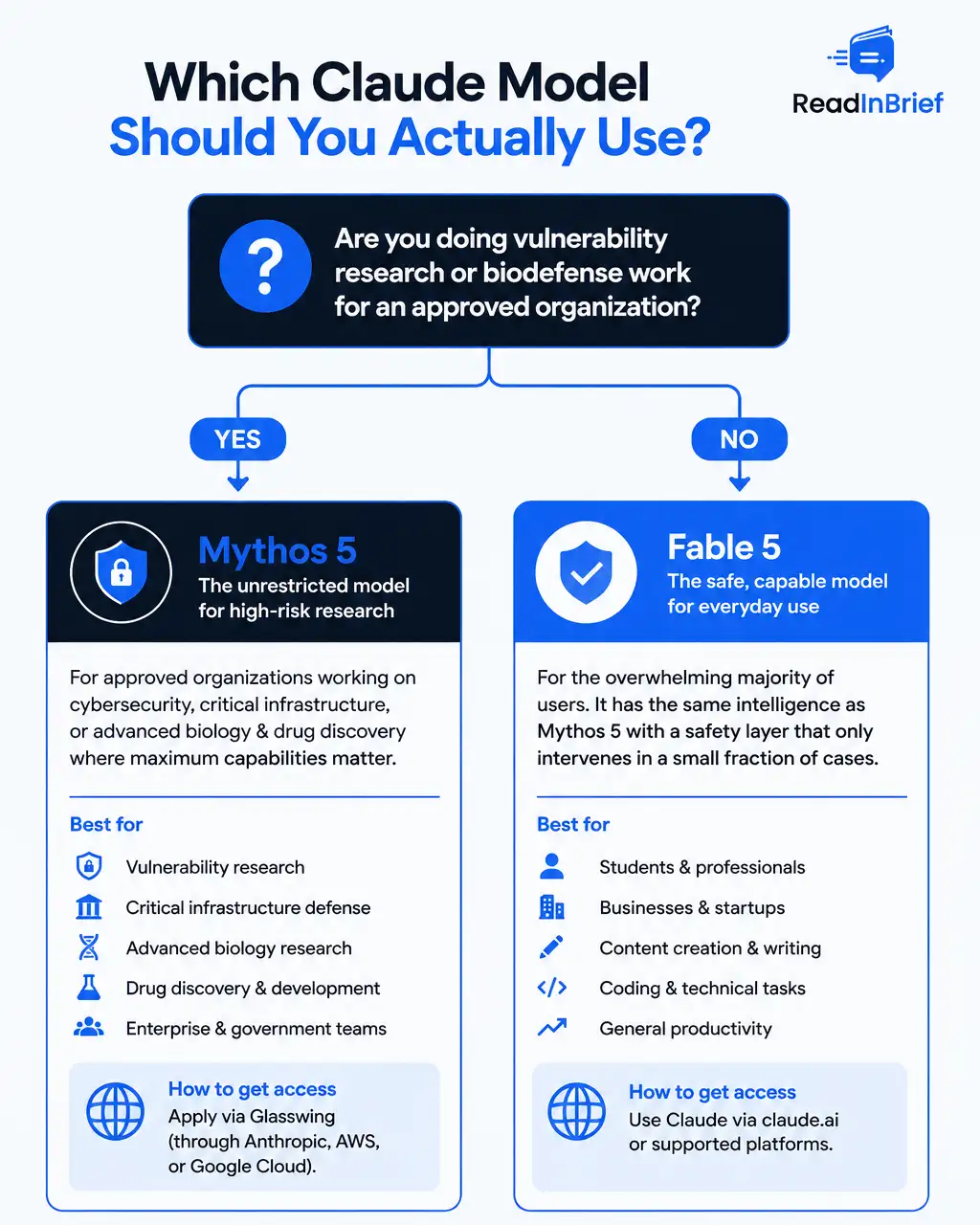
For the overwhelming majority of people reading this, the answer is simple: Claude Fable 5 is the model you have access to, and it's also the model you should want. It carries essentially the same raw intelligence as Mythos 5, with the safety layer only interrupting a tiny fraction of everyday sessions.
Mythos 5 only becomes relevant if you're part of a cybersecurity team doing vulnerability research, working in critical infrastructure defense, or conducting advanced biology and drug discovery research where the stronger, unrestricted version of the model provides real operational value. If that describes your organization, reaching out to your Anthropic, AWS, or Google Cloud account team is the actual next step, not signing up for a Claude subscription.
FAQs: Claude Fable 5 vs Claude Mythos 5
Is Claude Mythos 5 better than Claude Fable 5?
Not in terms of raw intelligence. They're built on the same underlying model. Mythos 5 simply has fewer safety restrictions in specific high-risk categories like offensive cybersecurity research, which is why access is limited to approved partners.
Can regular Claude users get access to Mythos 5?
Not currently. Mythos 5 is only available through Project Glasswing and requires approval from Anthropic, AWS, or Google Cloud. Anthropic has said it plans to expand access through a broader trusted access program over time.
Why was Claude Fable 5 taken offline in June 2026?
The US Department of Commerce applied export controls to Fable 5 and Mythos 5 on June 12, 2026, after a report surfaced about a way to prompt around Fable 5's safety classifiers. Anthropic suspended access globally as a precaution, then restored it on July 1 after the controls were lifted and an improved classifier was deployed.
Does Claude Fable 5 cost more than Claude Opus 4.8?
Yes. Fable 5 and Mythos 5 are priced at $10 per million input tokens and $50 per million output tokens, roughly double the cost of Opus 4.8, reflecting the jump in capability.
Is Claude Fable 5 the same as Claude Mythos Preview?
No. Claude Mythos Preview was an earlier, more limited version used in the initial Project Glasswing rollout. Mythos 5 is described as an upgrade to that preview version, sharing the same underlying model as Fable 5.
Final Thoughts
The Fable 5 versus Mythos 5 comparison isn't really about which model is smarter. It's about how much of that intelligence Anthropic is comfortable putting directly in your hands right now. Fable 5 gives nearly everyone access to genuinely frontier-level AI, with just enough guardrails to keep the riskiest capabilities in check. Mythos 5 is the uncapped version, reserved for the small group of people whose job is to defend systems the rest of us depend on.
For readers exploring which AI model actually fits their workflow, day-to-day coding, research, and writing, Fable 5 is already more than capable. If you want to keep track of how Anthropic's access policies evolve (and they have moved fast this year), it's worth bookmarking Anthropic's official announcements page directly.
Read Also:
GPT Image 1.5 vs Nano Banana Pro vs Midjourney: Best AI Image Tool
Midjourney vs DALL-E 3 vs Stable Diffusion: Best AI Image Generator
Claude vs ChatGPT vs Gemini in 2026: Which AI Is Best for You?
Siri AI vs Google Gemini vs ChatGPT: Which AI Assistant Actually Wins
N-gram vs RNN vs LLM: A Complete Guide to Language Model Development
Comments (0)
No comments yet. Be the first to share your thoughts!