The API Problem Nobody Talks About in Enterprise AI Integration

Author
Ravi Prajapati

Enterprise AI integration fails when APIs assume a human developer. Learn the hidden contracts AI agents break and how to score your APIs for agent readiness.
Most conversations about enterprise AI integration are about plumbing. Which connector, which gateway, which protocol, how many systems are wired up. Those questions matter, and the industry has made real progress answering them. But there is a quieter problem underneath, and it is the one that tends to surface only after an AI agent reaches production and does something nobody expected.
The problem is this: almost every enterprise API was built on an unwritten assumption about who would call it. It assumed a developer who read the documentation, understood the business rules that the documentation left out, wrote deterministic code, tested it, and shipped it. AI agents break that assumption. They choose which API to call at runtime, interpret field names on the fly, and string calls together in sequences no developer ever tested.
This article explains why that shift creates a different class of integration failure, what the latest evidence (as of October 2026) says about how widespread it is, and how to assess whether your APIs are actually ready for an AI caller. It includes an original planning framework, a decision table for which APIs to expose to agents, and the counterarguments worth taking seriously.
Quick Answer: What Is the Hidden API Problem in Enterprise AI Integration?
The hidden problem in enterprise AI integration is that most APIs depend on knowledge their callers were expected to carry in their heads: what fields really mean, which calls have side effects, what order operations must follow, and what a caller is allowed to do. Human developers absorbed that context before writing code. AI agents read only what the API exposes at runtime. Connectivity standards such as MCP solve how agents reach APIs, not whether agents understand and can safely use them.
Why Connectivity Is No Longer the Main Bottleneck
For years, the integration conversation was about access. Could a system reach the data at all? That problem is still large. The 2026 MuleSoft Connectivity Benchmark Report, based on a survey of more than 1,000 IT leaders, found that 95% of organizations face integration challenges and that half of AI agents operate in isolated silos. According to CIO Dive's coverage of the report, the average organization manages 957 applications, yet only 27% of them are connected, while enterprises already run an average of 12 AI agents, a number expected to reach 20 by 2027.
But the access layer is improving quickly. The Model Context Protocol (MCP), the open standard for connecting AI applications to tools and data, was donated by Anthropic to the Agentic AI Foundation under the Linux Foundation in December 2025. Its 2026-07-28 specification, finalized in July, made the protocol stateless at the protocol layer and formalized an extensions framework, changes aimed squarely at running agents at enterprise scale. Postman's API governance guide reports that MCP reached 97 million monthly SDK downloads across Python and TypeScript by March 2026. Integration platforms have followed, wrapping existing API catalogs so agents can discover them.
So agents can increasingly reach your APIs. The harder question is what happens once they do.
There is a useful signal in the same MuleSoft data. A large majority of IT leaders, 86%, warn that without proper integration, agents add more complexity than value. Complexity is not a connectivity symptom. It is what happens when a new kind of caller starts using systems built around assumptions it does not share.
What Do APIs Assume About Their Callers?
Traditional APIs assume a caller who learned the system before calling it. The developer read the docs, asked a colleague about edge cases, discovered through testing that one endpoint sends an email to the customer, and wrote code that encoded all of that permanently. The API itself never needed to explain any of it, because the knowledge lived in the calling code.
Consider what an experienced integration developer typically knows that most API specifications never state:
Meaning. That
status: 3means "pending legal review," not "shipped." Thatamountis in cents in one service and in dollars in another. Thatcustomer_idin billing is not the same identifier as in the CRM.Consequence. That calling
POST /orders/{id}/canceltriggers a refund, a customer notification and an inventory adjustment, and cannot be undone.Sequence. That you must call the eligibility check before the credit update, or the downstream ledger rejects the transaction a day later.
Authority. That the integration service account can technically update any record, but by policy should only touch records in its own region.
Load. That the pricing endpoint is expensive, rate limited, and should be cached rather than called per line item.
None of this is a design flaw in the traditional sense. It worked because the caller's code was written once, reviewed, tested and then frozen. The tribal knowledge was compiled into software.
An AI agent has no such compiled knowledge. It reads a tool name, a description and a schema, and then decides what to do. If the description says "Cancel an order," the agent has no way of knowing it also issues a refund unless someone wrote that down where the agent can see it.
How Do AI Agents Change the API Contract?
AI agents turn an API from a component called by fixed code into a capability chosen by a reasoning system at runtime. That moves three things that used to be settled at design time into runtime: which endpoint is called, in what order, and with what interpretation of the data. Every gap in the API's explicit contract becomes a decision the agent must guess at.
The contrast is easiest to see side by side.
Dimension | Traditional integration (developer-coded) | Agent-driven integration |
|---|---|---|
Who chooses the call | A developer, at design time | The model, at runtime |
Call sequence | Fixed and tested | Composed on the fly, potentially new every time |
Understanding of fields | Learned from docs, colleagues and testing | Inferred from names and descriptions |
Knowledge of side effects | Encoded in reviewed code | Only what the tool description states |
Error handling | Written for known error codes | Interpreted from error text, sometimes by retrying |
Volume pattern | Predictable, load-tested | Bursty, can loop on ambiguous results |
Identity | A service account with a known purpose | Often inherits a user's or a service's broad credentials |
Change management | Breaking changes caught in testing | Silent behavior shifts when descriptions or schemas change |
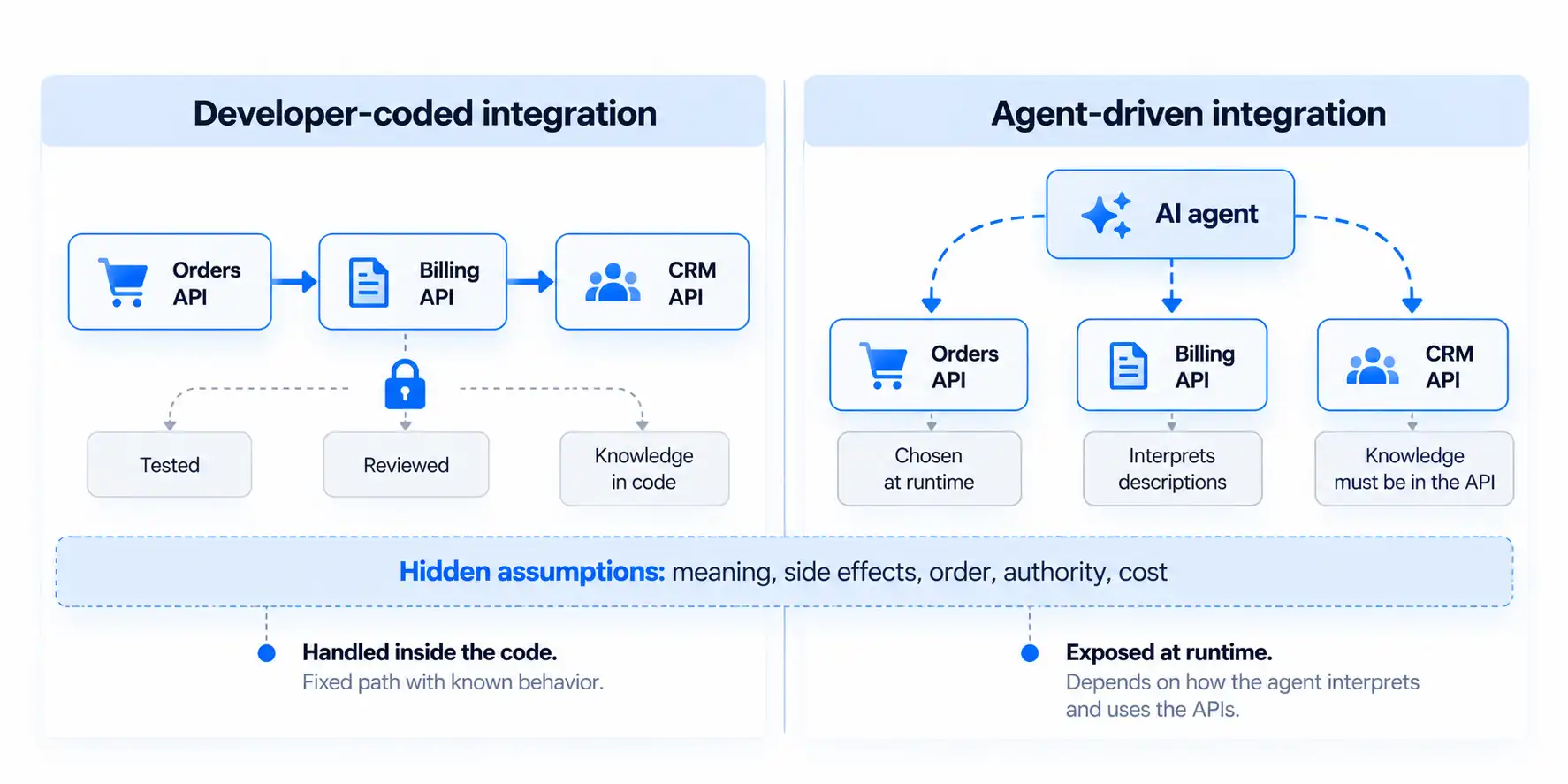
Developers already see this shift coming, but most have not acted on it. Postman's 2025 State of the API Report, which surveyed more than 5,700 developers and API professionals, found that only 24.3% are designing APIs with AI agents in mind. Postman's governance guide adds that 60% still design primarily for human consumption and 16% have not considered AI agents as API consumers at all.
Where Does Enterprise AI Integration Actually Break?
The failures below are drawn from the risk categories in current security and integration research. The scenarios illustrating them are hypothetical examples, written to show the mechanism, not real incidents.
1. Semantic drift: the agent misreads what the data means
An agent asked to "find customers with overdue invoices" queries a billing API where due_date is stored in the account's local time zone and status: 2 means "disputed," not "overdue." The agent returns a confident, plausible list that is wrong in both directions. Nothing errors. Nothing alerts. The failure is silent because the API worked exactly as designed.
2. Hidden side effects: the agent does more than it intends
A support agent is given a tool described as "update order shipping address." The underlying endpoint also recalculates tax, voids the existing shipping label and emails the customer. The agent calls it three times while trying to correct a typo. The customer receives three emails and the warehouse prints three labels.
This is exactly the pattern the OWASP GenAI Security Project describes in the OWASP Top 10 for Agentic Applications for 2026, published in December 2025. Its Tool Misuse and Exploitation category (ASI02) covers agents using legitimate tools in unsafe or unintended ways, often without exceeding the permissions they were granted.
3. Borrowed authority: the agent inherits more power than the task needs
To ship quickly, a team connects its agent with the same service account the old integration used. That account can modify records across every region. The agent only needs read access to one. If the agent is manipulated through a prompt injection in a customer email, the blast radius is every record the service account can touch.
The same OWASP list names this Identity and Privilege Abuse (ASI03): agents exploiting inherited credentials, delegation chains or cached sessions. Developers rank it among their biggest worries. In the Postman survey, 50.8% cited unauthorized or excessive API calls by AI agents as their top security concern, 49% worried about AI systems accessing sensitive data they should not see, and nearly 46% worried about credentials being shared or leaked.
4. Load surprises: the agent turns one request into hundreds of calls
A finance analyst asks an agent to compare pricing for 400 products. The agent calls the pricing API once per product, receives a rate-limit error, interprets it as a temporary failure and retries. The pricing service, sized for a nightly batch job, degrades for every other consumer.
Traditional rate limits protect the API. They do not tell an agent how to behave well. An error that a developer would have read once and designed around becomes, for an agent, an ambiguous signal it may respond to by trying again. Gartner had already predicted, in a March 2024 forecast, that more than 30% of the increase in API demand would come from AI and LLM-based tools by 2026.
5. Silent change: the API evolves and the agent quietly behaves differently
A team renames a field or rewrites a tool description to be clearer. No contract test fails, because the schema is backward compatible. But the agent now interprets the tool differently and routes a category of requests to it that it never handled before. In developer-coded integrations, a change like this would surface in testing. In agent-driven integrations, behavior can shift without any code changing at all.
How Big Is the Problem? What the 2025-2026 Evidence Shows
Finding | Source | What it suggests |
|---|---|---|
95% of organizations face integration challenges; 50% of AI agents operate in silos | Agents are being deployed faster than the systems around them are connected | |
Only 27% of the average 957 enterprise applications are connected | Most business context is still out of an agent's reach | |
27% of enterprise APIs are considered ungoverned; 94% say AI agent success needs a more API-centric architecture | A meaningful share of the surface agents could call has no clear owner or policy | |
Only 24.3% of developers design APIs with agents in mind; 50.8% fear unauthorized or excessive agent calls | Builders know the caller has changed, but most designs have not | |
Over 40% of agentic AI projects will be canceled by end of 2027 | Cost, unclear value and weak risk controls are expected to end many projects |
Two cautions about this evidence. First, the MuleSoft and Postman figures come from vendors that sell integration and API tooling, so their framing naturally emphasizes the problems their products address. The underlying survey sizes are large, but the interpretation deserves a skeptical read.
Second, Gartner attributes expected cancellations to escalating costs, unclear business value and inadequate risk controls, not to APIs specifically. The argument of this article is that API readiness sits underneath all three: hidden side effects raise risk, load surprises raise cost, and semantic errors erode the business value that justified the project.
Read Also: AI Adoption Statistics
The SCALE Contracts: A Framework for Agent-Ready APIs
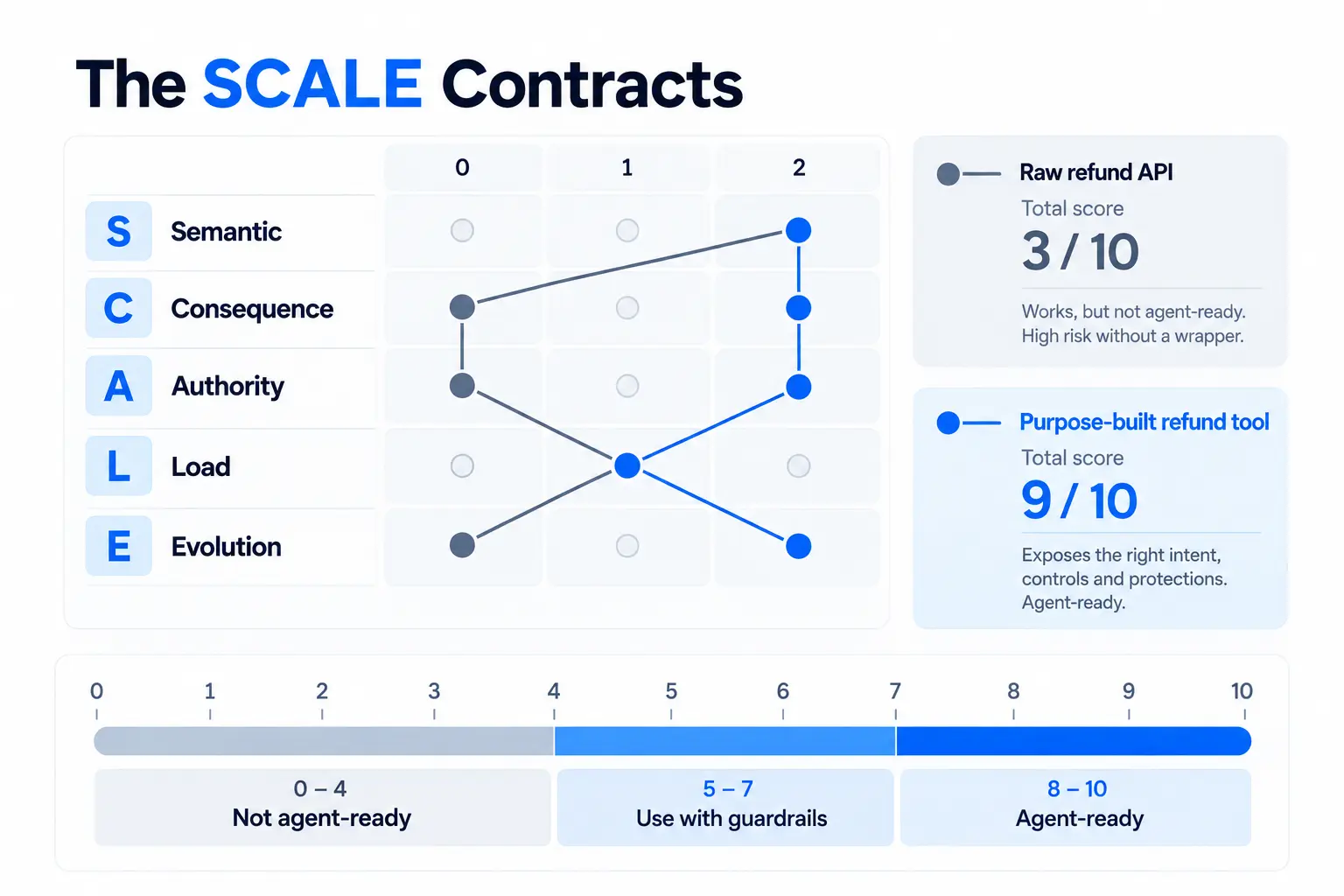
An API is ready for AI agents when five contracts that used to live in developers' heads are made explicit and enforceable: Semantic, Consequence, Authority, Load and Evolution. Together they form the SCALE Contracts. An API that leaves any of them implicit is safe only for callers who already know the rules, which agents do not.
The SCALE Contracts is an original analytical framework created for this article. It is a planning and assessment model for technology leaders, not a scientifically validated standard.
Contract | The question it answers | Implicit (risky for agents) | Explicit (agent-ready) |
|---|---|---|---|
Semantic | What do these fields and operations actually mean? | Cryptic names, undocumented enums, units left unstated | Business definitions, units, enum meanings and examples in the schema and tool description |
Consequence | What happens in the world when this is called? | Side effects discovered only by reading code or by accident | Side effects declared; idempotency keys supported; reversible vs irreversible marked |
Authority | Who is this caller acting for, and what may it do? | Shared service accounts with broad scope | Per-agent identity, task-scoped permissions, user delegation that can be traced and revoked |
Load | How much can be called, at what cost, and how should a caller back off? | Rate limits only enforced, not explained | Limits, costs and retry guidance exposed; batch or bulk alternatives offered |
Evolution | How will changes be communicated and tested? | Schema versioning only; description changes unreviewed | Tool descriptions versioned and tested like code; agent behavior regression tests |
How to score an API against the SCALE Contracts
Rate each contract 0 (implicit), 1 (partly documented) or 2 (explicit and enforced), for a maximum of 10.
0 to 4: Not agent-ready. Keep it behind deterministic code or a narrowly scoped wrapper. Do not expose it directly as an agent tool.
5 to 7: Agent-usable with guardrails. Suitable for read-heavy or reversible tasks, with human approval on writes and monitoring on volume.
8 to 10: Agent-ready. Suitable for direct agent use within the scope its Authority contract defines.
Illustrative scenario: scoring a refund API
This is a hypothetical example, not a real company. A retailer wants its customer service agent to issue refunds. The refund endpoint has clear field names and documented currency units, so Semantic scores 2. It triggers a customer email and a ledger posting that are not mentioned in its description, and it has no idempotency key, so Consequence scores 0. It runs under a shared service account, so Authority scores 0. Rate limits exist but are not exposed, so Load scores 1. Description changes are not reviewed, so Evolution scores 0. Total: 3.
The verdict is not "never let the agent issue refunds." It is "do not hand this endpoint to the agent as-is." The fix is a purpose-built refund tool that adds an idempotency key, declares its side effects, caps the refund amount, runs under a dedicated agent identity, and requires human approval above a threshold. That wrapper might score 8 or 9 on the same API underneath.
Which APIs Should You Expose to AI Agents First?
Start with read-only APIs that have clear semantics, then move to reversible write operations, and expose irreversible actions only through purpose-built tools with approval steps. The deciding factors are what happens if the agent gets it wrong and whether that mistake can be undone.
API type | Example | Agent exposure approach | Human approval |
|---|---|---|---|
Read-only, low sensitivity | Product catalog, store hours, public documentation | Expose directly after Semantic review | Not needed |
Read-only, sensitive data | Customer records, HR data, financial reports | Expose through task-scoped tools with field-level filtering | Not needed per call; audit access |
Reversible writes | Draft creation, tagging, ticket updates, cart changes | Expose with idempotency and clear side-effect descriptions | Optional, based on volume |
Irreversible or financial writes | Refunds, payments, cancellations, deletions | Only through purpose-built wrappers with limits | Required above defined thresholds |
Bulk or expensive operations | Pricing engines, report generation, data exports | Offer batch endpoints and cost signals instead of per-item calls | Required for unusual volume |
One practical pattern works in almost every row: do not expose your raw API surface as tools. Expose a smaller set of task-shaped tools, each designed around something an agent is actually asked to do. Salesforce described a version of this in a Dutch-language Salesforce blog post on AI agent integration: an internal team used MuleSoft's API management to limit the number of fields its agents could use in an API request. Fewer, clearer tools reduce semantic errors and shrink the authority each tool carries.
What MCP and Integration Platforms Cannot Solve on Their Own
It is tempting to assume that standardizing the connection standardizes the risk. It does not.
MCP standardizes how agents discover and call tools. It does not decide what those tools should do. The 2026-07-28 specification hardened authorization and made the protocol easier to scale, as WorkOS's analysis of the specification update details. Those are real improvements to how an agent proves who it is and reaches a server. But an MCP server that wraps a poorly described, side-effect-heavy API simply makes that API easier for an agent to misuse. The protocol carries the tool description; it cannot make the description complete.
Integration platforms and agent registries improve visibility, not semantics. Discovering every agent and every API in a catalog is valuable. MuleSoft's own data showing 27% of APIs are ungoverned makes that case. But a catalog entry that says "Order Cancel API, owner: commerce team" still does not tell an agent that cancellation triggers a refund.
Smarter models reduce some errors, not the structural ones. Better reasoning helps an agent interpret ambiguous field names. It cannot help an agent know about a side effect nobody documented, and it should never be the mechanism that limits what an agent is authorized to do. Authority and consequence need to be enforced by the system, not inferred by the model.
Read Also: MCP vs API: What Changes in the AI Agent Era?
Counterarguments Worth Taking Seriously
"This is just API documentation debt with a new name." Partly true. Much of the fix looks like good API hygiene that teams have deferred for years. The difference is the cost of deferral. A human developer who hits an undocumented behavior files a ticket and works around it once. An agent can repeat the same mistake across thousands of conversations before anyone notices. Old debt now compounds faster.
"We should not expose core APIs to agents at all." For some systems, that is the right answer, at least for now. The decision table above effectively says so for irreversible operations without wrappers. But blanket refusal pushes teams toward shadow integrations, browser automation and copied credentials, which are harder to govern than a deliberately designed tool layer.
"Agent-specific APIs will duplicate everything we already have." The wrapper approach does add a layer. The goal is not a parallel API estate, but a thin, task-shaped tool layer over existing APIs, versioned and tested like any other product. Most enterprises will need far fewer agent tools than they have endpoints.
"Vendor surveys overstate the problem." As noted above, the strongest data comes from companies that sell the solutions. Treat the exact percentages with caution. The direction of the evidence is still consistent across independent sources such as Gartner and OWASP: agent projects are failing on cost and risk controls, and the security community has made tool misuse and identity abuse first-class categories.
What Should Technology Leaders Do Now?
Treat AI agents as a new class of API consumer, and make the five SCALE Contracts explicit before expanding agent access. The practical sequence below is designed to fit into existing API governance rather than replace it.
Inventory what agents can already reach. Include MCP servers, integration platform connectors and any service accounts agents use. Unknown agent access is the first risk to close.
Score your top 20 agent-facing APIs against the SCALE Contracts. Prioritize by business impact, not by how easy they are to fix.
Wrap before you expose. For any API scoring under 8, build a task-shaped tool that adds missing descriptions, idempotency, limits and approval steps.
Give every agent its own identity. Retire shared service accounts for agent use. Scope permissions to tasks and make delegation from a user traceable and revocable.
Version and test tool descriptions like code. A description change is a behavior change for an agent. Add regression tests that check how agents use tools after edits.
Monitor agent traffic separately. Track call volume, error loops and unusual sequences per agent identity, so load surprises and misuse show up before customers notice.
Frequently Asked Questions
What is enterprise AI integration?
Enterprise AI integration is the work of connecting AI models and agents to an organization's systems, data and workflows so they can retrieve information and take actions. It covers APIs, data pipelines, identity and access controls, integration platforms and protocols such as MCP. The hardest part is usually not making the connection, but making sure the AI understands what each system does and is limited to actions it should take.
Why do AI agents need different APIs than traditional applications?
AI agents decide which API to call and how to interpret the response at runtime, while traditional applications follow logic a developer wrote and tested in advance. That means agents rely entirely on what the API exposes: names, descriptions, schemas and error messages. Knowledge that developers used to carry, such as side effects, required call order and permissions, has to be made explicit in the API or the tool wrapped around it.
Does MCP solve enterprise AI integration problems?
MCP solves a large part of the connection problem by giving AI applications a standard way to discover and call tools. Its July 2026 specification also strengthened authorization and scalability. It does not fix unclear semantics, undocumented side effects or overly broad permissions in the APIs behind those tools. An MCP server is only as safe and understandable as the API and descriptions it exposes.
What makes an API "agent-ready"?
An agent-ready API makes five things explicit: what its data means, what side effects its operations have, who the caller is acting for and what it may do, how much it can be called and at what cost, and how changes will be communicated and tested. This article calls these the SCALE Contracts. APIs that leave them implicit should sit behind purpose-built tools before agents use them.
Should AI agents be allowed to call write APIs?
Yes, but in stages. Reversible writes, such as creating drafts or updating tickets, can be exposed with idempotency keys and clear side-effect descriptions. Irreversible or financial actions, such as refunds, payments and deletions, should only be available through purpose-built tools with limits and human approval above defined thresholds. The deciding question is whether a mistake can be undone.
How do you prevent AI agents from overloading APIs?
Give agents batch or bulk alternatives to per-item calls, expose rate limits and costs in tool descriptions, and return error messages that tell the caller how to back off rather than simply failing. Monitor agent traffic per agent identity so loops and spikes are visible quickly. Rate limits alone protect the API but do not teach an agent how to behave.
What are the biggest security risks of connecting AI agents to enterprise APIs?
The most prominent risks are tool misuse, where an agent uses a legitimate API in an unsafe way, and identity and privilege abuse, where an agent inherits broader credentials than its task needs. Both are named categories in the OWASP Top 10 for Agentic Applications for 2026. Prompt injection, credential leakage and access to sensitive data are closely related concerns.
So, What Is the API Problem Nobody Talks About?
The problem is not that enterprise APIs are hard to reach. It is that they were designed for callers who already knew the rules. For two decades, the meaning of fields, the consequences of operations, the limits on authority, the cost of calls and the impact of changes lived in developers' heads and in reviewed code. AI agents arrive without that knowledge, and they act on whatever the API tells them.
Enterprise AI integration succeeds when those five contracts are moved out of people's heads and into the API layer, where both agents and governance systems can see and enforce them. Connectivity standards like MCP make the reach easier. The value, and most of the risk, depends on what agents find when they get there.
Comments (0)
No comments yet. Be the first to share your thoughts!