
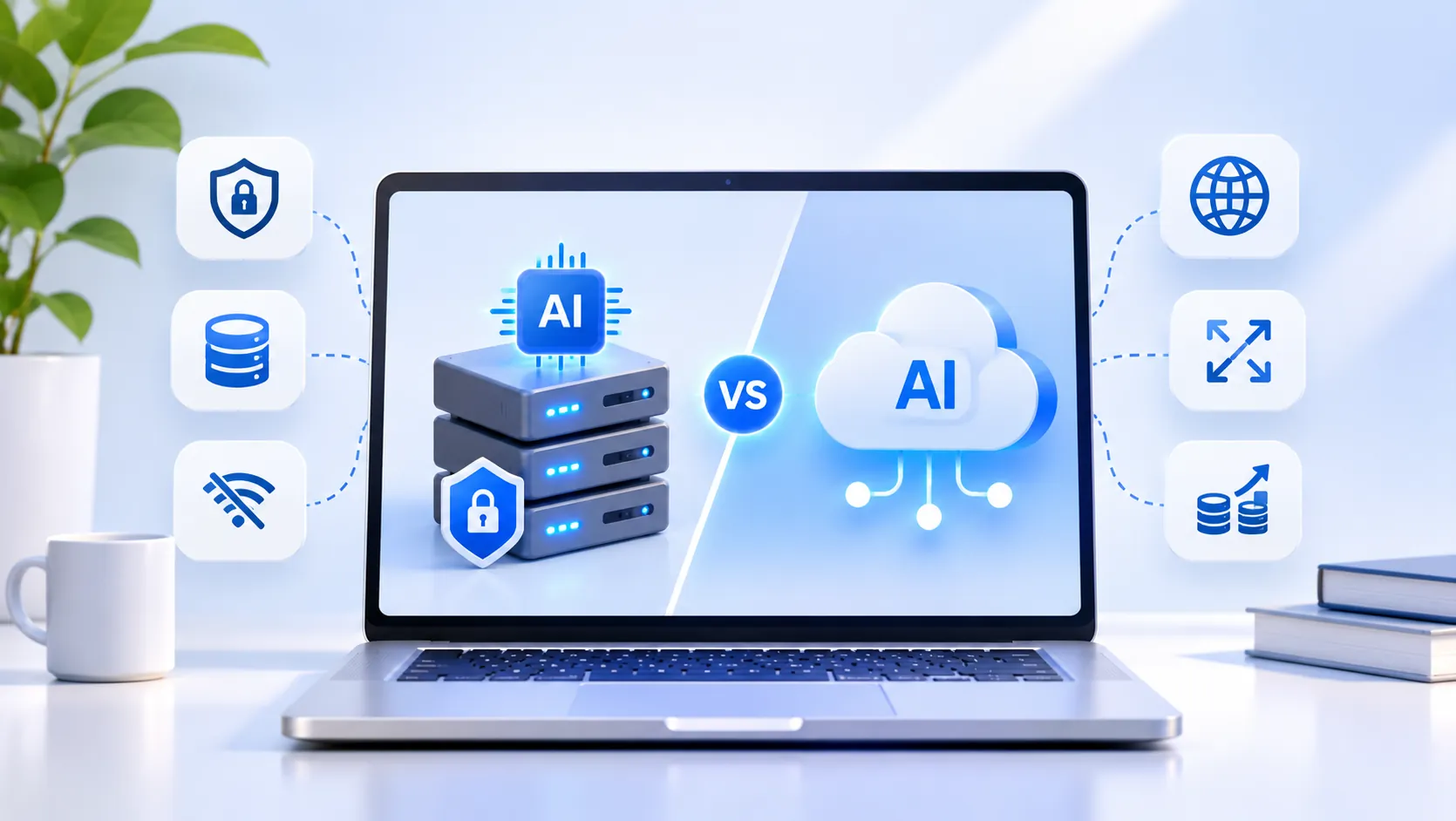
Compare local AI models and cloud AI APIs for business use across privacy, latency, quality, scaling, GPU cost, and maintenance. Learn how to choose.
Introduction
Businesses evaluating AI infrastructure face a decision that is often framed too simply: run a model locally for privacy, or use a cloud API for convenience. In practice, the choice affects more than where inference happens. It influences model quality, response time, data governance, total cost, reliability, scaling, engineering effort, and how quickly a team can adopt new capabilities.
A local model runs on hardware the organization controls, such as a workstation, on-premises server, or private cloud environment. A cloud AI API sends requests to a managed provider’s infrastructure and returns results over a network. Hybrid architectures combine the two, routing different workloads to different environments.
There is no universal winner. This guide compares the approaches for business use and provides a decision framework based on workload, risk, volume, and operational capacity. Model performance and provider terms change quickly, so benchmark current candidate models and verify current pricing, data-use policies, regional availability, and service limits before committing.
What is the difference?
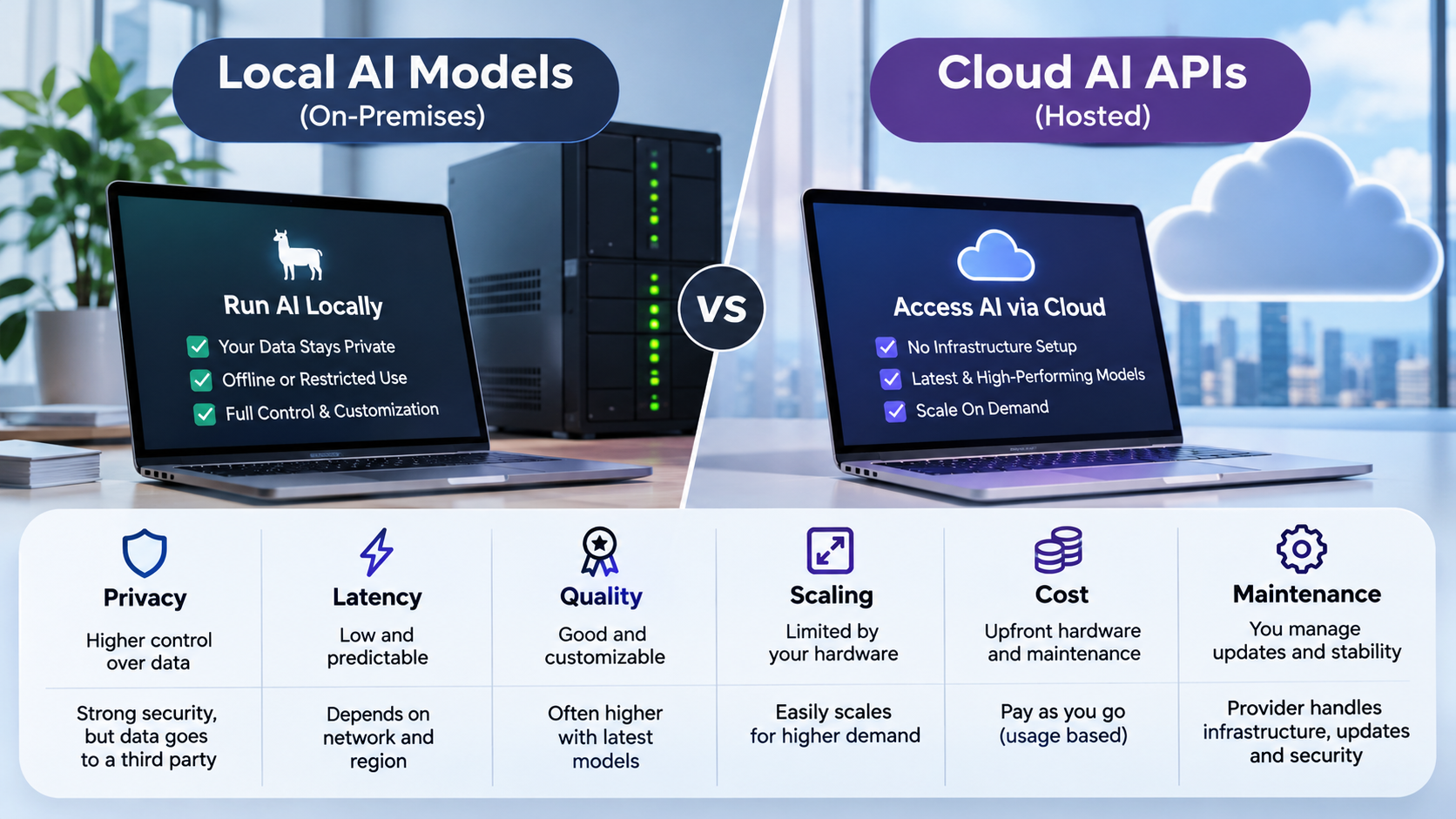
Local AI models
A local model is deployed on infrastructure controlled by the business or its chosen hosting environment. The organization selects the model, runtime, hardware, access controls, update process, and monitoring. Local deployment can offer greater control over data flow and predictable behavior for a fixed environment, but it also makes the organization responsible for capacity, patching, reliability, and model lifecycle management.
Cloud AI APIs
A cloud API provides access to hosted models through a managed service. The provider operates the inference infrastructure and typically handles scaling, availability, model deployment, and service updates. This can reduce infrastructure work and provide access to high-capability models, but it introduces network dependency, provider-specific terms, usage costs, and external data-processing considerations.
Hybrid AI
Hybrid AI uses local and cloud components together. A business might run classification or document redaction locally, then send a minimized request to a cloud model for complex reasoning. Another workflow might use a local model for routine requests and fall back to a cloud API when confidence is low. Hybrid designs can balance control and capability, but require routing logic, observability, and clear fallback rules. For a related explanation of orchestration patterns, see AI agents vs. AI workflows.
Comparison at a glance
Dimension | Local model | Cloud AI API |
Privacy and data control | More control over storage, network boundaries, and retention when configured correctly. | Data is processed by a provider; protections depend on contract, settings, region, and product tier. |
Latency | Can be low when hardware is nearby and adequately provisioned; performance depends on model and load. | Includes network time and provider queueing; can be fast with optimized regional endpoints. |
Model quality | Depends on selected model, quantization, hardware, and task; smaller models may struggle with complex reasoning. | Access to a range of hosted models, including high-capability options, subject to provider changes. |
Scaling | Requires capacity planning, hardware, orchestration, and concurrency management. | Provider-managed scaling is often simpler, though quotas and rate limits still apply. |
Cost | Hardware, power, hosting, operations, utilization, and refresh cycles. | Usage-based or committed pricing; costs vary with tokens, modality, model, and traffic. |
Maintenance | The business manages deployment, updates, monitoring, security, and reliability. | Provider manages much of the serving stack; application integration and governance remain yours. |
Customization | Can support local fine-tuning, adapters, retrieval, and tightly controlled environments. | Customization options vary by provider and model; some require additional services or restrictions. |
Resilience | Can operate without external connectivity if the full stack is local. | Depends on network and provider availability; multi-provider or fallback designs can improve resilience. |
Privacy: local does not automatically mean secure
Local deployment can reduce the number of external systems receiving prompts, but security still depends on implementation. A poorly secured server, permissive logs, unencrypted storage, or broad internal access can expose sensitive data. Organizations must still manage authentication, authorization, encryption, audit logs, retention, patching, and incident response.
Cloud APIs can also be appropriate for sensitive workloads when the provider offers suitable contractual protections, retention controls, access management, encryption, and regional processing options. The relevant question is not simply “local or cloud?” It is whether the complete data path satisfies the organization’s risk, legal, and regulatory requirements.
For each use case, map what data is sent, where it is processed, whether it is retained, who can access it, and whether it is used for model training. Verify the specific product and plan rather than relying on broad marketing statements.
Latency and user experience
Local inference may be attractive for interactive workflows that need predictable response times, especially when the application and model run on nearby hardware. But a local model that is too large for available memory can be slower than a hosted service. Concurrent users, context length, quantization, batching, and hardware utilization all affect latency.
Cloud APIs add network round-trip time, but managed providers can operate optimized accelerators and serving systems. For many business applications, the practical experience depends more on model choice, prompt size, streaming, and application design than on location alone.
Benchmark the full workflow using representative prompts. Measure time to first token, total completion time, throughput, error rate, and behavior under peak concurrency. Avoid comparing a lightly loaded local machine with a cloud service under different conditions.
Model quality and task fit
“Model quality” is not one score. A model may be excellent at classification, extraction, summarization, or code generation and weaker at multi-step reasoning, nuanced writing, or following long instructions. Local models are increasingly capable, but performance varies by model size, training, quantization, and task.
Cloud APIs offer a menu of models and may provide access to leading capabilities without requiring the business to operate the hardware. However, hosted model versions can change, and a stronger general model may still make mistakes on domain-specific material.
Build a task-specific evaluation set from representative business examples. Score factual accuracy, completeness, instruction adherence, refusal behavior, formatting, and human correction time. Use retrieval-augmented generation or structured outputs where they improve reliability, and keep human review for consequential decisions.
Scaling and reliability
Local deployments require capacity planning: GPU memory, CPU and RAM, storage, concurrency, failover, and workload peaks. Scaling may mean buying more hardware, distributing inference, or limiting usage. That can be sensible for stable, high-volume workloads, but it requires technical ownership.
Cloud APIs simplify many infrastructure decisions and can scale quickly, but they are not unlimited. Rate limits, service quotas, regional outages, model deprecations, and provider dependencies must be considered. Production systems need retries, timeouts, observability, graceful degradation, and a plan for model or provider changes.
A hybrid architecture can route workloads by sensitivity, complexity, cost, or service level. It can also become harder to debug if routing decisions and model versions are not logged consistently. The integration layer is also discussed in MCP vs API: What Changes in the AI Agent Era?.
GPU cost and total cost of ownership
Local AI is not “free after buying a GPU.” Total cost includes hardware purchase or lease, electricity, cooling, networking, storage, hosting, utilization, maintenance, security, staff time, and replacement cycles. Low utilization can make dedicated hardware expensive per request. High, predictable utilization may improve the economics.
Cloud API cost is often easier to start with because it scales with usage, but high-volume or long-context workloads can become expensive. Pricing may vary by model, input and output tokens, cached input, batch processing, images, audio, or reserved capacity.
Compare cost per successful business task, not only cost per token or GPU hour. Include retries, human correction, downtime, and operational overhead. A cheaper model that produces more errors may have a higher total cost.
Maintenance and organizational readiness
Local deployments need an owner for model selection, runtime updates, hardware health, security patches, performance tuning, and incident response. Teams should plan how to test new model versions and roll back when behavior changes.
Cloud APIs reduce the burden of serving infrastructure, but they do not remove application maintenance. Teams still own prompt design, evaluations, access controls, data governance, logging, vendor review, and integration reliability.
The best architecture is partly a staffing decision. If the organization lacks people to operate inference infrastructure, a managed API may be the more responsible choice even when local deployment appears attractive on paper.
Which approach should a business choose?
Choose local when…
Local deployment is worth prioritizing when data must remain within a controlled environment, connectivity is limited, workloads are stable and high-volume, latency requirements favor nearby inference, or the business needs deep control over model versions and runtime. It is most compelling when the organization has the infrastructure and engineering capacity to operate it well.
Choose cloud APIs when…
Cloud APIs are often the better starting point when the team needs strong general-purpose capabilities quickly, usage is variable, infrastructure ownership would distract from core work, or the organization wants to test several models without purchasing hardware. They are also useful when the best available model quality is a priority and data-processing terms meet requirements.
Choose hybrid when…
Hybrid is appropriate when workloads have different risk and capability profiles. For example, a local model can redact or classify documents before a cloud model performs complex analysis. A router can use local inference for routine cases and escalate uncertain requests to a managed model, subject to policy and user consent.
A practical decision and pilot framework
1. Classify workloads
List each AI use case, its data sensitivity, expected volume, latency target, quality threshold, and consequence of error. Do not select infrastructure for “AI” in general; select it for defined workloads.
2. Define non-negotiable controls
Document data residency, retention, access, audit, availability, and contractual requirements. Eliminate options that cannot satisfy them before comparing performance or cost.
3. Benchmark representative tasks
Run the same evaluation set across candidate local models and cloud APIs. Record accuracy, latency, throughput, failure rate, and human correction effort. Test peak load and edge cases.
4. Model total cost
Estimate infrastructure and staffing for local deployment, and usage plus integration costs for APIs. Compare cost per successful task at expected and peak volumes, including retries and review.
5. Plan for change
Version prompts, models, and evaluation sets. Define monitoring, fallback behavior, rollback, and vendor or model migration procedures before production launch.
Frequently asked questions
Are local AI models always more private?
They can provide more direct control over data flow, but privacy depends on the complete implementation, including logs, access controls, storage, and security. Cloud services may meet strict requirements when configured and contracted appropriately.
Are cloud AI APIs always more accurate?
No. Quality depends on the model and task. Some local models perform well on focused workloads, while hosted models may offer stronger general reasoning or multimodal capabilities. Benchmark your own use cases.
When does local AI become cheaper?
It may become economical with sufficiently high and predictable utilization, suitable hardware, and manageable operational costs. There is no universal break-even point; calculate it using workload and staffing assumptions.
Can a business use both local models and cloud APIs?
Yes. Hybrid architectures can route requests based on sensitivity, complexity, cost, latency, or confidence. They need explicit routing policies, monitoring, and fallback behavior.
What should be tested before production?
Test accuracy, latency, throughput, cost, privacy controls, access permissions, failure handling, model updates, and human review using representative data and realistic traffic.
Conclusion
Local AI models and cloud AI APIs are deployment choices, not competing ideologies. Local inference offers control and can suit stable or sensitive workloads, while cloud APIs reduce infrastructure burden and provide flexible access to managed models. Hybrid systems can combine these strengths when the business is prepared to operate the added complexity.
Start with the workload, define the controls, benchmark actual tasks, and compare total cost of ownership. The right decision is the one that meets business requirements reliably, with a sustainable operating model.
Comments (0)
No comments yet. Be the first to share your thoughts!