AI Customer Feedback Analysis Tools: How to Choose for Surveys and Reviews

Author
Ravi Prajapati
Compare AI customer feedback analysis tools for surveys and reviews: built-in survey AI, specialist platforms and LLM pipelines, with accuracy evidence.
The right AI customer feedback analysis tools depend on where your comments live and how many you have. Survey platforms such as SurveyMonkey and Qualtrics now analyze open-text answers inside the survey tool. Specialist platforms such as Thematic and Alchemer link themes to NPS and CSAT scores. Large language model (LLM) APIs suit teams that can build and test their own pipeline. Comment volume, language and validation method matter more than the feature list.
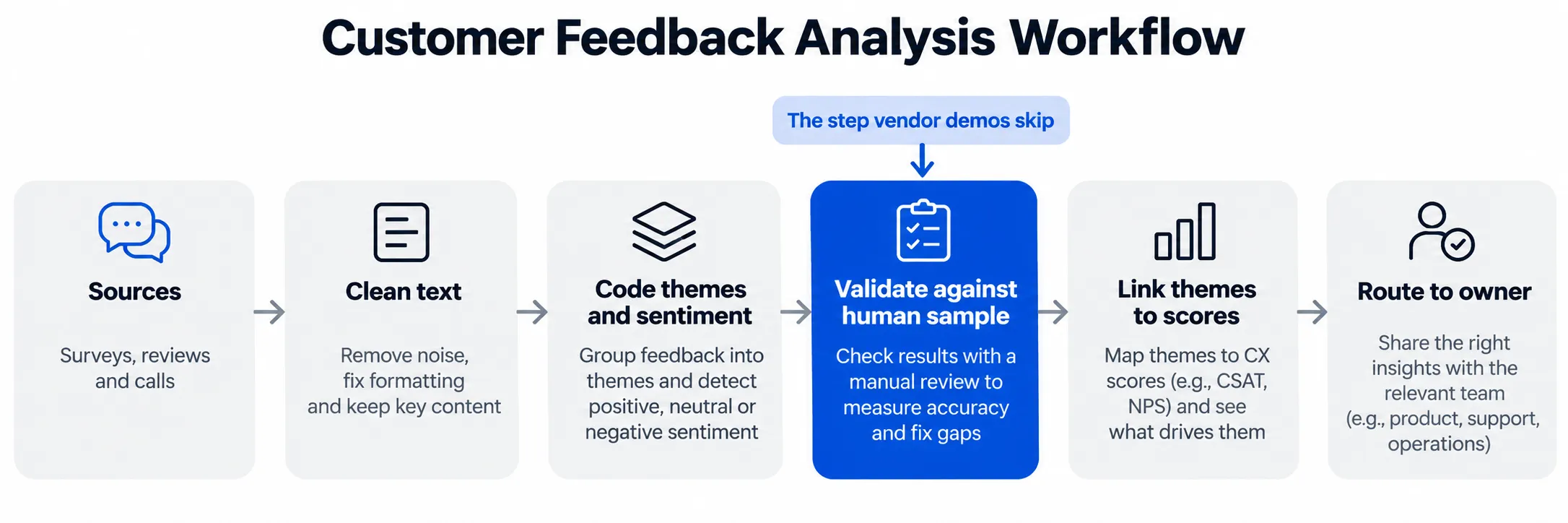
That last point is where most buying guides stop short. Published research shows LLMs agreeing with human coders on individual categories at high rates, yet one 2026 preprint found the best model reproduced a human coder’s full label set for fewer than 60% of responses. A tool can look accurate in a demo and still tell a different story about your customers.
This guide focuses on survey open-text and mixed-source feedback. For a vendor-by-vendor look at public review streams, see our guide to AI tools for customer review analysis. The comparison here rests on vendor documentation and published studies, not on hands-on testing of output quality, and vendor statements are treated as vendor claims.
Which Type of Tool Fits Your Feedback Mix?
Four categories cover most buying decisions. The right one follows from where your comments are collected and who must act on the result.
Survey-platform built-in AI (SurveyMonkey AI, Qualtrics Text iQ). Best for teams already running surveys in that platform. Main trade-off: plan gating, language limits and size limits.
Survey-linked theme and driver analytics (Alchemer Pulse, Thematic). Best for NPS and CSAT programs that must rank themes by score impact. Main trade-off: it needs enough comment volume to be meaningful.
Enterprise voice-of-customer suites and CX analytics (Qualtrics XM Discover, Medallia, InMoment, Chattermill, Enterpret). Best for programs combining surveys, reviews, calls and tickets. Main trade-off: cost and setup time.
LLM API pipeline (OpenAI, Anthropic and Google models plus your own code). Best for custom taxonomies and unusual data residency needs. Main trade-off: you own validation, maintenance and dashboards.
What Do the Built-In Survey Tools Include, and Where Do They Stop?
Built-in survey AI is the lowest-friction option, and its limits are specific. The table summarizes documented constraints as of November 27, 2026. Confirm them against your own plan, since features and tiers change.
Tool | What the documentation says | Constraints to check |
|---|---|---|
SurveyMonkey thematic and sentiment analysis | AI-generated themes, summaries and sentiment on open-ended answers; listed for Advantage, Premier, Team and Enterprise plans | Not on lower tiers |
SurveyMonkey Analyze with AI | Answers questions about results with charts and summaries | |
Qualtrics Text iQ Basic | Topic creation and search | Up to 20,000 responses per survey; no sentiment analysis, summary mode or Recommended Topics |
Qualtrics Text iQ Advanced | Adds sentiment, Recommended Topics, Query Builder and comment translation | Languages: 14 supported, with other languages not guaranteed at the same quality |
Two details deserve attention. First, SurveyMonkey states that Analyze with AI uses OpenAI and that your content is not used to train the third-party model, which is a vendor assurance to check against your own data policy. Second, Qualtrics says its sentiment model cannot guarantee the same quality for languages it has not optimized. A multilingual survey can therefore look fine in the dashboard and be unreliable in some languages.
For driver analysis, Alchemer’s impact analysis help page describes comparing average NPS or net sentiment for comments where a theme is present or absent. Thematic’s impact score has drawn at least one G2 reviewer comment that it is hard to understand, a reminder to ask any vendor how its scores are calculated.
How Accurate Is AI at Coding Survey Comments?
AI can match human coders on well-defined category tasks, but accuracy depends on the codebook, the language and how you measure it. The evidence below is mixed on purpose, because the studies measure different things.
Near-human on a large codebook. Mellon and colleagues compared LLMs and other methods on British Election Study responses sorted into 50 categories. The best LLM reached 93.9% accuracy against 94.7% for a second human coder, and beat a neural network trained on 1,000 labeled cases. The model tested, Claude 1.3, is long superseded.
Good, after the codebook is tuned. Pew Research Center coded 3,635 open-ended answers into 17 categories with GPT-5.2. After reviewing disagreements and making minor codebook adjustments, micro-averaged F1 reached 0.86. The process, not only the model, produced that result.
High per-category agreement can hide response-level error. In a 2026 SocArXiv preprint (not peer reviewed), Soria tested eight LLMs on 3,200 responses. Models reached 82 to 97% per-category agreement with human consensus, yet even the best reproduced the full human label set for fewer than 60% of responses, and agreement was lower for some demographic groups. Overall category rankings still correlated strongly with human results (Spearman 0.75).
Not automatically better than older methods. A German-language study of GPT-4o, Llama 3.2 and Mistral NeMo concluded that off-the-shelf LLMs are not necessarily superior to other computational methods, and that results depend on topic and language. It also noted that LLM output is non-deterministic, so recoding new data can shift results.
The practical reading, which is our interpretation: AI is reliable enough to code survey comments at scale when you give it a clear codebook and check it. It is not reliable enough to trust on vendor claims alone. The metric to ask for is response-level agreement on your own data, split by segment, not a single accuracy number.
Summaries need separate scrutiny. A summary can state something no respondent said. Understanding AI hallucination helps you design checks that tie every summary claim to counted source comments.
How Much Feedback Do You Need Before Themes and Drivers Mean Anything?
Automatic theme discovery and driver analysis need volume. Vendors encode this in their own documentation. Alchemer advises at least 500 responses for impact analysis and filters out themes with fewer than ten responses. Qualtrics generates Recommended Topics only once there are at least 500 comments without topics in a single language. Upper limits exist too: 10,000 responses for SurveyMonkey’s Analyze with AI and 20,000 for Text iQ Basic, as shown above.
Combining those documented thresholds with our judgment gives a working guide. The bands are editorial, not a vendor standard.
Comments per analysis | Sensible approach | Avoid |
|---|---|---|
Under about 500 | LLM-assisted coding with a fixed codebook, plus a person reading every comment | Driver rankings and trend claims from tiny themes |
About 500 to 10,000 | Built-in survey AI or a specialist platform, validated on a labeled sample | Treating auto-generated themes as final |
Above 10,000 or several sources | Specialist or enterprise platform, or an LLM pipeline with a regression test set | Plan tiers with response caps |
Hypothetical example, for illustration only: a team runs a 300-response quarterly NPS survey and sees a “delivery” theme with 12 comments rank as the top detractor driver. With that few comments, a handful of respondents can reorder the ranking. Reading the 12 comments and reporting the count is more defensible than reporting an impact score.
What Happens to Sensitive Data in Open-Text Answers?
Open-text answers often contain names, order numbers, health details or complaints about named staff, even when the question never asked for them. Check three things before sending comments to any AI feature: where the text is processed, whether it is used for training, and whether regulated data is excluded. SurveyMonkey’s documentation, for instance, says Analyze with AI is not available to HIPAA-enabled accounts or those with Enhanced Sensitive Data Protection. For teams weighing a self-hosted pipeline against a shared service, our comparison of private AI versus public AI covers the trade-offs.
Which Survey Tools Are Being Retired?
Platform risk is part of the buying decision. Qualtrics’ Delighted FAQ states that access was terminated on July 1, 2026, with data deleted after the final sunset date. SurveyMonkey says it is transitioning all GetFeedback Direct customers to SurveyMonkey Enterprise by December 31, 2026, after which Direct is unavailable. As of this article, that leaves about five weeks. If you rely on either product’s history of NPS comments, export it now and confirm the format before migrating, because a theme model trained on old categories may not transfer.
How Do You Choose? A Decision Table by Situation
Your situation | Start with | Verify before buying |
|---|---|---|
Run surveys in SurveyMonkey, moderate volume, English | SurveyMonkey thematic and sentiment analysis | Plan tier, tagging requirement for Analyze with AI |
Run surveys in Qualtrics, multilingual | Text iQ Advanced or XM Discover | Quality in each of your languages |
NPS or CSAT program that must justify priorities | Alchemer Pulse or Thematic | Volume above 500, how impact scores are computed |
Surveys, reviews, calls and tickets in one program | Enterprise VoC or CX analytics platform | Source coverage, editable taxonomy, time to first insight |
Engineers on staff, custom taxonomy or residency needs | LLM API pipeline | Your labeled test set, rerun consistency, cost per 10,000 comments |
Under 500 comments per wave | Spreadsheet plus LLM-assisted coding, human read | Whether the effort justifies a platform |
How Do You Validate a Tool on Your Own Survey Data?
A short pilot exposes problems that demos hide. The method below is our recommendation, built from the studies above, not a vendor standard.
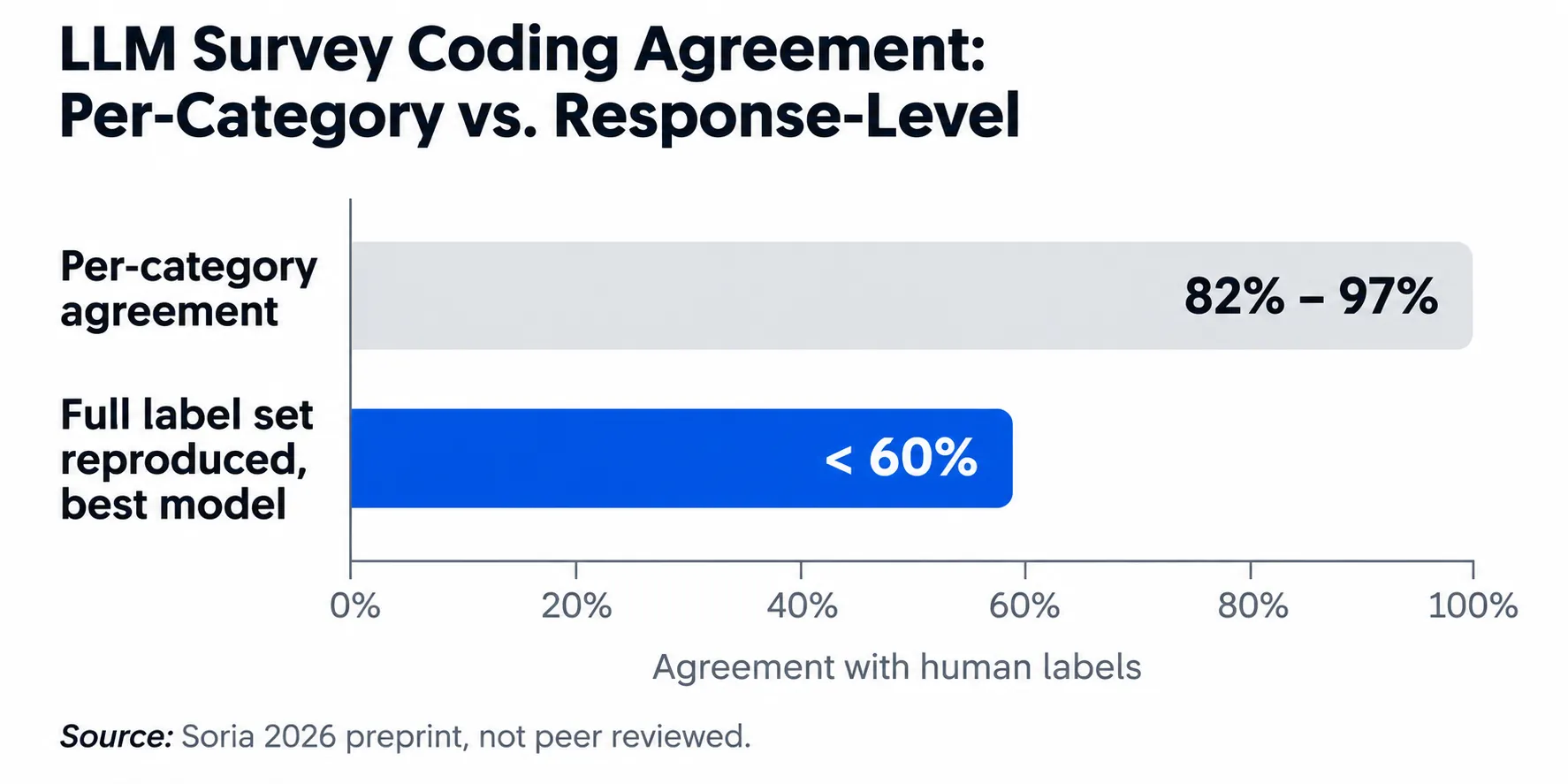
Prepare the text. Remove duplicates and test responses, and decide how blank or “don’t know” answers are labeled. Best practices for cleaning text data for NLP cover typical preparation steps.
Build a gold set. Sample a few hundred comments spread across scores, segments and languages. Have two people code them against the same codebook, then resolve disagreements.
Add a “no substantive answer” category. Research shows these responses cause coder disagreement.
Score at the response level. Count how often the tool’s full label set matches yours, not just per-category agreement.
Split results by segment and language. The Soria preprint found lower agreement for some groups.
Rerun the same data twice. If categories shift, the pipeline is not stable enough for trend reporting.
Review disagreements and revise the codebook. Pew’s process did this before reporting its final score.
Check the action path. Confirm a verified theme can reach an owner without manual export.
What Can AI Feedback Analysis Not Do?
It cannot fix a biased sample. People who answer surveys or write reviews are not a random cross-section of your customers, and AI analysis inherits that bias. It cannot decide whether “slow checkout” belongs under payments or performance, so someone must own the taxonomy. And it cannot turn a correlation into a cause: a theme associated with lower NPS is a lead to investigate, not proof.
Counterargument worth stating: human coding is not a perfect benchmark either. In the Mellon study the second human coder agreed with the original coder 94.7% of the time, not 100%. The point is not that machines are worse, but that any comparison needs a documented human baseline.
[INTERNAL IMAGE SUGGESTION] Placement: After the table in “How Much Feedback Do You Need Before Themes and Drivers Mean Anything?” Image Type: Matrix Image Concept: A 3-row matrix by comment volume (under 500, 500 to 10,000, above 10,000) against recommended approach and main risk. Purpose: Lets readers locate their situation at a glance. Suggested Alt Text: Matrix matching comment volume bands to recommended feedback analysis approaches and risks Suggested Filename: feedback-volume-approach-matrix.webp Image Generation Prompt: Minimal editorial matrix on white, three rows and three columns with thin light grey #E5E7EB gridlines. Row labels: Under 500, 500 to 10,000, Above 10,000. Column labels: Volume, Recommended approach, Main risk. Blue #2563EB accent on the middle row, charcoal #111827 text, grey #6B7280 captions. Premium whitespace, no icons, no decoration.
FAQs
What are the best AI tools for analyzing survey open-ended responses?
No single tool is best. SurveyMonkey and Qualtrics suit teams already collecting surveys there, Alchemer and Thematic suit NPS and CSAT programs that need theme impact, and LLM pipelines suit teams that can validate their own results. Choose by comment volume, languages and where your data lives, then test on your own comments.
Can ChatGPT or another LLM code survey comments reliably?
Often, with a clear codebook and checking. Studies show near-human accuracy on defined categories, but results vary by language and topic, and output can change between runs. Validate on a labeled sample at the response level before relying on it for reporting.
How many survey responses do I need for AI theme and driver analysis?
Vendors suggest about 500. Alchemer advises at least 500 for impact analysis and drops themes with fewer than ten responses, and Qualtrics generates Recommended Topics from 500 uncoded comments. Below that, read the comments and report counts rather than driver scores.
Is it safe to put survey comments into AI tools?
It depends on the tool and data. Check where text is processed, whether it is used for training, and whether regulated data is excluded. SurveyMonkey, for example, says Analyze with AI is unavailable to HIPAA-enabled accounts. Remove personal identifiers where you can and follow your own data policy.
Do AI feedback tools work for non-English surveys?
Partly. Qualtrics lists 14 supported Text iQ languages and does not guarantee equal sentiment quality elsewhere. SurveyMonkey’s Analyze with AI requires English surveys. Research on German responses found performance depends on topic and language. Test each language separately in your pilot.
What happened to Delighted and GetFeedback Direct?
Delighted was discontinued, with access ending July 1, 2026. SurveyMonkey says GetFeedback Direct customers move to SurveyMonkey Enterprise by December 31, 2026. GetFeedback Digital, since renamed GetFeedback, is a separate product. Export your history and confirm formats before migrating.
How should I combine survey feedback with online reviews?
Analyze them under one codebook but keep a source tag on every comment, because the populations differ: surveys are prompted and carry scores, reviews are self-selected. Compare themes across sources before merging counts. This is our recommendation, not a vendor standard.
Conclusion: Match the Tool to Your Volume, Language and Validation Capacity
The evidence supports using AI to code survey and review comments at scale, provided the codebook is clear and the output is checked at the response level. It does not support trusting a single accuracy figure, and it does not support driver rankings from a few hundred comments.
Start with the tool already attached to your survey platform if your volume sits between roughly 500 and 10,000 comments in supported languages. Move to a specialist or enterprise platform when you need score-linked priorities or several sources. Build with LLM APIs only when you can own validation. What remains uncertain is how any product handles your categories and languages over time, and how fast vendors will change plans and retire products. A short pilot on your own comments, with a rerun test and a segment check, will tell you more than any comparison table.
Comments (0)
No comments yet. Be the first to share your thoughts!