Best AI Tools for Customer Review Analysis in 2026: A Buyer's Guide by Use Case

Author
Ravi Prajapati
Compare AI tools for customer review analysis by use case: VoC suites, feedback analytics, reputation platforms and LLM APIs, plus a pilot to test accuracy.
The right tool depends less on whose AI is smartest and more on where your reviews live, who has to act on them, and how much control you need over the categories.
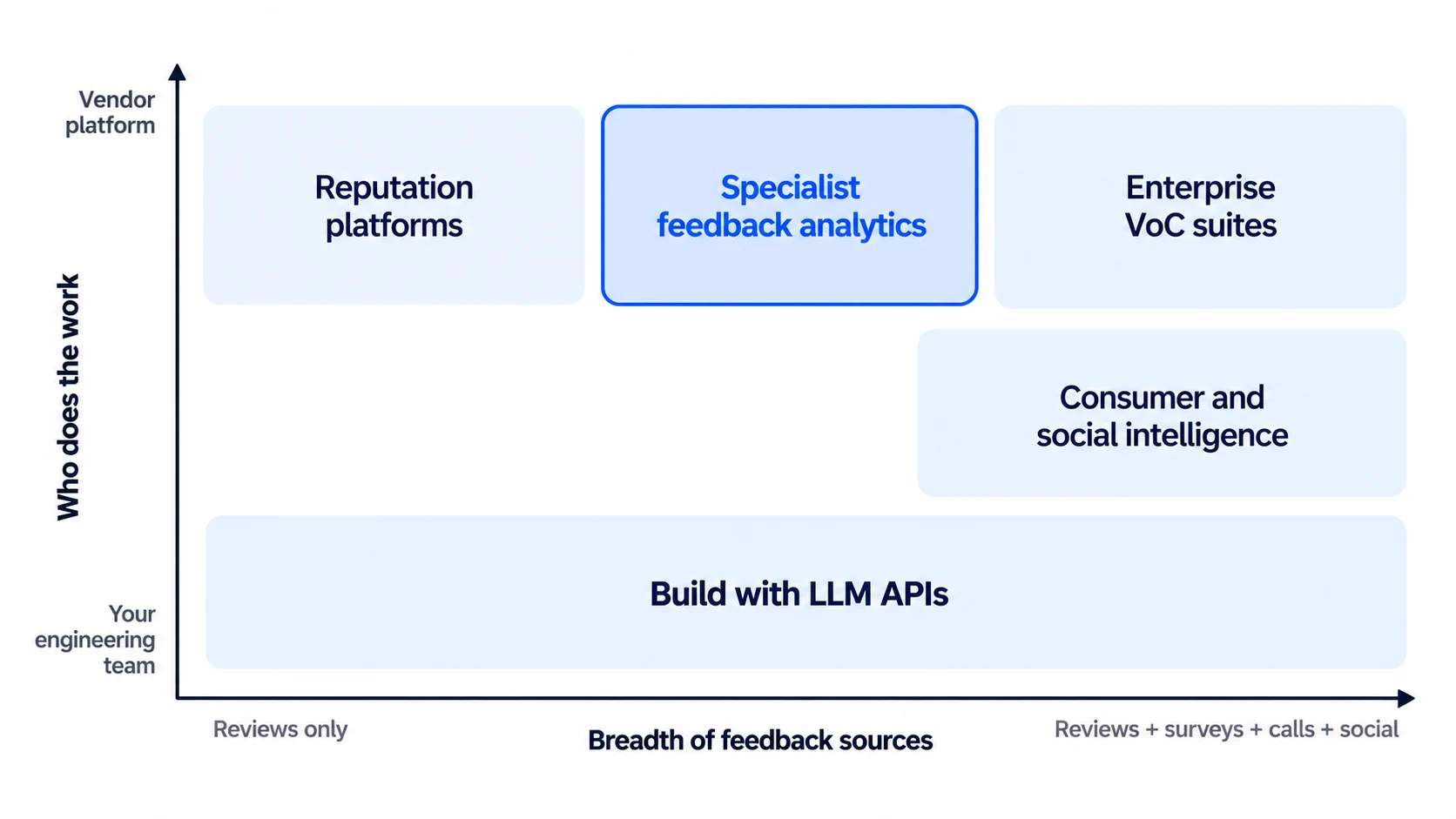
Short answer: The best AI tools for customer review analysis fall into five groups. Enterprise voice-of-customer suites (Qualtrics XM Discover, Medallia, InMoment) suit large programs that combine reviews with surveys and contact-center data. Specialist feedback analytics platforms (Thematic, Chattermill, Enterpret) suit CX and product teams that need transparent, editable themes. Birdeye suits multi-location brands focused on Google and local reviews. Sprinklr Insights suits brands tracking reviews alongside social conversation. Large language model APIs suit teams with data engineers who want full control.
Most "best AI tools" lists rank products as if they compete for the same job. They do not. A hotel group trying to find which property has a housekeeping problem needs something very different from a SaaS product team trying to tie feature complaints to revenue at risk. This guide groups the tools by the job they do, explains what changed in 2026 for teams that build their own pipelines, and gives you a pilot method to test accuracy before you sign a contract.
It is written for CX and voice-of-customer leaders, product and insights teams, marketing heads at multi-location and e-commerce brands, and the technical leads who get asked whether the company should just build this with an LLM.
What Does an AI Tool for Customer Review Analysis Actually Do?
An AI review analysis tool converts unstructured review text into structured data that can be counted, trended and acted on. The core functions are sentiment classification, aspect-based sentiment (which part of the experience a sentiment refers to), theme or topic categorization, summarization, and routing insights to the team that can fix the problem.
The distinction that matters most is between overall sentiment and aspect-based sentiment analysis (ABSA). A review that says "the food was excellent but we waited 40 minutes for a table" is mixed overall. That label is close to useless. ABSA separates the positive opinion about food from the negative opinion about wait time, which is what an operations team can act on. Microsoft's documentation describes its opinion mining feature in exactly these terms, as the aspect-based sentiment analysis component of Azure Language sentiment analysis.
Turning review text into structured sentiment is only the first step. Teams also need confidence that the resulting insights are accurate, explainable, and useful for decisions. Our guide to the AI trust gap explores how transparency, data quality, and accountability influence trust in AI-driven business decisions.
Three product categories often get confused in buyer research:
Review management tools collect reviews, request new ones and help you reply. Analysis is often a secondary feature.
Review or feedback intelligence tools categorize what customers say into a taxonomy, quantify it and track change over time.
Voice-of-customer (VoC) platforms combine feedback collection, analysis and action across many channels. Gartner defines a VoC platform as one that integrates feedback collection, analysis and action into a single platform.
If your main problem is responding to reviews faster, you are shopping for review management. If your problem is knowing what to fix, you are shopping for intelligence. Many vendors sell both, so check which one their demo actually shows.
The Five Categories of Review Analysis Tools
The table below maps each category to the buyer it fits and the trade-off it carries. Use it to shortlist a category before comparing individual products.
Category | Examples | Best fit | Main trade-off |
|---|---|---|---|
Enterprise VoC suites | Qualtrics XM Discover, Medallia, InMoment | Large organizations combining reviews, surveys, calls and chats under governance | Longer setup and higher cost; text analytics may be tuned more for surveys than public review streams |
Specialist feedback analytics | Thematic, Chattermill, Enterpret | CX, insights and product teams who need editable, auditable themes | Usually depend on other tools to collect reviews and handle responses |
Reputation and local review platforms | Birdeye | Multi-location brands (hospitality, healthcare, retail, services) | Analysis is organized around locations and ratings rather than deep product taxonomies |
Consumer and social intelligence | Sprinklr Insights | Brands tracking reviews alongside social, news and forum conversation | Broad listening scope can add noise; configuration takes expertise |
Build your own with APIs | Claude, GPT and Gemini model APIs; Amazon Bedrock; Azure Language; Google Cloud Natural Language | Teams with data engineering capacity and unusual taxonomies or data residency needs | You own evaluation, maintenance, dashboards and drift |
Once recurring complaints have been identified, the next challenge is getting them to the right team and ensuring they are addressed. Explore how AI agents for customer support can help classify incoming issues, route requests, and support follow-up workflows. Review analysis identifies patterns; support automation helps teams act on them.
The Best AI Tools for Analyzing Customer Reviews, by Category
Product descriptions below separate what a vendor says about itself from what independent sources confirm. Vendor capability claims are labeled as such. Confirm current features in a demo, because this market ships changes quarterly.
Enterprise VoC suites
Qualtrics XM Discover
XM Discover is the text and conversation analytics layer of the Qualtrics XM platform. It is built on technology from Qualtrics' 2021 acquisition of Clarabridge, and it brings in feedback from support conversations, chat, social posts and review sites. At launch, Qualtrics said it analyzed conversations in 23 languages with more than 150 prebuilt industry models. Qualtrics was named a Leader in the 2025 Gartner Magic Quadrant for Voice of the Customer Platforms, published 16 April 2025. It fits organizations that already run Qualtrics surveys and want reviews in the same model.
Medallia
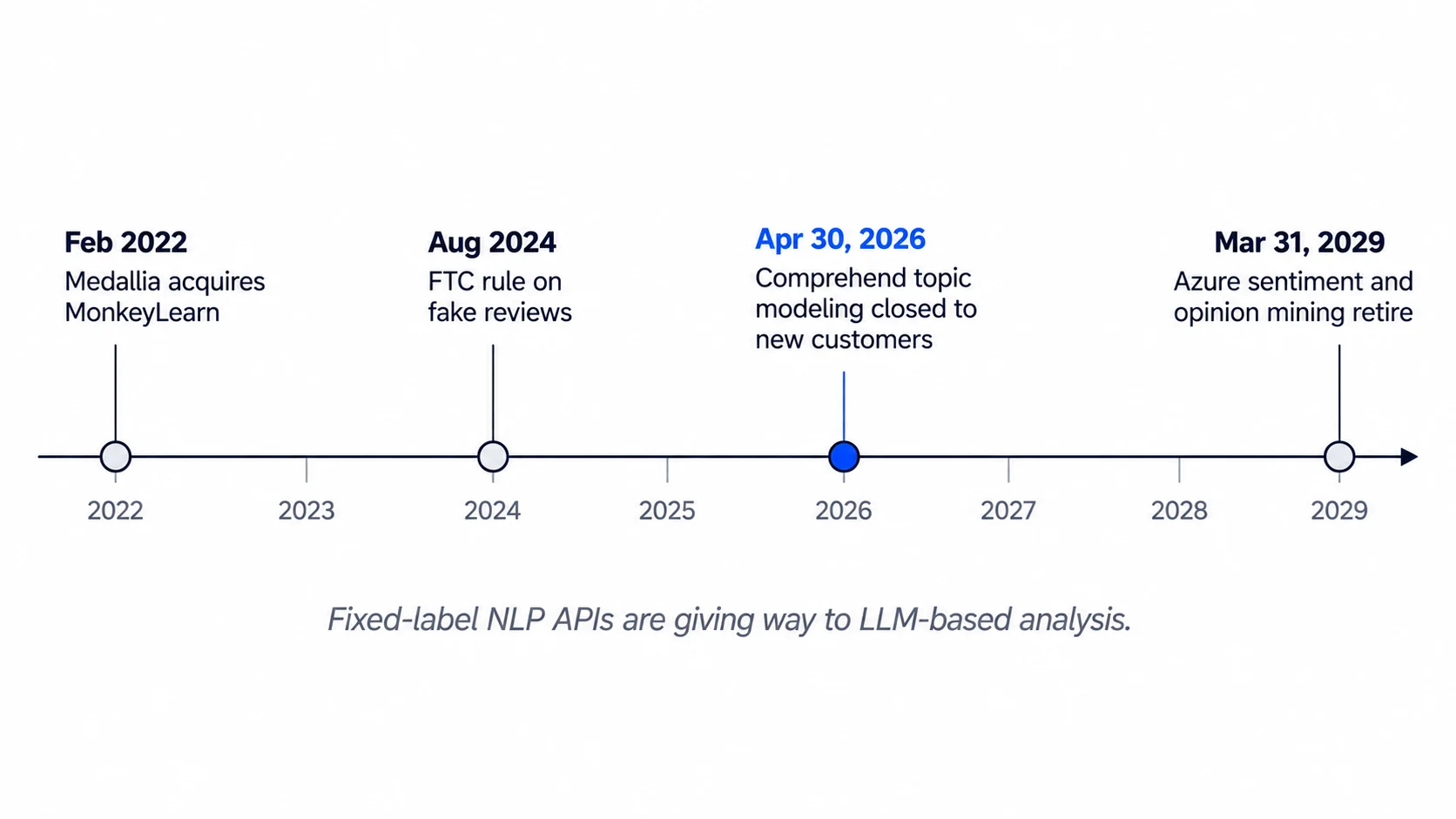
Medallia Experience Cloud combines feedback collection with text and speech analytics. Medallia acquired the no-code text analysis company MonkeyLearn in February 2022. According to CX Today's summary of the 2025 Magic Quadrant, Qualtrics and Medallia led the VoC category for a second consecutive year. Medallia's strength is breadth and governance at enterprise scale. The common criticism from buyers and competitors is time to value, so ask for a reference customer with a review-heavy program, not only a survey program.
InMoment
InMoment folded the natural language processing company Lexalytics into its XI Platform, and announced that Lexalytics now powers its unstructured analytics, including emotion and intent. InMoment also announced it was named a Leader in the 2025 Gartner Magic Quadrant for VoC Platforms. It offers reputation management alongside analytics, which helps companies that want review response and review analysis from one vendor.
Specialist feedback analytics platforms
Thematic
Thematic focuses on theme discovery from open-text feedback. Its own product page says it analyzes all feedback rather than a sample and provides an interactive theme editor so analysts can validate and refine themes before they drive decisions. That human review step is the reason to choose it: if your analysis will be challenged in an executive meeting, you need to trace every number back to the comments behind it.
Chattermill
Chattermill unifies surveys, reviews, support tickets and calls. The company says it offers 50+ native integrations and an MCP server, which lets teams query feedback from AI assistants such as Claude or ChatGPT. MCP (Model Context Protocol) is an open standard for connecting AI assistants to external data, so this matters if your analysts already work inside an AI assistant. On G2, Chattermill has 238 reviews in the Feedback Analytics category, a reasonable signal of real deployment.
Enterpret
Enterpret targets product-led companies. In an October 2025 announcement, it described a platform that ingests feedback from more than 50 channels and links it to accounts and opportunities through a customer knowledge graph, with an "adaptive taxonomy" that updates categories as customer language changes. Named customers include Perplexity, Notion and Canva. It fits B2B and product teams who need to answer "how much revenue is behind this complaint?"
Reputation and local review platforms
Birdeye
Birdeye is a reputation and customer experience platform built for multi-location businesses. Its Insights AI module combines review, survey and listings data into a location-level health score and a ranked list of what to fix at each location. If you run 40 clinics or 200 restaurants, location-level ranking is the view your regional managers will actually use. The trade-off is depth: it is designed to compare locations, not to build a fine-grained product taxonomy.
Consumer and social intelligence
Sprinklr Insights
Sprinklr Insights handles social listening, brand monitoring, VoC and competitive intelligence. In its vendor-supplied listing, Sprinklr says it covers 30+ channels and claims 90%+ accurate sentiment and emotion detection. Treat that accuracy figure as a vendor claim: it does not specify the dataset, language mix or sentiment granularity. Reviewers on Gartner Peer Insights describe the platform as highly customizable but say it needs substantial training to master.
Building with LLM and NLP APIs
For teams with engineering capacity, the build option is now mostly an LLM option. You send batches of reviews to a model such as Claude, GPT or Gemini with a fixed taxonomy and a structured output schema, store the results, and visualize them in your BI tool. Batch processing makes this economical. Anthropic and OpenAI both offer asynchronous batch APIs that cost about half of standard real-time API calls, and review analysis rarely needs real-time answers.
The hidden cost is not tokens. It is building a labeled evaluation set, maintaining the taxonomy as products change, handling deduplication and multilingual input, and building the dashboards that business users expect from a vendor platform.
Why 2026 Changed the Build-Your-Own Option
The classic cloud NLP APIs that many teams used for review sentiment are being narrowed or retired in favor of LLM-based services. Anyone designing a new pipeline should check deprecation notices before choosing an endpoint.
Amazon Comprehend: AWS stopped offering topic modeling, event detection and prompt safety classification to new customers from April 30, 2026, and points to Amazon Bedrock as the alternative for topic detection. Comprehend's other features, including sentiment, were not affected by that change.
Azure Language: Microsoft's documentation states that sentiment analysis and opinion mining retire from Azure Language on March 31, 2029, with guidance to move to Foundry models.
Google Cloud Natural Language: Its entity-level sentiment method, which ties sentiment to named entities, currently supports English only, according to Google's gcloud reference. That matters for global review sets.
MonkeyLearn: The self-serve text analysis tool that many small teams used was acquired by Medallia in 2022 and no longer operates as a standalone sign-up product.
The practical reading: a pipeline built on a fixed-label sentiment API in 2026 is building on the part of the stack vendors are moving away from. If you build, design around an LLM with a versioned prompt, a versioned taxonomy and a regression test set, so you can switch models without re-inventing the pipeline.
How Accurate Is AI at Reading Customer Reviews?
AI is reliable at simple sentiment classification and much less reliable at fine-grained, structured analysis. The strongest independent evidence shows large language models matching or beating human crowd workers on basic labeling, while trailing specialized models on aspect-level extraction. Accuracy on your own reviews, with your own categories, is the only figure that should drive a purchase.
Two peer-reviewed studies frame the evidence:
A study in Proceedings of the National Academy of Sciences by Gilardi, Alizadeh and Kubli found that ChatGPT's zero-shot accuracy on text annotation tasks was about 25 percentage points higher than crowd workers on average across four datasets, at under $0.003 per annotation. The tasks were tweets and news articles, not product reviews, so treat it as evidence about labeling capability in general.
Zhang and colleagues tested LLMs on 13 sentiment tasks across 26 datasets. They found LLMs performed well on simpler sentiment classification but lagged specialized smaller models on tasks needing structured sentiment information, such as aspect-sentiment triplet extraction. LLMs did much better than small models when only a few labeled examples were available.
Both studies used models that are now superseded, so newer models may perform better. The direction of the finding still matters for buyers: overall sentiment is close to solved, and the hard part is consistently mapping each opinion to the right aspect in your taxonomy. That is exactly where vendor demos look best and real deployments get messy.
When a vendor quotes an accuracy figure, ask four questions. Which dataset? Which languages? Is it document-level or aspect-level? Was it measured against your categories or theirs?
Accuracy is not only about assigning the right sentiment label. AI-generated summaries can also introduce unsupported claims or misrepresent the evidence in the underlying reviews. Understanding AI hallucinations helps teams design verification steps that keep review summaries grounded in the original customer comments.
The Data Access Problem Most Buyer Guides Skip
An AI tool can only analyze reviews it can legally and reliably collect. Review data is spread across many sites, and the major platforms restrict access. This often decides the shortlist before any AI capability does.
Spread is real. BrightLocal's 2026 Local Consumer Review Survey found that 97% of consumers read reviews for local businesses and the average consumer uses six different review sites. Analyzing only Google reviews can miss much of what customers say.
Access is restricted. Google's Business Profile API returns reviews only for locations you manage, and its reviews list method is only valid if the specified location is verified. That works well for your own locations and does not give you competitor reviews. For competitor benchmarking, vendors typically rely on licensed data or collection methods you should check against each review site's terms of service.
Before comparing AI features, ask every vendor for a written list of supported review sources, how each one is collected (official API, partnership or scraping), refresh frequency, and whether competitor reviews are included.
Review data becomes more actionable when teams can connect customer feedback with account history, support interactions, and existing business workflows. If your goal is to bring review insights into customer records and follow-up processes, compare AI tools for CRM alongside your review analytics shortlist.
Fake Reviews Distort the Analysis
Fake reviews are a data-quality problem as well as a legal one. If 5% of reviews for a product are fabricated, sentiment trends and theme counts inherit that error.
In the United States, the Federal Trade Commission issued a final rule in August 2024 banning fake reviews and testimonials, including AI-generated fake reviews, and allowing civil penalties against knowing violators. The rule targets businesses that create, buy or disseminate fake reviews, not companies analyzing reviews. It still matters for analysis teams in two ways. Your dashboards should flag suspicious patterns (bursts of five-star reviews, near-duplicate text, reviewer accounts with no history) rather than counting them. And any AI tool you buy that can draft review responses should not be usable to generate reviews.
Few analysis platforms publish how, or whether, they filter suspected fake reviews. Ask.
How to Choose: A Five-Question Decision Framework
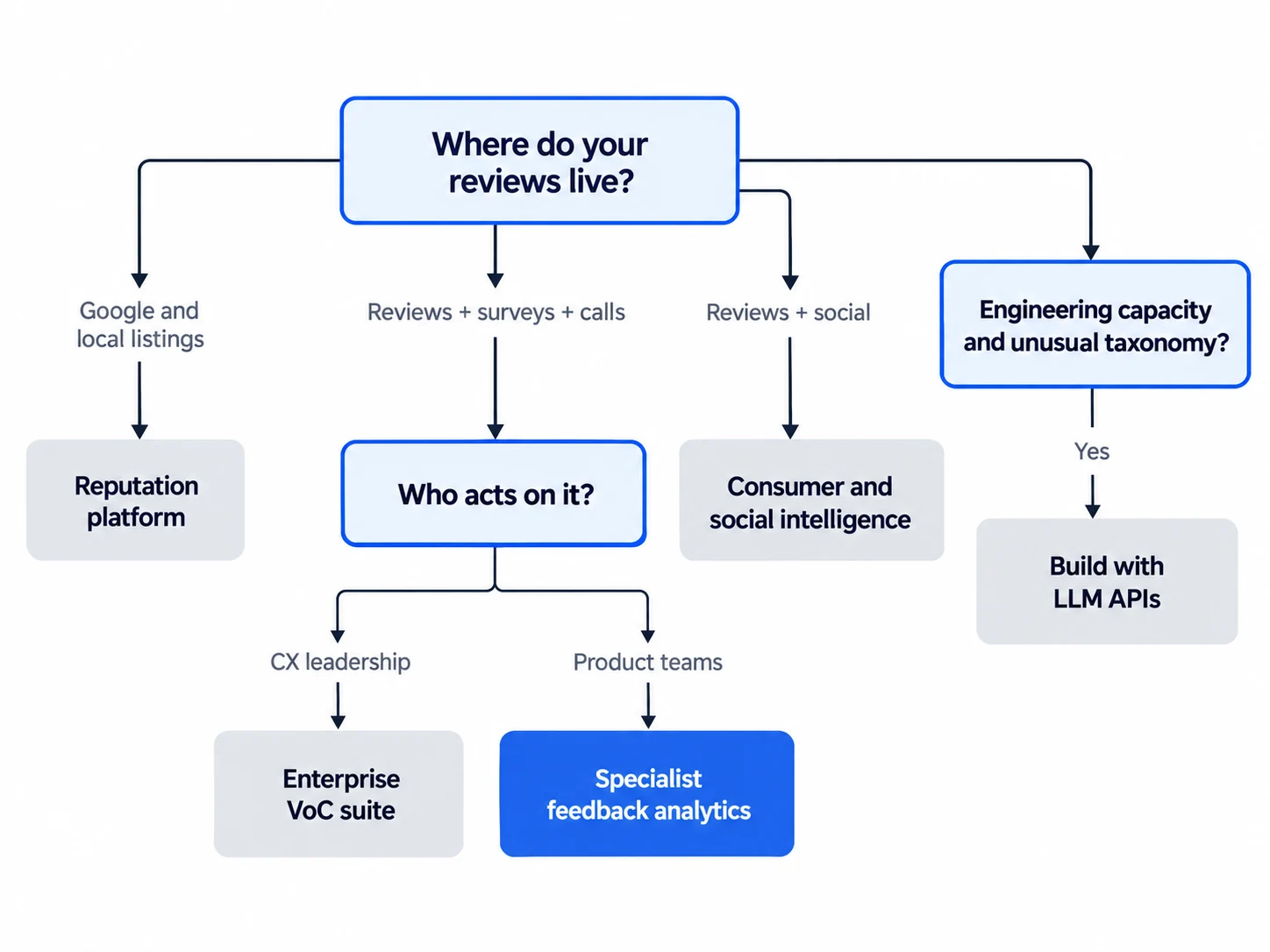
Choosing an AI tool for customer review analysis comes down to five questions, answered in order. Each answer removes categories from consideration, so by the fifth question most buyers have two or three realistic options.
Where do your reviews live? Mostly Google and local listings points to a reputation platform. App stores, e-commerce marketplaces and social points to specialist analytics or social intelligence. Reviews plus surveys and calls points to a VoC suite or specialist platform.
Who acts on the insight? Location managers need location rankings. Product managers need feature-level themes linked to accounts. CX leaders need cross-channel trends.
How much control do you need over the taxonomy? If categories must match your internal product structure and survive audit, prioritize tools with editable themes and traceability to source comments.
What are your volume and language mix? Ask vendors for language support at the aspect level, not only for overall sentiment, and test your hardest languages in the pilot.
Do you have engineering capacity? If yes, and your needs are unusual, an LLM pipeline can be cheaper and more flexible. If no, buy.
Your situation | Start your shortlist with | Verify in the demo |
|---|---|---|
Multi-location brand, mostly Google and local reviews | Birdeye; InMoment if you also need enterprise VoC | Location-level drill-down; review sources beyond Google |
Enterprise with existing survey program | Qualtrics XM Discover or Medallia, matched to your survey platform | Time to first insight on public reviews, not surveys |
Product team needing feature themes tied to accounts | Enterpret, Chattermill | Link from theme to account and revenue data |
Insights team that must defend every number | Thematic | Theme editing, traceability to comments |
Reviews plus social and competitor monitoring | Sprinklr Insights | Noise filtering; who maintains the queries |
Data team, unusual taxonomy or residency needs | LLM API in batch mode, plus your BI tool | Your labeled test set; cost per 10,000 reviews |
How to Run a Two-Week Pilot Before You Sign
A short, structured pilot exposes accuracy and fit problems that demos hide. The steps below are our recommended method, not a vendor standard.
Build a gold set. Pull a few hundred of your own reviews across sources, languages and star ratings. Have two people label overall sentiment and the aspects mentioned, then resolve disagreements. Include mixed reviews, sarcasm and short reviews such as "fine."
Give every vendor the same data. Run the gold set through each shortlisted tool, plus an LLM baseline with a clear prompt. The baseline tells you what you are paying the platform for beyond the model.
Score at the aspect level. Measure whether each tool found the right aspects with the right sentiment, not only whether the overall label matched.
Test a taxonomy change. Ask each vendor to add or split a category mid-pilot. How long it takes predicts how painful the next product launch will be.
Check the action path. Confirm that an insight can reach the owner (a ticket, an alert, a location manager's dashboard) without manual export.
A successful pilot should test more than whether the model classifies reviews correctly. Teams also need to confirm that insights reach the right owners, trigger appropriate follow-up, and improve a measurable business outcome. A practical AI implementation strategy connects the technology to workflow design, ownership, and outcome measurement.
What AI Review Analysis Tools Cannot Do
These tools describe what reviewers say. They do not tell you what your silent customers think, and people who write reviews are not a random sample of your customers. Use review analysis alongside survey and behavioral data before making large investment decisions from it.
They also cannot fix a taxonomy nobody owns. Adaptive and AI-generated taxonomies reduce manual tagging, but someone still has to decide whether "slow checkout" belongs under payments or under app performance. Without an owner, categories drift and trends become unreliable.
Finally, AI summaries can be confidently wrong. A summary that says "customers love the new design" may rest on a handful of comments. Prefer tools that show the count and the source comments behind every summary claim.
Frequently Asked Questions
What is the best AI tool for analyzing customer reviews?
There is no single best tool, because the categories solve different problems. Birdeye fits multi-location brands focused on local reviews. Thematic, Chattermill and Enterpret fit teams that need editable, traceable themes. Qualtrics XM Discover, Medallia and InMoment fit enterprises combining reviews with surveys and calls. Sprinklr Insights fits brands monitoring reviews alongside social media.
Can I use ChatGPT or Claude to analyze customer reviews?
Yes, for exploration and for batch pipelines. Pasting a few hundred reviews into a chat assistant works for quick themes. For ongoing analysis, use the model's API with a fixed taxonomy, structured output and a batch mode, then validate against a labeled sample. The trade-off is that you build and maintain dashboards, collection and quality checks yourself.
What is aspect-based sentiment analysis?
Aspect-based sentiment analysis identifies the specific features or parts of an experience a review discusses and the sentiment toward each one. In "great food, slow service," it labels food as positive and service as negative instead of calling the review mixed. It is the level of analysis that operations and product teams can act on.
How accurate is AI sentiment analysis on reviews?
Accuracy is high for overall positive or negative labels and lower for fine-grained aspect extraction. Peer-reviewed research found LLMs beat crowd workers on general text labeling but trailed specialized models on structured sentiment tasks. Vendor accuracy claims rarely state the dataset or granularity, so test each tool on your own labeled reviews.
Is review management software the same as review analysis software?
No. Review management software helps you request, monitor and respond to reviews. Review analysis software categorizes and quantifies what reviews say so you can find and prioritize problems. Many platforms offer both, but the depth of each varies widely, so confirm which capability a demo is showing.
Can AI tools analyze competitor reviews?
Some can, depending on how they collect data. Official APIs such as Google's Business Profile API only return reviews for locations you manage. Competitor coverage usually depends on licensed data or collection methods that you should check against each review site's terms. Ask vendors to document their sources in writing.
How much does it cost to analyze reviews with an LLM API?
Token cost is usually the smallest part. Anthropic and OpenAI batch APIs cost roughly half of real-time calls, and review analysis rarely needs real-time results. The larger costs are building a labeled test set, maintaining the taxonomy, collecting reviews and building dashboards for business users.
Which AI Review Analysis Tool Should You Choose?
Choose by job, not by feature list. If your reviews are mostly local listings and your users are location managers, start with a reputation platform. If your team must defend every theme in front of executives, start with a specialist analytics platform that shows the comments behind each number. If reviews are one channel in a large survey and contact-center program, extend the VoC suite you already run. Build with LLM APIs only when you have engineers to own evaluation and maintenance, and design that pipeline around models rather than the fixed-label APIs that AWS and Microsoft are winding down.
The evidence supports AI for reading reviews at scale. It does not support taking any vendor's accuracy claim on trust. What remains uncertain is how well each tool handles your aspects, your languages and your taxonomy changes, and a two-week pilot on your own data is the cheapest way to find out.
For a practical example of what can happen after reviews are analyzed, read our coverage of an AI agent built to interpret consumer reviews, identify business-relevant insights, and route those insights to the appropriate team. It illustrates how AI-powered customer review analysis can move beyond sentiment summaries toward actionable business recommendations.
Comments (0)
No comments yet. Be the first to share your thoughts!