Generative AI in Pharmacovigilance: Use Cases, Risks & Human Oversight

Author
Ravi Prajapati

Learn how generative AI can support pharmacovigilance case narratives, ICSR workflows, human review, validation and regulatory compliance.
Pharmacovigilance teams deal with a difficult combination of growing safety data, regulatory deadlines, fragmented source documents and the need for precise medical interpretation. Writing individual case safety report (ICSR) narratives is one part of that workload where generative AI appears particularly attractive.
A language model can potentially turn structured case data, medical notes and follow-up information into a coherent draft narrative in seconds. But pharmacovigilance is not ordinary business writing. A fluent narrative can still omit an important event, introduce unsupported information, distort chronology or create inconsistencies with structured ICSR fields.
That makes generative AI in pharmacovigilance less a question of whether an AI model can write a narrative and more a question of whether organizations can design a controlled process in which AI-generated text remains traceable, reviewable and clinically reliable.
Quick Answer: How Can Generative AI Be Used in Pharmacovigilance?
Generative AI can support pharmacovigilance by extracting information from source documents, organizing case chronology, drafting ICSR narratives, summarizing follow-up information and checking narrative consistency. Its most realistic near-term role is as an assistive system operating under human oversight, rather than an autonomous medical or regulatory decision-maker.
That distinction matters because regulatory expectations for safety reporting focus on the quality and consistency of the underlying case information, regardless of which technology helps process it.
The FDA Emerging Drug Safety Technology Program specifically addresses AI and other emerging technologies in pharmacovigilance. FDA notes that early adopters are using AI to automate activities such as adverse-event intake, data entry and case processing, while also recognizing uncertainty about how emerging technologies fit within regulatory obligations.
Why Case Narratives Are a Natural Candidate for Generative AI
An ICSR is not simply a block of free text.
It contains structured information covering the patient, reporter, medicinal products, adverse events, medical history, dates, outcomes and other relevant safety information. The narrative connects those elements into a clinically understandable sequence.
The European Medicines Agency's GVP Module VI states that, where applicable, a case narrative should present information in a logical time sequence and include the patient's clinical course, therapeutic measures, outcome and follow-up information. It also says the narrative should function as a comprehensive stand-alone medical report and remain consistent with relevant structured ICSR data elements.
This creates a task that looks well suited to modern language models: transform structured and unstructured information into coherent natural language while preserving context.
But that description hides the hard part.
The system must not merely produce good prose. It must produce prose that faithfully represents the source case.
Where Generative AI Can Help in the Case Narrative Workflow
Generative AI can potentially support several stages surrounding narrative preparation.
Workflow stage | Potential AI role | Main risk | Recommended oversight |
|---|---|---|---|
Source intake | Identify clinically relevant information | Missed information | Human verification |
Data extraction | Extract dates, drugs, events and outcomes | Incorrect extraction | Validation against source |
Chronology | Arrange events in temporal order | Wrong sequence | Reviewer confirmation |
Narrative drafting | Generate a concise case summary | Hallucination or omission | Mandatory review |
Follow-up processing | Incorporate new information | Contradiction with prior data | Change review |
Consistency check | Compare narrative with structured fields | False reassurance | Human resolution |
Quality control | Flag missing or contradictory information | Missed exceptions | Risk-based QC |
The strongest implementation model therefore separates information retrieval, deterministic validation and generative writing instead of asking one large language model to perform the entire process from an uncontrolled prompt.
1. Extracting Relevant Information From Source Documents
Safety information may arrive through spontaneous reports, literature, emails, call-center transcripts, patient-support programs, clinical sources and other channels.
AI-assisted document processing can help identify information such as:
suspected medicinal products
adverse events
dates and timelines
dose and route
medical history
concomitant medications
laboratory information
treatment provided
patient outcome
reporter information
Traditional NLP and extraction models may handle some of these tasks more predictably than a general-purpose generative model.
Generative AI becomes useful when the source material is less structured and information must be interpreted across multiple passages or documents.
The important design principle is that extracted information should remain linked to its source.
A reviewer should ideally be able to click a narrative statement and see the evidence from which it was generated.
2. Building the Clinical Timeline
Case narratives depend heavily on chronology.
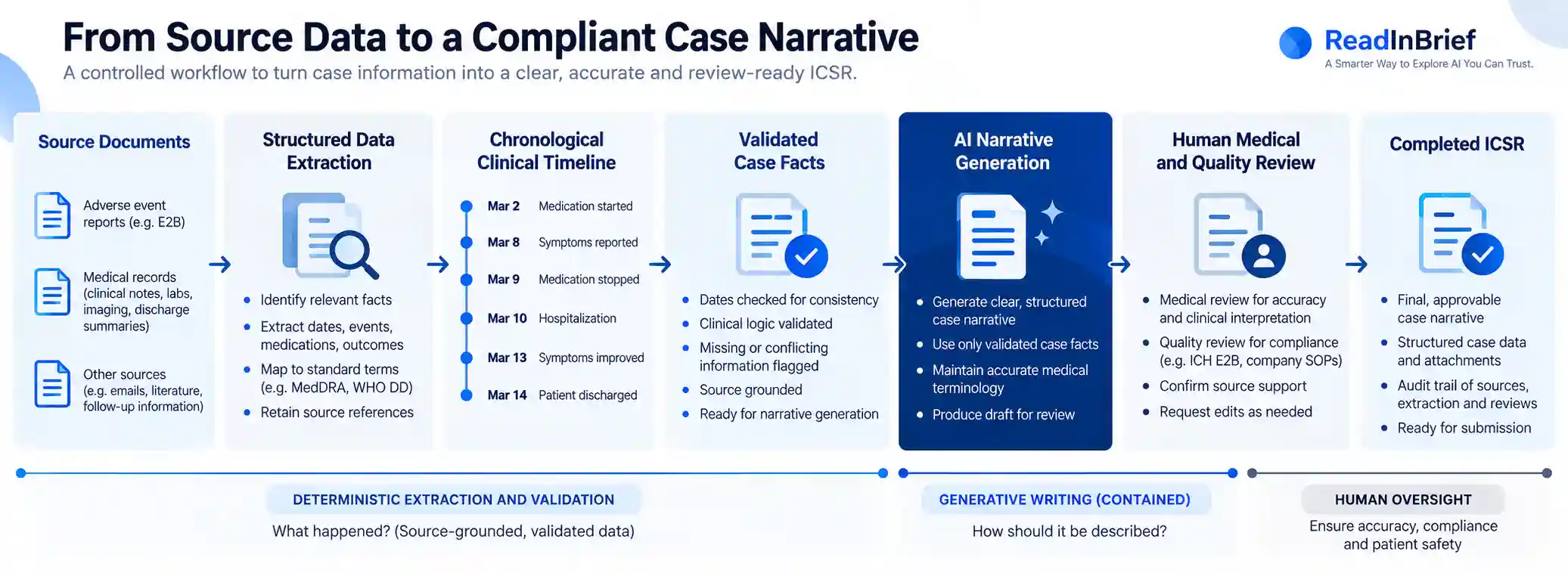
Suppose an incoming case contains:
medication started on March 2
symptoms first reported on March 8
medication stopped on March 9
hospitalization on March 10
symptoms improved on March 13
patient discharged on March 14
A model could transform these facts into readable prose.
But a safer architecture would first create a structured event timeline and validate dates before allowing the language model to draft the narrative.
This separates two problems:
What happened?
from
How should what happened be described?
The first problem should rely heavily on source-grounded extraction and validation. The second is where generative AI can add the most value.
How Generative AI Could Draft an ICSR Narrative
Once validated case facts are available, a generative model can receive a controlled input containing the relevant information rather than unrestricted raw documentation.
A simplified pipeline could look like:
Source evidence → extraction → normalization → chronology → validation → narrative generation → consistency checks → human review → approval
The prompt or generation template could specify:
which facts may be used
required narrative structure
chronological ordering
prohibited speculation
terminology rules
privacy requirements
how missing information should be represented
how conflicting information should be flagged
The generated narrative can then be compared automatically with the structured case fields before reaching a human reviewer.
This architecture reduces one major LLM risk: allowing the model to decide simultaneously what the facts are and how they should be communicated.
The Narrative Must Agree With the Structured ICSR
Narrative quality cannot be evaluated only by reading the paragraph.
A well-written narrative might say that the patient recovered after treatment withdrawal while the structured outcome field says "not recovered." It might describe an event as occurring before treatment initiation when structured dates show otherwise.
EMA guidance explicitly states that narrative information should be consistent with the relevant ICH E2B data elements in the ICSR.
The ICH E2B(R3) ICSR specification provides the standardized data and message framework used to exchange individual case safety information electronically. Its implementation materials are designed for organizations and software systems creating, editing, transmitting and receiving ICSR messages.
This creates an important opportunity for AI system design.
Instead of treating the narrative as independent text, organizations can run automated narrative-to-structured-data consistency checks.
For example:
Narrative statement | Structured field | Check |
|---|---|---|
"Treatment began on 4 April" | Therapy start date | Date match |
"Patient was hospitalized" | Seriousness criterion | Consistency |
"Drug was discontinued" | Action taken | Consistency |
"Patient recovered" | Reaction outcome | Outcome match |
"Symptoms appeared three days later" | Event/start dates | Temporal validation |
Generative AI can even assist in identifying inconsistencies, but deterministic rules should be used wherever a clear comparison is possible.
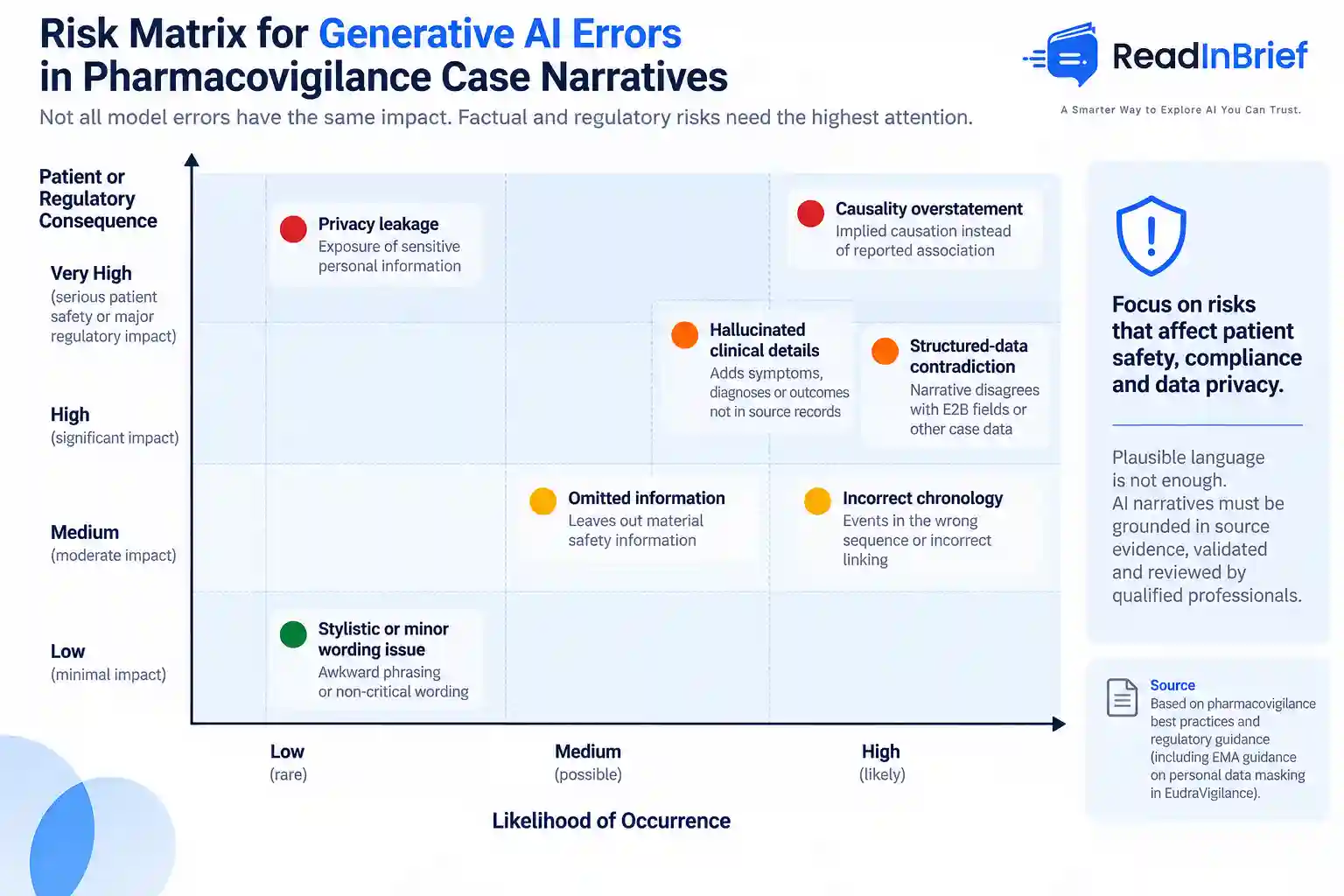
The Biggest Risk Is Not Bad Writing. It Is Plausible Inaccuracy.
Large language models are optimized to produce plausible language.
Pharmacovigilance requires something different: faithful representation of evidence.
A sentence can sound medically reasonable while still being unsupported by the source record.
Potential failure modes include:
Hallucinated clinical details
The model may introduce a symptom, diagnosis, relationship or outcome that was never reported.
Omitted information
The narrative may be factually correct but leave out information that materially changes interpretation.
Incorrect chronology
Dates can be individually correct while the generated sequence connecting them is wrong.
Overinterpretation
A model may turn an observed temporal relationship into implied causality.
Contradictory information
The narrative may disagree with E2B fields or another part of the case.
Loss of uncertainty
"Reporter suspected the drug may have contributed" and "the drug caused the reaction" are very different statements.
Generative systems can inadvertently collapse that distinction.
Privacy leakage
Safety reports can contain sensitive information. Prompt design, model hosting, data retention, access controls and output handling therefore become part of pharmacovigilance governance rather than merely IT configuration.
The EMA has separate guidance covering masking of personal data in ICSRs submitted to EudraVigilance, reinforcing that privacy protection is an operational part of case reporting.
Human-in-the-Loop Review Is More Realistic Than Autonomous Narrative Generation
For safety-critical workflows, the practical question is not:
Can AI generate the narrative without a person?
A better question is:
Which parts can AI prepare so qualified reviewers spend their time on verification, medical judgment and exceptions?
This aligns closely with emerging regulatory thinking.
The 2025 CIOMS Working Group XIV report on AI in pharmacovigilance established principles around a risk-based approach, human oversight, validity and robustness, transparency, privacy, fairness, and governance and accountability.
CIOMS Artificial Intelligence in Pharmacovigilance report
CIOMS also describes intelligence augmentation as combining human and artificial intelligence rather than simply eliminating the human specialist. Its working-group materials specifically warn that automation driven only by efficiency or financial objectives could remove valuable human contribution from pharmacovigilance.
FDA research points in a similar direction. An FDA pharmacovigilance AI quality-assurance project states that many AI applications have not achieved performance sufficient for use without human intervention, making rigorous evaluation and quality assurance important.
A reasonable near-term operating model is therefore:
Automation lane
The system can:
extract case information
build chronology
identify missing fields
prepare a draft
compare narrative statements against structured fields
flag contradictions
highlight source evidence
Human-review lane
Qualified personnel verify:
medical meaning
completeness
chronology
seriousness
causality-related wording
conflicting information
unusual cases
low-confidence extraction
final narrative acceptability
The objective is not to remove human accountability.
It is to reduce the amount of mechanical work required before human judgment becomes valuable.
A Practical Risk-Based Model for AI Narrative Automation
Organizations do not necessarily need the same review intensity for every AI-assisted task.
A useful planning model is the Narrative Automation Risk Ladder.
This is an analytical framework, not a regulatory standard.
Level | AI activity | Risk | Human role |
|---|---|---|---|
1 | Formatting and grammar | Low | Spot review |
2 | Reorganizing validated facts | Low–moderate | Review output |
3 | Drafting from validated structured data | Moderate | Mandatory approval |
4 | Synthesizing multiple source documents | High | Detailed source verification |
5 | Interpreting ambiguous clinical information | Very high | Expert-led |
6 | Causality or regulatory decision-making | Very high | Human decision authority |
The principle is simple:
As AI moves from presentation toward interpretation, oversight should increase.
This also reflects broader regulatory approaches to AI.
The FDA draft guidance on AI supporting regulatory decision-making proposes evaluating AI credibility according to its specific context of use and risk. Importantly, FDA's document is draft guidance and explicitly distinguishes certain operational uses from AI that produces information supporting regulatory decisions.
FDA and EMA's more recent Guiding Principles of Good AI Practice in Drug Development similarly emphasize human-centric design, risk-based approaches, clear context of use, data governance, performance assessment and lifecycle management.
These documents do not create a specific approval formula for generative-AI-written pharmacovigilance narratives. They do, however, reinforce a broader direction: AI controls should be tied to what a model actually does and the consequences if its output is wrong.
What Should Be Validated Before Generative AI Is Used in Production?
A successful proof of concept is not enough.
A model producing ten convincing narratives during a demo says little about how it will perform across thousands of cases involving incomplete reports, multiple products, follow-ups, pregnancies, deaths, conflicting dates, literature cases and unusual clinical situations.
Production evaluation should examine at least five dimensions.
1. Factual fidelity
Does every generated clinical statement have support in the source case?
2. Completeness
Does the narrative contain the relevant information required for understanding the case?
3. Consistency
Does generated text agree with structured ICSR fields?
4. Clinical meaning
Has the system preserved uncertainty, reporter attribution and clinically meaningful relationships?
5. Reliability across case types
Does performance remain acceptable for complex and uncommon cases rather than only straightforward examples?
A sixth dimension is equally important in production: operational traceability.
Teams should be able to reconstruct which source data, model version, prompt/template and validation rules contributed to a particular generated narrative.
Accuracy Alone Is Not a Sufficient KPI
A single "accuracy" percentage can hide clinically meaningful errors.
Imagine two systems both achieving 95% overall accuracy.
System A makes mostly punctuation and formatting errors.
System B occasionally invents an outcome or omits a serious event.
Treating those systems as equivalent would be misleading.
A better evaluation framework separates error categories and assigns them according to consequence.
Possible metrics include:
unsupported clinical statement rate
clinically significant omission rate
chronology error rate
structured-field contradiction rate
reviewer correction rate
percentage of statements traceable to source evidence
time saved per reviewed narrative
percentage requiring substantial rewriting
performance by case complexity
performance drift after model or workflow changes
The FDA's work on quality assurance for AI in pharmacovigilance is particularly relevant here because it focuses on methods for evaluating whether AI performance is adequate for its intended PV application.
What Should a Production Architecture Look Like?
A production pharmacovigilance AI system should not be designed as:
Case data → LLM → final narrative
A more defensible architecture is:
Source data → secure ingestion → extraction → normalization → source references → timeline engine → rule validation → LLM drafting → automated consistency checks → confidence/exception routing → human review → approved narrative → audit record
This creates several control points.
If the extraction layer is uncertain about a date, it can flag the value rather than allowing the language model to infer one.
If the narrative conflicts with a structured outcome field, the consistency layer can block straight-through processing.
If a case contains unusual circumstances, it can automatically move into an enhanced-review workflow.
This architecture also makes model replacement easier. The generative model becomes one controlled component rather than the system of record.
Should Pharmacovigilance Teams Use RAG for Case Narratives?
Retrieval-augmented generation can be useful, but its role needs to be defined carefully.
For narrative drafting, the primary grounding source should generally be the actual case evidence.
RAG may additionally retrieve controlled materials such as:
internal narrative conventions
approved terminology guidance
standard operating procedures
relevant coding guidance
regulatory instructions
validated templates
However, retrieval does not guarantee factual accuracy.
A model can still misunderstand retrieved information or combine it incorrectly. RAG therefore improves access to relevant context but does not replace validation.
Where Should Generative AI Stop?
Some tasks sit much closer to medical judgement than administrative drafting.
Examples include:
deciding whether a causal relationship exists
interpreting complex conflicting clinical evidence
making final seriousness judgments in ambiguous cases
resolving medically significant inconsistencies
deciding whether unusual information should change safety assessment
making regulatory decisions
AI may provide supporting information for expert consideration, but automating these decisions carries substantially greater consequence than drafting text from validated facts.
CIOMS's work is particularly relevant here. Its AI-in-pharmacovigilance framework emphasizes human oversight and a risk-based approach, while noting the continuing importance of specialist expertise in areas such as differential diagnosis and causality assessment.
A Practical Implementation Roadmap
Organizations considering generative AI for case narratives can start narrowly rather than attempting end-to-end autonomous case processing.
Phase 1: Define the exact context of use
Specify precisely what AI is allowed to do.
For example:
Generate a draft chronological narrative exclusively from validated ICSR data and identified source excerpts. The output requires human approval before use.
This is considerably easier to govern than "use AI to process pharmacovigilance cases."
Phase 2: Establish a benchmark dataset
Build a representative test set containing straightforward and difficult cases, including incomplete reports, follow-ups, multiple products and complex chronology.
Phase 3: Build source traceability
Every important generated statement should ideally be connected to its underlying evidence.
Phase 4: Add deterministic controls
Use rules for checks that do not require generative reasoning, including date validation, required fields and structured-data consistency.
Phase 5: Test failure modes
Deliberately test cases with missing, contradictory and ambiguous information.
Phase 6: Introduce human review
Measure not just whether reviewers approve narratives but what they change and why.
Phase 7: Monitor production performance
Track error categories, exceptions, reviewer interventions and model changes over time.
The model should be treated as a changing component within a controlled pharmacovigilance process, not as a one-time software installation.
Generative AI Could Change the Reviewer’s Job More Than Eliminate It
The strongest business case may not come from eliminating narrative reviewers.
It may come from changing what they spend time doing.
Instead of manually transforming every case into prose, reviewers could increasingly focus on:
verifying evidence
resolving contradictions
evaluating difficult cases
reviewing clinically meaningful exceptions
performing medical assessment
investigating unusual patterns
improving data quality
That is a more realistic interpretation of AI-assisted pharmacovigilance than full autonomy.
FDA's Emerging Drug Safety Technology Program explicitly recognizes the potential for emerging technology to reduce administrative burden while improving processing and analysis of increasingly large safety datasets.
The Real Question Is How Much Authority AI Should Receive
Generative AI can already produce text that looks like a professionally written case narrative.
That is the easy part.
The difficult part is building a system that can demonstrate where each important fact came from, recognize when information is uncertain, remain consistent with structured ICSR data, protect sensitive information and route ambiguous cases to qualified professionals.
For most organizations, the sensible progression is therefore:
assist → validate → measure → expand
rather than:
generate → trust → automate.
Generative AI in pharmacovigilance is likely to be most valuable when it reduces repetitive documentation while preserving the human expertise required for patient-safety and regulatory decisions.
The future of case processing may be highly automated.
But automation and autonomy are not the same thing.
Frequently Asked Questions
What is generative AI in pharmacovigilance?
Generative AI in pharmacovigilance refers to using models capable of generating or transforming text and other information to support drug-safety activities. Potential applications include summarizing adverse-event reports, organizing case chronology, drafting ICSR narratives, processing follow-up information and supporting quality checks. High-consequence medical and regulatory decisions require stronger controls and human oversight.
Can generative AI write ICSR case narratives?
Yes, generative AI can produce draft ICSR narratives from structured data and source documents. The challenge is ensuring factual fidelity, completeness, chronological accuracy and consistency with structured case fields. A production workflow should therefore combine source grounding, automated validation and qualified human review rather than relying solely on fluent model output.
Can AI fully automate pharmacovigilance case processing?
Some administrative stages can potentially be highly automated, but full autonomous processing is substantially more difficult because pharmacovigilance includes medical interpretation, ambiguous information and regulatory responsibilities. Current CIOMS guidance emphasizes risk-based AI use, human oversight, validity, transparency, privacy and governance.
What are the biggest risks of generative AI in pharmacovigilance?
The major risks include hallucinated clinical information, omitted safety details, incorrect chronology, loss of uncertainty, inconsistency with structured ICSR fields, privacy problems and excessive reliance on apparently fluent outputs. These risks differ in consequence, so evaluation should measure clinically significant errors separately from minor language problems.
Why is human oversight important for AI-generated case narratives?
Human reviewers can verify whether generated text accurately represents the evidence and can resolve ambiguous clinical information that automated systems may misinterpret. Human oversight becomes particularly important as AI moves beyond formatting and summarization toward medical interpretation or regulatory decision support.
How should AI-generated pharmacovigilance narratives be validated?
Validation should assess factual fidelity, completeness, chronology, consistency with structured data, clinical meaning and performance across different case types. Organizations should also evaluate traceability, reviewer corrections, clinically significant error rates and performance changes after model or workflow updates.
What regulations specifically govern generative AI case narratives?
There is not a single universal regulation dedicated solely to LLM-generated pharmacovigilance narratives. Existing pharmacovigilance obligations, ICSR standards, privacy requirements and quality-system expectations remain relevant, while newer guidance from organizations including CIOMS, FDA and EMA is developing principles for responsible AI use. Organizations should evaluate requirements according to jurisdiction and the AI system's specific context of use.
Read Also:
AI in Prior Authorization: How Healthcare Teams Can Reduce Manual Review
AI Agents for Dental Clinics: Automating Patient Intake and Reminders
Comments (0)
No comments yet. Be the first to share your thoughts!