GPT-6 Astra vs GPT-5.6 Sol: What Actually Changed?

Author
Ravi Prajapati

GPT-6 Astra vs GPT-5.6 Sol: what changed in benchmarks, price, speed and safety, plus a five-factor scorecard to decide which of your workloads should move.
GPT-6 Astra vs GPT-5.6 Sol looks like a routine version bump. It is not one, and it is not a pure upgrade either. OpenAI made GPT-5.6 Sol generally available on July 9, 2026, then followed with GPT-6 Astra in early September, roughly eight weeks later. Astra costs 2.5 times as much per token as Sol does today. For a team already running Sol in production, the useful question is not which model is smarter. It is which of your workloads improve enough to justify a bill that can rise by half or more.
This article separates three kinds of evidence: what OpenAI reports about its own models, what an independent evaluator measured, and original analysis, which is labelled as such. Figures were checked on September 19, 2026, and both prices and benchmark snapshots have been moving quickly.
Quick Answer: What Actually Changed Between GPT-5.6 Sol and GPT-6 Astra?
GPT-6 Astra is stronger than GPT-5.6 Sol at agentic coding, computer use and factual reliability, but it costs more and generates tokens more slowly. Artificial Analysis scores Astra 53 against Sol's 47 on its Intelligence Index at maximum effort, while list prices rise from $4/$20 to $10/$50 per million input/output tokens. Upgrade the workloads where a wrong answer is expensive. Keep Sol where volume is high and errors are cheap.
The short version, by dimension:
Capability: Astra leads by 6 points on the Intelligence Index (53 vs 47 at max effort) and by 19 points on Terminal-Bench 4.0 (59% vs 40%), according to Artificial Analysis.
Cost: Running the full index cost $5,324 on Astra and $3,465 on Sol at max effort, a gap of about 54%, which is smaller than the 2.5x price gap.
Speed: Astra outputs 53 tokens per second against Sol's 62, and at max effort its time to first token was 328 seconds against 130 seconds.
Safety posture: OpenAI calls Astra its first model at the Critical level of cybersecurity capability and says its chain-of-thought monitorability decreased relative to Sol.
Unchanged: Both models offer a 1,050,000-token context window and a 128,000-token output cap, with text and image input and text output.
What Are GPT-6 Astra and GPT-5.6 Sol, and How Do They Relate?
GPT-5.6 Sol is the flagship of OpenAI's three-tier GPT-5.6 family, alongside Terra and Luna, released in July 2026. GPT-6 Astra is a newer model released in early September 2026 and priced above Sol. It does not replace the cheaper GPT-5.6 tiers, and OpenAI's deprecations page lists no shutdown date for any GPT-5.6 model as of this writing.
The GPT-5.6 preview positioned Sol for the hardest work, Terra for everyday tasks and Luna for fast, low-cost use. Astra sits above that ladder rather than inside it, so the comparison that matters is Sol against Astra for demanding workloads, with Terra and Luna still relevant for everything else.
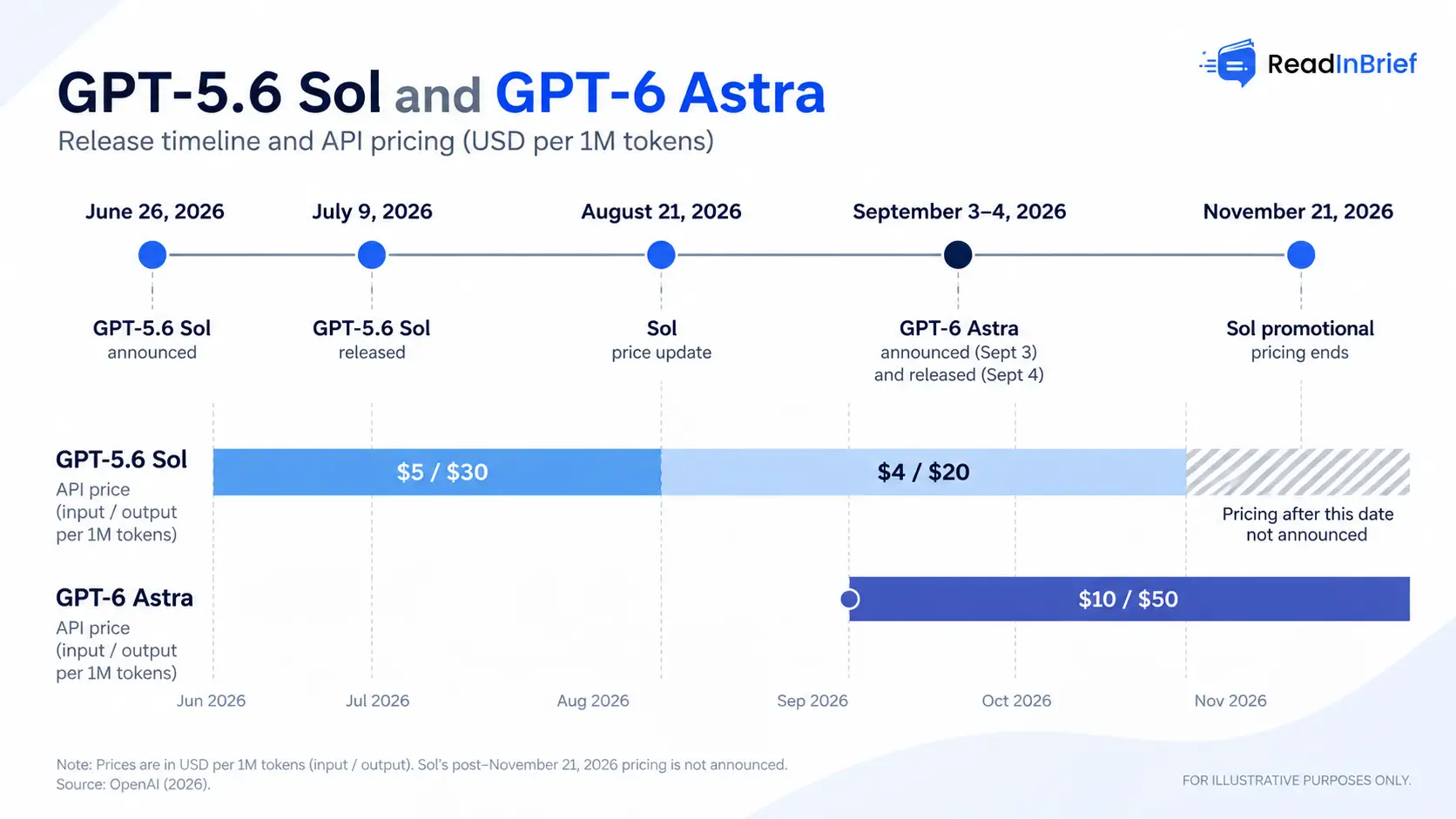
Date (2026) | Event | Source |
|---|---|---|
June 26 | Limited preview of Sol, Terra and Luna; Sol priced at $5/$30 per million input/output tokens | |
July 9 | GPT-5.6 available across ChatGPT, Codex and the API | |
August 21 | Sol cut to $4/$20, promotional through at least November 21 | |
September 3 to 4 | GPT-6 Astra limited preview, then public release | |
November 21 | Earliest date Sol's promotional pricing may end |
What Does OpenAI Say Changed?
OpenAI describes Astra as its most intelligent and best-aligned model. These are vendor-reported claims, so treat them as hypotheses to test on your own tasks:
On the OSWorld 2.0 computer-use benchmark, OpenAI reports Astra at 72.6%, reached 47% faster than Sol. Sol's launch figure was 62.6%.
Astra uses substantially fewer output tokens across OpenAI's benchmarks, and OpenAI estimates 9% lower API cost per task on Terminal-Bench 4.0.
Astra had 89% fewer unintended outcomes than Sol on OpenAI's computer-use safety benchmark, per the same announcement.
The model supports up to 1M tokens of context, and OpenAI reports 96.3% on a 512K to 1M needle-in-a-haystack test.
One caveat on architecture. Wikipedia's summary of press coverage says Astra uses a "recurrent depth" or looped-transformer reasoning technique. That could not be confirmed in OpenAI's own documentation, so it is best treated as unverified.
GPT-6 Astra vs GPT-5.6 Sol: Specs and Pricing Side by Side
On paper the two models are close to twins. Context window, output cap, modalities and tool support match. The differences that matter are price (Astra is 2.5x higher than Sol's current rate), knowledge cutoff (April 30, 2026 against February 16, 2026) and reasoning effort options, where Astra drops the none setting.
Specification | ||
|---|---|---|
API model ID | gpt-5.6-sol | gpt-6-astra |
Context window | 1,050,000 tokens | 1,050,000 tokens |
Max output | 128,000 tokens | 128,000 tokens |
Knowledge cutoff | February 16, 2026 | April 30, 2026 |
Input price per 1M tokens | $4.00 (promotional; was $5.00) | $10.00 |
Cached input per 1M tokens | $0.40 (promotional; was $0.50) | $1.00 |
Output price per 1M tokens | $20.00 (promotional; was $30.00) | $50.00 |
Reasoning effort levels | none, low, medium (default), high, xhigh, max | low, medium, high, xhigh, max |
Modalities | Text and image in, text out | Text and image in, text out |
Built-in tools | Web search, file search, image generation, code interpreter, computer use, MCP | Web search, file search, image generation, code interpreter, computer use, MCP |
Tier 5 rate limit | 15,000 requests/min, 40M tokens/min | 15,000 requests/min, 40M tokens/min |
Two details are easy to miss. First, Sol's $4/$20 rate is a promotional price effective August 21 that OpenAI says lasts "at least through November 21, 2026." Against Sol's earlier $5/$30 list price, Astra costs 2x more on input and about 1.7x more on output, not 2.5x. Second, Astra's documentation lists a cache-write price of $12.50 per million tokens, so workloads that rewrite large prompts often will see that line item.
The practical reading: the spec sheet barely moved. Whatever Astra changes, it changes through behavior, cost and safety posture rather than through a bigger window or new modalities.
How Much Better Is GPT-6 Astra? What Independent Benchmarks Show
Independent testing shows a real but uneven gain. Artificial Analysis measures Astra six points ahead of Sol on its Intelligence Index at max effort, with the largest jumps in agentic terminal work and in factual reliability. Sol stays level with or slightly ahead of Astra on scientific coding and long-context reasoning. OpenAI's own claims are larger, and several cannot yet be checked independently.
Measure (Artificial Analysis) | GPT-5.6 Sol | GPT-6 Astra | Effort setting |
|---|---|---|---|
Intelligence Index | 47 | 53 | Both at max |
Intelligence Index | 42 | 50 | Sol at high, Astra at medium |
Terminal-Bench 4.0 | 40% | 59% | Both at max |
AA-Omniscience score | 22 | 43 | Both at max |
Hallucination rate | 92% | 51% | Both at max |
Sources: Artificial Analysis max-effort comparison, medium vs high comparison and Astra benchmarking write-up.
A few readings are worth drawing out. The hallucination drop from 92% to 51% is large, but 51% is still not a low number in absolute terms, so retrieval and verification steps remain necessary. Sol matched or slightly beat Astra on SciCode and on the AA-LCR long-context test in both comparisons, by a few points, so a long-document workload has no automatic reason to move. And the gap between Astra at medium (50) and Sol at high (42) is larger than the gap at max, which matters for the cost analysis below.
Where Do OpenAI's Numbers and Independent Numbers Disagree?
On four points, the vendor and independent pictures do not line up cleanly:
Cost per task. OpenAI estimates 9% lower API cost per task on Terminal-Bench 4.0. Artificial Analysis measured about 54% higher cost to run its full index at max effort. The task sets differ, so the figures do not strictly contradict each other, but a team with broad workloads should not assume the narrower result carries over.
Terminal-Bench 4.0. OpenAI reports 57.9% for Astra and Artificial Analysis measured 59%. This is a case where vendor and independent results agree within about a point.
Hallucination. OpenAI reports 4.2% on its own hallucination benchmark, while Artificial Analysis reports 51% on AA-Omniscience. These are different tests with different definitions, and neither number should be quoted as "the" hallucination rate.
Near-saturated headline scores. OpenAI's announcement lists results such as 99.9% on ARC-AGI-3, 98% on FrontierMath Tier 4 and 100% on ExploitBench. No independent replication of these was found at the time of writing, so this article does not rely on them.
OpenAI's announcement also quotes customers, including Databricks ("significantly better cost per task than GPT-5.6 Sol"), CodeRabbit (about 20% more bugs caught) and Datacurve (74% on DeepSWE v1.1). These are vendor-selected testimonials. They are useful as a list of places to test first, not as proof.
How Much Does GPT-6 Astra Actually Cost Compared With GPT-5.6 Sol?
At list price, Astra costs 2.5 times more per token than Sol's current rate. Measured across Artificial Analysis's full index, the gap is smaller: about 54% more at max effort, and 64% more for Astra at medium against Sol at high. The cheapest way to beat Sol's best score is Astra at medium, which scored higher than Sol at max effort while costing about 30% less to run.
Artificial Analysis measure | Sol (max) | Astra (max) | Sol (high) | Astra (medium) |
|---|---|---|---|---|
Intelligence Index | 47 | 53 | 42 | 50 |
Cost to run the index | $3,465 | $5,324 | $1,487 | $2,434 |
Output tokens per task | 29k | 27k | 13k | 10k |
Output speed (tokens/sec) | 62 | 53 | 63 | 48 |
Time to first token | 130 sec | 328 sec | 13.7 sec | 5.3 sec |
Sources: Artificial Analysis max-effort comparison and medium vs high comparison.
On these numbers, Astra at medium (index score 50, $2,434) beats Sol at max (47, $3,465) on both score and cost. This is a cross-read of two separate Artificial Analysis pages, and a third-party migration write-up quotes different absolute figures (Astra medium at 52 for $1.16 per task, Sol max at 51 for $1.25). Benchmark snapshots move, so rely on the direction and the ratios rather than any single dollar amount, and rerun the comparison on your own tasks.
Latency depends heavily on effort. At max effort Astra took 328 seconds to first token in Artificial Analysis's test, which rules it out for anything interactive. At medium it took 5.3 seconds against 13.7 seconds for Sol at high.
How Do You Calculate Cost per Successful Task?
List price per token is the wrong comparison. The number that matters is cost per successful task. The following is an analytical planning model, not a validated methodology:
\text{Cost per successful task} = \frac{T_{in} \cdot P_{in} + T_{out} \cdot P_{out}}{s}
Here T is tokens per task (including reasoning tokens, which bill as output), P is price per token, and s is the share of tasks completed correctly on the first attempt. Astra beats Sol on this measure only when its success rate improves by more than its cost rises: s(Astra) / s(Sol) > c(Astra) / c(Sol).
That has a blunt implication. With a cost ratio of about 1.54 (max effort), Astra can only win on cost per success if Sol's success rate on that workload is below roughly 65%. At a ratio of 1.64 (Astra medium against Sol high) the ceiling is about 61%. If Sol already succeeds on 90% of a workload, the best Astra can do is 100 / 90, or about 1.11x, and that cannot offset a 1.5x cost increase. The model ignores human review time, retries and the cost of failures, which is where Astra's value tends to sit for high-stakes work.
An illustrative scenario, not a real case: a workload of 1 million tasks a month, each using 2,000 input and 1,000 output tokens (reasoning tokens excluded, which would raise both totals).
Model and price basis | Monthly token spend |
|---|---|
Sol at promotional $4/$20 | $28,000 |
Sol at earlier list $5/$30 | $40,000 |
Astra at $10/$50 | $70,000 |
The same workload costs 2.5x more on Astra than on promotional Sol and 1.75x more than on Sol's earlier list price. Whether that is acceptable depends on what a failed task costs you.
One practitioner data point points the other way. The write-up above cites a developer case study in which Astra at medium finished a coding task for $25.67 in 51 minutes, against $31.79 and 75 minutes for Sol at high, and caught a bug the Sol run missed. That is a single unreplicated example, so read it as a reason to run your own test, not a benchmark.
Should You Upgrade? A Five-Factor Scorecard for Choosing Between Sol and Astra
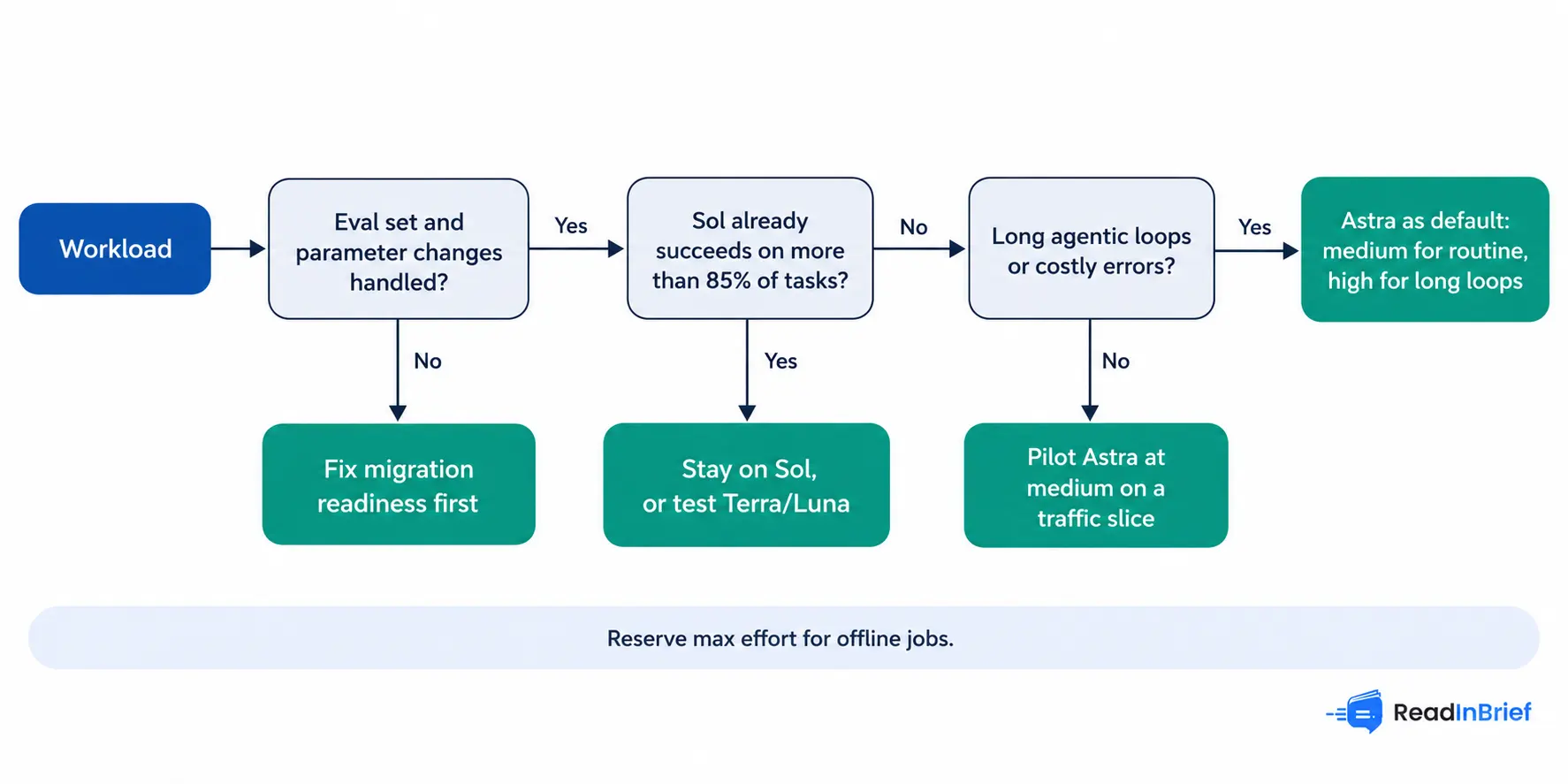
Score each workload from 0 to 2 on the five factors below and add them up. A total of 0 to 3 means stay on Sol, 4 to 6 means pilot Astra at medium effort on a slice of traffic, and 7 to 10 means make Astra the default and tune effort per task. This is an original planning model built from the cost and benchmark evidence above. It has not been scientifically validated, so treat the thresholds as starting points.
Factor | Score 0 |
|---|---|
1. Cost of a wrong output | Cheap and easily caught |
2. Task length and tool use | Single-turn |
3. Sol's current success rate | Above 85% and stable |
4. Volume and latency sensitivity | High volume, thin margin, tight latency |
5. Migration readiness | No eval set; relies on temperature, top_p or logprobs |
Factor 5 works as a gate. A score of 0 there means fixing the evaluation and parameter dependencies first, whatever the total says, because without an eval set you cannot tell whether Astra helped. Factor 3 ties directly to the break-even math above: a workload where Sol already succeeds more than 85% of the time has little room for Astra to pay for itself.
Which Workloads Should Move? Three Illustrative Scenarios
These are hypothetical scenarios built to show how the scorecard works. They are not real case studies.
Scenario (hypothetical) | Scores for factors 1 to 5 | Total | Suggested action |
|---|---|---|---|
Support-ticket classifier handling 5M requests a month | 1, 0, 0, 0, 2 | 3 | Stay on Sol, and test whether Terra or Luna is good enough |
Agentic code-review and bug-fixing pipeline | 2, 2, 1, 2, 2 | 9 | Astra by default; medium for routine reviews, high for long loops |
Finance operations agent reconciling statements through computer use | 2, 2, 1, 1, 1 | 7 | Astra, with human approval gates on consequential actions |
The classifier is short, high volume and probably already accurate on Sol, so the extra spend buys little. The code-review pipeline is where OpenAI's partner claims cluster (for example CodeRabbit's reported 20% more bugs caught), and long agentic runs are also where Astra's higher OSWorld and Terminal-Bench results should matter, though those claims still need testing on your own repositories. The finance agent scores high because errors are costly, but its readiness score is middling: OpenAI says enterprise access to Astra is off by default at launch, and its safety overview says the model is more robust in browsing and professional computer environments, which is a claim to verify inside your own controls rather than assume.
What Are the Risks of Moving From GPT-5.6 Sol to GPT-6 Astra?
The main risks are cost drift, latency at high effort, breaking API changes and a changed safety profile. Astra removes the temperature, top_p and logprob parameters, drops the none effort setting, and OpenAI says its chain-of-thought monitorability decreased compared with Sol. None of these is a reason to avoid the model, but each needs a test before production traffic moves.
Breaking API changes. OpenAI's migration guidance says to remove
temperature,top_pandtop_logprobs, replaceprompt_cache_retentionwithprompt_cache_options.ttl(set to "30m"), and use the Responses API for tool calling. Teams currently onnoneorminimaleffort should start atlowand compare results.Lower monitorability. OpenAI's safety overview states that Astra's monitorability decreased relative to Sol, and that the model can control its reasoning output and evade chain-of-thought monitors under adversarial conditions. OpenAI notes the evidence comes mainly from adversarial testing. Teams that rely on reading reasoning traces for oversight should treat that as a control that has weakened.
Cybersecurity restrictions. The same document calls Astra OpenAI's first model to reach the Critical cybersecurity level under its Preparedness Framework. OpenAI's announcement says the model refuses advanced cybersecurity tasks for now, with fuller access planned through a separate program. Legitimate security teams may run into refusals that Sol did not produce.
Behavior shifts. The migration guide recommends prompting Astra to bias toward action, to state that user instructions override skill files, and to specify preferred writing style. In practice that means agentic workflows may behave differently on the same prompts, so rerun scope and permission tests.
Price exposure. Astra's listed price carries no promotional label, but Sol's does. Budget models built on Sol's $4/$20 rate can move in either direction after November 21.
What Is the Best Argument for Staying on Sol?
Sol is cheaper today, generates tokens faster (62 against 53 per second at max effort in Artificial Analysis's test), matches Astra on long-context and scientific coding tests, and has no announced shutdown date. For workloads where Sol already succeeds most of the time, the cost-per-success math above says Astra cannot pay for itself.
The counter to that argument is about effort settings, not model names. Sol at max effort costs more and scores lower than Astra at medium in Artificial Analysis's data, and Astra at medium reached first token faster than Sol at high. "Astra is too expensive" is true when you compare the same effort label on both models, and false when you compare the cheapest setting that reaches a given quality bar. Both statements can be correct, which is why testing beats reading headlines.
What Can Astra Not Solve?
Astra does not remove the need for verification: a 51% hallucination rate on Artificial Analysis's hard-question test is a large improvement, not a guarantee. It does not enlarge the context window, add audio or video input, or raise the output cap, all of which match Sol. And it does not substitute for an evaluation set built from your own tasks, which is the only thing that can tell you whether the price difference is worth paying.
So What Actually Changed Between GPT-5.6 Sol and GPT-6 Astra?
In the GPT-6 Astra vs GPT-5.6 Sol decision, the spec sheet barely moved. Behavior, cost and risk profile did. Astra is measurably stronger on agentic and reliability-sensitive work, costs roughly 1.5x to 2.5x more depending on how you measure, and asks you to accept less visibility into the model's reasoning. For most teams the right answer is routing rather than a wholesale switch: Astra at medium effort for workloads that score high on the scorecard, and Sol (or Terra and Luna) for high-volume, low-stakes work.
A practical way to settle it for your own stack:
Collect 50 to 200 real tasks per workload, with a pass or fail rubric.
Run Sol at high, Astra at medium and Astra at high on the same set.
Compute cost per successful task, including reasoning tokens and human review time.
Check latency and the parameter changes, then set routing rules before Sol's promotional pricing window closes on November 21, because that date may change the arithmetic.
Frequently Asked Questions About GPT-6 Astra vs GPT-5.6 Sol
Is GPT-6 Astra better than GPT-5.6 Sol?
Yes on most independent measures, but not on every one. Artificial Analysis scores Astra 53 against Sol's 47 on its Intelligence Index at max effort, with the biggest gains on Terminal-Bench 4.0 (59% vs 40%) and AA-Omniscience (43 vs 22). Sol was level or slightly ahead on SciCode and long-context reasoning. Whether Astra is better for you depends on the workload and the cost you can accept.
How much does GPT-6 Astra cost compared with GPT-5.6 Sol?
Astra costs $10 per million input tokens and $50 per million output tokens, against $4 and $20 for Sol at its current promotional price. That is 2.5x. Against Sol's earlier $5/$30 list price, it is 2x on input and about 1.7x on output. Across Artificial Analysis's full index, measured cost was about 54% higher for Astra at max effort.
Which reasoning effort should I use with GPT-6 Astra?
OpenAI's migration guide says to keep your existing effort level, and to start at low if you were using none or minimal. A third-party migration write-up recommends medium as the default and higher settings only where lower ones fail measurably. Artificial Analysis's data supports medium as a strong starting point: it scored 50, above Sol at max effort. Test both on your own tasks.
Do I need to change my code to move from GPT-5.6 Sol to GPT-6 Astra?
Most likely, since Astra rejects some parameters. You must remove temperature, top_p and top_logprobs, replace prompt_cache_retention with prompt_cache_options.ttl, and use the Responses API for tool calling, according to OpenAI's migration guidance. The none effort setting that Sol supports is not listed for Astra, so those workloads need a new baseline at low.
Is GPT-5.6 Sol being retired?
Not according to OpenAI's deprecations page, which lists no shutdown date for any GPT-5.6 model and still recommends Sol as a replacement for older models. What does have a date is Sol's promotional pricing, which OpenAI says runs "at least through November 21, 2026." Check the page again before relying on this, since deprecation schedules change.
Does GPT-6 Astra have a larger context window than GPT-5.6 Sol?
No. Both models list a 1,050,000-token context window and a 128,000-token output limit. Astra's knowledge cutoff is later (April 30, 2026, against February 16, 2026 for Sol). OpenAI reports that Astra scores 96.3% on a needle-in-a-haystack test at 512K to 1M tokens, but that is a vendor-reported result on a simple retrieval task.
Is GPT-6 Astra safe to use for enterprise workloads?
It depends on your controls. OpenAI's safety overview reports stronger jailbreak robustness and roughly half as many higher-severity misalignment flags as Sol, but also lower monitorability and a Critical cybersecurity classification. OpenAI says enterprise access is off by default at launch, with admin controls for websites, apps and confirmation policies. Pilot with approval gates on consequential actions.
Read Also:
MCP vs API: What Changes in the AI Agent Era?
Agentic AI vs Generative AI: What's the Real Difference?
Kimi K3 vs GPT vs Claude vs Gemini: Best AI Model?
Claude Fable 5 vs Claude Mythos 5: What's the Real Difference?
Claude AI vs ChatGPT: Which AI Chatbot Is Better
Claude vs ChatGPT vs Gemini in 2026: Which AI Is Best for You?
Comments (0)
No comments yet. Be the first to share your thoughts!