MCP vs APIs vs AI Plugins: What Is the Difference, and When Should You Use Each?

Author
Deval Shah
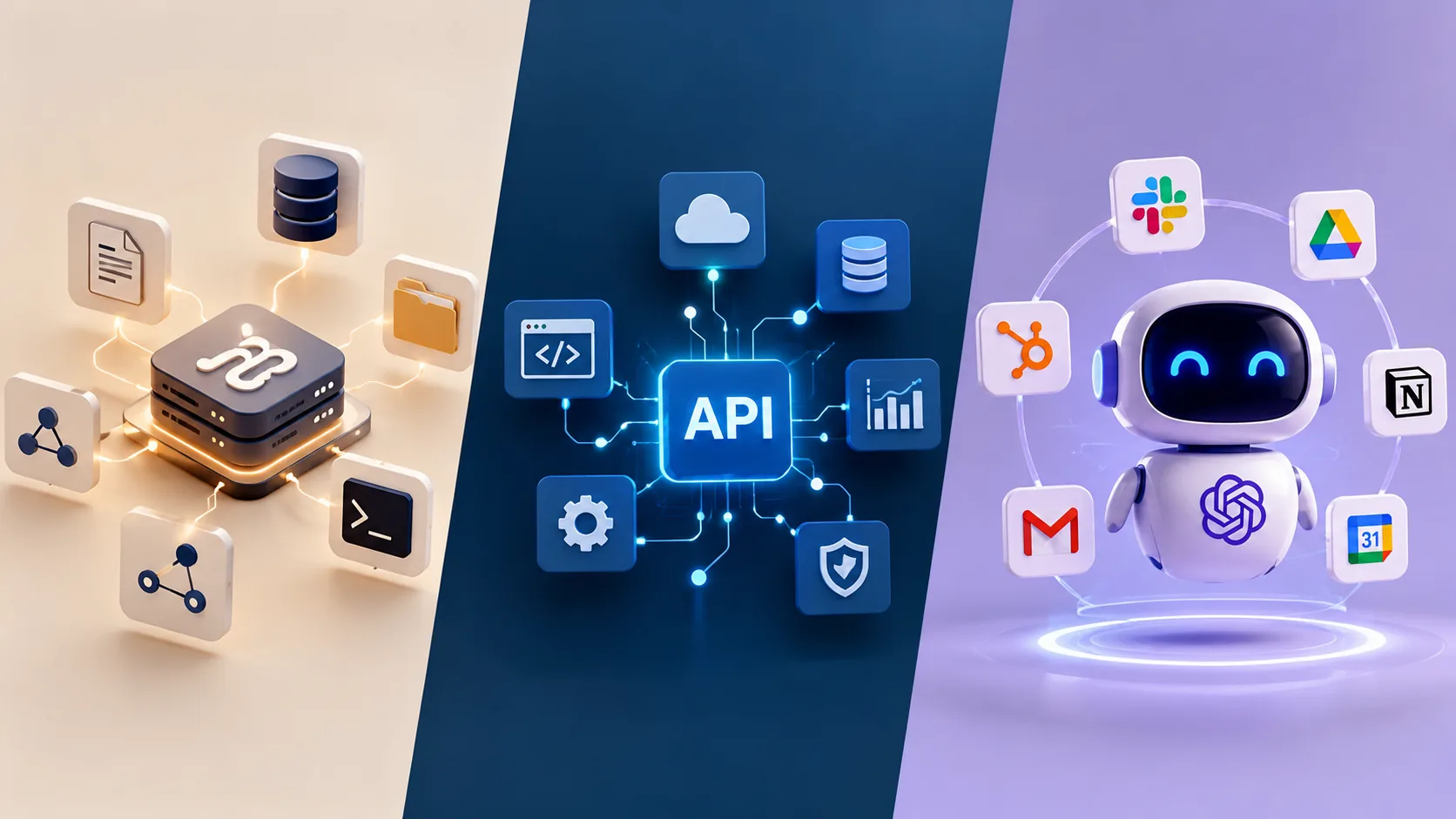
MCP vs API vs plugins explained: what each one does, a decision table for builders and teams, real token costs, and when to use all three together.
You can tell MCP, APIs and plugins apart with two questions: who calls the capability, and who installs it. Your code calls an API. An AI app calls an MCP server on a model's behalf. A person installs a plugin.
Take Zerodha as a concrete case. The Kite Connect API lets a developer's Python script fetch your holdings. Kite MCP lets Claude or Cursor fetch the same holdings when you ask in plain English. A plugin could then package that connection with an instruction, such as "always show sector exposure first," so a whole team gets the same behavior from one install.
The three layers stack. They don't compete.
MCP vs API vs plugins at a glance
MCP, APIs and plugins differ most in who calls them, how portable they are and who builds them. Here is the comparison on one screen.
Attribute | API | MCP | AI plugin |
|---|---|---|---|
What it is | A service's interface for software | An open protocol connecting AI apps to tools and data | An installable bundle for an AI platform |
Who calls it | Your code | An AI client, when the model picks a tool | A person installs it; the AI uses what's inside |
Who usually builds it | The service owner | The service owner, on top of its API | The service owner, the platform or your own team |
Portability | Any language, any app | Any MCP-compatible AI app | Usually one platform's directory format |
Discovery | You read the docs | The AI client lists tools at run time | Browse a directory, click install |
Example | Razorpay Payments API | Razorpay MCP server (35+ tools) | A ChatGPT plugin bundling apps and skills |
Main weakness | Each AI app needs custom glue code | Token overhead and new attack paths | Tied to one platform; quality varies |
What is an API?
An API (application programming interface) is the set of rules a service publishes so other software can request data or trigger actions. When your checkout page charges a card through Razorpay, it calls an API.
Most web APIs today are REST or GraphQL endpoints over HTTPS. Your code sends a request with an API key or OAuth token. The service checks permissions and rate limits, then returns JSON. The developer decides exactly which endpoint to call, with which inputs, and when.
That precision is the point. Say a nightly job syncs 2,000 invoices from your billing tool into your accounting system. It should call the same three endpoints every night. No model needs to decide anything, so no model should sit in the loop.
Where APIs fall short for AI: an API has no standard way to describe itself to a language model. Every AI app that wants to use it needs custom glue: tool definitions, auth handling and error mapping. Four AI apps means four integrations, and someone has to maintain all of them.
What is MCP (Model Context Protocol)?
MCP is an open standard that lets AI applications discover and use external tools, data and prompt templates through one common interface. Anthropic released it in November 2024. Since December 2025, it has been governed by the Agentic AI Foundation, a directed fund under the Linux Foundation co-founded by Anthropic, Block and OpenAI.
MCP has three roles:
The host is the AI app you use, such as Claude, ChatGPT, Cursor or VS Code.
An MCP client runs inside the host.
The client connects to one or more MCP servers.
Each server can expose three kinds of capability:
Tools: actions the model can call. Each has a name, a description and an input schema, for example
create_payment_link.Resources: data the app can load as context, such as a file or a record.
Prompts: reusable templates a user can choose.
The model never talks to the server directly. The host sits in the middle and can ask you before a tool runs. For a refresher on how models use tools like these, see our guide to what AI agents are and how they work.
Adoption is broad. In December 2025, the MCP project reported more than 97 million monthly SDK downloads and over 10,000 active servers. Client support covered ChatGPT, Claude, Cursor, Gemini, Microsoft Copilot and VS Code.
The current specification is the 2026-07-28 revision, the largest since launch. It made the protocol stateless, so every request now carries its own protocol version and client details. That means a server can run behind an ordinary load balancer without sticky sessions. The revision also tightened authorization to match standard OAuth and OpenID Connect deployments. It deprecated three older features (roots, sampling and logging), which keep working for at least 12 months.
Where MCP falls short: connected tools' descriptions can fill the model's context, and that costs tokens (see the worked example below). MCP also opens new attack paths, such as instructions hidden inside a tool description. The 2026-07-28 changes are breaking, so older servers and SDKs need migration work.
What is an AI plugin in 2026?
An AI plugin in 2026 is an installable bundle that adds capabilities to one AI platform. It usually packages MCP connections with instructions, templates or commands. The definition has shifted twice in three years, which is why the word confuses people.
The 2023 version was different. ChatGPT plugins launched in beta in March 2023 and let third-party services act inside ChatGPT. They worked only in ChatGPT and were switched off in April 2024.
The 2026 version is a container:
ChatGPT: On July 9, 2026, OpenAI replaced its app directory with a Plugin Directory. A plugin can include skills, apps and app templates. The apps are the integrations that connect ChatGPT or Codex to outside data and actions, and OpenAI tells developers to build them with MCP.
Claude: Anthropic's documentation defines three things. Connectors are connections to MCP servers. Skills are written instructions Claude loads when a task calls for them. Plugins are packages holding skills, MCP connectors, commands and agents in one install.
A sales team's plugin might bundle a CRM connector, such as one for HubSpot's AI features, with a skill that defines how your team writes follow-up emails.
Where plugins fall short: each platform has its own format and review process. A Claude plugin and a ChatGPT plugin are separate submissions even when the MCP server inside them is identical. A directory listing is also a product review, not a security audit.
How did we get here? A short timeline
Plugins, APIs and MCP got tangled because the industry tried three integration models in three years. Each platform started with its own format and then converged on a shared protocol underneath.
Date | What happened |
|---|---|
March 2023 | ChatGPT plugins launch in beta |
November 2023 | OpenAI announces custom GPTs with actions |
April 9, 2024 | Original ChatGPT plugins are switched off |
November 2024 | Anthropic open-sources MCP |
March 2025 | OpenAI adds MCP support to its Agents SDK [VERIFY] |
October 6, 2025 | OpenAI launches apps in ChatGPT and the Apps SDK, built on MCP |
November 2025 | MCP Apps extension proposed; spec 2025-11-25 ships |
December 9, 2025 | MCP donated to the Agentic AI Foundation |
January 26, 2026 | MCP Apps becomes the first official MCP extension |
July 9, 2026 | ChatGPT's app directory becomes the Plugin Directory |
July 28, 2026 | MCP 2026-07-28 spec ships with a stateless core |
The MCP Apps entry matters more than it looks. It lets an MCP server return interactive screens, such as forms, charts and dashboards, inside the chat. That was once the main reason to build a platform-specific plugin. OpenAI and the MCP-UI project co-developed it, so one server can now show the same interface in Claude, ChatGPT, VS Code and goose.
MCP vs APIs vs plugins head-to-head
Head to head, APIs win on control and cost, MCP wins on reach across AI apps, and plugins win on ease of install. The details below go criterion by criterion.
Who each one is built for
APIs are built for developers writing predictable code. MCP is built for AI apps acting on a user's request. Plugins are built for end users and team admins who want a capability in a few clicks.
A finance analyst who wants Claude to summarize last week's failed payments needs a plugin or connector. The engineer who builds the payments dashboard needs the API.
Setup effort
Using an MCP server is often a sign-in or a pasted URL. Building one is a real project. Razorpay offers two options. Its hosted remote server has no infrastructure to manage. Its local server runs in Docker and gives full control. Razorpay recommends the remote option for most teams.
Calling an API takes a key and some code. Building a plugin means a manifest, a platform review and ongoing updates for each directory you list in.
Portability and the integration math
MCP's main advantage is that one build reaches many AI apps. Here is a worked example.
You run a service and want it usable from four AI apps: Claude, ChatGPT, Cursor and VS Code. Without a shared protocol, each app needs its own integration. Across ten services, that is up to 4 × 10 = 40 integrations to build and maintain across the industry. With MCP, each service ships one server. That is 10 builds in total, and each server works in all four apps.
Cost and token overhead
A direct API call costs only the API's own price. MCP can add model-token costs, because many clients load every connected tool's definition into the model's context on each request.
Anthropic's engineering team published an example in November 2025. A workflow that moved a meeting transcript from Google Drive into Salesforce used about 150,000 tokens when tool definitions and intermediate results passed through the model. When the agent instead wrote code that called the tools, the same workflow used about 2,000 tokens, a 98.7% reduction.
Here is what that means at an illustrative price of $3 per million input tokens [VERIFY current model price]:
Setup | Tokens per run | Cost per run | 1,000 runs a day |
|---|---|---|---|
Direct tool calls through context | 150,000 | $0.45 (about ₹40) | $450 (about ₹39,600) |
Code execution with MCP | 2,000 | $0.006 (about ₹0.50) | $6 (about ₹530) |
Prices checked October 2026. INR at about ₹88 per US$.
The lesson is narrow but useful: connect only the servers a task needs, and prefer clients that load tool definitions on demand.
Security and control
APIs give you the most control, because you choose every endpoint and scope. MCP hands that choice to a model. That creates risks a plain API integration doesn't have.
OWASP's MCP Top 10 (currently in beta) names several of them:
Tool poisoning (MCP03): hidden instructions inside a tool's description.
Command injection and execution (MCP05).
Shadow MCP servers (MCP09): servers running outside your security team's view.
Plugins inherit whatever risk their bundled servers carry. Our analysis of why agentic AI has a trust problem covers the wider issue.
Zerodha shows one good defensive pattern. Its hosted Kite MCP server leaves out potentially destructive trading operations. You can ask Claude about your portfolio, but you can't have it place trades through that endpoint.
Maturity and stability
APIs are decades-old, well-understood technology. MCP is two years old and changes through dated spec revisions, the latest of which broke compatibility with older servers. SDKs adopt new revisions at their own pace. Plugin formats have changed twice since 2024. Expect more churn in the top two layers than in the bottom one.
The Pipe, Port, Package framework
Pipe, Port, Package is the three-layer model ReadInBrief uses to place any AI integration. The API is the pipe, the MCP server is the port, and the plugin is the package.
Layer | What it is | Who uses it | Build order | Buy order |
|---|---|---|---|---|
Pipe (API) | The service's own door for software | Your code | First | Last |
Port (MCP server) | A standard socket any AI app can plug into | An AI client, picked by the model | Second | Second |
Package (plugin) | A bundle of ports plus instructions and templates | A person clicking install | Last | First |
The rule has two halves. If you own a service, build bottom-up. A plugin with no solid API underneath breaks every time the platform changes. If you're adopting AI tools, buy top-down. Start with an official plugin or connector, and drop to the port or pipe only when the package doesn't do what you need.
One test from the framework is worth keeping: if you can't name the pipe under a plugin, don't connect it to business data. An unknown pipe means you don't know where your data goes.
Which should you choose?
Choose an API when your code decides what happens, MCP when a model decides, and a plugin when a person installs. The table below applies that rule by role.
If you are... | And you want to... | Use | Why |
|---|---|---|---|
A backend developer | Automate a fixed job, such as a nightly invoice sync | API | Predictable, cheapest, no model needed |
A SaaS founder | Let AI assistants work with your product | API, then an MCP server | One server reaches Claude, ChatGPT, Cursor and VS Code |
A marketer or ops lead | Have ChatGPT or Claude read your CRM or drive | An official plugin or connector | No code, sign-in only |
A team lead | Standardize how your team uses AI on a workflow | A plugin (or your own bundle) | Packages connectors with house instructions |
An agent developer | Give an agent many tools | MCP for tools, API for core logic | Tools stay swappable; critical paths stay predictable |
An IT or security lead | Allow AI access to company systems | Approved MCP servers through an allowlist | Central control and audit logs |
A student | Learn how this works | One API call, then a tiny MCP server | You'll see exactly what MCP adds |
The case for skipping MCP
Most automation doesn't need MCP, and adding it can make a job slower, costlier and less predictable. If the steps never change, a script that calls APIs in order beats a model choosing tools at run time. MCP earns its place when the request varies and a model has to decide which tool fits. Our explainer on the difference between AI agents and AI workflows draws the same line.
Can you use MCP, APIs and plugins together?
Yes, and most real setups do. The plugin contains the MCP connection, and the MCP server calls the API.
Picture an Indian D2C skincare brand. Its checkout calls the Razorpay API directly, because that path has to be predictable. Its finance team uses Claude with Razorpay's MCP server to ask "which UPI payments failed yesterday, and why?" A team plugin bundles that connector with a skill that applies the brand's refund policy. That is one service touched at three layers, each by a different user.
Agent builders mix layers the same way. Frameworks such as LangGraph and CrewAI can load MCP servers as tools while the agent's core logic calls APIs directly [VERIFY current MCP support in each framework's docs]. Our guide to AI orchestration and how agents are coordinated covers that design. You can also browse more agent builds on the ReadInBrief AI agents hub.
What should teams in India check?
Teams in India should check two things: whether a service publishes an official MCP server, and whether connecting it moves personal data in ways the DPDP Rules cover.
Several large Indian platforms already publish official servers:
Razorpay: its MCP server is described as an official, production-ready integration with 35+ tools covering payments, orders, refunds and more.
Zerodha: Kite MCP is free to connect to Claude, Cursor and Windsurf, and it mainly offers market data and portfolio analysis.
Prefer official servers like these over community copies. Community copies often store your API secret in a local file.
On compliance, MeitY notified the Digital Personal Data Protection Rules in November 2025. Sources give either November 13 or November 14. Most obligations apply from May 13, 2027. An MCP connector that lets an AI app read customer records is processing personal data. So you need a clear purpose, consent where required, and logs showing which tool accessed what. Our explainer on AI governance and compliance for growing companies covers how to set up those controls.
[EDITOR: hands-on note, connect Kite MCP to Claude, then report setup time, which tools appear and whether any order-placing tools are exposed]
Common misconceptions about MCP, APIs and plugins
Most confusion comes from treating the three as rivals. They are layers.
"MCP replaces APIs." It doesn't. An MCP server almost always calls an existing API, and Razorpay's still needs your Razorpay API keys. What MCP replaces is the custom glue each AI app used to need.
"Plugins died in 2024." The 2023 ChatGPT plugins did. The word returned in 2026 with a new meaning: a bundle of skills and MCP-based apps.
"MCP is Anthropic's product." Anthropic created it, but since December 2025 a Linux Foundation fund has stewarded it. OpenAI is a co-founder of that fund, and the MCP maintainers keep technical control.
"More connected tools make an agent smarter." More tools mean more definitions in context, higher token bills and more chances the model picks the wrong one. Ten well-chosen tools usually beat 150.
"A directory listing means it's safe." Review processes check function and policy. They can't catch a tool that changes its behavior after approval, which security researchers call a rug pull.
Our verdict: build the pipe, then the port, then the package
We'd use all three, in a fixed order. If you own a service, ship a clean API first, add an MCP server second, and list a plugin in each directory third. If you're adopting AI tools, start with the official plugin from the service's own publisher, connect as few servers as the task needs, and grant read-only access by default. If a job doesn't need a model to decide anything, skip MCP and call the API.
The open question for 2027 is how many plugin directories will exist. If every AI platform runs its own, the package layer fragments again even though the port underneath is shared. Which directory will your customers actually browse?
FAQ
Is MCP replacing APIs?
No. MCP servers almost always call an existing API underneath. Razorpay's MCP server, for example, wraps Razorpay's payment APIs and still needs your API keys. MCP replaces the custom glue code each AI app used to need. If you run a service, you keep your API and add an MCP server on top so AI clients can use it.
Are ChatGPT plugins still available?
The original ChatGPT plugins from 2023 were switched off in April 2024. The word came back on July 9, 2026, when OpenAI moved its app directory into a new Plugin Directory. Today a ChatGPT plugin is a bundle of skills, apps and app templates, and the apps inside it are built on the Model Context Protocol.
Do I need to know how to code to use MCP?
Not to use it. In Claude and ChatGPT, you can add a listed connector or plugin with a sign-in, much like installing a phone app. You need coding skills to build an MCP server, or to connect an unlisted server by its URL, which usually means editing a configuration file or using a developer setting in the AI app.
What is the difference between an MCP server and an MCP client?
An MCP server exposes tools, data and prompt templates from a service, such as GitHub or Zerodha Kite. An MCP client lives inside the AI app, such as Claude, ChatGPT, Cursor or VS Code, and connects to servers on the model's behalf. The model never talks to a server directly, because the host app sits in the middle.
Is MCP safe to use with my business data?
MCP is as safe as the servers you connect and the permissions you grant. OWASP now tracks MCP-specific risks such as tool poisoning, where hidden instructions sit in a tool's description. Use official servers from the service owner, grant read-only access where possible, review what each tool can change, and keep logs of every tool call.
Should a startup build an MCP server or a plugin first?
Build the MCP server first if you want AI users to act on your product. One server works in Claude, ChatGPT, Cursor and VS Code. Wrap it in a plugin later, adding instructions and templates, when you want a listing in a specific directory. If your product has no public API yet, build the API before either of them.
Does MCP cost more tokens than a direct API call?
It can. Many MCP clients load every connected tool's definition into the model's context on each request. Anthropic's engineers showed one workflow dropping from about 150,000 tokens to 2,000 when tools were called through code execution instead. Connect only the servers you need, and prefer clients that load tool definitions on demand.
What is the difference between a GPT action and MCP?
A GPT action lets a custom GPT call an external API described by an OpenAPI schema, and it only works inside ChatGPT. MCP is an open protocol that any compatible AI app can use, governed since December 2025 by the Agentic AI Foundation under the Linux Foundation. For new integrations, MCP reaches more AI clients with one build.
Comments (0)
No comments yet. Be the first to share your thoughts!