Claude Opus 4.8 vs Sonnet 5: Which Is Better for Coding, AI Agents and Real-World Work?

Author
Ravi Prajapati

Compare Claude Opus 4.8 vs Sonnet 5 for coding, AI agents, pricing, context and real-world work, plus which model makes sense for each workload.
Claude Sonnet 5 is the better choice for most production workloads where speed, cost and strong coding or agent performance matter. Claude Opus 4.8 makes more sense when the task is unusually difficult, long-running or dependent on deeper reasoning and judgment.
That was the practical tradeoff when the two models were current.
There is now an important update.
Anthropic released Claude Opus 4.8 on May 28, 2026 and Claude Sonnet 5 on June 30, 2026. Both have since moved into Anthropic's legacy model lineup. Developers starting a new project today should also evaluate the newer Opus 5.5 and Sonnet 5.5 models rather than treating Opus 4.8 and Sonnet 5 as Anthropic's current frontier choices.
Still, the Opus 4.8 vs Sonnet 5 comparison remains useful for teams already running these models, assessing migration options or trying to understand when a cheaper Sonnet-class model became capable enough to replace an Opus model.
The biggest difference is not simply intelligence.
It is how much capability you need to buy for each task.
Opus 4.8 vs Sonnet 5: Quick Answer
For most coding, high-volume AI agents and everyday professional workflows, Sonnet 5 offers the stronger cost-performance tradeoff.
For difficult software engineering, complex multi-step reasoning and agentic work where failure is expensive, Opus 4.8 provides the stronger capability ceiling.
Anthropic itself described Sonnet 5 as approaching Opus 4.8 performance while costing substantially less. At launch, the company specifically said Sonnet 5 could match Opus 4.8 on some higher-effort agentic tasks.
Here is the practical comparison:
Area | Claude Opus 4.8 | Claude Sonnet 5 | Better Choice |
|---|---|---|---|
Difficult coding | Stronger overall | Very strong | Opus 4.8 |
Everyday coding | More capability than many tasks need | Strong | Sonnet 5 |
Long-running agents | Stronger judgment and persistence | Strong, more economical | Depends on task |
High-volume agents | Expensive | Much cheaper | Sonnet 5 |
Complex reasoning | Stronger | Close on some tasks | Opus 4.8 |
Computer use | Strong | Strong | Workload-dependent |
Large context | 1M tokens | 1M tokens | Tie |
Maximum standard output | 128K | 128K | Tie |
API input price | $5/MTok | $2/MTok | Sonnet 5 |
API output price | $25/MTok | $10/MTok | Sonnet 5 |
Cost-sensitive production | Expensive | Better fit | Sonnet 5 |
Hardest edge cases | Better fit | May be sufficient | Opus 4.8 |
The important phrase in that table is "better fit."
A more capable model is not automatically the better production model.
What Is Claude Opus 4.8?
Claude Opus 4.8 is an Anthropic reasoning model released on May 28, 2026, with a particular focus on coding, agentic tasks and professional knowledge work.
According to Anthropic's official Claude Opus 4.8 announcement, the model improved on Opus 4.7 across coding, agentic skills, reasoning and practical knowledge-work evaluations.
Anthropic also introduced stronger support for long-running work alongside the model. Claude Code's dynamic workflows could coordinate hundreds of parallel subagents within a session, with Opus 4.8 able to keep those agents working for longer and verify outputs before returning results.
The model's technical specifications are substantial.
According to Anthropic's Claude Opus 4.8 documentation, Opus 4.8 provides:
1 million-token context window
128K maximum standard output
adaptive thinking
text and image input
$5 per million input tokens
$25 per million output tokens
Anthropic currently labels Opus 4.8 Active (legacy) rather than its current Opus model.
That matters if you are selecting a model for a new system rather than maintaining an existing one.
What Is Claude Sonnet 5?
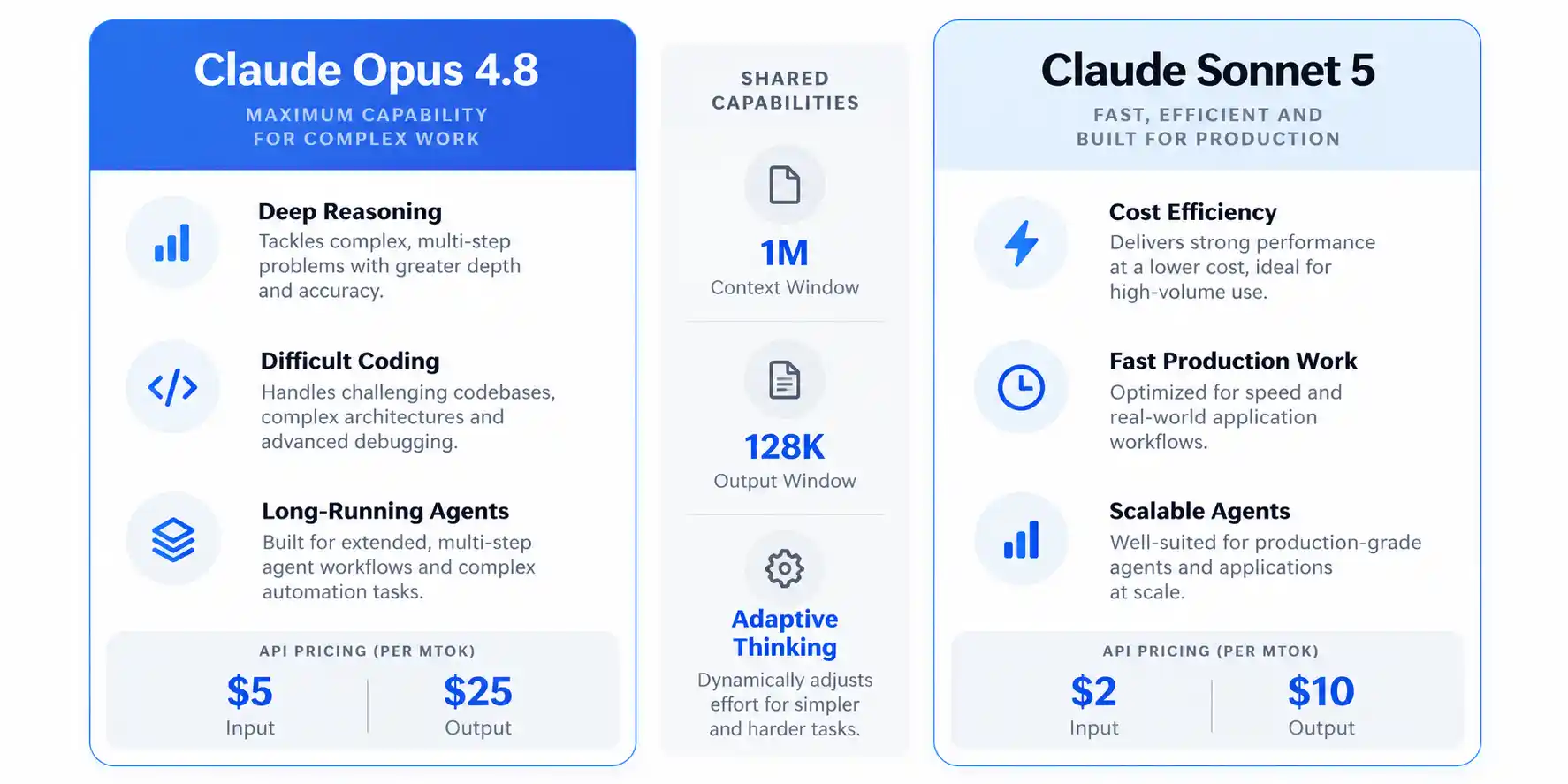
Claude Sonnet 5 is the next-generation Sonnet model Anthropic released on June 30, 2026.
Its main significance was not simply that Sonnet improved.
It substantially narrowed the gap between Anthropic's cheaper Sonnet tier and the more capable Opus tier.
In Anthropic's Claude Sonnet 5 launch announcement, the company described Sonnet 5 as its most agentic Sonnet model at launch, capable of planning, using browsers and terminals, and running autonomous workflows at a level that had recently required larger models.
Anthropic also explicitly positioned its performance as close to Opus 4.8 at a lower price.
According to Anthropic's Sonnet 5 platform documentation, the model offers:
1 million-token context window
128K maximum output
adaptive thinking
text and image input
$2 per million input tokens
$10 per million output tokens
That means Sonnet 5's base token rates are 60% lower than Opus 4.8 for both input and output.
There is one cost nuance worth knowing. Sonnet 5 uses Anthropic's newer tokenizer, and Anthropic says the same text can produce roughly 30% more tokens than Sonnet 4.6. So its lower per-token pricing should not be translated directly into the same percentage reduction for every real workload.
Opus 4.8 vs Sonnet 5 for Coding: Which Is Better?
Opus 4.8 is the stronger choice for the hardest coding tasks, while Sonnet 5 is usually the more economical choice for routine and production-scale software development.
That distinction is more useful than asking which model is simply "better at coding."
Coding workloads vary enormously.
Generating a React component is not the same problem as debugging a distributed system.
Writing unit tests is not the same as planning a migration across hundreds of thousands of lines of code.
Where Opus 4.8 Has the Advantage
Opus 4.8 was designed for complex engineering work where the model may need to reason through a large codebase, maintain context across many steps and notice problems before making changes.
Anthropic reported that Opus 4.8 was roughly four times less likely than Opus 4.7 to allow flaws in its own generated code to pass without being flagged in its evaluations.
That is particularly relevant for tasks such as:
large refactoring projects
difficult debugging
architecture changes
multi-service problems
codebase migrations
complex pull-request review
unfamiliar repositories
long-running Claude Code workflows
Anthropic also demonstrated Opus 4.8 with its dynamic workflows feature for codebase-scale migrations across hundreds of thousands of lines of code.
That is a different use case from code completion.
The model is effectively being asked to plan, execute, inspect and correct.
Where Sonnet 5 Has the Advantage
Most developers do not spend every token on the hardest problem in the repository.
A large share of AI-assisted development involves:
generating functions
fixing normal bugs
creating tests
explaining existing code
implementing API endpoints
updating documentation
SQL generation
routine refactoring
frontend work
repetitive engineering tasks
For these workloads, paying Opus rates may produce little business value if Sonnet already reaches the required quality threshold.
This is where Sonnet 5 becomes attractive.
Anthropic's own comparison states that Sonnet 5's higher-effort performance can match Opus 4.8 on some tasks, while providing a wider range of cost-performance options.
That does not mean Sonnet 5 equals Opus 4.8 everywhere.
It means the capability overlap became large enough that model selection should happen at the task level.
The More Useful Coding Question: What Happens When the Task Gets Hard?
Average coding benchmarks can hide an important production issue.
Models often look similar on ordinary tasks and separate when the problem becomes ambiguous, long-running or difficult to verify.
Imagine two coding requests.
Task A: Create an API endpoint, validation logic and unit tests from a clear specification.
Task B: Investigate an intermittent production failure spanning four services, understand unfamiliar architecture, identify the root cause, design a safe fix, update the implementation and verify that nothing else breaks.
Sonnet 5 may be entirely sufficient for Task A.
Task B is where the extra reasoning budget of Opus 4.8 becomes more valuable.
This suggests a practical model-selection rule:
Use the cheapest model that reliably clears the quality threshold for the task, not the strongest model available.
That is especially important when AI-generated code runs at scale.
Opus 4.8 vs Sonnet 5 for AI Agents
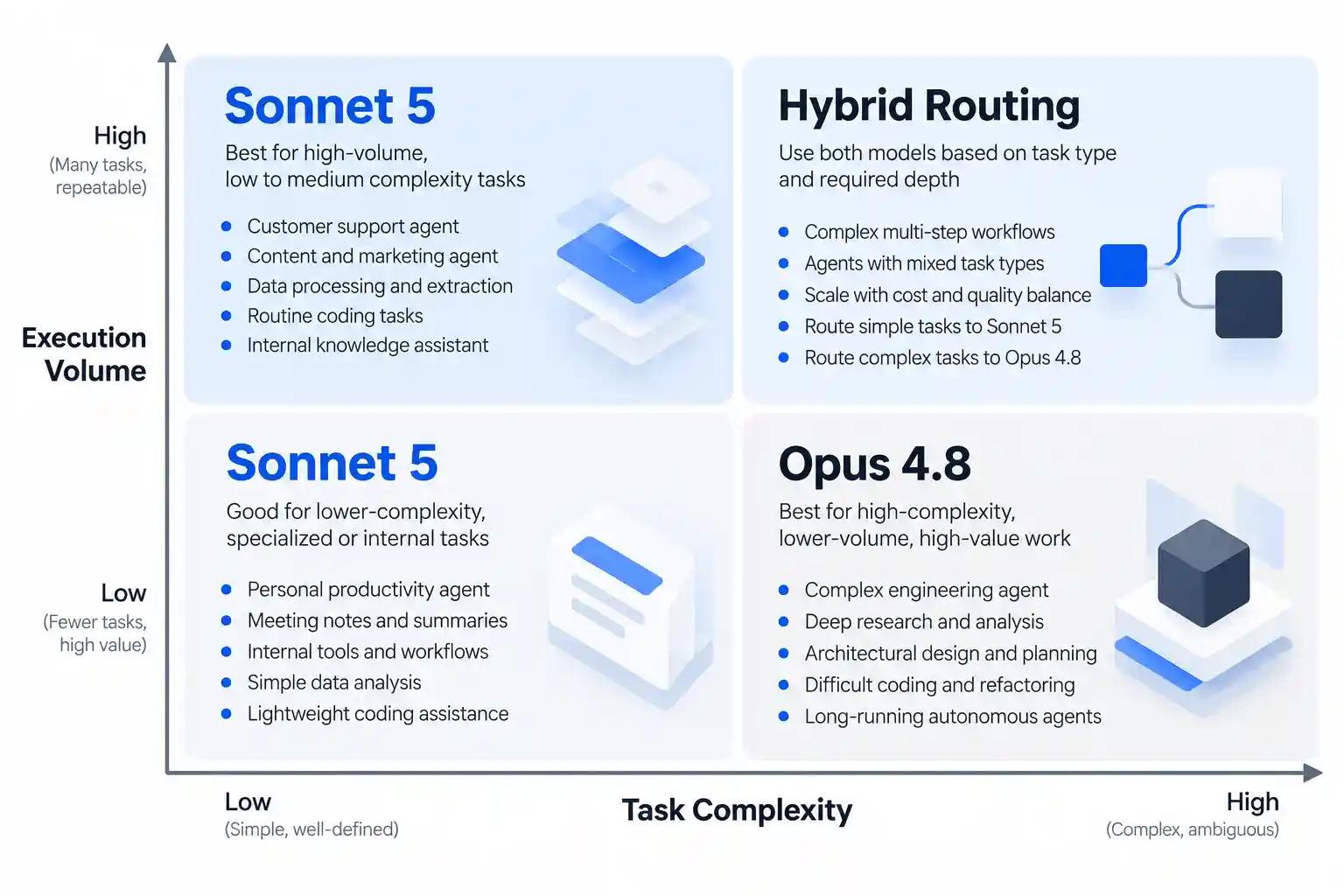
For high-volume and well-defined AI agents, Sonnet 5 is usually the better economic choice. For difficult, long-running agents where planning quality and recovery from unexpected situations matter more than token cost, Opus 4.8 has the stronger case.
Agent performance involves more than answering questions.
An agent may need to:
interpret a goal
create a plan
select tools
execute actions
inspect results
recognize failure
change strategy
continue working
verify the final result
Small differences at each step can compound across a long workflow.
That is why agentic reliability matters differently from chatbot quality.
Why Opus 4.8 Works Well for Complex Agents
Anthropic emphasized judgment and long-running execution when it released Opus 4.8.
Early testers cited by Anthropic reported improvements in tool use, complex multi-service exploration, long-running analysis and end-to-end task completion.
Those are first-party and partner reports rather than independent universal benchmarks, so they should be treated as evidence of reported production experience rather than proof that Opus 4.8 will win every agent workload.
Still, the pattern is consistent with the model's intended positioning.
Opus makes the most sense when a failed step can invalidate a long sequence of expensive work.
Why Sonnet 5 Is More Interesting for Agent Scale
Sonnet 5 changed the economics.
At $2 per million input tokens and $10 per million output tokens, it costs substantially less than Opus 4.8's $5/$25 base pricing.
That matters because agents can consume far more tokens than a normal chat interaction.
An agent may repeatedly:
reason → call tool → inspect output → reason → call another tool → retry → verify.
Multiply that across thousands of users or autonomous workflows and model economics quickly become part of the architecture.
Sonnet 5 therefore makes a stronger case for:
customer-facing agents
research assistants
internal knowledge agents
routine developer agents
workflow automation
support automation
browser agents with bounded tasks
high-volume tool-calling systems
Opus 4.8 vs Sonnet 5 for Computer Use
Both models were designed for increasingly agentic workflows that can interact with software rather than only generate text.
Anthropic's Sonnet 5 launch materials compare the model with Opus 4.8 on OSWorld-Verified, an evaluation focused on computer-use capabilities.
Anthropic reported that Sonnet 5 provided a broader cost-performance range and could match Opus 4.8 capability levels in some high-effort settings.
Opus 4.8 also received strong first-party and partner results for browser and computer-use tasks. Anthropic's launch post cites an early tester reporting an 84% score on Online-Mind2Web for Opus 4.8.
That number should be interpreted carefully because it comes from an Anthropic launch announcement quoting a partner evaluation rather than an independent head-to-head study.
The practical distinction remains similar:
Sonnet 5: better when computer use needs to happen frequently and economically.
Opus 4.8: better when the workflow is difficult enough that additional reasoning and judgment justify higher cost.
Which Model Is Better for Long-Context Work?
On headline context size, neither has an advantage.
Both models support a 1 million-token context window according to Anthropic's official platform documentation.
Both also support up to 128K output tokens for standard API use.
But context-window size should not be confused with effective reasoning over every token.
A model accepting one million tokens does not mean that every part of a million-token prompt will receive equal attention or that stuffing an entire repository into context is the best engineering approach.
For large codebases and document collections, retrieval quality, context selection, prompt structure and tool design can matter as much as the nominal context limit.
So this category is a specifications tie, not necessarily a real-world performance tie.
Opus 4.8 vs Sonnet 5 Pricing
The pricing difference is one of the clearest reasons to choose Sonnet.
According to Anthropic's official pricing and model documentation:
API pricing | Opus 4.8 | Sonnet 5 |
|---|---|---|
Input | $5 / MTok | $2 / MTok |
Output | $25 / MTok | $10 / MTok |
5-minute cache write | $6.25 / MTok | $2.50 / MTok |
1-hour cache write | $10 / MTok | $4 / MTok |
Cache read | $0.50 / MTok | $0.20 / MTok |
Batch processing | 50% discount | 50% discount |
Anthropic's current Claude API pricing documentation provides the authoritative pricing reference.
The simple interpretation is that Sonnet 5 has 60% lower base input and output token rates than Opus 4.8.
But token price is not the same thing as task cost.
A cheaper model that retries repeatedly, takes more tool steps or produces an incorrect result requiring human correction can become more expensive at the workflow level.
Likewise, using Opus for thousands of straightforward tasks wastes money if Sonnet completes them reliably.
This is why production teams should measure:
cost per successful task, not just cost per token.
The Best Architecture May Be Opus 4.8 and Sonnet 5 Together
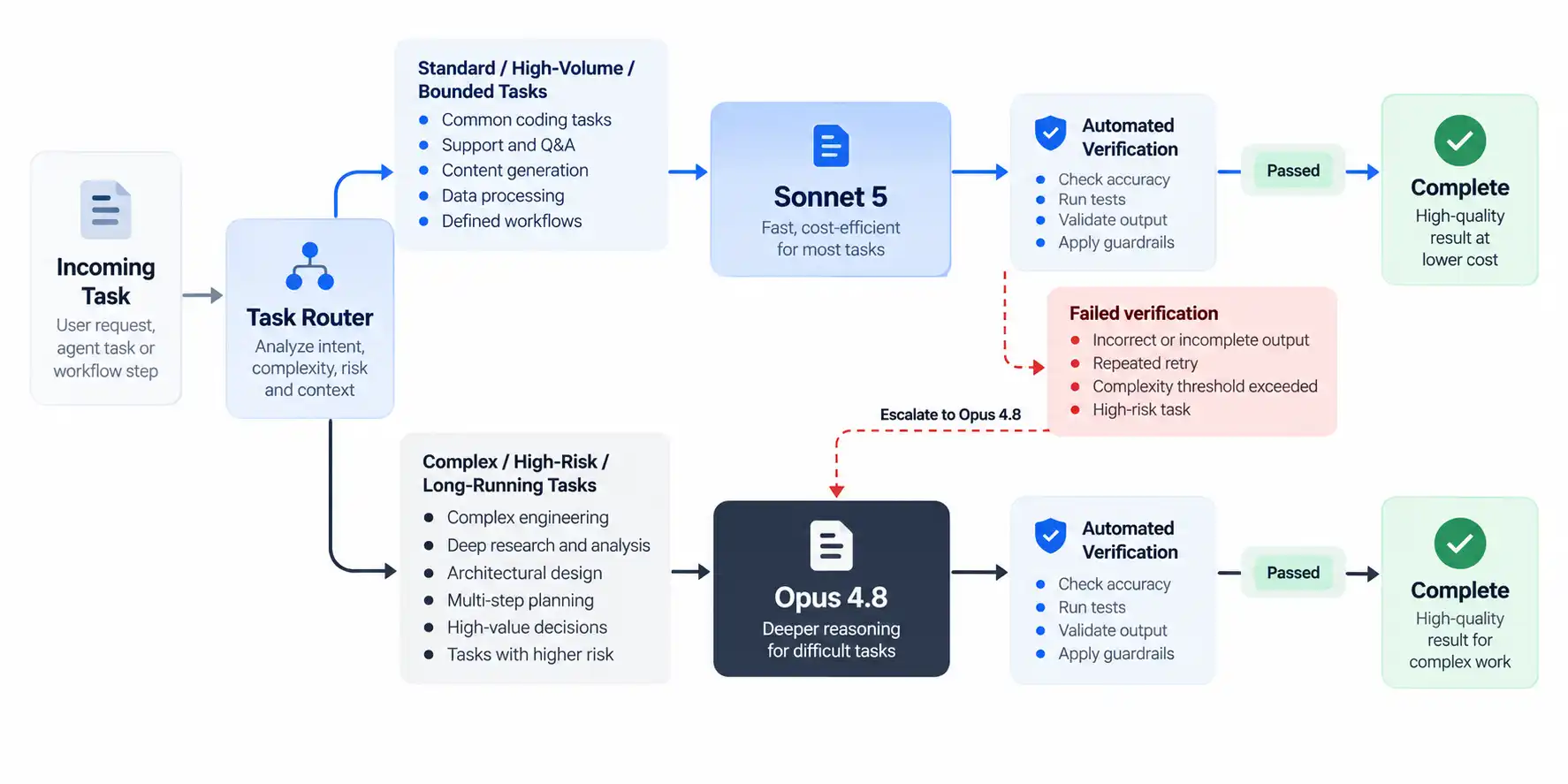
The most useful conclusion from this comparison is not necessarily choosing one model.
It may be routing work between them.
Consider an engineering agent.
Sonnet 5 receives the initial task.
If it can solve the issue confidently, run tests and satisfy the acceptance criteria, the workflow ends.
If it detects a complex architectural problem, repeatedly fails tests or falls below a confidence threshold, the task escalates to Opus 4.8.
The architecture becomes:
Request → Sonnet 5 → evaluate result → accept OR escalate → Opus 4.8
This creates a different optimization target.
Instead of asking:
Which model is best?
You ask:
What is the cheapest model capable of completing this specific task reliably?
That is a much better production question.
Which Is Better for Research and Knowledge Work?
For difficult research requiring synthesis across many sources, ambiguity resolution and sustained reasoning, Opus 4.8 was positioned as the stronger model.
Its launch announcement included reported improvements across financial analysis, legal workflows, document research and other professional work.
But Sonnet 5 changes the calculation for routine knowledge work.
For tasks such as:
summarizing documents
extracting structured information
producing first drafts
researching bounded questions
analyzing routine business data
generating reports
processing customer information
Sonnet's lower cost may outweigh a modest capability difference.
The decision again depends on the consequence of failure.
A first-pass internal summary and a high-stakes legal analysis should not necessarily use the same model.
Which Model Should Developers Choose?
If you are specifically maintaining an application built around these two models, a practical selection looks like this:
Choose Sonnet 5 when:
workload volume is high
latency matters
tasks are well scoped
coding problems are routine to moderately difficult
agents have bounded workflows
API cost matters
the system already includes good verification and escalation
Choose Opus 4.8 when:
the task is unusually difficult
long-horizon reasoning matters
mistakes are expensive
the model must work across a large unfamiliar codebase
agent workflows contain substantial ambiguity
deeper planning matters more than token cost
the task has already defeated a cheaper model
But for a new application in October 2026, neither should be the automatic starting point.
Anthropic released Claude Opus 5.5 and Sonnet 5.5 in its current model lineup in September 2026.
Anthropic's current model documentation describes Sonnet 5 as legacy and explicitly recommends considering migration to Sonnet 5.5.
So the real decision for a new deployment is more likely:
Sonnet 5.5 vs Opus 5.5, with older models retained where compatibility, validation or migration constraints justify them.
Opus 4.8 vs Sonnet 5: Final Verdict
There is no universal winner because the models solve different economic problems.
Opus 4.8 wins when the task is difficult enough that additional reasoning, judgment and agentic reliability justify higher cost.
Sonnet 5 wins when strong performance needs to be delivered repeatedly, quickly and economically.
For coding, Sonnet 5 is enough for a large share of everyday development work, while Opus 4.8 makes more sense for difficult debugging, architecture and long-running engineering tasks.
For AI agents, Sonnet 5 has the stronger case at scale. Opus 4.8 becomes more attractive as workflows become longer, less predictable and more expensive to get wrong.
For production systems, the strongest design may be neither "all Opus" nor "all Sonnet."
It is often:
Sonnet by default. Opus when complexity earns it.
There is one final caveat.
That conclusion describes these two specific generations. As of October 2026, both have been succeeded by newer Anthropic models. Teams making a fresh model decision should benchmark the current Sonnet 5.5 and Opus 5.5 models against their own workloads before committing to either legacy model.
Frequently Asked Questions
Is Claude Sonnet 5 better than Opus 4.8?
Sonnet 5 is better for many cost-sensitive and high-volume workloads, but Opus 4.8 has the stronger case for difficult reasoning, coding and long-running agentic tasks. Anthropic reported that Sonnet 5 could match Opus 4.8 on some high-effort tasks, but it did not claim that Sonnet universally surpassed Opus 4.8.
Is Opus 4.8 better than Sonnet 5 for coding?
Opus 4.8 is better suited to difficult coding problems, complex debugging, architecture and long-running engineering tasks. Sonnet 5 is generally the more economical option for everyday coding, code generation, routine bug fixing and production workloads where the additional Opus capability is unnecessary.
Which is better for AI agents, Opus 4.8 or Sonnet 5?
Sonnet 5 is generally better suited to high-volume and well-defined agent workflows because of its lower API price. Opus 4.8 makes more sense for agents handling complex, ambiguous or long-running tasks where stronger reasoning and judgment can justify higher inference cost.
How much cheaper is Sonnet 5 than Opus 4.8?
Sonnet 5 is priced at $2 per million input tokens and $10 per million output tokens, compared with $5 and $25 respectively for Opus 4.8. That makes Sonnet 5's base token rates 60% lower. Actual workflow savings depend on tokenization, retries, tool calls, caching and task success rates.
Do Opus 4.8 and Sonnet 5 have the same context window?
Yes. Anthropic's official documentation lists a 1 million-token context window and 128K standard maximum output for both models. Context size alone does not establish equivalent reasoning quality across very large prompts.
Should I use Opus 4.8 or Sonnet 5 for Claude Code?
Sonnet 5 is a reasonable choice for routine development where responsiveness and cost matter. Opus 4.8 is better suited to difficult codebase exploration, large migrations and long-running engineering tasks. Teams can also route normal tasks to Sonnet and escalate difficult work to Opus.
Are Opus 4.8 and Sonnet 5 still current Claude models?
They remain available but are now legacy models. Anthropic's current lineup includes newer Opus 5.5 and Sonnet 5.5 models. New projects should compare those current models unless compatibility or existing validation requires an older version.
Should I migrate from Sonnet 5?
Anthropic's current platform documentation recommends considering migration from Sonnet 5 to Sonnet 5.5 for improved performance. Migration should still be tested against your own prompts, agents, tools, latency requirements and evaluation suite before production rollout.
Read Also:
Gemini 4 Argon vs Claude Opus 5.5: Coding, Agents, Context and Pricing Compared
Gemini 4 Argon vs GPT-6 Astra: Which Is Better for Coding, AI Agents and Real-World Work?
GPT-6.1 Sol vs Claude Opus 5.5: Which Is Better for Coding, AI Agents, and Real-World Work?
Claude Opus 5.5 vs GPT-6 Astra: Which Model Is Better for Coding, AI Agents and Real-World Work?
Comments (0)
No comments yet. Be the first to share your thoughts!