Should AI-Generated Art Count as "Real" Art? The Debate, Explained

Author
Ravi Prajapati
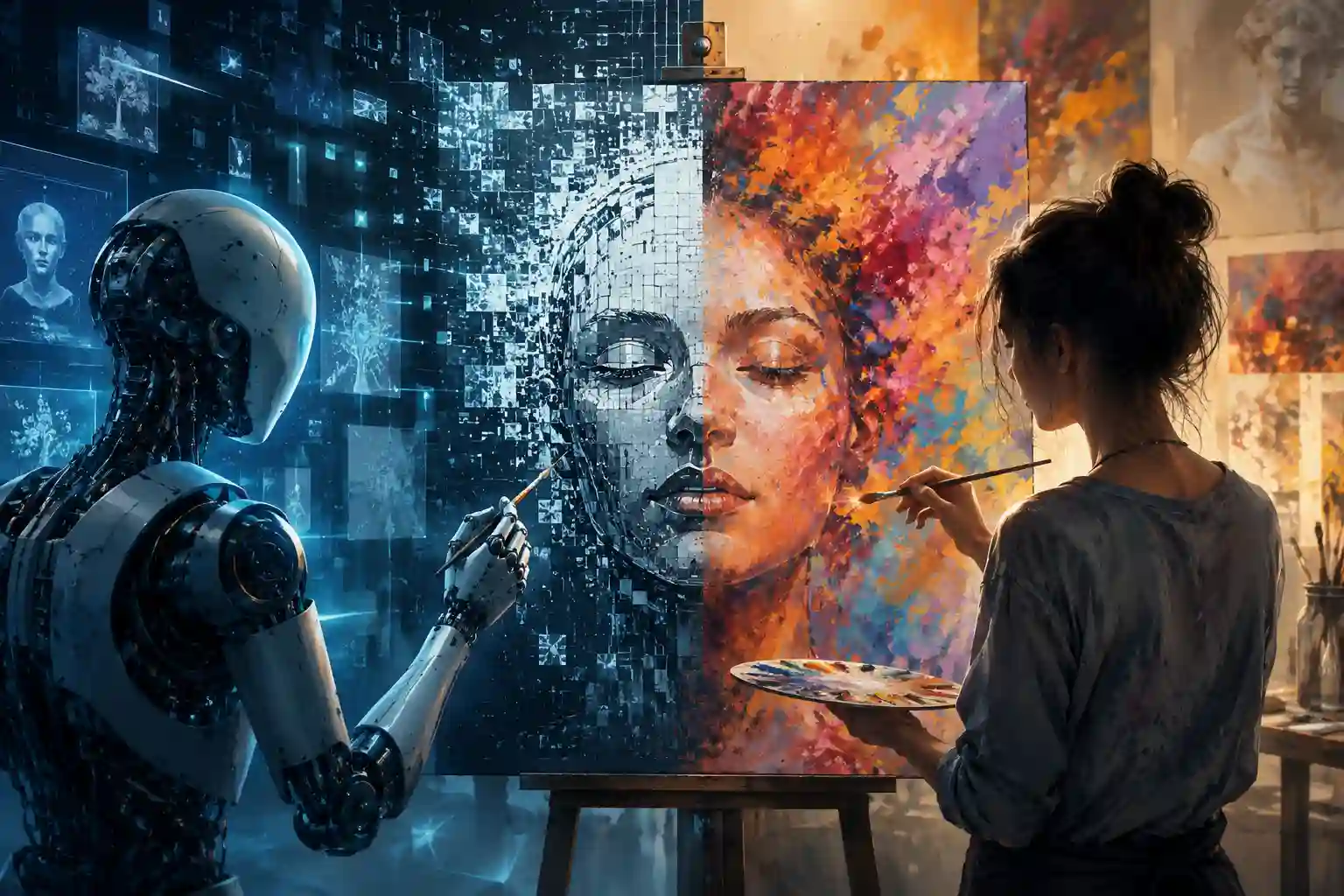
Is AI-generated art real art? We break down the arguments, the law, and the history behind one of the biggest debates in creativity today.
Key Takeaways
AI-generated art is created using models, most commonly diffusion models, that transform text prompts into images through an iterative refinement process
The debate over whether this counts as "real" art closely echoes historical arguments over photography and readymade art
Supporters point to prompt engineering as a genuine skill, and to AI's role in accelerating creative ideation across industries
Critics point to unconsented use of artists' work in training data, style imitation without credit, and economic displacement
The US Copyright Office confirmed in 2023 that purely AI-generated work cannot be copyrighted, a position reaffirmed in a 2025 report
Jason Allen's Théâtre D'opéra Spatial remains a central case study, having won a state fair competition and then been denied copyright protection
The Getty Images v. Stability AI case, decided in the UK in November 2025, rejected Getty's core copyright claims but found limited trademark infringement
Portrait of Edmond de Belamy sold for $432,500 at Christie's in 2018, proving AI art can command real market value
Most professional creative workflows use AI as one early-stage tool among many, not as a full replacement for human involvement
Regulation and case law are both still actively evolving, meaning today's answers may look different within just a few years
A painting wins first place at a state fair art competition. Months later, the internet discovers it was made with an AI tool called Midjourney, and the artist never hid that fact from the judges. The backlash is immediate and loud. Some call it theft. Others call it the future. Nobody, it turns out, agrees on what actually happened.
That moment, involving Colorado artist Jason Allen and a piece called Théâtre D'opéra Spatial, became a flashpoint in a debate that has only grown louder since. AI image generators have gone from a niche research curiosity to tools used by hundreds of millions of people. Midjourney, DALL-E, Stable Diffusion, and Adobe Firefly can now produce images that look convincingly like oil paintings, photographs, or concept art in seconds, based on nothing more than a typed description.
That speed and accessibility is exactly why this debate matters right now. Museums are exhibiting AI-generated installations. Auction houses have sold AI art for hundreds of thousands of dollars. Courts in the US, UK, and EU are actively deciding what legal protection, if any, this work deserves. Meanwhile, working artists are watching their styles get replicated by tools trained on images they never agreed to share.
This article won't tell you whether AI-generated art is "real" art. That's a question with no single correct answer, and anyone who claims otherwise is oversimplifying it. Instead, we'll walk through the technology, the history, the philosophy, the law, and the strongest arguments on both sides, so you can form your own answer with the full picture in front of you.
What Is AI-Generated Art?
AI-generated art refers to images created with the help of generative AI models, systems trained on massive datasets of existing images that learn to produce new images based on patterns they've absorbed.
Most of today's popular tools rely on something called a diffusion model. In simple terms, the model starts with an image made entirely of random visual noise, then gradually refines that noise, step by step, into a coherent picture that matches a text description. It's a bit like sculpting a shape out of static, guided by the words in your prompt.
This process is called text-to-image generation, and it's the foundation of tools like Midjourney, DALL-E, and Stable Diffusion. A user types a description, sometimes just a few words, sometimes an elaborate paragraph specifying style, lighting, composition, and mood, and the model generates an image attempting to match that description.
But it rarely stops there. Most serious AI art involves several additional layers of human decision-making:
Prompting, which is choosing and refining the exact wording that shapes the output
Iteration, generating dozens or hundreds of versions and selecting the best one
Editing, using tools like Photoshop to fix flaws, combine elements, or add detail
Upscaling, increasing resolution for print or display
The underlying models themselves were trained on enormous datasets, often scraped from the public internet, containing millions or billions of existing images. This training process is where much of the legal and ethical controversy begins, since many of those images were created by human artists who never consented to their work being used this way.
Did You Know? A single AI image generator can produce a finished image in under 10 seconds, but the artists who use them professionally often spend hours or days refining prompts, curating outputs, and editing the results before they consider a piece finished.
A Brief History of AI Art
AI-assisted art is not a new idea. It stretches back further than most people realize.
1960s: Early computer art. Artists like Georg Nees and Frieder Nake began using algorithms and early computers to generate geometric patterns, some of the first works ever described as "computer art."
1973: AARON. Artist Harold Cohen developed AARON, a program designed to create original drawings, one of the earliest serious attempts at building software with something resembling artistic autonomy.
2015: DeepDream. Google engineers released DeepDream, a tool that used neural networks originally built for image recognition to generate strange, hallucinatory, dreamlike imagery, introducing many people to AI-generated visuals for the first time.
2014 to 2018: The GAN era. Generative Adversarial Networks, or GANs, became the dominant approach to AI image generation. A GAN works by pitting two neural networks against each other: one generates images, the other tries to detect fakes, and the competition between them gradually improves the output.
2021: DALL-E. OpenAI introduced DALL-E, one of the first widely publicized text-to-image models, capable of generating original images from written prompts.
2022: The breakout year. Midjourney and Stable Diffusion both launched to the public, dramatically lowering the barrier to entry for AI art. This is also the year Jason Allen's Midjourney-assisted piece won the Colorado State Fair.
2023 and beyond: Mainstream integration. Adobe Firefly launched with a training dataset built from licensed and public domain content, aiming to sidestep some of the copyright controversy surrounding earlier tools. Newer models, including Flux and various multimodal systems, have continued pushing image quality and control closer to what professional artists and studios demand.
What Makes Something "Art"?
Before we can settle whether AI-generated images qualify as art, it helps to ask what "art" has ever meant, and the honest answer is that philosophers and critics have never fully agreed.
Some traditions define art around expression, the idea that a work channels genuine human emotion or experience. Others emphasize intent, the idea that art requires a conscious choice to communicate meaning. Still others focus on skill and craft, the physical or technical mastery required to produce the work. And some modern and postmodern movements argue that art is defined largely by interpretation, meaning a work becomes art the moment an audience engages with it as such, regardless of how it was made.
These definitions frequently conflict with each other. A can of soup silkscreened by Andy Warhol raised the exact same "is this really art" questions decades before AI entered the picture, precisely because it challenged the assumption that art requires visible technical skill. Marcel Duchamp's decision to display a urinal as sculpture in 1917 pushed the same boundary even further, arguing that context and intent could matter more than the object itself.
This history matters because it shows the definition of art has never been fixed. It has shifted every time a new tool, medium, or provocation forced the question open again, and AI is simply the latest disruption in a very long pattern.
Key Debate: If art has always been defined partly by human intention, does an AI system's lack of intention automatically disqualify its output, or does the human prompting and curating behind it satisfy that requirement instead?
Arguments Supporting AI Art
Supporters of AI-generated art tend to make a few recurring points, and many of them draw direct parallels to earlier moments of technological disruption in creative fields.
AI is a tool, not a replacement for the artist
Just as a camera doesn't take a photograph by itself, an AI model doesn't produce a finished piece without human direction. The person behind the prompt makes the creative decisions that shape the final result, choosing subject matter, style, composition, and mood.
Photography faced nearly identical criticism
When photography emerged in the 19th century, many painters and critics dismissed it as a mechanical process incapable of "real" art, arguing that a machine capturing reality couldn't involve genuine creativity. Photography is now unquestionably recognized as a fine art form, and supporters of AI art argue the same evolution is likely happening again.
Prompt engineering is a genuine skill
Getting a generative model to produce a specific, high-quality, coherent result often takes deep knowledge of how the model interprets language, lighting terms, artistic references, and composition. Jason Allen, for example, entered more than 600 text prompts before arriving at his final Colorado State Fair piece, iterating extensively before ever touching Photoshop.
It democratizes creative expression
Someone with a strong creative vision but no formal training in painting or illustration can now produce a finished visual concept. This has real value for people who were previously locked out of visual creation by the cost of tools or years of technical training.
It accelerates ideation across industries
Concept artists, game studios, marketing teams, film productions, and architecture firms increasingly use AI-generated images for rapid mood boards, early concept sketches, and storyboarding, speeding up the earliest, most exploratory phase of a creative project without replacing the detailed human work that follows.
It enables new kinds of experimentation
Some artists use AI specifically to generate combinations and visual ideas they wouldn't have arrived at on their own, treating the unpredictability of the model as a creative collaborator rather than a shortcut.
Arguments Against AI Art
Critics of AI-generated art raise a different, equally serious set of concerns, many of which go beyond aesthetics into ethics and economics.
No lived experience behind the image
A model has never felt grief, joy, or longing. Critics argue that art created without any underlying emotional or lived experience is fundamentally hollow, no matter how visually convincing it looks, because it's assembling patterns rather than expressing anything.
Training data was often used without consent
Many of the datasets used to train major AI image models were scraped from the public internet, frequently including copyrighted artwork from working artists who were never asked and never compensated. This is arguably the single biggest source of anger from the professional art community.
Style imitation without attribution
AI tools can replicate a living artist's distinctive visual style closely enough to produce new images "in the style of" that artist, without their permission and without any payment, raising serious questions about creative ownership.
Economic displacement
Illustrators, concept artists, and stock photographers have reported real, measurable drops in commissioned work as clients turn to AI generation instead, particularly for lower-budget projects like book covers, marketing assets, and social media graphics.
Authenticity concerns in competitions and journalism
The Colorado State Fair controversy illustrated a specific fear: that AI-generated work submitted without disclosure could unfairly compete against, and beat, purely human-made work in contexts where audiences assume a human hand was involved.
Deepfake and misuse risks
The same underlying technology used to generate artistic images can also generate convincing fake photographs or misleading imagery, and critics argue the normalization of AI-generated visuals makes it harder for the public to distinguish real from synthetic content in general.
Can AI Actually Be Creative?
This question sits at the center of the entire debate, and researchers studying creativity itself are divided.
Traditional creativity research often defines creativity as the ability to produce something both novel and valuable, a definition broad enough that it doesn't strictly require human consciousness. By that narrow technical definition, an AI system that combines existing patterns in genuinely unexpected, useful ways could arguably qualify.
But critics point out an important distinction: AI models don't generate ideas from nothing. They recombine and remix patterns learned from their training data. Whether that counts as "true" creativity or an extremely sophisticated form of pattern recognition and interpolation is exactly where researchers disagree.
Some AI researchers argue that human creativity itself works similarly, that human artists also absorb influences from everything they've seen and recombine them in new ways, meaning the difference between human and machine creativity may be one of degree rather than kind. Others push back hard on this comparison, arguing that human creativity is inseparable from consciousness, memory, and intention in ways current AI systems simply do not possess.
Current AI models also have clear limitations that bear on this question. They lack persistent memory of their own creative choices across sessions, they cannot explain why they made a particular aesthetic decision the way a human artist can discuss their intent, and they cannot independently decide to create something without a human prompt initiating the process.
Expert Insight: Much of the creativity research community agrees that AI systems demonstrate what's sometimes called "combinatorial creativity," the recombination of existing elements into new forms, while remaining split on whether that satisfies the deeper, more philosophically loaded definitions of true creative intent.
Legal Questions
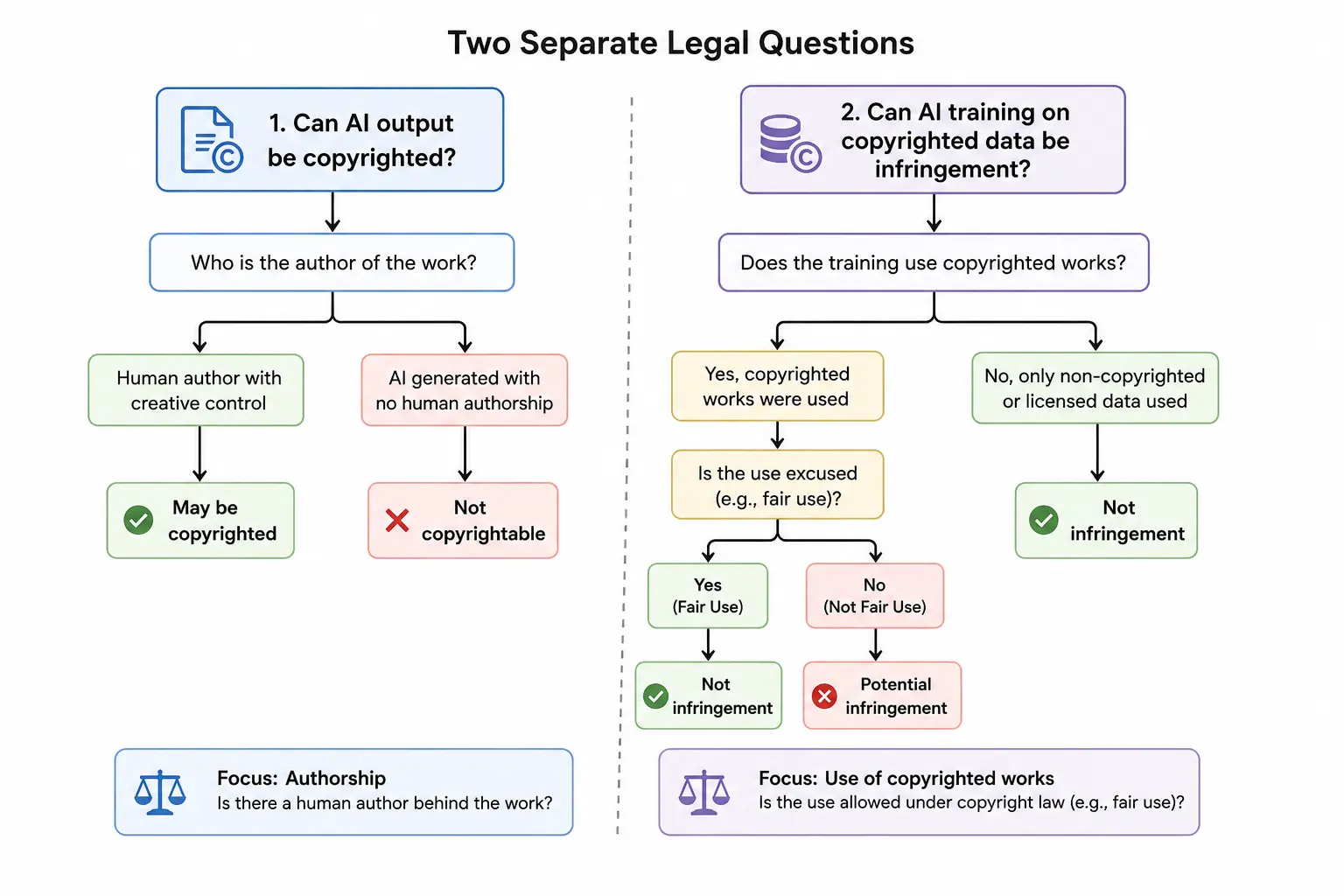
The legal system has been forced to catch up to this debate quickly, and the current state of the law is more settled than many people assume, at least in the United States.
US Copyright Office position. In March 2023, the US Copyright Office issued formal guidance confirming that human authorship is required for copyright protection, and that purely AI-generated material cannot be copyrighted. Where a work combines human and AI-generated content, only the human-created portions are eligible for protection. In a January 2025 follow-up report, the Office went further, stating that under current technology, prompts alone do not give a user enough creative control over the output to be considered the legal author of the resulting image.
This is not just theoretical. Jason Allen's Théâtre D'opéra Spatial was formally denied copyright registration by the Office in September 2023, on the grounds that he hadn't properly disclaimed the AI-generated portions of the work as required. Allen has since filed a federal lawsuit challenging that decision, arguing the Office's review process can't reliably distinguish AI-assisted work from purely human-made art. That case is ongoing.
Training data lawsuits. Separately from the question of whether AI output can be copyrighted, a wave of lawsuits has targeted the practice of training AI models on copyrighted material without permission. The most closely watched case, Getty Images v. Stability AI, reached a UK High Court judgment in November 2025. The court rejected Getty's core copyright infringement claims, ruling that Stable Diffusion's underlying model weights don't constitute an "infringing copy" of the training images since the model doesn't store the original images directly. However, the court did find limited, historic trademark infringement, because some outputs reproduced Getty's watermark. Getty has been granted leave to appeal, and a related US case is proceeding separately in the Northern District of California.
What's settled versus what's still being decided. It's worth being precise here. What's currently settled in the US is that fully AI-generated images cannot receive copyright protection, and human authorship is required for any protectable elements. What remains genuinely unresolved, both in the US and internationally, is the much bigger question of whether training an AI model on copyrighted images without a license constitutes infringement in the first place. The Getty ruling addressed a narrow set of claims specific to UK law and didn't resolve that broader question, since Getty withdrew its primary training-related claims before trial due to jurisdictional issues.
Other jurisdictions. Not every country has taken the same approach. India's Copyright Office notably registered a work called "SURYAST" in 2021 that listed an AI tool as a co-author alongside its human creator, a meaningfully different stance than the US position. The EU and UK governments both have ongoing policy reviews specifically examining how copyright law should handle AI training data going forward.
How Artists Are Actually Using AI
Away from the courtroom drama and social media outrage, a large number of working creative professionals have quietly folded AI tools into their existing workflows, usually as one step among many rather than a replacement for the whole process.
Concept art and mood boards, generating quick visual references early in a project before detailed human illustration begins
Storyboarding, rapidly visualizing scene ideas for film and animation pitches
Game development, prototyping environment textures, character concepts, and early asset ideas
Book cover design, generating initial visual directions that are then refined or fully repainted by a human designer
Advertising and marketing, producing quick visual drafts for campaigns before final production
Architecture and interior design, visualizing mood and material concepts before detailed technical rendering
Music visuals, generating album art and concert visuals
Fashion, exploring pattern, texture, and silhouette concepts during early design phases
In nearly every one of these professional contexts, the AI-generated output tends to function as a starting point rather than a finished product. A human still selects, edits, combines, and often substantially reworks the result before it reaches a client or audience, which is precisely why so many professionals resist being lumped in with the "AI just does it all" narrative.
Famous AI Art Moments
A handful of specific incidents have repeatedly anchored this debate in public consciousness.
Portrait of Edmond de Belamy (2018)
Created by the Paris-based collective Obvious using a GAN trained on 15,000 historical portraits, this piece became the first AI-generated artwork sold at a major auction house, fetching $432,500 at Christie's, roughly 43 times its high estimate of $10,000. The sale is widely credited with putting AI art on the map for the mainstream art world for the first time.
Théâtre D'opéra Spatial (2022)
Jason Allen's Midjourney-assisted piece won first place in the digital arts category at the Colorado State Fair, sparking the modern wave of public debate about AI and artistic legitimacy. The judges later confirmed they knew about the AI involvement and awarded the prize anyway, based on the story and emotional impact of the finished piece.
Refik Anadol's museum installations
The Turkish-American artist has become one of the most prominent figures using AI as a large-scale artistic medium, creating immersive data-driven installations for major institutions, including a widely covered piece at New York's Museum of Modern Art that transformed the museum's own visual archive into a constantly shifting, machine-generated visual experience.
Each of these moments pushed the debate into a slightly different arena, auction houses, state fairs, and museums, showing just how broadly this question now touches the art world.
Industry Perspectives
Reactions to AI art vary sharply depending on where someone sits in the creative ecosystem.
Traditional and digital artists are often the most skeptical, particularly those whose visual styles have been directly imitated by AI tools without consent. Professional illustrator communities have been among the loudest voices pushing for stronger transparency and consent requirements around training data.
Design agencies and creative directors tend to take a more pragmatic view, treating AI as one tool in a broader toolkit, useful for speed and early-stage ideation, but generally still requiring human oversight and refinement for client-facing final work.
Photographers occupy an interesting middle position, having lived through their own medium's decades-long fight for recognition as "real" art, and some draw direct parallels between that history and what AI artists are now experiencing.
Museums and collectors have shown genuine willingness to exhibit and purchase AI-generated work, as demonstrated by both the Belamy sale and ongoing institutional interest in artists like Refik Anadol, though this remains a small fraction of the overall art market.
Technology companies building these tools, including Adobe with Firefly, have increasingly emphasized training data provenance and licensing as a selling point, responding directly to the ethical criticism aimed at earlier, less transparent models.
Pros and Cons Table
Advantages | Challenges |
|---|---|
Lowers the technical barrier to visual creation | Trained on copyrighted work often without consent |
Speeds up early-stage ideation and concept work | Can closely imitate a living artist's style without permission |
Enables rapid iteration and experimentation | Currently cannot receive full copyright protection in the US |
Useful across many industries, from gaming to architecture | Displacing paid commission work for illustrators |
Prompt engineering is a genuinely learnable skill | Raises authenticity concerns in competitions and journalism |
Parallels historical acceptance of photography as fine art | Lacks lived human experience or emotional intent |
Makes creative expression more accessible to non-specialists | Contributes to broader deepfake and misinformation concerns |
Can generate combinations humans might not arrive at alone | Legal status of training data remains unresolved in most jurisdictions |
Supports human creative collaboration when used deliberately | Environmental and computational costs of training large models |
Pushes philosophical conversations about creativity forward | Encourages a flood of low-effort, derivative "AI slop" content online |
Common Myths
"AI creates art entirely by itself." In practice, nearly all professionally used AI art involves substantial human decision-making, prompting, curation, editing, and iteration, even when the final image looks seamless.
"AI will replace all artists." Current adoption patterns show AI mostly being used as an early-stage tool within existing creative workflows, not as a wholesale replacement for illustration, concept art, or fine art. Displacement is real in certain lower-budget commercial segments, but it is not the industry-wide replacement some headlines suggest.
"Prompting takes no skill." Producing a specific, high-quality, coherent image through prompting alone requires real knowledge of how these models interpret language, style references, and composition, as illustrated by Jason Allen's more than 600 prompt iterations for a single piece.
"AI art is illegal." Using AI tools to generate images is not illegal. What remains legally contested is narrower and more specific: whether training models on copyrighted data without a license constitutes infringement, and whether AI-generated output itself can receive copyright protection.
"AI art has no value." Market behavior directly contradicts this claim. The Belamy portrait's $432,500 auction sale and continued institutional interest from major museums demonstrate that some AI-generated work is treated with real cultural and financial value, even as its legitimacy remains debated.
Future of AI Art
Several trends look likely to shape where this debate heads next.
Hybrid creativity will likely dominate
Rather than a binary split between "human art" and "AI art," the more probable future is a spectrum, where the majority of professional creative work involves some blend of AI-assisted ideation and human-led execution and refinement.
Ethical and licensed training data is gaining ground
Adobe Firefly's approach of training on licensed and public domain content points toward a broader industry shift, as companies try to sidestep the legal and ethical baggage attached to earlier, unlicensed training datasets.
Regulation is actively catching up
Both the UK and EU currently have formal government reviews underway specifically addressing how copyright law should treat AI training data, and further legal clarity is expected as more cases like Getty v. Stability AI work through appeals.
New creative careers are emerging
Roles like AI art director, prompt engineer, and AI ethics consultant for creative studios didn't meaningfully exist five years ago and are now appearing in job listings across the industry.
Art education is adapting
Some art schools have begun incorporating AI tools directly into coursework, treating them as a medium worth understanding and critiquing rather than something to ban outright, similar to how digital illustration software was eventually absorbed into traditional curricula.
Expert Takeaways
Across the range of perspectives covered in this article, a few points of genuine agreement do emerge, even among people who disagree sharply on the bigger question.
What both sides tend to agree on: AI is now a permanent fixture in the creative toolkit, the training data consent issue is a legitimate and serious ethical problem that the industry hasn't fully resolved, and purely typing a prompt with no further human refinement generally produces weaker, less original work than a thoughtful human-AI collaboration.
Where disagreement remains sharpest: Whether AI-generated output can ever satisfy the deeper philosophical definitions of art tied to intention and lived experience, how much legal protection AI-assisted work deserves, and where exactly the line sits between using AI as a legitimate tool versus using it to shortcut genuine creative labor.
Why this debate isn't ending anytime soon: The technology is still evolving quickly, the legal frameworks are still being actively litigated and rewritten, and the underlying philosophical question, what actually makes something art, has never had a single agreed-upon answer even before AI entered the conversation.
FAQ
Is AI-generated art real art?
There's no universally agreed answer. It depends heavily on which definition of "art" you're using, whether you emphasize the finished visual result, the human intention behind it, or the process used to create it. Many professionals now treat it as a legitimate but distinct category rather than framing it as a strict yes-or-no question.
Who owns AI-generated artwork?
In the US, purely AI-generated images cannot be copyrighted at all, since the Copyright Office requires human authorship. If a human meaningfully edits, arranges, or combines AI output with original human-created elements, those specific human contributions can potentially be copyrighted, though the AI-generated portions themselves generally cannot.
Can AI replace artists?
Current evidence suggests AI is mostly displacing certain lower-budget, faster-turnaround commercial work, like stock imagery and some marketing assets, rather than replacing skilled illustration, concept art, or fine art wholesale. Most professional workflows still rely heavily on human judgment, editing, and creative direction.
Is AI art copyrighted?
Fully AI-generated images are not eligible for copyright protection under current US Copyright Office guidance. Works that combine substantial human-authored elements with AI assistance may receive copyright protection for the human-created portions specifically.
How do AI art generators work?
Most modern tools use diffusion models, which start with random visual noise and gradually refine it into a coherent image based on a text prompt, guided by patterns the model learned from a large training dataset of existing images.
Is AI art ethical?
This depends heavily on the specific model and its training data. Tools trained on licensed or public domain content, like Adobe Firefly, raise fewer ethical concerns than tools trained by scraping copyrighted images without artist consent or compensation, which remains one of the most contested issues in the space.
Why do artists oppose AI art?
The most common concerns are unconsented use of their work in training datasets, AI tools replicating their personal style without credit or payment, and reduced commission income as clients shift toward AI-generated alternatives for lower-budget projects.
Can AI feel creativity?
Current AI systems don't have subjective experience, emotion, or consciousness in any way comparable to humans. Whether their output still qualifies as "creative" depends on which definition of creativity you use, a narrow technical definition focused on novel, useful combinations, or a broader one requiring genuine intention and feeling.
Can AI-generated images be sold?
Yes. AI-generated art has been sold at major auction houses, most notably Portrait of Edmond de Belamy for $432,500 at Christie's in 2018, and continues to be bought and sold, though buyers should understand the current legal limits around copyright protection for purely AI-generated work.
Will AI change the future of art?
It already has. AI tools are now embedded in concept art, game development, advertising, architecture, and fashion workflows across the creative industry. The bigger open question isn't whether AI will keep shaping the art world, it's exactly how large a role it will eventually play relative to human-led creation.
Timeline
1960s   →  Early algorithmic art (Georg Nees, Frieder Nake)
1973    →  Harold Cohen develops AARON
2015    →  Google releases DeepDream
2014-18 →  GANs become the dominant AI art technique
2018    →  Portrait of Edmond de Belamy sells for $432,500 at Christie's
2021    →  OpenAI launches DALL-E
2022    →  Midjourney and Stable Diffusion launch publicly
2022    →  Jason Allen's Théâtre D'opéra Spatial wins Colorado State Fair
2023    →  US Copyright Office issues formal AI authorship guidance
2023    →  Théâtre D'opéra Spatial denied copyright registration
2025    →  Getty Images v. Stability AI decided in UK High Court
2025    →  US Copyright Office reaffirms position in follow-up report
Comparison Table
Traditional Art | Digital Art | AI-Assisted Art | Fully AI-Generated Art | |
|---|---|---|---|---|
Human Creativity | Entirely human-driven | Entirely human-driven | Shared between human and model | Minimal, limited to prompting |
Tools Used | Brush, canvas, physical media | Digital software (Photoshop, Procreate) | AI generator plus editing software | AI generator only |
Skill Required | Technical and conceptual mastery | Technical and conceptual mastery | Prompting, curation, and editing skill | Prompting skill only |
Ownership | Fully copyrightable | Fully copyrightable | Human-authored portions copyrightable | Not copyrightable in the US |
Time Required | Hours to months | Hours to weeks | Minutes to hours | Seconds to minutes |
Originality | Entirely original expression | Entirely original expression | Original combination of AI output and human input | Derived from training data patterns |
Creative Control | Complete | Complete | Substantial, but shared with the model | Limited to prompt wording and selection |
Conclusion
There is no clean, satisfying answer to whether AI-generated art counts as "real" art, and that's not a dodge, it's an honest reflection of where this debate genuinely stands. The technology has already produced auction records, museum installations, and multi-year lawsuits, while also raising legitimate, unresolved concerns about consent, compensation, and authenticity that deserve to be taken seriously rather than dismissed by either side.
What seems clear is that this conversation echoes older ones the art world has had before, about photography, about readymades, about digital illustration, each time forcing a redefinition of what "counts." Whether AI-generated images eventually earn the same grudging acceptance photography did, or whether they settle into a permanently separate category, is still being written in real time, by artists, courts, and audiences alike.
So here's the question worth sitting with: when you look at an image and it moves you, does it matter whether a human spent days with a brush, or thirty seconds with a prompt, to put it in front of you?
Read Also:
AI Doesn't Lie. It Just Doesn't Know It's Wrong. Here's Why That's Worse
If AI Never Forgets, What Happens to Forgiveness?
Comments (0)
No comments yet. Be the first to share your thoughts!