AI in Automotive Technology and the Rise of Intelligent Vehicles

Author
Ravi Prajapati
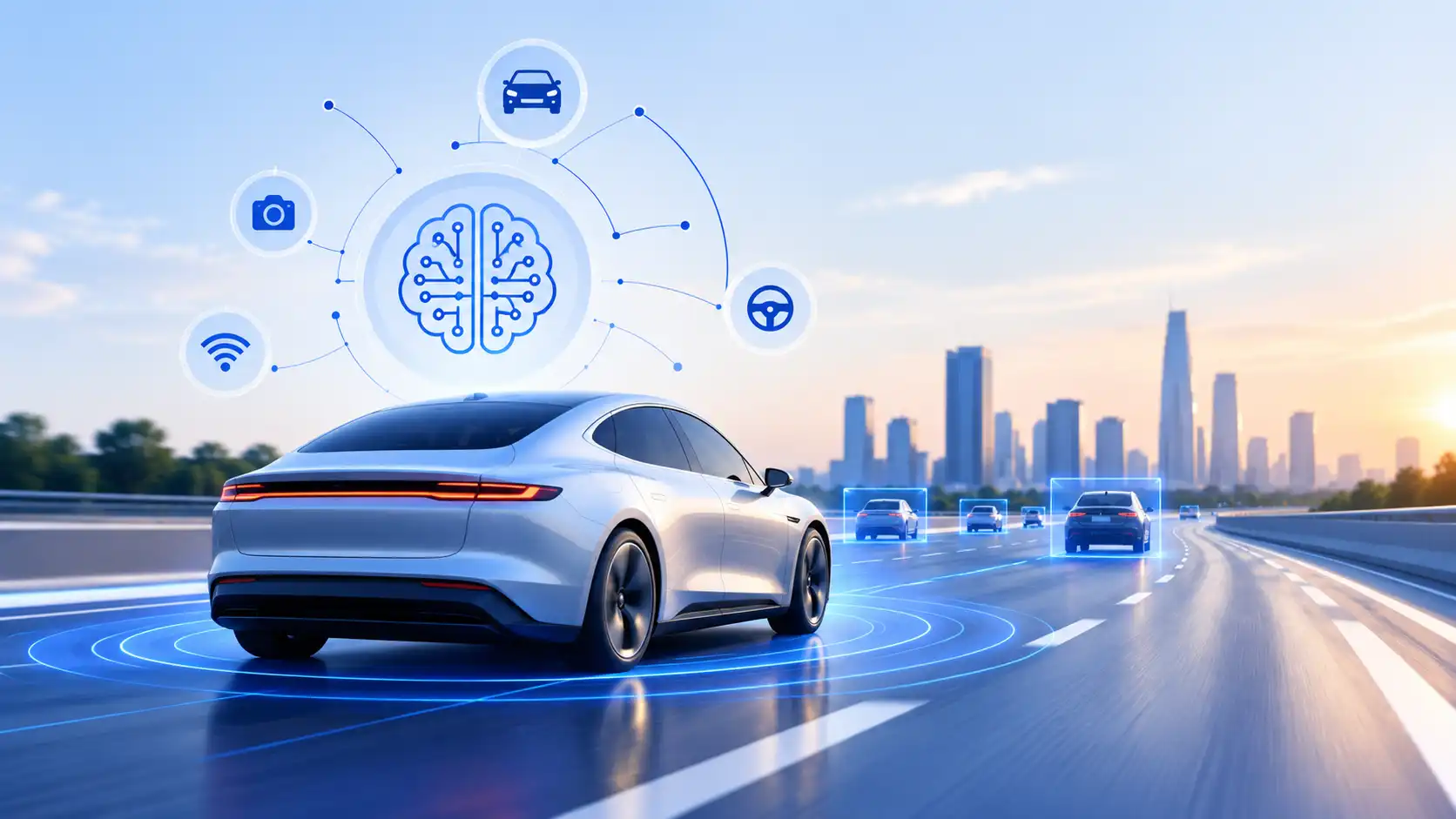
Explore how AI in automotive technology is powering autonomous driving, predictive maintenance, vehicle safety, and the future of intelligent vehicles.
Artificial intelligence is increasingly being utilized in the design of modern cars and its impact on vehicle performance is evident by the way cars assess the conditions of the road, handle energy, discover faults, and assist the driver. The technologies like machine learning, computer vision, predictive analytics, and intelligent control systems are establishing themselves in production vehicles gradually.
This transition is closely linked to an explosion of data provided by cameras, radars, electronic control units, batteries, and connected vehicle systems. As automotive architecture becomes solely based on software, artificial intelligence starts being beneficial for the enhancement of vehicle functionality.
AI Transitioning from Support to Intelligent Road Vehicles
Modern vehicles process information coming from various sources including cameras, radar, lidar, GPS, electronic control units (ECU) and connected systems. AI algorithms help interpret their inputs and detect objects, road markings, traffic situation as well as possible dangers in less than a second. According to NHTSA studies, machine learning perception, localization, decision making and path planning are essential parts of automated driving.
AI systems in intelligent vehicles must continuously interpret sensor data, evaluate the surrounding environment, and select appropriate actions. This perception-and-action cycle is closely related to the principles behind different types of intelligent agents in artificial intelligence, which explain how AI systems observe their environment and make decisions.
Commercial use of automotive AI continues to develop rapidly as well. According to DataIntelo, autonomous driving belonged to 42.3% of AI for automotive market in 2025. The global market was estimated to be worth $13.5 billion in 2025 and is projected to reach $123.2 billion by 2034 with 28.5% CAGR.
Improved Driver Assistance and Road Safety
Advanced driver assistance systems have experienced significant progress from just simple alerts due to artificial intelligence (AI). The modern driver assistance systems are capable of integrating information from cameras and radar devices to learn about other vehicles and pedestrians, as well as the lane markings and other road situations. Many modern safety systems including automatic emergency braking, adaptive cruise control, driver monitoring systems and lane-support technologies rely on continuously processed information about the driver and the surrounding conditions.
However, the effectiveness of these systems depends on the quality of their input data, the reliability of their predictions, and their performance in changing road conditions. These challenges reflect a broader issue explored in why AI systems face data and trust problems.
Government studies have proven this potential. According to NHTSA's Partnership for Analytics Research in Traffic Safety, automatic emergency braking systems were found to lead to 49% drop in the number of rear-end collisions with vehicles manufactured between 2015 and 2023. The research findings suggest that new types of vehicle technology can be proved based on real accident statistics.
The topic of safety is still very important. According to NHTSA, vehicles caused 39,254 fatalities in 2024 in the United States. However, the majority of the vehicles continue placing huge demands on drivers' attention, which makes a distinction between assisted driving and fully autonomous driving very important.
How Artificial Intelligence Influences Predictive Maintenance of Vehicles
Predictive maintenance represents a domain where AI is transforming vehicle engineering. Rather than waiting for the failure of a component, machine-learning models can monitor temperature, vibration, pressure, presence of battery power, and a variety of other parameters to detect changes in behavior. This makes diagnostics based on data possible.
Predictive maintenance also depends on dependable sensor data and consistent model performance. The same concerns appear in research on AI data quality and trust, particularly when AI outputs inform decisions that affect real-world operations.
Government-funded battery research reveals the potential advancements possible in the field. In a project backed by the United States' Department of Energy, electrochemical modeling technology and machine learning were employed to perform lithium-ion battery health assessments, thus demonstrating that the system created would be more efficient. As a result, this model showed 10x the efficiency compared to traditional methods that take 40 hours to complete the required battery diagnostics.
AI in Electric Vehicle Systems
The performance of electric vehicles relies on the integrated software-controlled batteries, electric motors, electronic devices for power supply management, and thermal energy management. The use of AI technology is helping to analyze the charging mode, determine the battery status, optimize energy consumption and help engineers design the components.
Integrating AI into electric-vehicle systems also requires a clear understanding of the wider AI adoption process, including implementation costs, organizational readiness, and measurable outcomes. The latest AI adoption statistics and industry trends provide broader context for evaluating how businesses are putting AI to work.
Scientists at Oak Ridge National Laboratory applied for the support from the Department of Energy to give another example of how electric motors can be produced using AI technology. The 2025 study employed knowledge-based AI technology coupled with fuzzy logic to come up with an optimal design for a 100 kW electric car motor. Thus, the development resulted in a compact motor of 2.2 liters in volume, which proves that AI can also be used for developing physical parts of the car and is not used only in software functions.
The scale of the economic impact of AI in car production corresponds to the hardware-software relationship mentioned above. In 2025, software accounted for around $5.94 billion (44% of the automotive AI market), while the hardware represented approximately $4.59 billion (34%). The rest share was split between other components and services.
Automotive AI Indicator | Value | Relevance |
AI automotive market, 2025 | $13.5 billion | Current market scale |
Autonomous driving share, 2025 | 42.30% | Major application area |
AI software, 2025 | $5.94 billion | Largest component category |
AI hardware, 2025 | $4.59 billion | Computing and processing infrastructure |
Projected market, 2034 | $123.2 billion | Long-term expansion |
Recent Research on Automated Driving
Recent reports have highlighted the role of artificial intelligence (AI) when it comes to traffic that is complicated and unpredictable. The National Highway Traffic Safety Administration (NHTSA) evaluated systems used for automated driving in areas such as sensing, machine learning perception, and decision making, path planning, localization, and execution of the system. A report published by the government has analyzed 81 Federal Motor Vehicle Safety Standards to determine whether they apply to vehicles that make use of automated driving systems or not.
These functions illustrate how intelligent systems move from processing information to selecting actions. For a broader explanation of this architecture, see how AI agents work and make decisions.
Further research that has been backed by Oak Ridge National Laboratory has shown predictive deep reinforcement learning as being applied to automated vehicles that operate in conjunction with traditional vehicles. One of the studies that was conducted in the year 2025 made use of simulations and real-life data to investigate lane crossing situations. This has been considered very important because it implies that the automated vehicles will have to act not depending only on the infrastructure of the road, but also on other drivers’ unpredictable actions.
Fundamental Progress in Intelligent Vehicles
Currently, there are many technological developments that are taking place at this time: Sensor fusion merges information coming from cameras, radar, lidar, and vehicle systems.
Sensor fusion is combining data been received from various devices, such as cameras, radars and lidars.
Edge computing facilitates the execution of artificial intelligence programs inside automobiles with no delay.
Over-the-air updates make it possible to carry out software updates for cars much after the time of delivery.
Driver monitoring systems employ artificial intelligence algorithms and visual imaging systems to measure driving style.
The growing number of electronic systems means that additional engineering tasks have to be completed. The NHTSA notes that cybersecurity is an important criterion as the technology of connected and automated vehicles evolves.
Choosing the right AI architecture depends on the task, available data, and level of autonomy required. The guide to LLMs, retrieval-augmented generation (RAG), and AI agents explains the differences between these approaches and when each is useful.
The Next Steps in Automotive AI
The next phase of automotive AI will likely involve greater integrated systems between vehicle sensing, vehicle control, energy management, vehicle servicing, and automotive software. Centralized computing platforms can consolidate many systems, while better processors make it possible for the AI systems to process large amounts of information collected by various sensors.
Moving AI systems from research into dependable real-world use requires more than technical capability. Teams must also address validation, risk controls, operational readiness, and measurable outcomes, challenges discussed in why AI strategies fail during implementation.
Tech development is contingent upon testing, validation, creation of quality databases, cyber security and consistent quality across climatic, road, traffic and material conditions. AI is becoming an integral technology in automotive area, but its real significance will be determined by the reliable operation of intelligent machines in real-life situations.
References
NHTSA – Automated Driving Systems — AI/ML, perception, decision-making and path-planning research.
NHTSA – Automated Driving SystemsNHTSA – Partnership for Analytics Research in Traffic Safety (PARTS) — 2015–2023 vehicles mein AEB ke 49% front-to-rear crash reduction finding.
NHTSA PARTS ResearchNHTSA – 2024 Traffic Fatality Data — 2024 mein 39,254 traffic fatalities.
NHTSA 2024 Traffic Fatality DataU.S. Department of Energy – Vehicle Technologies Office — AI/ML-based lithium-ion battery health diagnostics and 10× speed improvement versus the standard 40-hour diagnostic.
DOE Battery Research ReportOak Ridge National Laboratory – EV Motor Design Research — knowledge-based AI and hierarchical fuzzy logic applied to a 100 kW EV motor, producing a 2.2-liter design.
ORNL – EV Motor AI ResearchNHTSA – FMVSS Research for Automated Driving Systems — evaluation of 81 Federal Motor Vehicle Safety Standards for automated vehicle designs.
NHTSA – Automated Vehicle Safety Standards ResearchOak Ridge National Laboratory – Predictive Deep Reinforcement Learning — 2025 research on connected automated vehicles operating in mixed traffic and lane-changing conditions.
ORNL – Predictive Deep Reinforcement Learning ResearchDataIntelo – Artificial Intelligence for Automotive Market — $13.5 billion in 2025, projected $123.2 billion by 2034, with autonomous driving at 42.3% share.
DataIntelo – Artificial Intelligence for Automotive Market
Comments (0)
No comments yet. Be the first to share your thoughts!