AI Agent Internet Traffic: When Users Aren't Human

Author
Ravi Prajapati
Over half of web traffic is now non-human. A researched look at AI agent internet traffic, what agents actually do, and what it changes for SEO and publishers.
What Happens When Most Internet Users Aren't Human?
Over the course of 2025, Anthropic's crawlers fetched web pages as many as 500,000 times for every single human visitor they sent back to a site. Google's equivalent ratio ranged between roughly 3:1 and 30:1. Both numbers come from the same measurement, Cloudflare's crawl-to-refer metric, and together they describe the quiet collapse of the deal that funded the open web: you let the machines read your pages, and the machines sent you readers.
That deal is now being renegotiated under conditions nobody designed for. Automated traffic is growing roughly eight times faster than human traffic, according to HUMAN Security's 2026 State of AI Traffic & Cyberthreat Benchmark Report, which analyzed more than a quadrillion interactions. AI-driven traffic grew 187% in 2025. Traffic from AI agents specifically grew 7,851%.
Those numbers get quoted constantly and understood rarely. They describe at least four different kinds of software doing four different things, and the difference between them decides whether your business should be worried, indifferent, or restructuring.
The Web Crossed a Line Nobody Can Measure Precisely
In July 2026, Cloudflare reported that more than half of traffic on the internet is now non-human, a threshold crossed for the first time this year. It's a genuinely significant milestone and it deserves an asterisk.
Cloudflare sits in front of more than 20% of the web, which makes its view unusually broad but still a view from one network. And Cloudflare's own longitudinal data, published seven months earlier in the 2025 Radar Year in Review, tells a subtler story: measured against HTML requests only, human traffic accounted for 47% of requests as of early December 2025, non-AI bots 44%, and AI bots an average of 4.2% across the year. Same company, same network, different denominator. The second picture shows humans roughly holding their own against automation rather than being swamped by it.
Neither figure is wrong. They measure different things. "All traffic" includes API calls, image and asset fetches, and machine-to-machine chatter that no human ever sees the output of. "HTML requests" is closer to a proxy for page reading. Anyone citing a "more than half is bots" statistic without saying which denominator they mean is producing a headline, not a measurement.
The distinction that matters more than the percentage is what kind of non-human traffic you're looking at.
Internet actor | Purpose | Typical behavior | What a site owes it |
|---|---|---|---|
Human | Consume, decide, act | Browses, clicks, abandons, buys | The human interface |
Search crawler | Index for retrieval | Fetches pages, respects robots.txt | Access, in exchange for referrals |
AI crawler | Train models or ground answers | Fetches content in bulk, often without referring back | An access and licensing policy |
AI agent | Complete a user's goal | Searches, compares, logs in, occasionally transacts | Identity checks and scoped permissions |
Agentic browser | Navigate and act inside a user's session | Operates with the user's cookies and credentials | The hardest question on this list |
Malicious bot | Exploit | Scrapes, stuffs credentials, commits fraud | Blocking or challenge |
Lumping these together and calling the result "AI agents" is the most common error in this whole conversation. A training crawler and a shopping agent share almost nothing except that neither one has eyes.
What is AI agent internet traffic?
AI agent internet traffic is web activity generated by software acting toward a goal on a person's behalf: searching, comparing options, logging into accounts, filling forms, or completing purchases. It differs from crawler traffic, which retrieves content for indexing or model training, and from malicious automation, which has no legitimate user behind it.
Bots Are Old News. Agents Break a Different Assumption.
Automated clients have been fetching web pages since the mid-1990s. Search crawlers, uptime monitors, price scrapers, feed readers. None of this is new, and the web absorbed all of it without much architectural drama.
Agents break something that crawlers never touched: the assumption that requests and intentions are roughly one-to-one.
A crawler reads. It fetches a page, extracts what it needs, and leaves. It doesn't hold a session, doesn't authenticate, doesn't change state on your server. The web's defenses against crawlers were correspondingly simple. Robots.txt, formalized as RFC 9309, is a text file expressing a preference. As Cloudflare's own engineers put it, it functions as a keep-out sign with no enforcement behind it.
An agent acts. It maintains state across many requests, authenticates as a real user, submits forms, and sometimes spends money. When a person asks an agent to find a hotel in Tokyo under $250 near Shinjuku and book the best option, that single sentence expands into searching, comparing rooms, reading reviews, checking availability, logging in, applying loyalty benefits, paying, and confirming. One human intention. Dozens or hundreds of machine interactions, spread across systems that each see only their own fragment.
How are AI agents different from bots?
Traditional bots retrieve information. AI agents pursue goals. They plan multi-step workflows, hold sessions, authenticate as real users, and take consequential actions like booking or purchasing. A crawler reads your site. An agent uses it, and expects it to work.
This is why "how much of your traffic is non-human" turns out to be the wrong question for most businesses. The better one: how many requests now arrive per human intention, and can you still tell which requests belong to the same intention?
What Agents Actually Do All Day
Here the evidence gets specific and mildly deflating for anyone selling agentic commerce as an accomplished fact.
HUMAN Security publishes a monthly benchmark on agent behavior drawn from its Sightline platform. In June 2026, product and search routes (browsing listings, reading articles, running searches) accounted for 79% of agentic activity, up from a historical 75-76%. Checkout and payment flows held steady at 2.34%. Authentication routes were 5.38%. User account routes, 5.7%.
.webp)
Read those numbers again. After a year of explosive growth in agent traffic, agents are overwhelmingly reading, and only marginally buying. The share of agentic activity that touches a checkout is roughly one request in forty-three.
That reframes the near-term risk. The immediate threat to most businesses is not that software will negotiate them out of margin. It's that software is consuming their research and comparison content at scale while a human, somewhere else, makes the decision. Discovery has been automated well ahead of transaction.
The operator mix tells you who's doing it. Comet Browser generated 47.6% of agentic traffic in June 2026, Claude 20.8%, and Atlas 16.5%. The more interesting movement sat further down the list: Browserbase, a headless browser infrastructure provider, reached 2.8% after growing fourfold month over month and nearly tenfold in a quarter. Browser Use and AgentCore each doubled.
Consumer agentic browsers dominate the volume today, but the fastest growth is in developer tooling: infrastructure for programmatically building agents that browse. That's the leading indicator. Consumer agent traffic reflects how many people are experimenting. Developer browser-agent traffic reflects how many companies are building products that will generate agent traffic continuously, whether or not any human is watching.
By sector, ecommerce led at 43.8% of agent volume, media followed at 41.3%, and travel took 13.5%. Financial services sat at roughly 0.46% and fell by nearly half month over month. The pattern is legible: agents go where information is public, structured, and comparable, and they stay away from where regulation, authentication friction, and liability are highest.
One methodological caveat HUMAN states plainly and most coverage drops: sector and route categorization reflects the destination endpoint, not the agent operator's intent. A request to a checkout page isn't proof a purchase happened.
The Web Was Built for Eyes. Agents Want Schemas.
Almost every convention of modern web design exists to manage human attention. Visual hierarchy, hero images, persuasive copy, social proof, urgency banners, exit-intent popups. All of it exists to move a distractible primate through a funnel.
An agent ignores essentially all of it. What an agent wants is the boring stuff: structured product data, real-time availability, unambiguous pricing including fees, machine-readable policies on returns and cancellation, stable identifiers, and an authentication path that doesn't require solving a puzzle about traffic lights.
The infrastructure to serve that is arriving fast, from two directions at once.
From the browser: WebMCP, a proposed W3C standard developed jointly by Google's Chrome team and Microsoft's Edge team, lets a website declare its own capabilities as structured, callable tools through a navigator.modelContext API. Instead of an agent screenshotting your checkout page and guessing which pixel is the submit button, your site hands it a typed function with a schema. Chrome shipped an early preview in early 2026.
From the server: the Model Context Protocol gives agents a standard way to reach tools and data, while Google's A2A protocol, now donated to the Linux Foundation, standardizes agent-to-agent delegation. Google's own framing of the distinction is a useful heuristic: if it's a quick deterministic action, it's a tool; if you might end up in a conversation, it's an agent. Alongside these sit AP2 for payment authorization and UCP for the commerce journey.
Which raises the question every product team will face within two years: do you maintain one interface or two?
Human web | Agentic web | |
|---|---|---|
Optimized for | Attention and persuasion | Retrieval and execution |
Success signal | Time on page, conversion | Task completed, correctly |
Discovery via | Search rankings, brand recall | Structured data, tool schemas, APIs |
Trust established by | Design polish, reviews, brand | Provenance, signatures, reputation data |
Cost of a bad experience | A bounce | A failed workflow, silently retried |
Failure mode | User leaves | Agent picks a competitor and never says why |
That last row is the one that should worry marketers. A human who has a bad experience sometimes tells you. An agent that finds your pricing ambiguous simply excludes you from the comparison, generates no complaint, and leaves no trace in your analytics beyond a request that didn't convert.
What Does Ranking #1 Mean When Nobody Sees the Rankings?
The SEO industry has produced a tidy progression: search optimization, then answer engine optimization, then generative engine optimization, now agent optimization. Treat the terminology with suspicion. Most of it is repackaging, and some of it is being sold by people who need a new acronym every eighteen months.
The underlying shift is real, though, and it's narrower than the marketing suggests.
Ranking has always been a mechanism for allocating scarce human attention. A results page can show ten links because a person will read maybe three. An agent has no such constraint. It can query twelve sources in parallel, ignore ordering entirely, and select on criteria the user specified rather than criteria the ranking algorithm inferred.
So position stops being the currency. Eligibility replaces it. The question is no longer whether you rank above a competitor but whether an agent can find you, parse you, verify you, and act on you without ambiguity, and whether, having done so, it has reason to trust what it found.
Practically, that shifts investment toward things SEO teams have historically treated as hygiene: complete and current structured data, product feeds that match what's actually in stock, policies expressed in machine-readable form, entity consistency across the sources agents actually consult, and freshness signals. Cloudflare has said explicitly that it's investing in real-time freshness signals partly to reduce wasteful crawling, which is a strong hint about where the industry expects retrieval to go.
There's a harder implication underneath. If agents select on verifiable attributes, then the returns to persuasion fall and the returns to actually being the better option rise. That's either good news or terrible news depending on whether your market position rests on the product or the copywriting.
Advertising Loses Its Substrate
Digital advertising rests on the impression: the presumption that a piece of creative was delivered to a consciousness capable of being influenced by it. Every metric downstream (viewability, frequency, brand lift, attribution) derives from that presumption.
An agent has no consciousness to influence. It doesn't impulse buy, doesn't respond to scarcity framing, doesn't remember your jingle, and can hold a hundred options in working memory without fatigue. Serving a banner to an agent is not a cheap impression. It's a nonexistent one.
So how do you advertise to software? The honest answer is that you mostly don't. You try to buy your way into its consideration set instead. And that's where things get uncomfortable, because paid inclusion inside an agent that supposedly acts in the user's interest is a different kind of arrangement from a banner ad.
A banner is obviously an advertisement. The user discounts it accordingly. A recommendation from an agent the user has delegated their judgment to carries the weight of advice. If that recommendation is influenced by payment the user can't see, the structure resembles a broker taking undisclosed commissions far more than it resembles display advertising. Financial services regulate that situation heavily and for good reason. Nobody has yet decided whether agent recommendations will be regulated the same way, and the answer will shape a large share of internet economics.
Watch for a split: agents that charge users a subscription and refuse merchant payments, versus agents that are free because merchants fund placement. Both models will exist. Users will mostly not know which one they're using.
Publishers Are Watching an Exchange Rate Collapse
For publishers, this stopped being theoretical some time ago.
The mechanism failing is a barter arrangement: content in exchange for referral traffic. The crawl-to-refer ratio is the exchange rate of that barter, and Cloudflare's data shows it moving by orders of magnitude depending on which platform you're trading with. Anthropic's ratio reached as high as 500,000:1 before settling into a range of roughly 25,000:1 to 100,000:1. Google's stayed between about 3:1 and 30:1. Perplexity's mostly stayed under 400:1.
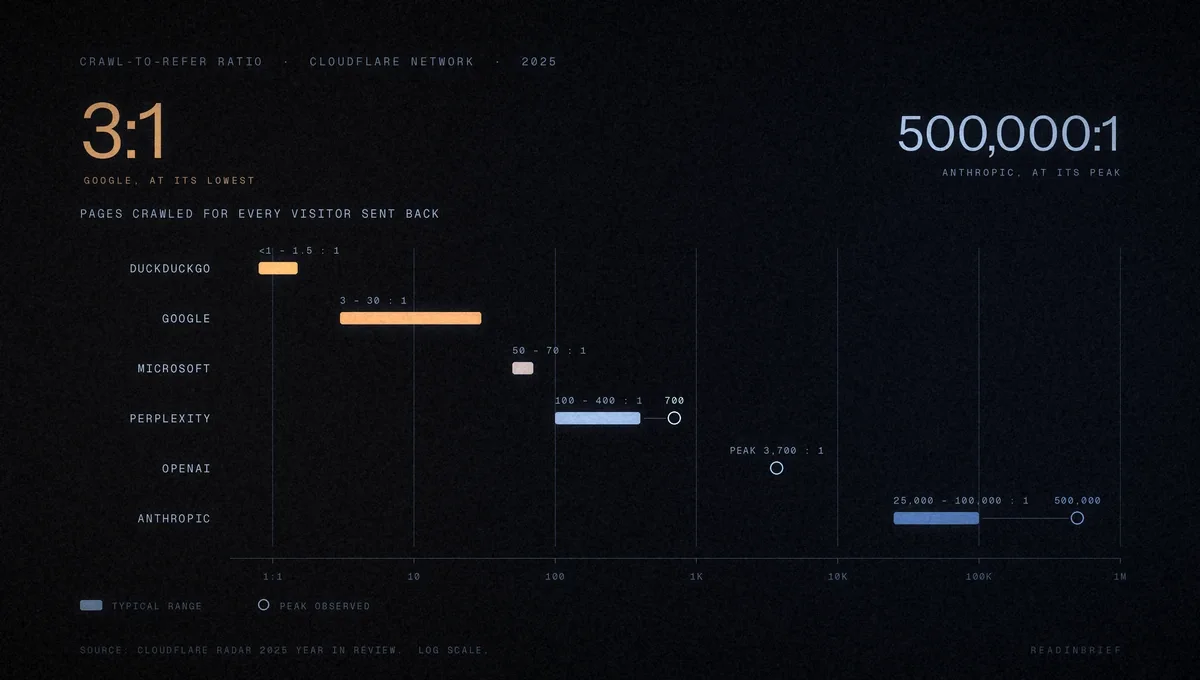
That spread is the most actionable number in this entire article for anyone running a content business, and almost nobody tracks it.
The demand side is deteriorating at the same time. Pew Research Center's analysis of 68,879 Google searches from the browsing data of 900 U.S. adults found that users clicked a traditional result 8% of the time when an AI summary appeared, versus 15% when it didn't. Clicks on sources cited inside the summary ran at 1%. Sessions ended outright 26% of the time with a summary present, against 16% without.
Pew's study measures actual browsing behavior rather than simulated search results, which makes it methodologically stronger than most CTR research. It also predates the current agent wave, covers U.S. English only, and Google has publicly disputed the methodology. Treat the magnitude as directional and the direction as settled.
Now add agents to that picture. An AI summary at least appears on a page the publisher's link could theoretically be clicked from. An agent completing a task may consult the publisher's review, use it to eliminate three options, and never surface the publisher's name to the human at all. Zero-click discovery becomes zero-impression discovery.
Cloudflare's response has been to change the defaults, blocking AI training crawlers on new domains unless owners opt in, on the theory that transparency creates scarcity and scarcity creates bargaining power. A year on, the company reports more than 50 publisher-AI agreements signed since 2023 and a licensing market genuinely forming, while conceding that licensing remains bespoke and is unlikely to fully replace lost referral, advertising, and affiliate revenue.
One structural problem sits underneath all of it. As of mid-2026, 52% of crawler requests on Cloudflare's network were for AI training, up from 22% in spring 2025, and more than a third came from mixed-use crawlers that blend search, agent, and training purposes in a single user agent. Google is the notable case: because its crawler serves both search indexing and AI, publishers can't participate in search discovery without also feeding the AI system that may substitute for it. Cloudflare estimates this gives Google access to roughly twice as much content as leading AI-only companies.
That's not a technical detail. It's the pivot point of the whole negotiation. A publisher can price access to a crawler whose purpose is declared. A publisher cannot price access to a crawler that won't say what it's for.
A Session Is No Longer a Person
Analytics has a vocabulary problem that runs deeper than a settings change.
Users, sessions, pageviews, bounce rate, time on page, funnel drop-off. Every one of these terms encodes an assumption that a browsing session corresponds to a person deciding something. When one human intention produces four hundred requests across nine properties, that correspondence breaks. A "session" with a two-second duration and forty pageviews isn't an engaged user or a bounce. It's a fragment of a workflow whose outcome happened somewhere you can't see.
The metrics that will actually matter look different: agent sessions distinguished from human ones, requests per completed task, the ratio of agent research activity to eventual human-confirmed conversion, revenue where an agent participated in the path, and completion rates for agent-attempted workflows. That last one is quietly the most valuable, because a failed agent workflow is invisible in conventional analytics and expensive in reality.
HUMAN notes the practical obstacle bluntly: most analytics tools can't distinguish AI agents from human visitors at all, let alone identify which agent or classify what it was trying to do. Until identity gets solved, agent analytics is mostly inference.
"Prove You're Human" Is the Wrong Question Now
CAPTCHA encoded a specific worldview: humans are legitimate, automation is suspect, and the job of the gate is to sort them. That worldview is now backwards. A large and growing share of automated traffic arrives with a real customer behind it and real money to spend, while some of the most damaging traffic is designed specifically to look human.
HUMAN's benchmark report contains a line worth sitting with: the behavioral gap between legitimate automation and fraud has narrowed to about half a percentage point. Behavioral detection alone is running out of signal.
The replacement is cryptography, and it's arriving as an actual standard rather than a vendor product. Web Bot Auth, now an IETF architecture draft, has agents sign each HTTP request with a private key using HTTP Message Signatures, publishing their public keys in a discoverable directory. Three headers carry it: Signature, Signature-Input, and Signature-Agent. A companion registry draft authored by Cloudflare and Amazon engineers defines a "Signature Agent Card": a JSON document in which an agent declares its identity, purpose, expected request rate, and keys.
That is, functionally, a passport for software. Amazon's Bedrock AgentCore already signs browser requests this way, Cloudflare has folded message signatures into its Verified Bots program, and Akamai has described the approach and its limits.
The limits are the interesting part. A signature proves which software is calling. It says nothing about whether a specific human authorized this specific action, or capped the spend, or can revoke it.
That second problem is being solved from the opposite end of the stack, by the payments industry. Card networks have shipped credentialing systems for agent-initiated transactions with consumer-set spending caps, merchant restrictions, and real-time revocation, and have been expanding deployments through 2026. Google's AP2 approaches the same problem with verifiable digital credentials: cryptographically signed, tamper-evident objects representing a user's mandate.
Question | Layer that answers it | Status |
|---|---|---|
What software is this? | Web Bot Auth signatures | IETF drafts, real deployments |
Who operates it? | Signature Agent Card registries | Draft, early |
Which human authorized it? | Payment credentials, AP2 mandates | Shipping, fragmented |
How much may it spend? | Tokenized credentials with caps | Shipping |
Who's liable when it's wrong? | Unresolved | Unresolved |
Two stacks converge from opposite directions: provenance from the network layer, authority from the payments layer. Between them sits a liability gap nobody has closed.
And a third problem sits underneath both, unsolved in a way that should temper everyone's enthusiasm. Brave's security team demonstrated that indirect prompt injection works against agentic browsers and later showed it works even through text hidden in images. An attacker embeds instructions in white-on-white text, an HTML comment, or a faintly rendered image; the agent, operating inside the user's authenticated session, reads them as commands. Asking an agent to summarize a page can become an instruction to fetch a one-time password from the user's email.
Brave's assessment was that this is systemic across the category rather than a bug in one product, and OpenAI has publicly acknowledged that prompt injection is an unsolved frontier problem unlikely to be fully eliminated. An agent authenticated as you, holding your session cookies, executing instructions it read on a webpage, breaks assumptions the same-origin policy was built on.
One Sentence, Several Hundred Requests
Picture a plausible 2029. Not a leap. Just the current standards finished and adopted.
Someone tells their assistant: plan three days in Singapore next month, keep it under $1,500.
The assistant decomposes the request and delegates. A travel-specialist agent queries airline systems through structured endpoints rather than scraping fare pages. A hotel agent checks availability against live inventory feeds, filtered by the user's stored preferences: high floor, near an MRT line, no properties with unresolved cleanliness complaints in the last six months. A restaurant agent cross-references cuisine history and dietary constraints against reservation availability, and holds three tentative slots.
Each of these agents signs its requests. Each site verifies the signature, checks the operator's registry entry, and applies a policy: this agent is known, its declared purpose matches its behavior, its request rate is within expectations, allow it and log the session.
When the itinerary firms up, a payment mandate moves through the stack: a credential scoped to $1,500, valid for this merchant category, expiring in seventy-two hours, revocable from the user's banking app. The merchant's system verifies the mandate, confirms the booking, and returns a receipt to the agent. An insurance agent quotes trip coverage. A calendar agent blocks the dates and flags a conflict on day two.
Several hundred machine interactions. The human sees one line: Your trip is ready. Review and approve.
Now consider what happened to the businesses involved. The airline sold a seat and got no chance to upsell a bundle. The hotel filled a room without the human ever seeing its photography, its spa, or its loyalty pitch. Three restaurants held tables; one converted; the other two never learned why they lost. A comparison site that would have earned an affiliate commission wasn't consulted, because the agent went to primary sources.
Every one of those companies had a customer. None of them had a visitor.
The Case Against My Own Thesis
This argument can be pushed too far, and several counterweights are substantial.
Most internet use isn't transactional at all. People scroll, watch, message, play, argue, flirt, and follow things they care about. Nobody delegates a group chat to an agent. Nobody sends software to enjoy a film on their behalf. The categories where agents excel (comparison, booking, form-filling, research aggregation) are precisely the tedious categories people never wanted to do themselves. Automating chores is not the same as replacing culture.
The behavioral data supports the caution. Agents spend 79% of their activity on discovery and 2.34% on checkout. Financial services agent traffic is a rounding error and shrinking. This is a technology in a research phase, not a transaction phase, and the gap between them is filled with authentication, liability, and trust problems that remain genuinely unsolved.
The measurement caveats deserve repeating too. Cloudflare's own HTML-request data showed humans at 47% of requests against non-AI bots at 44% in late 2025, a near parity that "the internet is majority bot" headlines obscure. HUMAN's figures come from its customer base, weighted toward ecommerce, media, and travel, and its own methodology note warns that route categorization reflects destination, not intent. A 7,851% growth rate off a tiny base is a real signal about direction and a weak signal about scale.
There's also a plausible ceiling. Prompt injection remains unsolved. Liability for agent errors remains unassigned. Sites retain the option to refuse agents entirely, and some will. A hotel that discovers agents book and cancel at four times the human rate may decide that agent traffic is a cost center wearing a customer's clothes.
The strongest version of the counterargument is simply this: machine traffic dominating request volume tells you nothing about where value ends up. Humans still supply the intent, the money, the preferences, and the accountability. Agents are an intermediary layer, and intermediary layers have appeared before (search engines, marketplaces, comparison sites) without dissolving the humans on either end.
Will AI agents replace human internet users? No. Agents are becoming an intermediary between human intention and web infrastructure, not a replacement for human demand. People still originate the goals, hold the money, and bear the consequences. What changes is that fewer human eyes reach the websites where the work gets done.
The Internet Isn't Losing Humans. It's Losing the Bundle.
For thirty years, one request meant one person paying attention to one thing. That coupling was so reliable that the entire commercial web was built on top of it without anyone naming it. Advertising priced attention. SEO competed for attention. Analytics counted attention. CAPTCHA guarded the boundary between attention and its absence. Publishers traded content for attention and converted attention into revenue.
Agents don't remove the human. They unbundle the human from the request.
Intent, money, preference, judgment, and accountability all stay with the person. What leaves is presence: the human at the other end of the connection, in a state where a persuasive headline or a well-placed banner could do its work. The request survives. The attention doesn't travel with it.
Read that way, the disruptions stop looking like separate crises and start looking like one. Advertising is losing its substrate. Analytics is counting a unit that no longer maps to a decision. SEO is competing for a position nobody will see. Publishers are trading in a currency whose exchange rate has moved by five orders of magnitude. All four are downstream of the same unbundling.
The web that emerges is less human-operated without being less human-directed. Machines will do the searching, the comparing, the negotiating, and the transacting. People will still decide what they want and live with what they get.
Which leaves the question the standards bodies are quietly building infrastructure to answer, and nobody has answered yet. When an agent books the wrong flight, spends more than it should have, or accepts terms a person would have refused, the mandate was cryptographically valid, the signature verified, the merchant complied, and the software behaved as designed. Someone is out the money.
Who?
Read Also:
MCP vs API: What Changes in the AI Agent Era?
AI Agents Market Size & Statistics
LLM vs RAG vs AI Agent: Which One Wins
Comments (0)
No comments yet. Be the first to share your thoughts!